EW Clearly Sinking

A 4.29 Ad Age story about the firing of Entertainment Weekly publisher Scott Donaton — the mag’s fifth publisher in five years at the time of his hiring in late ’07 — reports that parent company Time Inc. is saying that “the magazine will continue to publish, contradicting persistent rumors to the contrary, and that a successor [to Donaton] will be named shortly.”

What is the blockage over there? The dwindling ad income at EW isn’t enough to support the massive staffing and overhead costs….hello? At best revenues are going to drop even more and then, if things work out, they may stabilize down the road. But the salad days are over. That means you abandon the big offices, have most of the staffers work from home, and…whatever, bump up Jess Cagle‘s salary in exchange for a new title as publisher/managing editor. Don’t hire a new publisher at $250,000 a year — take the money and snag three or four new writers in order to add snappy content.

A friend says he began hearing a couple of years ago that EW might eventually be folded into People magazine. What a comedown if that happens! What a terrible environment to have to adapt to. I worked for People from ’96 to ’98, and it was a miserable environment even back then. I was happy to be getting paid and have a kind of berth to call home, but it was hellish all the same.

I used to work for EW in the early to mid ’90s. Loved what it was, loved the work. News ‘n’ Notes craziness! Working late on Tuesday nights, faxes back and forth, etc. Those were the days.

“Previously the editor-turned-publisher of Advertising Age, Donaton became EW’s fifth publisher in five years when he accepted the vacant job post 17 months ago,” Nat Ives writes. “He and Rick Tetzeli, then the managing editor, set about a redesign and re-articulation of the mission designed, among other things, to set EW apart from celebrity magazines. He also oversaw an overhaul of EW’s website, boosting the number of blogs, videos and the range of community tools. In January, EW named Jess Cagle to succeed Mr. Tetzeli as managing editor.

“But, unsurprisingly given a recession that has caused dramatic drop in many consumer magazines’ ad revenue, ad-page declines continued after the redesign. EW’s first-quarter ad pages this year came in 38% below their mark in the first quarter last year, according to the Publishers Information Bureau. They fell 20% in 2008, Mr. Donaton’s first year on the job, after falling 13% in 2007 and 8% in 2006. Paid and verified circulation in the second half of 2008 averaged 1.7 million copies, 1% lower than a year earlier, as paid subscriptions dipped almost 3%, EW reported to the Audit Bureau of Circulations.

“There were some signs of progress under Donaton and Cagle. Newsstand sales increased almost 7% to 50,437, on the back of the redesign and editorial retooling. And traffic to EW.com appears to have been increasing too, with Alexa recording a 45% increase in visitors in the past three months.”
They Won’t Forget

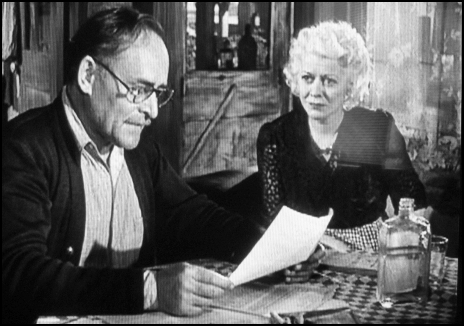
Make your own list of the most moving film performances of all time — the ones that reach right in and melt you down, no matter how many times you’ve seen them — and I’ll bet serious cash that Gladys George‘s in The Best Years of Our Lives is not among them. I’ll bet, in fact, that right now most HE readers haven’t a clue who Gladys George was. But watch this clip from William Wyler‘s Oscar-winning film (or start, rather, at the 37-second mark and stay with it until 1:51) and you’ll never forget her.

This YouTube clip is a little too murky-looking to appreciate the subtlety in George’s acting, and the sound levels are weak. It’s better if you can catch it on DVD, or even on TCM. As long as it’s on a larger screen.

She manages her big score without saying a word. It’s all in the tightening of her features and the watering of her eyes as her character, Hortense Derry, listens to her broken-down alcoholic husband Pat (Roman Bohnen) read a citation for bravery given to his WWII-veteran son, Fred Derry (Dana Andrews), who’s been having a rough time finding his civilian footing.

And it’s all over in 74 seconds. And the emotion only kicks in during the last 45 seconds. But it’s a devastating scene. Both characters holding it in, the burning cigarette, the pint of booze, the empathy for a young guy dealt a tough hand, etc. Gets me every time.

George was born in 1900 and died in ’54, basically from complications from too much drinking and smoking. Her most memorable role besides this was as Miles Archer’s widow in The Maltese Falcon (i.e., who’d been fooling around with Humphrey Bogart behind her husband’s back). As far as I’m concerned she lives forever and very proudly because of this one moment, which is by far the most affecting in Wyler’s film.

Beaten by Animals

My earnest sympathies to Movie City Indie‘s Ray Pride after getting beaten up by right-wing thugs during the Thessaloniki Doc Festival last month. His 4.29 posting says he suffered no organ damage or broken bones, and is on the mend — good to hear. And thank fortune for medical insurance.

But who sits on a story like this for over a month?

If you’re a movie blogger/columnist you’re filing as it happens — screenings, festivals, musings, reviews, etc. But when something like this occurs — an awful traumatic thing that could have been life-threatening — isn’t that journalistic gold? Meaning that you’d want to write about it as soon as possible? Or certainly as fast as you’d file a review of a hot new film? Horrible as it surely is, getting beaten up is a chance to step out of the rarified cineaste realm and grapple with something “real.”

I just can’t help wondering how someone of Pride’s stature, expertise and intelligence could say to himself the next day, “That was terrible but you know what? I’d rather not write about it. Or at least, I need to few weeks to think it over.”

If I’d been kicked and punched by Greek thugs you can be sure I’d have an account up a few hours later, or certainly by the next day. (Unless my hands were broken.) I would write the story and then find a way to send it out from the hospital. The day I was back on the street I would describe my attackers and explore to what degree the police had investigated and were prosecuting. And I’d want to read English translations of whatever press coverage came from this. And I’d look around for eyewitnesses and find out if others had been beaten by the same gang.

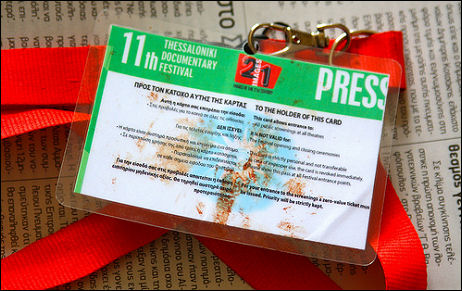
Pride’s photos of his bloody jacket, windbreakers and press pass are excellent, but I want to see photos of where it all happened.

The Thessaloniki Film Festival ran from March 13th to 22nd, and Pride’s misfortune happened on “a little more than a month ago,” he writes. That would be Sunday, 3.22, or the festival’s closing night. Pride’s attackers, he suggests, probably weren’t that much different from the brutes who took part in Yves Montand‘s murder in Costa-Gavras‘s Z (1969).

“Crazy” Avatar

Speaking earlier today to Coming Soon‘s Ed Douglas, Girlfriend Experience director Steven Soderbergh spoke about how it’s “hard for anything [these days] to have the cultural impact of a movie like The Godfather,” and that he was “disappointed there weren’t those sorts of benchmarks in the movies being made today.” But then he added that perhaps James Cameron‘s Avatar might punch through on this level. “I’ve seen some stuff and holy shit,” he told Douglas. “It’s the craziest shit ever. [So this] could negate everything I just said.”

Julie & Julia

Directed and written by Nora Ephron, starring Meryl Streep and Amy Adams, from Sony on 8.2.09. Streep’s vocal impersonation of Child sounds pretty good. Plus she somehow looks like she’s Child’s height of 6’2″, even though Streep is only 5’6″ or thereabouts. Which means it’s one of those noteworthy physical transformation roles a la De Niro in Raging Bull, which means she’s an automatic Oscar contender. Unless the film is a shortfaller.

Surreal

Three days ago the Independent‘s Rachel Shields ran a story about an anti-domestic violence TV spot with Keira Knightley, called The Cut, being banned from TV by Clearcast, an ad-approval org, unless footage is trimmed. The ad began appearing in British cinemas about three weeks ago.

It’s a riveting spot in the way it makes you feel the horror of physical assault. It’s especially noteworthy for a moment just after Knightley has been slapped by her brute boyfriend in which she breaks character and complains to the off-screen director that the slap “isn’t in the script,” or words to that effect.

“Charities working to combat domestic violence branded Clearcast’s decision as ‘pathetic,”” wrote Shields, “arguing that, in banning the advert, it is shielding the public from the reality of domestic violence.” The Cut was made for Women’s Aid, a charity group.

Hack

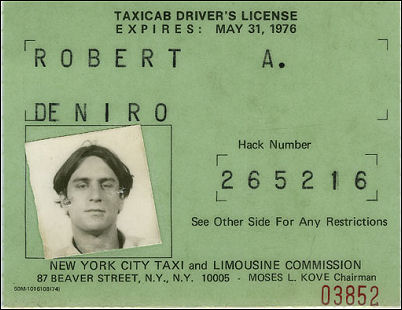
Outside of journalism my favorite all-time job was driving a Checker Cab in Boston, when I was in my early 20s. I always came home with fresh cash and learned something new every day. I met several pretty girls. I was once punched and spit on by biker psychopaths after I flipped them off after refusing to pick them up. I found a wallet in the back seat with no ID and about $400 in cash — a heavy sum in the ’70s. It was more or less one interesting episode after another.


From the Robert DeNiro Film Collection at the Harry Ransom Center at the University of Austin.

Great To Work On

Clive Donner‘s What’s New, Pussycat? (1965) was a sloppy, mostly unfunny sex farce, but the stories of its making are legendary (or at least the ones told to me by production designer Richard Sylbert were). It falls, then, into a category that’s rarely discussed — movies that suck on their own terms but would have been unforgettable to work on with the key creatives. If a film was fun or intensely dramatic to work on and was also great to watch then it doesn’t make the list.

John Landis‘s The Blues Brothers, a legendary cocaine movie, was another one of these, I’ve heard. Heaven’s Gate, however, doesn’t have the reputation of having been a great party shoot. The DVD documentary about the making of the disastrous Cleopatra (’63) is far more entertaining that the film itself, so that would be another. It’s a shame that no one tried to throw together a similar-type doc about the making of the ’62 Mutiny on the Bounty. I once head a story about Brian De Palma saying that if crew people are having too much fun on a set then something’s wrong. Good movies, he felt, are hard to make and therefore shouldn’t be relaxing or pleasurable during principal photography.

Expected

Earlier today it was reported by Fandango’s Harry Medved in an e-mail that Wolverine, which opens tomorrow night at midnight, is accounting for 65% of all advance ticket sales. Going out on a limb, Medved wrote that “in a survey 44% of Wolverine ticket-buyers had viewed the 2009 Academy Awards Show with Hugh Jackman as the host, and 34% of those viewers said the Oscar telecast actually made them more excited to see him as Wolverine. 64% said his Oscar duties had no effect on their anticipation for the movie, while 2% said it made them less excited to see him playing the character.”

“Noisy, Impersonal, Dull-Witted”

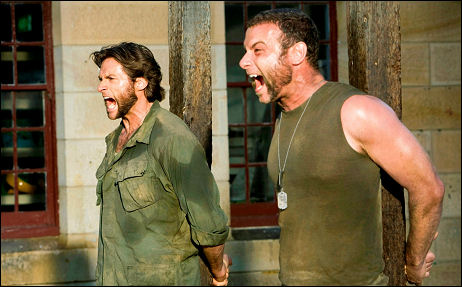
Already the yay-or-nay shorthand verdict for X-Men Origins: Wolverine has been decided upon, and that’s whether or not it’s better or worse than Brett Ratner‘s X-Men: The Last Stand. Which is why Justin Chang‘s Variety review could slightly encourage Fox marketers since he says that Wolverine “overpowers” X-Men 3. This reminds me of the first instant analysis about Waterworld after the first press screening — i.e., “It doesn’t suck.”


Hugh Jackman, Liev Schreiber in X-Men Origins: Wolverine.

“Heavily fortified with adamantium, testosterone and CGI, X-Men Origins: Wolverine is a sharp-clawed, dull-witted actioner that falls short of the two Bryan Singer-directed pics in the franchise but still overpowers 2006’s X-Men: The Last Stand. For all its attempts to probe the physiological and psychological roots of its tortured antihero, this brawny but none-too-brainy prequel sustains interest mainly — if only fitfully — as a nonstop slice-and-dice vehicle for Hugh Jackman.

“Jackman just about holds things together with his reliable but hardly revelatory all-brooding-all-the-time act; for sheer bellowing rage, he’s occasionally upstaged by Schreiber, whose grisly, vampiric presence has some interesting points of overlap with his role as another volatile bad-seed brother in Ed Zwick‘s recent Defiance.

“Noisy and impersonal, X-Men Origins: Wolverine bears all the marks of a work for hire, conceived and executed with a big budget but little imagination — an exception being Barry Robison‘s intriguing production design for Stryker’s island compound. Shot in Jackman’s native Australia, the pic is apparently set in the 1970s, though one would have to read the press materials to realize this.

“An unfinished print leaked online weeks before the film’s May 1 Stateside release will prove a mere flesh wound to Fox’s B.O. haul, which should be muscular locally and abroad.”

Acronyms

Two days ago Endeavor and the William Morris Agency finally and formally announced they’d agreed to merge. Except the name they’ve chosen to go by — William Morris Endeavor Entertainment — sounds drearily corporate, even with the strong likelihood that it’ll wind up being called WME. The problem is the sound of the name “William Morris Agency,” which carries the aura of 20th Century showbiz culture — analog, yesteryear, old times and Cadillac fins. If you were Endeavor chief Ari Emanuel would you want your agency’s name to be just tacked on to Morris’s, like the new last name of a woman who’s just gotten married in Vegas? I would have insisted on the new agency being called Endeavor Morris, or EMA.