Racist Snark?

I’ve long regaded Tom Wolfe as a political conservative, but I’ve never thought of him as an old-line racist. This is nonetheless the view of New Yorker critic David Denby in a new hardback essay he’s written called Snark. Here’s an excerpt from a review/summary/critque by reasononline’s Michael C. Moynihan.

“Denby identifies Wolfe’s Radical Chic as a progenitor of today’s snarky style, but it fails, he says, because the writer’s teasing of haute-liberal infatuation with the Black Panthers ‘now seems more fatuous than the assembled partygoers,'” Moynihan writes. “How so? Because, according to Denby, ‘In the end, [Wolfe’s trademark] white suit may have been less an ironic joke than the heraldic uniform of a man born in Richmond, Virginia, who entertained fancies of a distinguished Old South in which blacks kept their mouths shut, a conservative who had never accustomed himself to the new money in the Northeast.’

“While denouncing bloggers for rumor-mongering and for besmirching reputations with nothing but conjecture, Denby nevertheless finds it appropriate to imply that Wolfe’s writing is steeped in white supremacy.”

“Anyone who has been exposed to the subliterate animosities and grudges of the cruder anonymous commenters or bloggers, or has bristled at the lowered bar of what passes as clever satire on snark-heavy websites, will have some sympathy for Denby’s effort to attack against the ‘everyone-sucks-but-me’ culture,” Moynihan notes. “But his bizarre choice of targets and imprecise definition of ‘snarky’ derails his argument from the beginning.

“At its core, Snark is a deeply political book and, therefore, Denby offers special dispensations for a Right On!-variety of ideological snark.

“‘Snark is irresistible,’ he writes, when discussing our previous president (and who could disagree with that?), but it apparently becomes gauche when directed at Democrats peddling hope and change. A large chunk of his argument is ceded to score-settling and a post-election outpouring of anger against those who said impolite things about Hillary Clinton and Barack Obama. (Denby may be the only writer alive who would describe Sarah Palin‘s description of Barack Obama as ‘palling around with terrorists’ as snarky.)

“Denby tags the Fox News screamer Bill O’Reilly as a boorish knuckle-dragger, but his liberal counterpart Keith Olbermann is something else entirely: ‘One can’t help but noticing…that Olbermann’s tirades are voluminously factual, astoundingly syntactical…and always logically organized.’ The leftist writer Gore Vidal is a ‘master of high snark,’ while his conservative counterpart Tom Wolfe is an overrated racist. If you agree with the snark, it probably isn’t snark.”

Death in Pittsburgh

It was obvious within ten or fifteen minutes of watching The Mysteries of Pittsburgh what the central flaw is — it’s the way Art Bechstein, the lead character (and narrator), has been written, and particularly the aura of the actor who plays him — the almost 100% repellent Jon Foster. I paid to see Pittsburgh on Friday night at the AMC Empire, and I really can’t remember feeling such acute dislike for any non-villain character in so short a time. One result is that it was a serious struggle to force myself to watch the film to the end.

The problem is that time and again, Bechstein is shown to be a timid and inarticulate liar. His narration (said to be taken straight from Michael Chabon‘s 1989 best-seller) is wry, sharp and candid, but Bechstein is anything but. He’s a dull blob — a kind of bland sociopath — with a skinny frame and a face that is all about non-disclosure. This is not Bechstein from Chabon’s novel, which I remember reading in ’90 or thereabouts.

Foster stares glumly at his gangster father (Nick Nolte) and offers nothing but stupidly evasive half-replies to his questions. Out of boredom he has a hot-sex affair with his book-store boss (Mena Suvari) and treats her like dirt, and lies to her face, ineptly, when she accuses him of dissing her. He obviously hungers for Sienna Miller ‘s girlfriend-of-Peter Sarsgaard character but pushes it all down in spasms of suppression that lead nowhere. You just want to shoot him.

Foster conveys a single emotional condition throughout the entire film — a sense of quiet panic that people might actually be reading who and what he is (i.e., a cypher), and the absolute necessity of preventing this from happening.

On top of which Foster is a bore on his own terms. He has good bones and is somewhat handsome (if you don’t have an aversion to people with red hair) but I’m having trouble remembering another actor who’s conveyed less of an inner life of any kind — less vigor, less aliveness, less wit or humor. His eyes are like little brown pebbles on the side of a road. He needs to be play villains. Pittsburgh director Rawson Marshall Thurber probably would have bored me without Foster in the lead role, but his decison to cast Foster was absolutely fatal.

Reds

Another thing I don’t like about Mysteries of Pittsburgh star Jon Foster is the fact that he has red hair (along with the attendant pale skin and freckles). This is another one of my shallow and irrational objections, I realize, but red hair has always been a problem for me. It’s not as if I write redheads off when I meet them because I don’t — that would be incredibly stupid — but there’s something a little bit off-putting about them regardless. It’s not like I’m Rod Taylor and they’re morlocks. But I do tend to say to myself when I meet a redhead, “Oh…okay. Well, grow up and get past it.” Except I don’t.

I love the almost pumpkinish shade of Tilda Swinton‘s hair in real life, but it’s a kind of blockage at the same time. Cate Blanchett may be a redhead (not sure) but I know I tend to respond to her more favorably when she’s blonde — I distinctly remember recoiling when I saw her red hair in the first Elizabeth movie. I loved David Caruso ‘s performance in Mad Dog and Glory but there’s something about his pale freckly skin that’s always seemed a bit icky. I’ve never liked Carrottop. I could never warm to Red Buttons. The only red-headed actor I’ve really and truly liked without reservation was James Cagney, but the vast majority of his performances were captured in black and white. (I tried finding a color photo of a young Cagney — the only way I could get one would be to secure a frame capture from Captains of the Clouds.) Rita Hayworth also escaped the prejudice of people like me due to her mostly monochrome resume.

I’ve always loved Jack Warden (particularly his performances in Shampoo and Heaven Can Wait) and have never allowed this idiotic blockage to get in the way. Ditto Malcolm X — a man I’ve admired almost my entire life, and certainly one of greatest spiritual seekers of the 20th Century.

There’s a reason, I’m figuring, why I’ve never had a relationship with a red-haired woman in my life.

“Little Skinny For My Taste…”

Andy Garcia is 53 today. He’s been at it since the late ’70s, broke through in the mid ’80s (his role in Hal Ashby‘s Eight Million Ways to Die), has obviously made his bones. But he’ll never top this acting moment with Richard Gere in Internal Affairs (’90) — a scene that flashes through my head every time I think of him. It’s all the more remarkable because Gere’s doing most of the talking, and with great perverse charm. But Garcia owns it.

So which movie is Garcia directing first — Clemente or the Ernest Hemingway film? Items about both projects popped up within a two-day period late last month.

Purist Robes

“The Republican Party is like a dying tyrant, mad with syphilis, ironically like that very Stalin they would accuse their enemies of associating with. How else to account for their desperation to resurrect the wraith of Joseph McCarthy; the hammy and baffling utterances from high-level party officials like Boehner and McConnell; the blatant desire on their part to let the country fail out of sheer resentment; the wanton sedition of conservative shit-stirrers ranging from the quasi Madame Defarge Michele Bachmann to the porcine, pill-popping porcine propagandist Rush Limbaugh?

“It is an all-out assault on reason, on progress, on truth. What is the difference between the Republican Party and, say, the Taliban? A rogue by any other name would smell as rank. Their frantic accusations all churned out in a futile effort to explain their current pariah status is as pathetic and draconian as stoning a woman in the street.” — from Steven Weber‘s 4.11 HuffPost, titled “G.O.P. R.I. P.”

The stakes and some of the particulars have changed over the last five years, but as noted in a December 2004 review of Adam Curtis‘s The Power of Nightmares, the differences between the purist Republican right and the Taliban are actually fairly slight.

“The film contends that the anti-western terrorists and the neo-con hardliners in the George W. Bush White House are two peas in a fundamentalist pod, and that they seem to be almost made for each other in an odd way, and they need each other’s hatred to fuel their respective power bases but are, in fact, almost identical in their purist fervor, and are pretty much cut from the same philosophical cloth.

“They’re both enemies of liberal thought and the pursuit of personal fulfillment in the anti-traditionalist, hastened-gratification sense of that term. And they believe that liberal freedoms have eroded the spiritual fabric that has held their respective societies together in the past. Curtis’s doc shows how these two movements have pushed their hardcore agendas over the last four or five decades to save their cultures from what they see as encroaching moral rot.”

Toback at Harvard Club

My interview earlier today with Tyson director James Toback, which happened between 11:30 am and 1 pm at Manhattan’s Harvard Club, was easily the most spirited, relaxed and and enjoyable discussion I’ve had with anyone in a long while, taped or not. (Here’s more of the same.) Toback is one of the most sage observers I’ve ever known, and hands down the greatest gabber — not in a blah-blah, listen-to-me-talk sense but in the vein of a guy who just knows and doesn’t believe in trimming his sails.

Intimidation (even the intimidation that beautiful women impose on the best of us) never seems to affect him. He doesn’t seem to know from hesitancy either. Which is why his discussions with Mike Tyson went so well, which is the main reason, I feel, why Tyson connects.

I had more fun listening to this after the fact (i.e., as I edited it down at a Monticello pizza parlor) than any taped conversation I’ve ever done for Hollywood Elsewhere. Seriously. In large part because our chat was substantive. Here’s part #1 and part #2.

In discussion #2 Toback told me something I didn’t know, which was that two days ago Tyson began to be illegally downloaded. He said that Sony Classics attorneys were doing what they could to have the file taken down, and that it might already be down as we spoke. Toback isn’t horribly disturbed by this as he tends to believe that illegal downloads are seenhelpful to films that have drawn good word-of-mouth. Which would include Tyson, of course.

Hills Are Alive

I’ve been feeling more and more amped about the possibility of Ang Lee’s Taking Woodstock (Focus Features, 8.14.09) playing at Cannes next month, and so I decided on the spur of the moment early this afternoon to rent a car and drive up to the site of the 1969 Woodstock Music and Arts Fair. You can really feel something when you first arrive and take it all in. It’s like visiting Dealey Plaza or Ground Zero. The site is located on Hurd Road right off 17B in Bethel, New York — about a two-hour drive from Manhattan.


4.11.09, 6:35 pm, facing the area where the stage sat at the 1969 Woodstock Music and Arts Fair. A private security guy pulled up in the area behind the stage and told me I wasn’t supposed to be walking around on the field.

4.11.09, 6:35 pm, facing the natural amphitheatre from the area where the stage once stood.

Outcast Adrift

A year ago I ran a brief plea for the DVD release of Carol Reed‘s Outcast of the Islands, which coincidentally aired a month later on Turner Classic Movies. Yesterday, still fired up by the response to Thursday’s “The Disappeared” piece, I came upon this Pauline Kael capsule review.

“A marvellous film (drawn from Joseph Conrad‘s work) that relatively few people have seen,” she began. “It’s probably the only movie that has ever attempted to deal in a complex way with the subject of the civilized man’s ambivalence about the savage. It also contains some of the most remarkable sequences ever filmed by the English director Carol Reed; it’s an uneven movie, but with splendid moments throughout.

Trevor Howard is superb as Willems, who makes himself an outcast first through contemptible irresponsibility and through betrayal of those who trust him, and finally and hopelessly when, against his will, he is attracted to the silent, primitive girl, the terrifying Aissa (played by Kerima). Willems is wrong in almost everything he does, but he represents a gesture toward life; his enemy, Almayer (Robert Morley), is so horribly, pathetically stuffy that his family unit (with Wendy Hiller as his wife and Annabel Morley as his child) is absurdly, painfully funny.

“With Ralph Richardson, whose role is possibly ill-conceived, and George Coulouris, Wilfrid Hyde-White, and Frederick Valk. The screenplay is by William Fairchild; cinematography by John Wilcox.”

I wrote last year that Outcast of the Islands is “a forgotten film that nobody cares about at all. Except, I’m thinking, possibly those obsessives at the Criterion Collection. These fellows are just peculiar enough to put out a remastered version of this British-produced film on DVD.”

Tell It

Unless they’re sick or have found a better, higher-paying gig somewhere else, people almost never resign from cushy prestigious jobs. When somebody leaves a cool job it’s because they’ve been shown the door. So when you write a news story about some highly-placed person resigning, you have to try and convey what really happened. Who did the pushing and for what reason? Generic so-and-so is resigning stories along with generic “I’ve had a great run and am looking forward to the next challenge” statements are awfully damn annoying.

Songbird

You need to check out this new music player that’ll eventually replace iTunes,” Jett wrote a few minutes ago. “It’s called Songbird and is so dynamic. It has so many cool applications.” The download site says the goal “is to create a non-proprietary, cross-platform, extensible tool that will help enable new ways to playback, manage, and discover music. There are lots of ways to contribute your time to the project. We’d love your help! There are several features we’re proud of, but we’ll be the first to admit that others need ironing out, are experimental, or are just plain missing. There’s still a lot to do.”

Orange Wedge

Five and a half hours ago The Oregonian’s Shawn Levy quoted from a Gus Van Sant Twitter post (128 characters) that said the following: “My next film is Dustin Lance Black‘s adaptation of Tom Wolfe‘s The Electric Kool-Aid Acid Test. It’s going to be really funny.” The Twitter post was reportedly taken down after it appeared.

Levy noted that “the project has been in development, but this is the nearest thing to confirmed word that’s appeared anywhere so far. Take that, Variety!” In fact, the book’s Wikipedia page says that “a film adaptation of the book, directed by Gus Van Sant, is expected to be released in 2009. The screenplay was written by Dustin Lance Black, who also worked on the HBO series Big Love and Van Sant’s 2008 film Milk. The movie is being produced by Richard N. Gladstein.”

It might be funny but I’m predicting failure, or certainly an underwhelming reception. Van Sant gets the drug culture thing like no one else, but there’s no story here — Wolfe’s book is about mythology, performance art, wild episodes, characters (Ken Kesey, Neil Cassady, Wavy Gravy), ’60s atmosphere and, of course, the way it’s all described. Spiritual pyschedlic soul-searching material doesn’t play in cinematic terms. It can’t — it’s simultaneously too much and not enough.

(Thanks to HE’s Moises Chiullan for the alert.)

One Third Gone

The first four months are never expected to yield much, certainly not in terms of award-quality fare. But a few made the grade with me. Three or four can be called exceptional, and the rest good, mostly satisfying, decent, or at least diverting in an art-house indie obscura vein. Forget awards eligibility in terms of rules and release dates. This is simply the best of what’s opened so far in ’09, in order of preference.

Except for The Hurt Locker, that is, which opens on 6.26. I’m including it because it’s been showing around and has contributed to the winter-spring current.

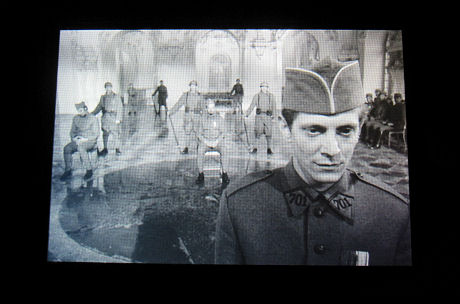
(In order of preference): Kathryn Bigelow‘s The Hurt Locker, Cary Fukunaga‘s Sin Nombre, Greg Mottola‘s Adventureland, James Toback‘s Tyson, Rupert Wyatt‘s The Escapist, Andrezj Wajda‘s Katyn, Kevin McDonald‘s State of Play, strong>Matteo Garrone’s Gomorrah,Ramin Bahrani‘s Goodbye Solo, Tony Gilroy‘s Duplicity, Steve McQueen‘s Hunger, Paolo Sorrentino‘s Il Divo, Carlos ReygadasSilent Light, Terrence DaviesOf Time and the City, Henry Selick‘s Coraline, Tom Tykwer‘s The International, Jan Troell‘s Everlasting Moments, and Adam Del Deo and James D. Stern‘s Every Little Step.

No complaints about my not yet posting multi-paragraph reviews of some of these. If I didn’t review two or three or four it’s because I haven’t fucking felt like it…okay? I’m not a machine. I never got around to seeing Matt Aselton‘s Gigantic, which might have made the list. (Or maybe not.) Ditto strong>Mary Stuart Masterson’s The Cake Eaters. And whatever happened to poor Killshot? Why won’t Harvey let some of us see it?