No Tetro in Cannes

Francis Coppola‘s publicist Kathleen Talbert has sent out the following message about Tetro, Coppola’s latest film, and the Cannes Film Festival: “Since there has been much speculation in the press about the Cannes line-up,” she staites, “we want you to be aware that Francis Coppola has declined to bring his new film Tetro, starring Vincent Gallo, to Cannes.

“Below is his statement. If you choose to use it, I would ask that you use it in its entirety. Oh, and just to correct another misconception — Tetro [has been] shot in black and white and color.” Todd McCarthy‘s Cannes lineup piece that ran in Variety yesterday mentioned that Tetro (a) is a prospective Cannes attraction and (b) has been shot in black and white.

“While I very much appreciate the invitation,” Coppola’s statement reads, “this is an independent film, self-financed and self-released, and I felt that being invited for a non-competition gala screening wasn’t true to the personal and independent nature of this film. More important than Cannes, our team can focus all our time, energy and resources into the U.S. release this June 11th.”

HE translation #1: “As some of you have gathered since the release of Youth Without Youth, the words ‘independent film,’ ‘self-financed’ and ‘self-released’ as they concern yours truly are euphemisms for confounding, difficult to stay engrossed in, draggy, mind-numbing, etc.” HE translation #2: “If we take our film to Cannes we’ll get killed by the critics and the word will go out everywhere so why do it? We can only lose.”

Tetro will open on 6.11 in Los Angeles, San Francisco, New York, Chicago, Seattle, Miami, and Washington, D.C.

Master of Il Divo

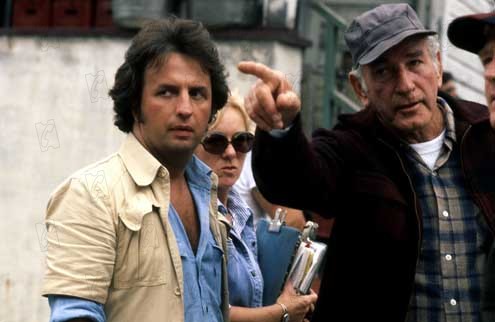
I spoke a couple of days ago with Il Divo director Paolo Sorrentino at the Standard Hotel. The interview went well and speaks for itself. We talked about the film (obviously), Tony Servillo ‘s portrayal of former Italian Prime Minister Giulio Andreotti (which the film is about), Bluray players, Rome, the world economy, etc.


Il Divo director Paolo Sorrentino at Manhattan’s Standard Hotel, a metallic, super-cool high-tech palace located in the meat-packing district.

I told Sorrentino that he reminded me of a somewhat thinner-faced pre-plastic surgery Michael Cimino (i.e., as Cimino looked in the late ’70s).

Il Divo (MPI, 4.24) has no website, but it is, as I said a few days ago, an immaculate, highly stylized film about Andreotti and his political career, particularly the events that led to revelations about his ties to the Italian mafia and his reported complicity in the murder of a journalist.

I saw it last year in Cannes, and my immediate reaction was basically (a) “a first-rate political drama but probably too Italian to play in the U.S.” (about which I was obviously wrong) and (b) “a brilliant performance by Servillo.”

Kutcher Crowned

“The old guard has passed and the new guard is here. And the new guard likes to ding dong ditch people just for fun.” — Ashton Kutcher after beating CNN (yes, CNN) to the million-follower mark yesterday afternoon. But what does it mean to be ding dong ditched?

Hard To Read

Nikki Finke‘s report this morning that 20th Century Fox is internally projecting a $70 to $75 million domestic opening-weekend gross for Wolverine (with rival studios predicting closer to $80 million) makes you wonder to what extent the illegal piracy and downloading of the film — which was first noticed on or about April 1st — may have hurt the earning potential. Would it be looking at a $90-to-$100 million opening without the piracy?

Brett Ratner‘s 2006 X-Men movie cost $210 million, opened to $102.7 millon. Bryan Singer‘s X-Men United cost $110 million, opened to $85.5 million. The key consideration, of course, is whether the illegal downloading has influenced the general word-of-mouth. How could it not?

Nazis and Hounds

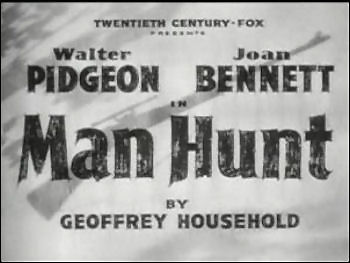
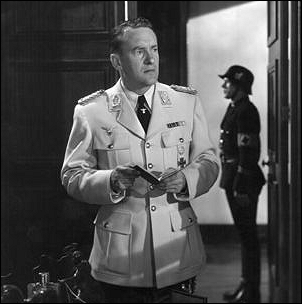
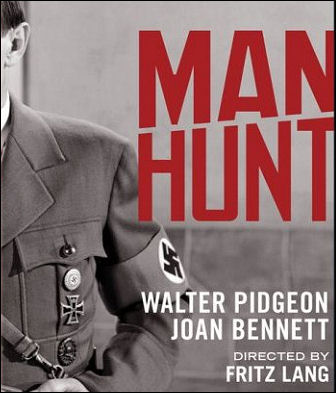
A DVD of Fritz Lang‘s Manhunt (1941), a classic World War II-era chase thriller, will emerge in remastered form on May 12th from Fox Home Video.

Manhunt was one of my favorite late-night TV movies when I was in my early to mid teens. But it hasn’t been aired in a long time and has never before been released on DVD or VHS.

Based on Geoffrey Household‘s “Rogue Male,” it’s about a gentleman hunter named Thorndike (Walter Pidgeon) who manages to penetrate Adolf Hitler‘s Berchtesgaden headquarters as a kind of hunting exercise, not to kill Hitler but to prove to himself that he was able to get him in his sights. I remember the close-up of Pidgeon’s trigger finger — pausing, hesitating.

Then the story kicks in. Pidgeon/Thorndike is discovered by German security, thrown off a cliff, survives, is tracked down by soldiers and hounds but manages to escape, makes his way to London with German agents still on his trail, meets an emotionally vulnerable streetwalker (Joan Bennett) who wears a little metal arrow in her beret. She falls for Thorndike, takes him in, pays the price.

It’s been decades since I’ve seen it but the principal baddie is played by George Sanders; John Carradine plays another ne’er do well. I especially recall the ending with Pidgeon hiding in a cave and Sanders talking to him from outside, trying to coax him out, and the manner in which the little arrow from Bennett’s beret resolves things.


It doesn’t work for me to call it Man Hunt — it has to be a one-word title.

As with all older action films the pace is slowish and deliberate. But old-fashionedness is what the enjoyment of a film like Manhunt is all about.

This data chart says that Manhunt was shot in March 1941 and was out in theatres three months later. This was more or less standard procedure back then.

One of the features on the disc is a restoration comparison. That’s always a closer for me. Shawn Belston‘s Fox Home Video team is highly respected. I’ve only seen Man Hunt on a primitive black-and-white TV with commercials every 10 minutes.

Sanders was repeatedly cast as villains because of that snide and effete manner that he did so well. But what about those of us who enjoy Sanders’ haughty airs? I loved his disreputable cad in Rebecca and the way he oozed out his insinuations. In any event mix his effeteness with good-guyness and you’ve got one of Sanders’ most winning roles ever — the adventurous journalist friend of Joel McCrea in Foreign Correspondent. And he was charming also (as well as perfect) as Addison DeWitt in All About Eve.

Alternate-Universe Journalism

The screenwriters of State of Play, says L.A. Times columnist Patrick Goldstein, “have taken a story that’s really a cop movie and grafted it into the world of journalism.” He makes some good points, but he should have clarified if the same plot points are in the original six-hour British miniseries. I need to watch it again myself so I can answer this question.

Russell Crowe actually interrogates one suspect — I mean source — in a motel room, with a backup crew of cops — I mean reporters — stashed in an adjoining motel room, secretly videotaping the encounter, which he then shows to another source/suspect in the story. This is, ahem, wrong on a thousand different ethical levels, not to mention, in an era of vastly diminished newspaper resources, who could afford to pay for all the video gear, much less two motel rooms?” Hilarious!

“Crowe has a basic conflict of interest that would disqualify any reporter from covering this story; he’s an old friend (and former college roommate) of the powerful congressman who’s at the heart of a murder mystery. Even worse, from a believability angle, Crowe’s top editor (nicely played as a tough-talking Fleet Street expatriate by Helen Mirren) knows all about their friendship, which in real journalistic life, would have disqualified Crowe from covering the story from the jump-off, especially since he has an even more complicated entanglement with the congressman’s wife.

“There [are] other farfetched moments, including a scene where Mirren refuses to print an explosive story, saying that the paper’s new owners are insisting that Crowe get at least one key source on the record. A reputable newspaper would indeed demand that at least one source be on the record before printing a big story, but that demand would come from the editors, not from the owners of the paper, who usually find out about a big story at the same time the readers do — after it’s printed.

“But for me, the biggest whopper of all happens after Crowe has pushed his deadline to the limit. He finally sits down and cranks out a complicated expose that could ruin a number of powerful Washington insiders in even less time than it took me to write this blog item. (Fair enough — that’s dramatic compression, since who wants to see the dreary details of all that typing.) But when Crowe is finished, he simply hits the SEND button, gets up and walks out of the newsroom, as if his job were done.

“It’s a heroic walk off into the sunset, but in terms of veracity, it leaves out all the real work that goes into a story after the first draft is finished. In other words, there’s no editing, no rewrites, no fact checking, no trims for space, no perusals by the paper’s lawyers, no nothing. It’s a wonderful movie moment, but like all too many movie moments, whether they involve lawyers, doctors, cops or grouchy newspaper reporters, it leaves out an awful lot of the rich detail that goes into accomplishing a task.”

Refined Hurt

Teasers mostly provide the mood and visceral flavor; trailers do the same but they also get out the blueprints and explain the story, characters and theme. And by this strategy a just-released, phase-two Hurt Locker trailer (Summit, 6.26) does its job quite well. Except, that is, for the artificial addition of an “oh, boy” when Jeremy Renner pulls out four or five bombs from under the sand. Too folksy sounding. Some kind of barely discernible animal sound would have worked better.

There’s a malfunction, by the way, when you click on the Hurt Locker‘s website. You get nothing, flatline, whiteness.

Inferno

Welcome to the commercially flush world of ultra-violent video games. I once watched my son Dylan play Grand Theft Auto, asking him at one point what kind of sick fuck would dream up the violent stuff in that game, but this is far worse. It’s satanic. I’m asking HE readers to watch this footage (i.e., which is somehow linked to www.projectmanhunt.com) and try to convey in 25 or 30 words how it makes them feel.

The guy who created this needs to be put in a damp dungeon, his leg chained to the floor, a pile of straw to sleep on. For life.

Jackson’s Greed

Digital Bits columnist Bill Hunt has reported that Peter Jackson is preparing to double-dip his Lord of the Rings trilogy on Blu-ray. Only the theatrical versions will be out on Bluray by the end of the year, obviously leaving room for the release of an “ultimate” Bluray box set of extended versions,which will be released concurrent with Guillermo del Toro‘s upcoming Hobbit films. Repeat the legend until it becomes fact: Jackson is Lucas, Jackson is Lucas, Jackson is Lucas, etc.

McCarthy’s Cannes Take

Todd McCarthy‘s annual Cannes forecast piece contains some fresh info but for the most part mentions a lot of the same films previously listed by Screen Daily‘s Mike Goodridge in a 2.11.09 speculation piece. The official slate of Cannes ’09 films will be announced on 4.23.

McCarthy and Goodridge have both listed Pedro Almodovar‘s Broken Embraces , Quentin Tarantino‘s Inglourious Basterds, Lars von Trier‘s Antichrist, Cristian Mungiu ‘s Tales From the Golden Age, Ang Lee‘s Taking Woodstock, Michael Haneke‘s The White Ribbon, Jane Campion ‘s Bright Star, Ken Loach‘s Looking For Eric, Terry Gilliam‘s The Imaginarium Of Dr. Parnassus and Andrea Arnold‘s Fish Tank.

McCarthy made no mention of Gaspar Noe‘s Enter the Void, Fatih Akin‘s Soul Kitchen or Todd Solondz‘s Forgiveness — you tell me. Nor did he mention Ron Howard’s Angels and Insects, which may, I’m told, have some kind of special screening there to promote the film with European audiences. (Why would Howard want to re-experience the terrible reception that The DaVinci Code received in Cannes in ’06?)

McCarthy has listed Francis Coppola‘s Tetro< ./em> (while forwarding the new information that it was shot in black and white), and Werner Herzog‘s Bad Lieutenant 2: New Orleans Port of Call Sweat and Seafood Gumbo (or whatever it’s called). An “almost certain midnight attraction,” he says, will be Sam Raimi‘s Drag Me to Hell.

He also mentions Jonnie To’s Vengeance (i.e., wolf-faced Johnny Hallyday as a hitman-turned-chef who heads to Hong Kong to avenge his daughter’s death, blah blah) , Marco Bellocchio‘s Vincere with Giovanna Mezzogiorno and Filippo Timi in a study of Mussolini’s secret lover and the couple’s son Albino, and Police, Adjective< ?em>, directed by 12:08: East of Bucharest helmer Corneliu Porumboiu.

Plus a whole bunch of Asian films that I’ll get around to mentioning later on. No hurries or worries.