Smart Thrillers Are Over

An L.A. Times story by John Horn is basically saying that the audience for smart complex dramas and thrillers like State of Play (which is expected to tank this weekend) and Duplicity isn’t big enough these days, and that the likelihood of more movies being made in this vein isn’t high.

The common element in these films is poor Tony Gilroy, who directed and wrote Duplicity and did a State of Play rewrite. So this trend (if it persists) is a big slap at the Gilroy brand, which of course many screenwriters respect and try to emulate.

Great. Bring on the lowest-common-denominator dumbness. Michael Bay movies, chick flicks, Bourne thrillers, Sascha Baron Cohen dramas, coarse comedies, family-friendly animated features, Roland Emmerich movies, Judd Apatow comedies, etc.

The underlying point of Horn’s piece isn’t that movies like State of Play and Duplicity can’t sell tickets, but that they cost too much for what they’re likely to make. State of Play should have been made for $25 or $30 million instead of $60 million. ditto Duplicity. It’s that simple. No more star salaries.

Horn quotes Universal production chief Donna Langley saying “you are going to find every studio saying, ‘I can’t do it, I can’t do it’…It will be awhile until there are a lot of really smart dramas.”

Late to Anvil!

It’s not that I’ve always loathed metal, although I have. I also think you have to be a bit of a low-life to play it, much less be a fan…right? What would the ghosts of Gustav Mahler or Chet Baker say about metal bands if they were brought back to life? They’d say, “Can we be dead again, please?” Metal, for me, is still the reigning metaphor for the coarsening of civilization. It’s for primitive, thick-fingered types who get high a lot and don’t want to know any better. Sorry.

But there is God and spirit in the playing and savoring of all music, even metal, and the love that the fans feel for it, however pathetic, is as genuine as my love for The Who, Patti Smith, Queen, Joni Mitchell, the acoustic sets of Kurt Cobain, early (’63 to ’66) Rolling Stones tracks and Bernard Herrman‘s score for North by Northwest.

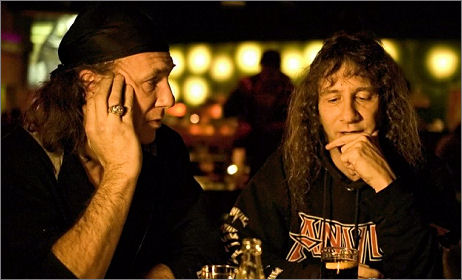
And I have to say, late as I am to the table on this, that Anvil!: The Story of Anvil — which opened last Friday in select cities — is one of the saddest (as in funny-sad) and most recognizably human, emotionally touching rock-music documentaries I’ve ever seen. Seriously.

It’s about a has-been metal group that I’d barely heard of (mainly because they never really made it commercially), and an attempt by the now-50ish members — Steve “Lips” Kudlow, Robb Reiner and Glenn Five — to get their lives going again. They were admired by some but their albums were reportedly poor sounding and they never tapped into any real money. And now they’re grappling with intimations of mortality, bald spots and ticking clocks, but they have to give the career-restart thing a go anyway. How can anyone not love that?

We first encounter them living rural, dead-end lives and trying to gradually make things happen again. Sisyphusian and then some. We see them going through some fairly anxious moments, often, as well as some depressing ones, and also some that warm your heart. And some that are close to hilarious — loser humor that only guys who’ve actually gone through the doldrums coudl come up with. (Talking to the camera about a European tour in which many things went “drastically wrong,” Lipps adds that “at least there was a tour for it to go wrong on.”)

There’s also a moment that’s damn nice in a familial way. And the ending is pure Hollywood.

I mean it about the heart-warming element. Lipps and Robb are nice-enough guys, but they’re basically apes playing ape music for the ape masses (let’s face it), and you can’t help but root for them. Theirs is a passion play for the ages — a universal never-say-die parable about the water that we all long for. The size of the fight in the dog and all that. Listen to this riff about the ticking of time,, initially voiced by Lips and seconded by Reiner. The whole film, in a way, is in this one passage.

Reach Back

In the wake of Billy Bob Thornton‘s psychotic interview on that Toronto radio show last week, it seems timely to note the 15th anniversary of the premiere of George Hickenlooper‘s Some Folks Call It A Sling Blade. There’s a complicated back-story about the short-to-feature transition, but the bottom line is that Thornton differed with Hickenlooper, grabbed the reins and directed the Sling Blade feature, which launched his career as a big-time hyphenate.

The short, too dark and softly focused for my taste, was uploaded to YouTube yesterday for the first time. The above clip is Part 1, of course. Here are part 2 and part 3. And here‘s a clip (the same scene at the beginning of the short) fromThronton’s feature-length version.

There’s a belief in some quarters that Thornton defrauded the Academy when he won the Oscar for Best Supporting Screenplay, having claimed it was based on his own play “Pearls Before Swine.” The play, I’m told, never actually existed, and was instead a one-man show in which the Karl character was one among many many characters. The reality is that the feature was based on the HIckenlooper’s short. I’ve understood that to be the case for years, and I don’t see how it’s disputable.

The above clip is Part 1 — here are part 2 and part 3. And here’s a clip (the same scene at the beginning of the short) fromThronton’s feature-length version.

The cast of the short includes Molly Ringwald, Suzanne Cryer (who later became the ‘yadda, yadda’ girl on Seinfeld), the late J.T. Walsh (the only one recast in the feature), Ron Livingston (who later starred in Office Space) and Jefferson Mays.

Ich Nicht

I’ve fallen into the small-talk habit of asking people at social occasions (parties, screenings, lunches, interviews) if they have a Bluray player. I’m not talking about MTA employees. I’m talking about folks with semi-sophisticated palates and attitudes — filmmakers, publicists, screenwriters, online entrepeneurs, etc. The point is that each and every one has said nope. Last week I asked a world-famous, absurdly rich actress if she was a Bluray person — ditto. The night before last I asked Diane Sawyer if she owns one, and she wasn’t entirely sure what I was talking about.

They all have high-def TVs but for whatever reason Bluray isn’t part of the picture. I understand being behind the curve on this or that lifestyle indulgence, but I don’t get people of comfort and sophistication not having Bluray players. Not in early 2009. I actually find this mind-blowing.

Teabag Fools

Racist xenophobe cretins who voted for Bush-Cheney’s laissez-faire “leave Wall Street alone, let the greedy pirates have fun” policies in ’00 and ’04, and who are therefore primarily responsible among the electorate for the current economic catastrophe. And so they’re marching against….?

“Sharif Ali, so long as the Arabs fight tribe against tribe, so long will they be a little people, a silly people…greedy, barbarous and cruel.” One or two people might not know what this line is from.

Misanthropic Paradigm

“It used to be Diane Keaton with me — she always used to tell me, ‘I’m terrible, I’m awful, I can’t do it, you should get someone else.’ And she was always brilliant. Well, Larry is like this,” said Woody Allen via telephone from his Upper East Side apartment last week. The 73-year-old director was discussing his new movie Whatever Works, which stars Larry David, and will open the Tribeca Film Festival on April 22 before hitting theaters in June.


Woody Allen, Larry David.

“I’d always been a fan…I asked him to do it, and he said, ‘But I can’t act! I can only do what I do, I’m not an actor, you’ll be disappointed,'” said Mr. Allen. “You know, those are the ones who can always do it. The ones that tell you how great they are can never do it. Larry is all, ‘I can’t do it. I can’t do it,’ but when it came time to do it, right out of the box, he did it. And not just the comedy, which I expected, but all the other things he had to do which required acting and emotions and being touching and all that — he did that, too.” — from “The Unshine Boys,” a Sarah Vilkomerson article in the New York Observer that was posted last night at 6 pm..

Rats vs. Prattle

“I was so excited to get a story in Vanity Fair‘s Hollywood issue two or three years ago. But I was so disappointed in the time I spent with the journalist, because she was giving me stuff about people’s opinions. ‘Well, Ain’t it Cool News says…’ Well, what do you say or think or feel or know about me?

“A lot of journalism has become gossip. I understand it’s a business; people want to sell magazines. But I just think it’s prattle. When I was sitting with this woman from Vanity Fair, I thought her questions were prattle. They were gossipy, they were shitty. It’s like disemboweling a ghost — that’s what Brando called it.” — Brett Ratner talking to Movieline‘s Stu Van Airsdale about Rat Press, which is re-publishing some very cool journalistic essays/interviews.

The Vanity Fair writer Ratner is referring to, apparently, is Nancy Jo Sales. The piece ran in the March 2007 issue, and was called “The Most Happy Fella.”

Nichols

Here’s an mp3 of a three-question chat with director Mike Nichols at MOMA about 45 minutes ago. He was there to kick off a two-week retrospective of his films. I began by mentioning production designer Richard Sylbert, who worked with Nichols on The Graduate, Catch 22 and Carnal Knowledge, among others. We ended by discussing The Fortune, his 1975 bomb that costarred Jack Nicholson, Warren Beatty and Stockard Channing (and which Nichols says he still doesn’t care for).

Diane Sawyer, Mike Nichols outside MOMA’s Titus theatre prior to this evening’s launch of a two-week Nichols retrospective.

My middle question was whether he’d be interested in directing that possible HBO narrative film, just announced as a possibility today, based on the 2008 election. In the same vein, I was thinking, as his work on Primary Colors.

Here’s his answer: “I would never again do a movie based on real life. It’s too hard. You can’t find a metaphor. You have to do what happened, and you’re chained to a series of facts. Or even pseudo-facts. It doesn’t matter [because] it’s what everybody thinks happened. And you can’t examine the story and find out what the secrets are. You have to turn yourself inside out to turn it into a metaphor and make it into a movie, but it’s really hard.”

Both Nichols and his wife Diane Sawyer looked very well tended. I’d like to look that well-tended down the road. I wouldn’t mind looking that well-tended now.