“We Fell In Love Later”

“When Natasha Richardson and Liam Neeson met on the set of a Broadway play, the chemistry between them was so apparent the production became the hit of the season,” the The Independent‘s Ian Johnston begins his hail and farewell piece about Richardson, who died yesterday at age 45.

The following anecdote has been, for me, the best passage of all the obits because it reveals a bit of who Richardson really was deep down, and how she expressed herself when it came to matters of intimacy — i.e., straight from the shoulder.

“Neeson had a reputation as a bit of a Lothario after relationships with Julia Roberts, Helen Mirren, Brooke Shields, Sinead O’Connor and Barbra Streisand,” Johnston writes, “and his encounter with Richardson in Eugene O’Neill‘s Anna Christie in New York in 1993 could have ended in just another name on his list.

“But Richardson, the daughter of the director Tony Richardson and the actress Vanessa Redgrave, ensured that their relationship blossomed into one of Hollywood’s most loving.

“She kept ringing Neeson until he agreed to take the part in the play, even though he knew he was in the running for the lead in Schindler’s List. When the play’s run ended, he had to leave immediately to film in Poland.

“On Richardson’s birthday, he sent her a last-minute fax message from Poland that was flippantly signed ‘lots of love, Oskar’ — i.e., his character’s name. Richardson responded with typical directness: ‘This is like a letter from a buddy. What is our relationship?’

“Forced to make a decision, Neeson realized where his heart lay. And Richardson, effectively deciding to leave her then husband, the director Robert Fox, flew to Poland to join him.

“The gossip columns had a field day, but Richardson said they jumped the gun. ‘When everyone assumed it, we actually weren’t at that point,” she recalled. ‘We fell in love later. Well, he certainly fell in love with me later.’

“The couple married in 1994 and their son Micheal was born the next year, followed by Daniel in 1996.

“‘What turns me on about a woman,’ Neeson once said, ‘is if she’s an individual or has some talent. If she has both she’s worth remembering.'”
Warm Afternoon

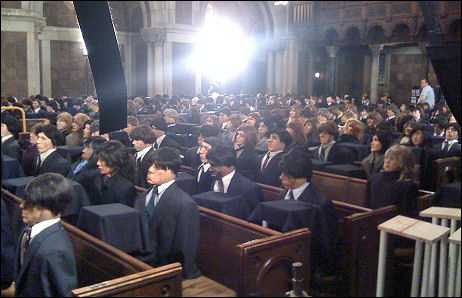
I’m prohibited from saying where I was in midtown Manhattan from 3 to 6 pm today, but it was very cool hanging out and watching it all go down. One day I’ll be able to reveal the particulars. I’m not trying to tease or play games, but I so love this iPhone photo that I’m figuring it can’t hurt to post it. I love that it reveals absolutely nothing and yet prompts an inevitable “what the…?”


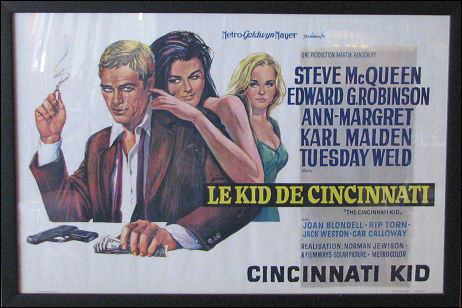
Talk about your lying one-sheets; this lobby card makes Steve McQueen look like some Euro stud from a Radley Metzger film.

Ditto, 2:25 pm.

Just Like That

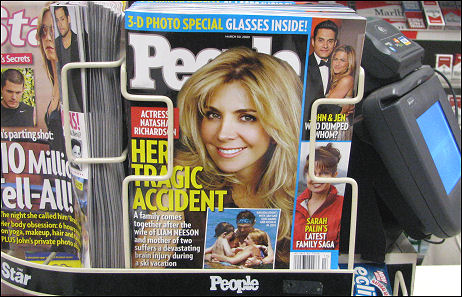
I read late this afternoon that Natasha Richardson‘s family, knowing her condition offered virtually no hope, had turned off her life-support system. I read the news about her passing on my iPhone when I came out of this evening’s all-media screening of Alex Proyas‘s Knowing. Tragic news…so awful. And then I went into a Duane Reade and there she was on the cover of People. Fast work, guys.

Lying One-Sheets

We all know how most movie trailers tend to sell the sizzle rather than the nutrients — pushing the lowest-common-denominator elements with such emphasis that the trailer, in many cases, winds up ignoring what the film is really about, what it feels like to watch it, what the mood is, and so on. But the art of movie posters doing some of their own flat-out lying is pretty much a lost art. Or is it? I’m trying to remember recent examples as I write this and coming up dry.

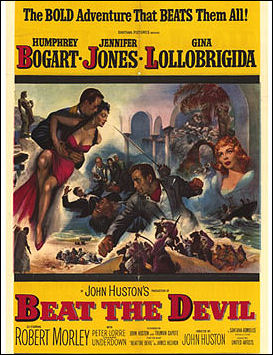
This Beat the Devil poster is a good example of the bald-faced bullshit aesthetic that was commonly deployed in the ’50s and early ’60s, and perhaps before. Beat the Devil is a clever little intellectual-conceit adventure spoof, shot in southern Italy in monochrome and enlivened by a slight sense of its own absurdity and Truman Capote‘s witty dialogue. But the Beat the Devil promised by the above poster — vivid, panormaic, colorful, erotic — doesn’t exist.

Another lying poster is this lobby card for the original 1951 The Day The Earth Stood Still, which adds a dark gray monster hand afflicted with psoriasis. Which, like, isn’t in the movie.

Can anyone think of any similar-styled movie posters used recently, or even within the last ten or fifteen years? If you can, please (a) describe the lies as clearly and simply as possible, and (b) include a link to the poster being discussed.

Edge Junkies

The Hurt Locker had its South by Southwest screening last night (6:30 pm) at Austin’s Paramount, and there’s been nothing but radio silence from the live-wire types who are supposedly covering. Nothing from HE‘s Moises Chiullan, nothing on AICN, nothing from New York/Vulture’s Eric Kohn, nothing from MCN’s Kim Voynar or Noah Forrest, nothing from the transgressive James Rocchi. Snail-paced reportage every which way.

During their recent NYC visit Hurt Locker dierctor Kathryn Bigelow and screenwriter-producer Mark Boal said that Jeremy Renner‘s edge-junkie character (i.e., Sgt. James) is an amalgam of guys Boal ran into during his embedded time in Iraq, which only lasted a couple of weeks.

How many adrenalin junkie/danger freaks did Boal run into over there exactly? It’s pretty remarkable that he ran into enough of them there in two weeks time to create an amalgam character. Who exactly are these guys? What are their names? Are any of them still in Iraq, or have they call come home to the narcotized comfort of life in the United States? Have any of them seen the film?

Them’s The Breaks

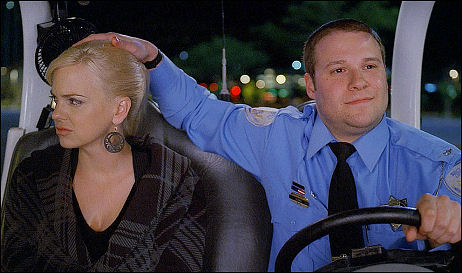
In a reference to Paul Blart, Mall Cop, Observe and Report director Jody Hill said during a recent South by Southwest press conference that “it’s annoying that every time I read an article, they mention this piece-of-shit movie. I don’t want a battle of the mall cops. If somebody’s doing something, I don’t want to do that.” Yeah, but you’re doing that regardless. And many — most? — of the schmoes who paid to see Blart are probably going to go “what, again?” Which wouldn’t be right or correct, given the allegedly superior, transgressive, Scorsese-like nature of Hill’s film.

Same Old AT&T

In his latest South by Southwest report, N.Y. Times columnist David Carr (a.k.a., “the Bagger”) writes that AT&T “apparently did not anticipate the onslaught [of concentrated iPhone users in Austin]. The sheer volume nearly pulled down the grid by Monday, with frustrated users screaming about outages on Twitter and elsewhere.

“‘It’s one thing for AT&T to drop random calls, but when it starts to put your hookup in jeopardy, well, that’s crossing the line,’ tweeted 7daysageek. AT&T responded to the hailstorm of complaints with a chastened news release and increased capacity on Monday.”

Oh, please! The same exact thing happened in Park City during Sundance two months ago. Too many iPhone users resulted in a frequent inability to websurf and grab e-mail, with AT&T reps saying uhm, gee, we didn’t anticipate, very sorry. Sure — in the same way your alcoholic younger brother borrows your car and says he’s sorry about getting into a fender bender. Not anticipating and preparing for usage overloads is AT&T’s raison d’etre. That is what they do. Indeed, it’s what theyr’e (in)famous for.

Scorsese’s Shadow

Writing from South by Southwest, Variety‘s Joe Leydon is calling Jody Hill‘s Observe and Report (Warner Bros., 4.10) a “shockingly and sometimes discomfortingly funny comedy about an unstable security guard (Seth Rogen) who views himself as vigilant protector — and, occasionally, avenging angel — while patrolling a suburban shopping mall.”

The film starts with a setup “that could have been played for sitcom jokiness and family-friendly slapstick,” and yet Hill “attempts something much darker, if not downright transgressive.” (Sounds like a James Rocchi film! ) The result is a pic that’s “bound to divide auds and critics into love-it-or-leave-it camps when it opens April 10th. It’s a gamble that might pay off handsomely for Warners. Or not.”

73 Scumbags

Several details about 73 AIG bonus recipients were revealed today by N.Y. State attorney general Andrew Cuomo in a letter sent to House Financial Services chairmanbBarney Frank. The recipients weren’t named, so the option of a torch-carrying, pitchfork-wielding mob congregating in from of their homes with Stephen Colbert leading them on isn’t likely at this stage.

One detail in the letter was that despite a claim from AIG’s topper than over $160 million in bonus payments had to be paid to keep the highly-valued employees from leaving the company, 11 out of 73 recipients are no longer with AIG,and one of the departed individuals received $4.6 million before cleaning out his desk.

The 73 recipients were members of AIG’s Financial Products subsidiary, “the unit of AIG that was principally responsible for the firm’s meltdown,” according to Cuomo.

Cuomo’s letter stated that (a) the top AIG recipient received more than $6.4 million, (b) the top seven bonus recipients received more than $4 million each, (c) the top ten bonus recipients received a combined $42 million; (d) 22 individuals received bonuses of $2 million or more, and combined they received more than $72 million;(e) 73 individuals received bonuses of $1 million or more.