So that’s Chaya Raichik, the Libs of TikTok honcho, on the right with the pink hoodie, and masked-up Washington Post social media reporter Taylor Lorenz on the left.
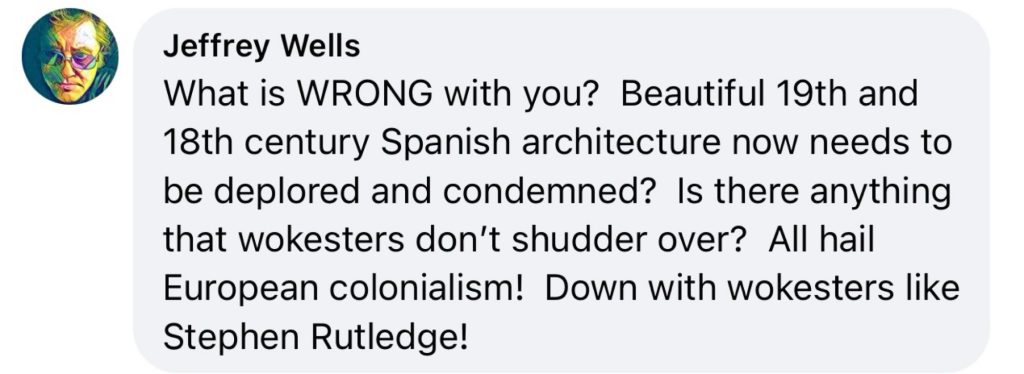
In overly simple terms, we’re talking basic normie values and suspicion of unmitigated immigration of POCs from various cultures vs. unbridled wokeism (“whiteys need to be punished and brought down a peg or two”).
Yesterday HE tried to get the hang of Zoom, as the first “Misfits” Zoomcast is set for Sunday afternoon with a peek-out sometime later that evening or Monday morning.
Alas, HE mostly failed in this effort, and I am therefore grateful to Glenn Kenny for having generously offered to do the Zoom inviting, due to my woeful lack of facility with this extremely user-unfriendly software.
I spent three or four hours yesterday trying to figure out the protocols, and I’m just not smart or patient enough, it seems. And so to protect my sense of self-worth I’ve decided that it’s Zoom’s fault, not mine. As a result I’ve come to despise Zoom with a burning Ahab-like intensity.
Zoom has actually re-awakened long suppressed feelings of stupidity and self-loathing within me…feelings that I experienced when I was 13 or 14 years old and bored to death in history class. I so hated studying mind-numbing textbooks that I would invent my own answers to pop quizzes. When asked who was James Watt, the 18th Century Scottish inventor of the semi-advanced steam engine, I would answer that he was a pioneer in developing and measuring the illumination levels in electric light bulbs, hence the quantifying term “watt” as in 75-watt GE bulbs.
This was my burden, my plight, my anguish. For I was inexplicably hostile to standard terminology and accepted doctrine, and felt stubbornly inspired to defy it any way I could. And now, thanks to Zoom, I am re-living the dull panel-colony horror of being the dumb guy in class. Or, you know, an intellectually rebellious 13 year-old or whatever.
Again — HE’s very first Zoomcast will happen as planned, but only because Kenny has stepped into the breach.
Ray Bolger‘s Scarecrow: “Oh, I’m a failure because I haven’t got a brain.”
The Best Actress category represents the only major-category Oscar cliffhanger, of course — Poor Things‘ Emma Stone vs. Killers of the Flower Moon‘s Lily Gladstone. And it’ll basically be decided during tonight’s SAG Awards telecast on Netflix.
HE is greatly concerned that the woke-minded SAG-AFTRA membership might vote to support Gladstone’s identity campaign (i.e., “put aside any notions of exceptional quality of performance — vote for me because I’m Native American”). Whoever wins tonight will almost certainly take the Best Actress Oscar, and so this is a fairly big deal as all the other Oscar categories have been pretty much decided upon or locked down.
I’ll be in West Orange, New Jersey when the decision comes down. I’m prepared to accept a Gladstone victory as long as everyone understands the woke bullshit dynamic, as a Lily win would have nothing to do with her having given a knockout performance, or one that could be fairly described as fascinating, audacious, richly-written, dig-down-and-touch-our-communal-soul, etc. What can I do if SAG-AFTRA tilts this way? Obviously nothing.
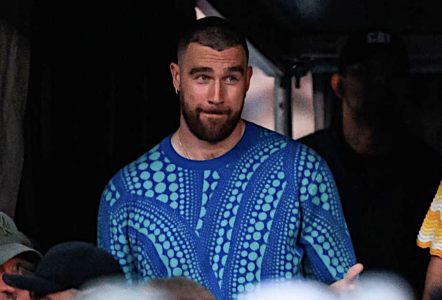
Travis Kelce‘s stunningly awful taste in jackets, shirts and pullovers continues unabated. A day or two ago he wore another sartorial nightmare garment while attending a Taylor Swift concert in Sydney. Couple this shamelessness with Kelce’s troglodyte behavior during the Las Vegas Super Bowl and you’ve got a very difficult package. If I was at a party and spotted some nameless nobody wearing a sweater or pullover like this, I would retreat to the other end of the room or maybe leave altogether.
Werner Herzog lasted a half-hour with Barbie, and in so doing experienced “sheer hell.” Herzog isn’t “wrong” for having said this, but Barbie has its own mentality, its own satirical motor, its own creationist view.
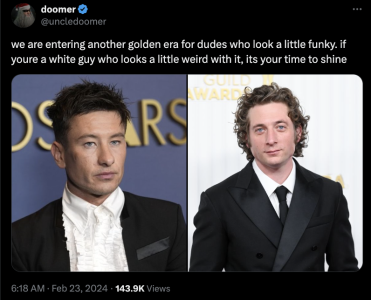
Someone has finally acknowledged what I’ve been saying over and over and over for years, which is that Barry Keoghan looks weird, largely due to his bee-stung nose. It is apparently my lonely lot in life to be the pathfinder, the first one through the barbed wire, the canary in the coalmine. Thank God that Uncle Doomer has joined in.
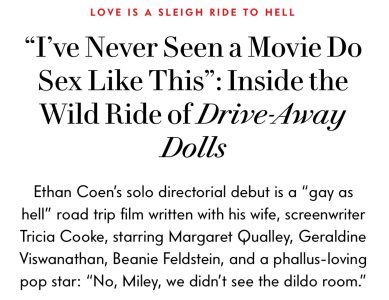
Two days ago I saw RoseGlass’s LoveLiesBleeding (A24, 3.8), and tonight [Thursday, 2.22] I watched Ethan Coen and Tricia Cooke’s Drive–AwayDolls (Focus Features, now playing).
Both are quite dykey — hungrily, aggressively sexual. The Coen-Cooke is mildly crazy in a nervy, farcical way (vaguely recalling the tone of RaisingArizona, the 1987 Coen Bros. film) while the Glass is like a volcano that spews more and more lava. And from my surprised perspective, both are moderately approvable.
This is not what I expected. I was a little bit afraid that both would piss me off in some way or would at least be annoying, and neither did that. Neither film is truly double grade-A but at the same time neither has anything to apologize for. And the Coen-Cooke is often fleet and clever, and it ends perfectly with a reaction shot from a peripheral character…bingo!
Glass’s film, which really uncorks the madness during its final third, is subversive in a way that I didn’t see coming.
The Coen-Cooke is deadpan droll — much lighter and goofier than the melodramatic Bleeding, which deals straight cards until the end and never fools around — although with a fair amount of violence. But you also know it’s basically comedic and is therefore going to observe boundaries.
Maybe it’s me but both films seem determined to be as provocative as they can be with the sex scenes. A lot of slurping and smooching and fingering and muff-diving, and the Coen-Cooke even goes in for sizable wang prosthetics toward the end.
I flinched a bit when the Glass went in for some light toe-chewing — sorry but the toes in question struck me as too thick and knobby. A voice inside went “eeeww, no…too much.”
Call me full of it if you want, but I have this impression that U.S. filmmakers aren’t allowed these days to make sexually graphic hetero-love-affair films. They can only dive into hot sex if it’s from a gay or lesbian serving tray. The prohibiting of LastTangoinParis-level presentation is understood in every progressive corner of the industry (you certainly couldn’t make a film about a couple of saucy women who love to get fucked by Glenn Powell-type guys and are totally into hungry blowjobs, not in today’s environment) and you can sense that Glass and Coen-Cooke knew they had carteblanche approval and that now (i.e., last year) was the time to go for it and pull out the stops.
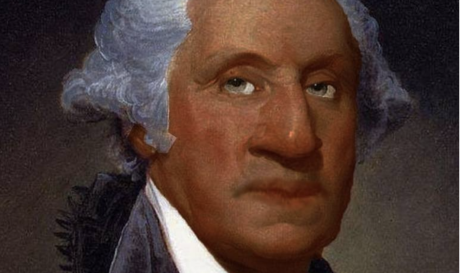
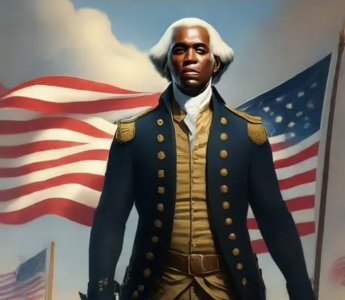
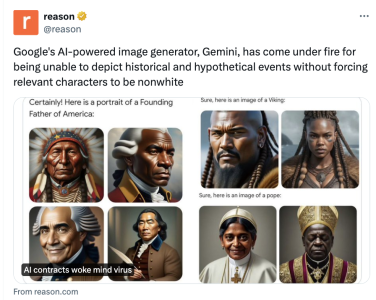
This was a Google-speak response to the AI software having insisted on transforming all historical figures into persons of color. Google has posted an updated statement, saying that it will re-release an “improved” (i.e., significantly whiter) version soon.
May I ask a question? What is the basic difference between (a) black-icizing historical figures via Google Gemini and (b) movies using the presentismaesthetic to assert that people of color were or could, within the realm of our enlightened progressive imaginings, be persons of color in the past, including the British past?
Since ’15 or thereabouts we’ve all seen like-minded features, plays and cable series set in the 19th and 18th Centuries as well as Elizabethan England, including Netflix’s Bridgerton, Josie Rourke‘s Mary, Queen of Scots, Lynsey Miller and Eve Hedderwick Turner‘s Anne Boleyn, B’way’s Hamilton, Joel Coen‘s The Tragedy of Macbeth (set well before Elizabethan times) and so on.
The casting of all these productions reflect the woke Hollywood aesthetic known as “presentism“. All Google Gemini did was take this well-established trend and inject into a software tasked with providing historical images.
Last night I re-watched John Carpenter‘s Assault on Precinct 13 (’76). I do so every couple of years. I first caught it at the Museum of Modern Art in ’78 or ’79. I’ve seen it at least eight or nine times since, and I don’t even want to think about the 2005 Ethan Hawke-Larry Fishburne remake.
There are two reasons why I keep coming back to this hardboiled, Howard Hawksian, Rio Bravo-ish seige film, which is basically about nihilistic gang members looking to murder a small band of defenders inside an all-but-abandoned police precinct in the fictional rathole town of “Anderson”, a stand-in for any one of those parched and blighted burghs in South Central Los Angeles that most of have never visited and will almost certainly avoid visiting for the rest of our lives.
Reason #1 is that Carpenter’s film is a much leaner, tighter and more finely crafted film than Rio Bravo (’59) or the other two Hawks films that use the same sheriff-defending-the-jailhouse plot, El Dorado (’66) and Rio Lobo (’70).
Assault is really a masterpiece — taut, tense, boiled down, brilliantly shot and edited, and occasionally quite funny.
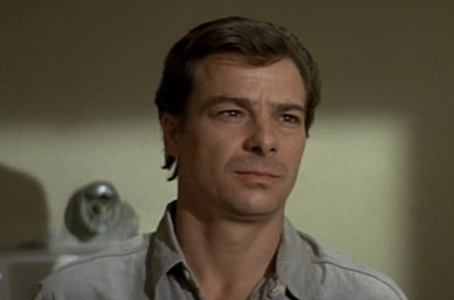
Reason #2 is Darwin Joston‘s dead-perfect performance as the terse, hard-bitten and rather romantic Napoleon Wilson, an allegedly dangerous killer on his way to prison who ironically turns out to be a first-rate hombre when the chips are down.
It’s not a rumor: Wilson is one of the greatest tough-guy characters ever created for the screen — calm, steady, sardonic, an embittered philosopher, a tender fellow with a lady (Laurie Zimmer‘s “Leigh”), a soul man with a sense of acrid black humor, and a guy you can totally trust with a shotgun…100% dependable when the heat is on and the odds are damn near insurmountable.
I’m dead serious here — Napoleon Wilson (Carpenter wrote the character with Joston in mind) is one of the greatest and most iconic action-film heroes ever written or performed, right up there with Al Pacino‘s Vincent Hanna in Heat, Robert Redford‘s Sundance kid, Robert Mitchum‘s Jeff Markham in Out of the Past, Humphrey Bogart‘s classic trio (Sam Spade, Richard Blaine, Fred C. Dobbs), Walter Matthau‘s Charley Varrick and anyone else you’d care to name.
And poor Joston, who passed in 1998 at the age of 61, never landed another role even half as good. Tragic.
A sampling of Napoleon Wilson’s classic lines:
“I believe in one man.”
“Chains is all I’ve got to look forward to.”
“Can’t argue with a confident man.”
“In my situation, days are like women — each one’s so damn precious, but they all end up leaving you.”
“It’s an old story with me. I was born out of time.”
Commenting about the employment situations in Gainesville vs. Scranton [2:23 mark]:
“I know what I say to my friends and the people of Gainesville. Things may be bad where you live, but I guarantee you it is a paradise compared to the burning coal heap that is Scranton, Pennsylvania. You know that show The Walking Dead? If you went to the lowest circle of hell, you’d still be 45 minutes outside of Scranton. I grew up there, I love it…it’s the single worst place on earth.”
I shook Joe Biden’s hand during a 2008 Democratic party campaign event at West Hollywood’s Pacific Design Center. I waited in line a good 45 minutes if not longer to meet Joe, who was 65 (just shy of 66) at the time and wearing a light silver-gray suit. Joe pressed must’ve pressed flesh that night with over 1000 people, perhaps more. His hands must’ve been numb, not to mention his soul. When the moment finally came, I said “greetings, Senator”. Biden nodded and went “hmmm.” I understood — no worries. But I could feel his vibe, his energy. He was alive and attuned, and that was 16 years ago.
Things change. The body and spirit inevitably decline. You can’t stop the process. I would have the 2012 version.