Tough Choices

Yesterday an HE reader named Ephemerinko called me out on being too conventional in my choices about what to see at the big film festivals. “I’d like to see you take more chances, “he wrote. “True, you gotta kiss a lot of frogs, as they say, but when something pays off there’s no better feeling in the world. Festivals are about discovery, not being force-fed what the studios want you to see. Your site would certainly be better for it.”

He had a good point but he was also missing the particulars. Yeah, I could take more chances and kiss more frogs, I responded. I could do that. Maybe I should do that. But I feel at root that I have to try and see the films that have a real shot at being distributed and seen by Average Joes in Terre Haute, or at least seen by sophisticated ticket-buyers in New York and other towns that cater to people with actual taste buds.

That means seeing movies with brand-name directors (and by that I mean guys like Carlos Reygadas, Bela Tarr and Brillante Mendoza, even though their most recent films have been seen by maybe 1% or 2% of the hip moviegoing public) and actors and screenwriters with some distinctive history of accomplishment.

You have to make choices at film festivals, and you have to file like mad during the eight or nine days that you’re there, which usually translates into seeing maybe 18 to 20 films, at best. 25 if you’re superman.

There’s a decent possibility that the following films will be at Cannes: Agora (no U.S. distributor), d: Alejandro Amenabar; The Road (Weinstein Co.), d: John Hillcoat; Brothers (MGM), d: Jim Sheridan; A Serious Man (Focus Features), d: Joel and Ethan Coen; Bright Star (no US distributor), d: Jane Campion; Whatever Works (Sony Classics), d: Woody Allen; Ondine (no US distributor), d: Neil Jordan; Forgiveness (no US distributor), d: Todd Solondz; Love Ranch (no US distributor), d: Taylor Hackord; Coco avant Chanel (Warner Bros.), d: Anne Fontaine; Nailed (Capitol Films), d: David O. Russell; Inglourious Basterds (Weinstein Co.), d: Quentin Tarantino. Plus Lars von Trier’s Antichrist, Cristian Mungiu’s Tales From the Golden Age, Gaspar Noe’s Enter the Void, a new Michael Moore documentary about profligate Wall Street bankers, Fatih Akin’s Soul Kitchen, Michael Haneke’s The White Ribbon, Jim Jarmusch’s The Limits of Control, Ken Loach’s Looking For Eric, Terry Gilliam’s The Imaginarium Of Dr. Parnassus, Andrea Arnold’s Fish Tank; and Jean-Pierre Jeunet’s Micmacs a tire-larigot.

I’m counting 22 films, meaning if they all turn up I may have to shine two or three. Which ones would you recommend not seeing if it comes to that?

By your standard I should ignore the Tarantino because it’ll be opening in August. My response to that is, “Are you fucking nuts?” Maybe you’d say ignore Taylor Hackford‘s film about Nevada prostitution (if and when it shows there). But Helen Mirren won the Best Actress Oscar a couple of years ago and I suspect HE readers (and those beyond the periphery) would want to hear about this film. But if I followed your thinking, I would say, “Naah, fuck the Hackford and find a nice little frog that may surprise you and turn into a prince.” Right? I get that way of looking at things because that’s how you discover the odd pearl (it’s true!), but it sure seems ill-advised right now.

Even the Gilliam film, which I suspect probably delivers in a nutso flipped-around way that even the most Gilliam-friendly critics will have a slight problem with, is of interest because it has the very last performance of Heath Ledger, which people are naturally interested in. Who wouldn’t be?

On the other hand you hear things at festivals about films that you hadn’t necessarily planned on seeing (not as a priority) but you go to anyway on a hunch. I hadn’t firmly decided on seeing the public showing of An Education at Sundance, but I decided to go at the last minute because it was written by Nick Hornby and directed by Lone Scherfig. It turned out to be a very good call on my part. Last year at Cannes I decided I had to finish a piece I was working on rather than see Gomorrah. That was a bad call as it turned out.

But you’re always juggling, always wondering, always on edge during festivals, always running with or behind your schedule but never ahead of it. You never see everything you wanted to see, and you always miss a couple of really good ones. Happens every time.

I’ll never forgive myself for failing to see Anton Corbin‘s Control during the early stages of the ’07 Cannes Film Festival at the premiere of Un Certain Regard. (Or was it Driector’s Fortnight?) I just blew it and didn’t go. I could have gone to the second screening but Robert Koehler told me not to bother. Hands down one of the best films of that year, and Koehler told me not to bother! I wound up seeing it on my last day there, at a market screening on the rue d’Antibes.

Again, let’s presume that each one of the above films is shown at Cannes. Which ones would you shine, and why? I’d like to hear your thinking on this. Because I don’t think you know more than what I know, and I don’t think your instincts are any better than mine either.
Good Times Are Bad

“It’s not rocket science,” USC academic Martin Kaplan tells N.Y. Times reporters Michael Ceiply and Brooks Barnes. “People want to forget their troubles, and they want to be with other people.”

Kaplan is explaining two facts: (1) 2009 ticket sales are up 17.5 % over last year for a tally of $1.7 billion, according to Media by Numbers, and (2) attendance has also jumped by nearly 16 %. Ceiply and Barnes conclude that “if this pace continues through the year, it would amount to the biggest box-office surge in at least two decades.”

Which underlines the old adage about the movie business being recession- or depression-proof and then some.

Except it’s not. Movie advertising has been down even in the online sector, there’s a general feeling of belt-tightening and weltschmerz out there, Warner Bros. recently fired a ton of people, long- and short-term loans are obviously harder to come by due to the general economic slump, fewer journalists attended Sundance six weeks ago and far fewer will attend Cannes, and so on. The bottom line is that the film business is booming as far as ticket sales are concerned, and yet things are looking lean and scary regardless.

Are we clear on that?

Moment in Paris

Martin Provost‘s Seraphine, a fictionalized story of painter Seraphine de Senlis that no one talked about during the Toronto Film Festival (certainly not in my circle), has won seven Cesar awards. The ceremony ended in Paris two or three hours ago. It won best picture, best original screenplay (Martin Provost), best actress (Yolande Moreau), best cinematography (Laurent Brunet), best costume design (Madeline Fontaine), best original score (Michael Galasso), and best set design (Thierry Francois).

Her Absence Is Healthy

The Independent‘s Sheila Johnson observes that the femme fatale has all but disappeared from screens. The last time there was a crop of such roles was in ’80s and ’90s films like Body Heat, Blood Simple, Basic Instinct, The Last Seduction, etc. I think the lack of femme fatales is a result of men’s maturing attitudes about women, since the original femme fatales of 1940s film noir were misogynist fantasies rooted in male loathing of women due to envy of their tremendous power.

“Personality Disorder and the Femme Fatale,” an essay by Scott Snyder, states in its summary that “the type of character pathology personified in the femme fatale may be viewed as representative of certain misogynistic conceptualizations of the women of [the late ’40s and ’50s]. Concurrently, these screen women may have helped to create a certain cultural image for some real-life women of the 1940s and 1950s as reflected in the areas of fashion and style, personality, and social status.”

No City for Country Boys


2.27, 4:45 pm.

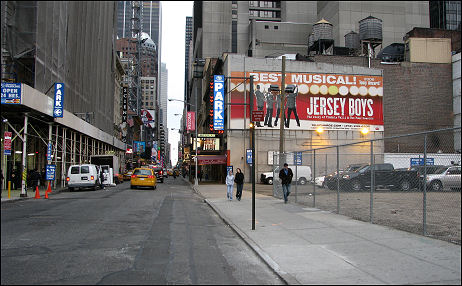
8th and 44th. 2.26, 7:15 pm.

Parking it at Friend of a Farmer, a comfortable, agreeably homey two-story restaurant on Irving Place that has been in operation for some 23 years. Serves first-rate comfort food. 2.27, 9:25 pm. [Photo by Svetlana Cvetko.]

Cool Enough, But Why?

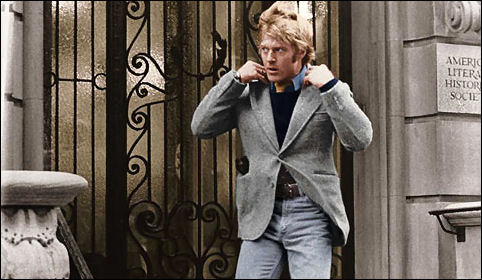
A Blu-ray Three Days of the Condor will be out on Tuesday, May 19th. In honor of Sydney Pollack, Robert Redford, David Rayfiel, that pretty Asian lady who was machine-gunned to death and Max Von Sydow, I’ve already bought it in my head. But with so many visual knockout films that were shot on big formats not yet announced as Blu-ray releases, why are visually so-so titles like Condor being chosen and not, say, To Catch a Thief, which was shot by Robert Burks in VistaVision and looks phenomenal even off a standard DVD (i.e., when played on a Blu-ray player and shown on a big plasma screen)?

Mrs. Mayor

I’m trying to think of a precedent in which a sexually-oriented relationship dramedy not only costars but has been produced by the wife of a big-city mayor who’s also regarded as a comer on the national scene. The film is The Trouble With Romance, which opened yesterday at Manhattan’s Quad Cinema, and the producer-costar is Jennifer Siebel Newsom, wife of San Francisco mayor Gavin Newsom.

The trailer tells us Mrs. Newsom plays a scene in champagne-colored underwear, and that it apparently has to do with her being the recipient of…well, watch the trailer. Hey, it’s okay with me. It just struck me as a bit unusual given that she’s the wife of a sitting big-city mayor, and …whatever, conventional expectations of modesty and decorum and all that.

In her N.Y. Times review that went up yesterday, Jeannette Catsoulis called The Trouble With Romance an “airless, fragmented feature [that’s] visually stagnant and tonally bewildered.” She didn’t comment on Newsom’s performance.

Fiber and Spirit

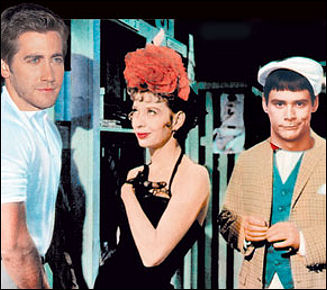
I was quoted in a N.Y. Post piece than ran today about the just-announced remake of Damn Yankees with Jim Carrey and Jake Gyllenhaal. The author is Mandy Stadtmiller.

Sample: “‘There are more musicals coming,’ Wells says, but he frets that remakes are the rage rather than originals. ‘A movie has to come from the fiber and the spirit and time that it’s made,’ he says, noting that you can’t just inject ‘iPods and Barack Obama’ into the Dwight D. Eisenhower-era Damn Yankees.”

A Cut Above

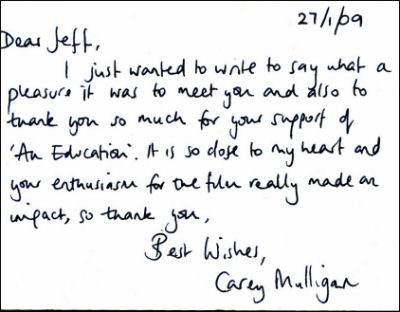
It’s fairly common for actors to express thanks to journalists who’ve said kind and supportive things about their work. It’s probably been happening since the days of Aeschylus and Euripides. How is their gratitude usually conveyed? At Oscar-season parties, mostly. Or an actor’s publicist will pass along a “much appreciated” in an e-mail. But in this day and age with everyone texting and twittering and never stopping to take a breath, it’s just about unheard of for an actor (and especially a very young actor) to mail a personal note. Is sharing this a breach of trust? All I know is that I was moved, and I want to say thanks back in a just-as-open-hearted way. This lady is all about class.

Ready To Go

I just bought my ticket to see Watchmen: The IMAX Experience at the 3.6 10 ayem show at the Lincoln Plaza. I tried to buy one for the Thursday midnight show but it was sold out. I won’t be able to see it before then because I’m still on the Warner Bros. shit list. I was led to think a couple of months ago that I might be reprieved, but no dice.

Ben and Benner

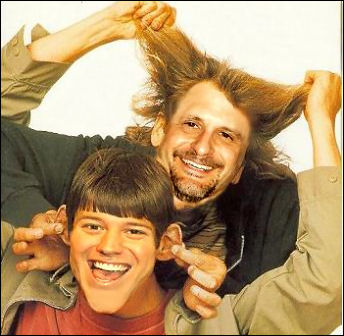
AP writer Lynn Elber‘s 2.27 interview with At The MoviesBen Lyons and Ben Machieweicz was neither here nor there. The guys sat down because they wanted to counter-spin the negativity, but Elber didn’t hammer them or get any live-wire quotes. The best thing that came out of it was Erik Childress‘s mock poster that accompanied his riff on the piece.

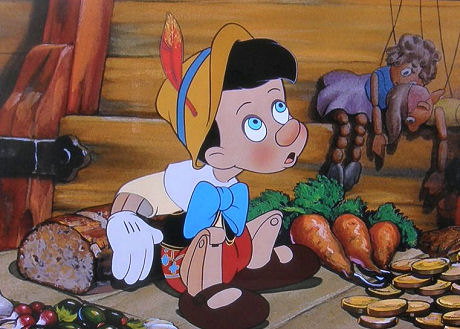
Pinoccho Reborn

“There’s one genre of filmmaking in which the ‘they-would-have-gotten-rid-of-the-grain-if-they-could’ line holds a great deal of water,” Some Came Running‘s Glenn Kenny wrote yesterday, “and that’s animation. Disney works with Lowry Digital on (thus far) all the restorations of its classic animation titles, and the digital work goes beyond erasing scratches and smudges. It extends well into the issue of the grain that was produced when the actual animation cels were photographed.

“It aims to give a representation of what the artwork would have looked like had the intermediaries of the camera lens and the film stock never, shall we say, interfered.

“The first high-definition demonstration of this wizardry was with 1959’s Sleeping Beauty, released on Blu-ray last fall, a staggeringly beautiful disc. In a week and a half, DIsney unveils a 70th-Anniversary edition of Pinocchio on Blu-ray, and in a way, it’s even more of a stunner.

“Okay, the actual 70th anniversary of this 1940 title is a year away, but let’s not quibble. For borderline boomers such as myself, Pinocchio never played as an ‘old’ movie when we saw it, or bits of it, on the color version of The Wonderful World of Disney on our households’ first color televisions in the early ’60s. But to look at this version is to look at something not just not old, but brand new.

“The colors, the detail, the almost preternatural absence of smudges, scratches, and whatnot…this does, I think, inarguably, honor the intentions and the labors of the filmmakers in a way that even they themselves could not have envisioned.” Yes!


DVD Beaver capture of Sleeping Beauty Blu-ray.