No — don’t buy Hancock on Blu-ray unless you have the movie-watching taste buds of a mountain gorilla. It has one of the dumbest, looniest third acts ever created in the history of drama. Relentless big-whomp special effects, but what’s that?
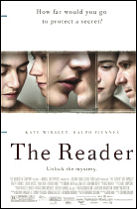
I’m finally ready to comment on a moderately controversial 12.2 Huffington Post piece by film critic Thelma Adams about how the older woman-teenage boy relationship in Stephen Daldry ‘s The Reader is basically a case of child abuse, and if the sexes were reversed (older guy, teenage girl) it would definitely constitute child abuse.

I’ve explained this a couple of times since the dawn of Hollywood Elsewhere in August ’04, and I’ll probably have to keep explaining it. If an older man takes a 15 year-old girl to bed, he’s an animal and a scumbag who deserves to go to jail. But if you’re a 15 year-old teenage boy (or 14 or 16 or whatever), you automatically get down on your knees and give thanks to God if an older woman wants to go to bed with you. No ifs, ands or buts — it’s a gleaming gift from heaven.
If a woman in her 20s or 30s or even her 40s had been interested in yours truly when I was 15 or so, I would have turned out a much happier person — certainly a more optimistic one. There’s no way in the world I would have ever been screwed up or even moderately traumatized by such a blessed, rhapsodic event.
Different standards but that’s how it is.
“I just saw Milk and as I’m watching it I’m thinking this is really, really dull. This is such a paint-by-numbers biopic that the only stand-out thing is the fact that it’s about gay men. But as an emotionally involving narrative, it’s just flat flat flat. And why is it that an incredible thriller like Transiberian can come out and no one pay attention to it. The state of film criticism is now so tied to the marketplace that it’s slowly choking American film as an art form. Maybe it’s just me.” — received this morning from a filmmaker friend.
The beginning of the real bitter end of the Hollywood Reporter happened yesterday when, as Nikki Finke has reported, several essential, first-rate people were cut from the payroll — film reporters Gregg Goldstein, Carolyn Giardina, Leslie Simmons, managing editor Harley Lond, TV critic Barry Garron, TV reporter Kimberly Nordyke, Manhattan-based special issues editor Randee Dawn, international department editor Hy Hollinger, plus Dan Evans, Lesley Goldberg, Michelle Belaski and James Gonzalez.
Plus the roilling heads at Paramount, Universal/Focus and Newsday.
Plus I’m told that film critic Glenn Whipp has been cut from the ranks of the L.A. Daily News. Put vaguely, his duties and/or compensation have been reduced beyond a duties/compensation diminishment that had happened previously. (I could make it vaguer.) Whipp didn’t reply to an e-mail, his colleague Bob Strauss didn’t reply to email and a call, Whipp’s arts editor didn’t pick up, etc. People never seem to want to call back when someone’s been cut. Nobody wants to touch it.
An intriguing, above- average interview with Che director Steven Soderbergh by Indiewire‘s Anthony Kaufman.
Annoyed by the one-week exposure of Steve McQueen‘s Hunger, Film Experience’s Nathaniel Rogers is claiming that the one-week qualifying runs are “cheating…they’re a loophole. You are not really a 2008 movie if you open at one theater in one city for one week and then remove yourself quickly to plan for 2009. The idea, for all films that try this tactic, is to win Oscar nods and hope that that will boost their profile when they open for real. But this is rather like trying to pay rent by buying yourself a lottery ticket.
“It’s not easy to get Oscar nods — particularly for small art films — and many films that go this route never make good on their ‘opening in February/March’ claims when they find themselves without Oscar nods… which is the case more often than not. Oops. The system as it is stinks; It’s not healthy for these small movies, it screws with the structural calendar idea of awards systems and most importantly, it’s no good for the movie-loving audience who are left out of the conversation altogether.”
Washington Post critic Michael O’Sullivan is calling Darnell Martin‘s Cadillac Records “a rousing, fast-paced tale, told with a modicum of verve and packed with colorfully flawed, occasionally heroic and even tragic characters. It also feels disappointingly bloated and too fast-paced by half. Cramming in that history doesn’t leave much room for — oh, I don’t know — story.

“History is propelled forward by the filmmaker’s over-reliance on such now-stale staples of musical biopics as the montage of nightclub marquees, ka-ching-ing cash registers, close-ups zooming in on the names of chart-topping singles and newspaper headlines. It’s a breathless approach, leaving little time in this speeding, noisy, overcrowded Cadillac to take in anything other than the milestones that go whizzing past.”
How, then, to explain the unqualified rave given to the film by the always observant N.Y. Times critic A.O. Scott? Because Scott seems to be into soul music big-time — his review suggests it’s been been making his spirit soar for decades — and so he’s decided to emphasize what he feels in his heart rather than nit-pick Cadillac Records to death.
Scott is especially appreciative of Jeffrey Wright‘s portrayal of blues singer and guitarist Muddy Waters. In his various portrayals of famous African-Americans, Wright “directs our attention away from the familiar, public face of the character in question toward a private zone where ambition struggles with anxiety, and where what seems to be at stake is nothing less than the integrity and viability of the self,” Scott observes. “And so, in his Muddy Waters, we see pride, ambition and uncertainty cohabiting with musical genius, sexual appetite and stubborn professionalism.”
Never underestimate the ability of a person possessed by demons to make reasonable people follow his/her lead and go temporarily mad or lose their composure. Especially if the possessed is an entertainment publicist. I’m not saying what you’re about to read happened last year or last month or a few days ago, but it did happen. At a big-deal premiere for a film. A minor mistake metastasized into Deep Ugly when a certain publicist poured kerosene on it and then threw a match. Brilliant.
The trouble started when I was given the wrong theatre ticket by the guy at the will-call table. I said my name clearly, twice, but I failed to put on my glasses so I could see the name on the envelope, which had my last name right but not the first. I should have put on my glasses and checked the name. My bad.
I went inside, said hi to a publicist friend and asked about snapping a big-name actor in the film at the after-party, and then went into the theatre I was directed to. Right away it felt wrong as my assigned seat was taken by someone else, and a young girl handling seating decided that I must be in the wrong theatre. Then another girl handling seating came to the same conclusion. Their vibe was a little accusatory — “you don’t feel right, you belong elsewhere, we’re going to figure this out.” I decided the best thing would be to stand in the back of the theatre and wait for a resolution.
Then a publicist with frosty blonde swept-back hair came in with a security goon and said a mistake had been made and then asked for the ticket back. I gave it to her — no problem. Everything would have been cool if she had said “sorry, we messed up, I think you were given the wrong ticket, let me have it and I’ll get you the right one.” But her vibe was icy, haughty, dismissive (“I don’t know you”). A mating of Evita Peron and Cruella De Ville.
She then asked for the two party tickets I was holding in a white envelope and I refused. “What does the party have to do with where I sit?,” I said. “I was invited by [publicist’s name], I’m here to help out the film,” etc. But I was ready to give them up anyway in the interests of peace and harmony as long as I had assurance. So I said to her, “Will you replace these two tickets?” and she said, “I’ll give you a party ticket.” No, I said — not “a” ticket but two tickets, as I’d arranged for a friend to join me later.
In response to this, this master of finesse and diplomacy shut down the conversation then and there and told the goons to throw me out of the theatre.
Two goons escorted me out to the lobby and told me I’d have to leave the premises. I said I’m not leaving because I was invited. I don’t mind saying that I was, at this point, livid. I was being treated like a crasher, a slumdog. It feels awful to be restrained by two big guys standing on either side of you, like you’re a prisoner on the way to a lock-up. It was the next thing to being handcuffed. I was saying to myself, “How dare they do this? I was invited, I’m here to see the movie and help out,” etc., and I’m being minded by two linebacker-sized apes.
Then the haughty publicist speedily walked by and I lunged over and grabbed her arm to get her attention and said, “Why are you doing this? What is wrong with you?” She turned and walked away.
Then a publicist friend finally came over and said I was cool and I was told to go into another, grubbier theatre, which I did. Then the haughty and dismissive publicist came in with two goons and had them escort me out of the theatre. “Again?” I said, doubly outraged, but this time I went.
On the way out I was told this was happening because I had “pushed” Ms. Haught. A willful fabrication from a professional liar. To push someone is a blatantly aggressive act, but I didn’t do this. I wanted Frosty’s attention so I grabbed her arm because (a) I didn’t know her name, (b) she wasn’t looking in my direction (i.e., was pointedly not allowing for eye contact so as to avoid conversation) so a gesture or a wave or a “hey, lady!” wouldn’t have worked, and (c) she had already demonstrated her refusal to talk to me and had actually directed security to have me thrown out of the theatre because I wouldn’t surrender the party tickets.
I should have lightly touched the fiendish publicist’s arm, at most. But I felt abused and mauled and violated, and I wanted justice.
The next day I wrote the haughty publicist and apologized for the arm-grab. I realize how it felt from her end, I wrote, but I’d been treated much, much more aggressively at her command. I was humiliated in front of others by being held against my will by a pair of big fat apes. On top of her order to have me thrown me out of the theatre because I wouldn’t surrender the party tickets — a party I was invited to by a publicist representing the film! But I should have sucked it in and chilled down. My bad.
If you ask me, the title of this Bilge Ebiri New York/Vulture story implies that somewhere out there are ten mezzo-mezzo movie Nixons, and perhaps ten forgettable move Nixons on top of these. The idea of 30 or 40 Nixons…a battallion of Nixons…Nixons in leotards doing the Rockettes kick…an infinite number of scurrying, rat-like Nixons….an Army of Nixon waiters in Being Richard Nixon.
“With Ron Howard’s Frost/Nixon opening this week — along with the release of hundreds of new hours of Nixon tapes — America’s 37th president is back in the news,” Ebiri begins. “And it couldn’t have come at a more critical time — let’s face it, Tricky Dick’s claim to the title of America’s Premier Political Bogeyman has been shaky these past eight years. But until Dubya headlines his own torture-porn horror franchise (hey, it could happen), Richard Milhous Nixon will still be the nation’s favorite movie president — only Lincoln, with his hundred-year head start, can even hope to challenge him.”
“At 78, perhaps the only actor in the history of American cinema to convincingly kick the butt of a guy 60 years his junior, the hard-headed, snarly mouthed Clint Eastwood of the 1970s comes growling back to life in Gran Torino,” writes Variety‘s Todd McCarthy. “Centered on a cantankerous curmudgeon who can fairly be described as Archie Bunker fully loaded (with beer and guns), the actor-director’s second release of the season is his most stripped-down, unadorned picture in many a year, even as it continues his long preoccupation with race in American society.
“Highlighted by the star’s vastly entertaining performance, this funny, broad but ultimately serious-minded drama about an old-timer driven to put things right in his deteriorating neighborhood looks to be a big audience-pleaser with mainstream viewers of all ages.” Methinks the key words in this last package are the words “audience pleaser.” Know what that means? You don’t?