Fascist Tart

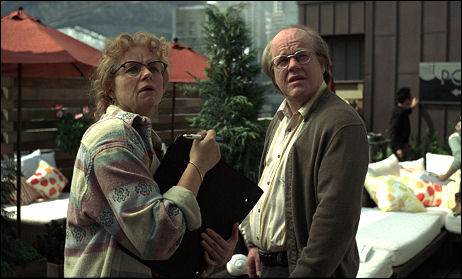
It is probably inevitable that Sally Hawkins, the cheerful and indefatigable Poppy in Mike Leigh‘s Happy-Go-Lucky (Miramax, 10.10), will be talked up as a Best Actress nominee once the film starts showing around. (It opened in England last April and came out last week on DVD over there.) An elementary-school teacher who happy-vibes just about everything and everyone, Polly is an unstoppable alpha dispenser — spirited, effervescent — and Hawkins certainly inhabits her whole-hog.


Sally Hawkins in Mike Leigh’s Happy-Go-Lucky

She carries Happy-Go-Lucky, she carries its spirit, and she does handle herself well in the sad-shock scenes at the end of the film with Eddie Marsan, the driving instructor with the correct manner and ferociously uptight, anti-immigrant attitude. In fact, the last 15 to 20 minutes contain the best stuff in the film, and I throughly respect Hawkins for her performance in this section. She handles her scenes with quiet maturity and resigned grace.
But her Poppy character epitomizes a sort of person I’ve never been able to tolerate — the emotional fascist who’s relentless about being happy, smiling and sparkly, but who also insists — here’s the problem — on forcing her bubbliness upon others (acquaintances, strangers, anyone) with the ultimate idea of converting them to their way of looking at life, or at least giving them a contact high to take home.
What’s especially oppressive and dictatorial about smiley-faced brownshirts like Poppy is their determination to gently bully you into submission. If you don’t get on board with the mutual-alpha, they’ll interrogate you like Laurence Olivier‘s Zell (the Nazi character in Marathon Man), looking at you with a quizzical grin and asking, “Are you happy?” or “Having a bad day?” Speaking from experience, I can advise that the best response is “I was feeling pretty good, actually, until you asked me that.”


Eddie Marsan, Hawkins

Imagine if Poppy was a born-again Christian asking total strangers, “So have you accepted Jesus as your personal savior?” and “Would you like to be saved?” The police would be called, she’d be cuffed and thrown into a van and taken down to the station. But there’s no recourse with the happy-happies.
I hate people who ask me if I’m happy because, of course, they’re not really asking me that. They’re saying they’ve observed my behavior, examined my vibe and decided that I just don’t have the right peppy-happy attitude, and that I need to adjust it right away so that it pleases them. I do meet these people from time to time. They’re like Moonies or Hara Krishna devotees — they’ve got the beautiful inner force inside them, and they know they’ve got that wondrous glow in their faces, and they’re determined to beat you over the head with it until you’re on your knees, bloody and begging them to stop.
Poppy feels like a kind of symbol of the whole happy-face movement of the ’70s, which for me represented a kind of alpha-vibe fascism that you could sense every so often in certain liberal-minded circles. Get with the positive attitudes or else! The late George Carlin once said on HBO’s “Real Time with Bill Maher” that “when fascism comes to America, it will not be in brown and black shirts. It will not be with jack-boots. It will be Nike sneakers and smiley shirts. Smiley-smiley.”

The French poster for Leigh’s film, called Be Happy over there, has a slogan at the bottom: “Adoptez la Poppy attitude!”
The term “emotional fascism” was first coined by Elvis Costello in the ’70s, and it’s real, you bet. There’s a scene when Poppy’s friend Zoe says, “You can’t make everyone happy” and Poppy replies, “There’s no harm in trying that Zoe, is there?” I am here to stand up and say that yes, there is harm in it, and would all the Poppy girls of the world please refrain from ever doing so again in my presence? It’s like being beaten with Mao’s little happy-face book during the Great Cultural Revolution.
There are many of us, I’m presuming, who look upon cheery, cock-eyed optimists as people you sometimes have to speak to at parties — sometimes it’s better just to suffer quickly and get it over with so you can move on — but if you see them coming down the street do cross over to the other side and duck into a book store or something, and then stay there for a good 15 minutes, just to be safe.

Monday Night

Just got back from Mike Leigh‘s Happy Go Lucky, a movie about a quirky, plucky lady (Sally Hawkins) given to laying spirited, feel-good emotional fascism upon others, including the audience. If this sort of thing lights you up, you may do cartwheels. (As Patrick Goldstein did.) If you find it oppressive, as I did, you’ll be in hell. And yet this is a very assured, self-aware film. Respect must be paid to Leigh, who knows his characters and their world and precisely how to make it all unfold in just the right way.

I didn’t have time to post Ted Kennedy‘s devastating Denver speech earlier this evening. I haven’t at this moment seen Michelle Obama‘s speech, but here’s almost all of it.

Quad

Four paintings by Jeff Ramirez — “Verzweiflung”, “Geschmerzt”, “Kampf”, “Entsetzt.” 5 x 7 inches each. $475.00 each or $1,800.00 for all 4. Interested parties should e-mail the Crazy 4 2 Artwork guys at gallery1988@aol.com.

That Voice

Politico‘s Jeffrey Ressner has posted a short profile of Cedering Fox, a special friend of yours truly and currently the voice of the Democratic National Convention in Denver. The best line, a description of Fox’s voice, is right at the top: “Soothing and smart. Slightly sexy. Raspy, too.”

Bloom and Brody

Since winning his Best Actor Oscar for The Pianist (’03), Adrien Brody has appeared in one underwhelming so-so after another — The Village, The Jacket, King Kong, Hollywoodland, The Darjeeling Limited. I don’t mean to be snide or churlish, but I’ve lately come to imagine that there’s something called the Adrien Brody curse, or an equation between the poor guy being in a film and that film being a problem. Brody is a fine actor; his performances are always rich. But he has this thing about appearing in films that are either gloomy indies or commercial head-scratchers.


Adrien Brody, Rachel Weisz, Mark Ruffalo

I’d like to believe that his latest pic, The Brothers Bloom, will break the pattern, although I’m a little concerned by the light caperish tone of the ads and the trailer. Here’s what gave me particular pause — an 8.24 New York magazine profile by Logan Hill of Bloom costar Rachel Weisz.
“In the globe-trotting con-artist movie The Brothers Bloom, two lifelong grifters (Adrien Brody and Mark Ruffalo) devise double-crosses so fabulously complex that they begin to lose track of where real life ends and the bamboozle begins,” Hill begins. “To them, everything — identity, love, friendship, death — is a lie.
“Even the film’s title is a classic bit of misdirection, because the movie isn’t really about the guys, after all. It’s about the marvelous mark they pursue: Penelope, a basket-case New Jersey millionairess with a thousand talents and just as many fabulous outfits. And the saucer-eyed, seemingly guileless actor playing Penelope — Rachel Weisz, as you have definitely never seen her — steals the film right out from under the brothers’ noses.”
See what I mean? Sounds frothy, negligible.

Obama 2.0

Two days ago N.Y. Times columnist Frank Rich wrote that it’s time for Barack Obama to retire “change we can believe in” and launch a new campaign theme. That seems to be the general consensus — Obama 2.0 (and it had better be something that’s analagous to Windows XP over Windows 98) needs to begin on Thursday night. And I can’t imagine what he could say that would really make a serious difference in perception except…well, what about saying “it ain’t me, babe — it’s us”?

In July 1960 JFK said the following in his Democratic Convention acceptance speech: “Woodrow Wilson‘s New Freedom promised our nation a new political and economic framework. Franklin D. Roosevelt‘s New Deal promised security to those in need. But the New Frontier, of which I speak, is not a set of promises — it is a set of challenges. It sums not what I intend to offer the American people, but what I intend to ask of them.”

It would be great to hear something along these lines from Obama — no promises, no magic wands, grim up, we can do it — but the conventional wisdom is that the teletubbies are so submerged in their WALL*E lifestyles that being challenged to do greater things would be, like….whuhdesay?

As I wrote earlier this morning, the average middle-class American is (and has been for some time) totally drunk on tech-comfort martinis, and he/she really doesn’t want to know or hear about anything that interferes with the buzz-on. That’s because the narcotic effects of a flush 21st Century comfort life (SUV, iPhone, LCD, Blu-ray, prescription mood medication…the whole schmeer) is far, far more enveloping and reality-diminishing than the lah-lah lifestyle of the French aristocracy in the late 1700s or the family of Czar Nicholas II before the Bolshevik revolution.

Nonetheless, I think Obama needs to go for it anyway by saying “it’s up to you,” “a nation is only as great as its citizens,” and “I can’t deliver any magic potion — no president can — but we can make things better if we all decide to give it up some and pull together, and that means living in the here-and-now of the 21st Century and engaging in the world as it is, not as it was, and that means electing a president who — yes! — uses a computer and knows from Mac Powerbooks, and it also means fighting the corporations tooth and nail for the soul of our country, and that means pushing back on the politics of greed and selfishness, now and forever.”
The people who say they don’t yet know Obama after 18 months of campaigning are either lying. We all know that “he doesn’t share our values” is a racial code phrase, but anybody who’s still claiming ignorance or serious uncertainty about the guy at this stage is basically saying he/she would rather not have Cleavon Little be the town sheriff. That’s what it boils down to. The TV commentators rarely allude to, much less acknowledge, the ocean of racism that lives under this country’s terra firma, particularly in the backwater areas. It’s sorta kinda there, the media says, but not quite as much as you’d think. Bull. They’re doing the old sidestep.
The people who believe John McCain is better equipped to handle the military and political challenges of the presidency are simply coming from a place of dedicated ignorance. McCain has shown time and again that he’s doddering and fuzzy-brained, gets lots of things wrong, misremembers history, and is emotionally invested in bluster and aggression….and yet people say he’s the guy they’d trust more in the Oval Office. It’s insane, illogical. The real reason has to lie elsewhere.
Obama is far from perfect, but he’s obviously brighter, sharper, less macho- belligerent and more in touch with the here-and-now world than McCain is capable of being (or willing to be). He has as much if not more experience than Abraham Lincoln had when he began his first term as President; ditto Woodrow Wilson and JFK. Older conservatives just don’t like the idea of a black guy in the White House — that’s it. People are who and what they are, and you can’t wave a magic wand and change human nature. My mother — well read, loves the arts, never a conservative — used to voice racist reservations about Obama when she first heard about him.
A guy on a Yahoo answer page wrote fhe following about two weeks ago, to wit: “Experience is evidentally not a reliable measure. When judging presidential performance vs. their experience, it’s all over the map. No reasonable correlation between experience and performance.
“Of course, the same is true in business. For example, most of the computer companies that are now mega-corporations were started by kids in garages.
“I myself got hired by a very big, very famous company into a pretty important position with no experience, I just convinced them to do it. I wound up being one of their two top performing executives and brought very significant turnaround to several departments in the company. No experience.
“Nowadays, I hire people because of what they can do, not what they have done (or not).
“If experience was so important, then only the top senators would have a chance in elections, the ones that have been in the senate for 25 years or more. Has this been the case? Ever?
“Experience does not matter, either to performance nor to the American people. Because we’re smarter than that. Experience doesn’t guarantee a person — it just tells you about what type of person they are.”

Assessing Mendes’ Road

An AICN poster named Dave Feldman has posted a very positive reaction to an early screening of Sam MendesRevolutionary Road in White Plains, New York, and that’s fine. But the guy doesn’t know how to spell “bawling” — in his mind it’s “balling” — and this, I feel, opens up a whole universe of caution and interpretation about the world of Mr. Feldman. If you don’t know how to spell “bawling,” what else don’t you know? What other aspects of the human condition have you misread or missed out on?
“The movie’s a killer,” he begins. “Clear the decks — this is a great ride.” Well and good, but then Feldman feels obliged to describe costar Kate Winslet as Mendes’ “beautiful wife” and again you go “what?” I don’t trust anyone who introduces any artist as someone’s beautiful wife or handsome husband. Artists stand on their own or they’re nothing, and information about who they’re married to or living with is a waste of breath in a review, so obviously one needs to say “watch it!” when reading anyone who brings this up.
Winslet plays “an idealistic wife in 1950s Connecticut who realizes that her dreams and freedom have withered away,” he writes, “[so] she persuades her husband, the debonair Leonardo DiCaprio, to rediscover the thing that made their marriage vital.” Winslet, he believes, has “never been better.” Okay, fine.
“I won’t give away too much, but let’s just say that DiCaprio goes along for the ride for a bit, but soon reality sets in and they’ve got to make some life-altering changes. Let’s just say not only was DiCaprio’s character balling [sic] by the end, but most of the audience was too.”
“The performances are absolutely stunning, he explains, “true powerhouse roles like we haven’t since in a lonnng time. I bet comparisons to Cat on a Hot Tin Roof are inevitable, and dare I say that DiCaprio and Winslet outshine Taylor and Newman.” Elizabeth Taylor and Paul Newman‘s performance, he means, in a not-very-good adaptation of a so-so play. The guy is referencing a 50 year-old movie that feels classic to some because of the current Broadway stage revival? Puzzling.
This, I say, is the third and final nail in the coffin. “Balling” plus “Mendes’ beautiful wife’ plus Cat on a Hot Tin Roofover and out.
Another AICN guy who called himself “Jay Diggler” (meaning…what, that he fancies himself a ladies’ man because his member is almost as large as Dirk Diggler’s?) liked it also — a little bit less than Feldman, but he’s a more explicit writer and seems more thoughtful and circumspect.
The film “clocked in at about 2 and 1/2 hours but it never felt that long,” he writes. “It starts off with the end of a play that April is starring in and shows Frank’s disappointing face. Turns out this play is in a local high school and April [we learn] never became the actress she really wanted to be. This scene culminates in an intense screaming match between the two and Frank punching the car followed by the credits or Revolutionary Road.
“This sets the mood for how this movie is going to be. April is a failed actress/depressed housewife and Frank is a failure working at a crappy job he hates [because he feels he’s] becoming his dad.
“DiCaprio and Winslet give Oscar worthy perfomances throughout the film. Their fights are intense; one in particular gave me the chills. You can see the anguish behind April’s eyes as she goes on each day, hiding the fact that she’s miserable. When April comes up with the idea to move to France and start over, you can see happiness reenter both of their lives and you really hope that everything works out for them. Those who’ve read the book know that this is only wishful thinking . For those that haven’,I don’t want to spoil the results.” You don’t?
Diggler believes that Mendes “really blew” the ending, though. “They could’ve had a perfect ending that left you feeling for the characters but they tacked on some scenes at the end that were unnecessary and they failed to give you any time to process what happened to the characters. [This is] a missed opportunity that I hope is corrected in the final cut. I made sure to detail my problems with the ending in the sheet that they passed around to everyone.
“Overall though I really enjoyed the film, the acting kept the movie afloat and I’m sure we’ll see a couple names from this movie [among] the Oscar nominations. For Sam Mendes [this is] not as good as American Beauty but still a great job.”

Only When I Laugh

You sure feel it the next morning, you bet. Stiff and aches galore. Swollen left hip with scab. Aching left rib area, hurts when I breathe in deeply. Left elbow slightly swollen, slightly painful. Swollen knob, scab on my left knee. In short, the usual stuff when you’ve suffered minor impact trauma (i.e., the kind you don’t need to go to the hospital for). I’ll be in decent shape by next weekend. Okay, maybe more like seven days but certainly by the time I leave for Toronto on 9.3.