The 60 Minutes CECOT** segment that was spiked by Bari Weiss late last month finally aired this evening. I watched it — solid, classic, grade-A reporting. I also watched the version that Canada’s Global Network streamed last month. I’m presuming there were slight differences between the version that aired this evening vs. the GN version. Whatever the differences are or were, I didn’t spot them. Maybe I need to watch again.
BREAKING: CBS just pulled its own 60 Minutes report exposing torture at El Salvador’s CECOT prison, a facility where Venezuelans were secretly sent instead of deported.
Adam Carolla, four days ago, 6:46 mark: “You know, I mean, like One Thing….One Bad Thing After Another? It’s a crappy film. It’s well shot, DiCaprio’s good and the soundtrack’s good, but [the film] is not good. It’s a fever dream for a leftist. It’s comical, it’s insane, and Sean Penn‘s character is comically nuts and the whole thing’s a mess.
“But it’s gonna win [Oscars] because it’s got proud women of color standing up, blah blah blah white guys, you know…it’s a joke. It’s not a well-written movie but it’s shot well, and One Battle After Another is going to win everything because it’s got the right theme, and when you do that” — reward films with Oscars for brandishing the right kind of woke bonafides — “you hurt your franchise.
“When you start handing out Best Picture Oscars to films like Moonlight and [they’re] semi-crappy movies that nobody wants to see…when [older] films that typically won the Best Picture Oscar..an On the Waterfront or Gone With The Wind or The Wizard of Oz, they have a life beyond that moment, beyond that date when they won. Moonlight won Best Picture, but nobody’s ever said “what are you doing tonight?” and the other guy says “oh, I was going to watch Moonlight.” Like, it doesn’t exist. So the [elite Academy members] kind of fucked up their own franchise.”
Right now and for the foreseeable future (i.e., until April), Fairfield County will be a miserable place in which to live. The frigid air, the constant slush and snow, damn slippery sidewalks and driveways. The proverbial indoor feeling of snug warmth and protected calm is nice but the outdoor world is beastly.
At the recent 2026 Golden Globes ceremony Julia Roberts called Victor “my hero” and begged audiences to see it.
Again: Apart from an unfortunate, vaguely annoying decision to tell yet another story about a brutish toxic male raping a woman — certainly the reigning or default narrative of present-day feminist cinema — Eva Victor’s Sorry, Baby (A24, 6.27) is really quite good.
In terms of being lulled and led along into a lesbian way of thinking to the point of feeling vaguely charmed and kind of fascinated, Sorry, Baby operates in a manner that’s more or less equivalent to Luca Guadagnino’s Queer, and that, for me, is quite an achievement.
Not only are Victor’s writing and direction top-tier, but her performance as lead protagonist Agnes, a brilliant literature professor who seems to be mostly gay or certainly bi (i.e., not averse to hetero coupling when candidates like the soft and vaguely squishy Lucas Hedges come along) is about as captivating as such a performance could be.
Victor’s dialogue leaks out in the manner of someone exceptionally bright and introspective and given to thinking out loud — confessional and candid in a cautious and hesitant way, but not overly so. It feels straight and true at every turn.
Sorry, Baby is infused with guarded but self-accepting attitudes that are basically lezzy, for sure, but it’s a quietly realistic small-town social drama that wins you over early on, and then keeps earning more and more points.
I knew it had won raves after debuting at last January’s Sundance Film Festival, but I went into tonight’s screening with doubts and trepidations. They evaporated fairly quickly.
It also delivers excellent supporting perfs from Naomi Ackie (Agnes’s totally gay, male-loathing lover during the first half), John Carroll Lynch, Kelly McCormack, Louis Cancelmi (a Scorsese guy playing the evil animal rapist), Hettienne Park as a whipsmart civil servant in a jury-selection scene, etc.
Produced by Adele Romanski and Barry Jenkins, this is definitely a goodie.
AI sez: Sorry, Baby has limited screenings in NYC, with scheduled times at Nitehawk Cinema Prospect Park for midnight on Friday and Saturday nights. It was also listed for screenings at the Roxy Cinema New York. Other listings indicate it is not currently playing at many AMC locations.
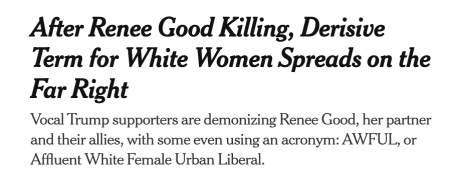
Before this morning, my first mass-culture association with the word “awful” was a kind of milkshake called the AWFUL AWFUL, which originated in the mid-20th Century. It was primarily promoted by the Rhode island-based Newport Creamery (and later adopted by Friendly’s).
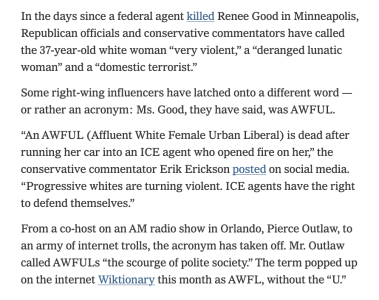
But that’s out the window now (too unhealthy) and the new AWFUL, according to the N.Y Times‘ Clyde McGrady, is a rightwing hate term that refers to ardent, combative, ultra-progressive leftie Karens.
AWFUL is an acronym for Affluent White Female Urban Liberal. Except the late Renee Good, apparently an AWFUL figurehead, wasn’t affluent — just a struggling, Honda-owning middle-class woman with a kid and a wife.
But without agreeing with the idea behind the term (hate grenades aren’t good for anyone), I get what it’s about. AWFULs are shrieking elitist wokeys, the righties are saying. They aren’t just pushing back in force against the Minnesota ICE bullies (which I agree with and totally support), but are also strongly in favor of AOC or Kamala Harris running for the White House in ’28.
HE is for any sensible centrist liberal of any gender who can beat JD Vance, but an AOC/Kamala candidacy will never, ever happen. It would be a flat-out calamity if either of them got nominated, AOC in particular. Both women seem like the epitome of AWFUL, and that would totally kill the Democratic cause. The Dems need to run a sensible, decent, democracy-loving, non-authoritarian normie like Gavin Newsom…please.
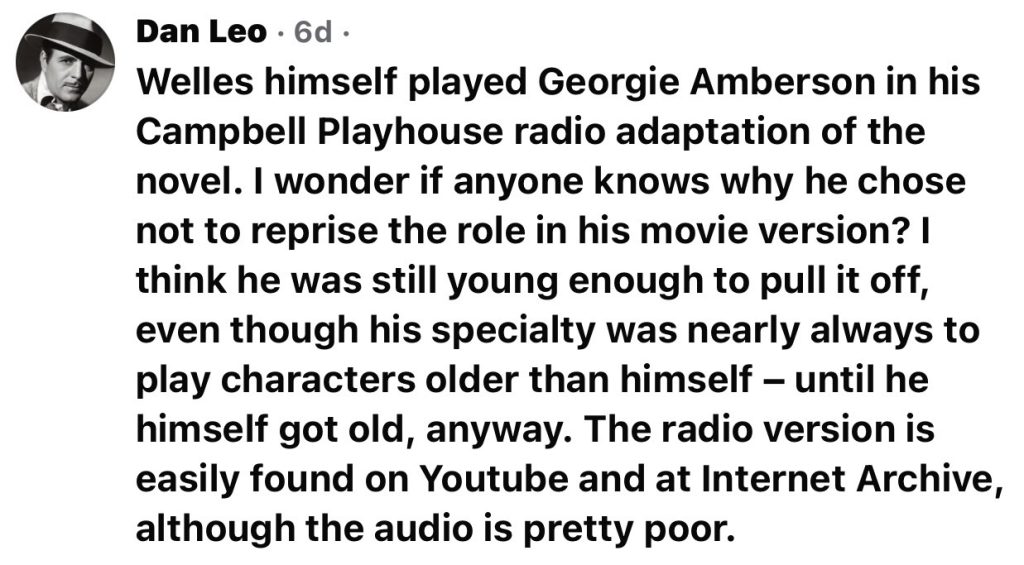
During a recent PaulSchrader-led discussion of OrsonWelles’ TheMagnificentAmbersons (‘42), Facebook commenter Dan Leo wondered why Welles didn’t play George Amberson Minafer instead of the under-talented, charisma-challenged Tim Holt.
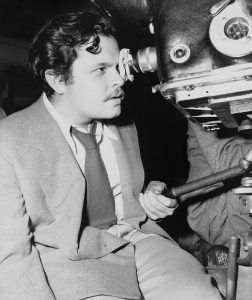
HEresponse: Welles as young George Minafer? Too fat for that.
Even at age 26, Welles, who had seemed slender** and fresh-faced and unmistakably young man-ish in 1941’s Citizen Kane, which began filming in June 1940 when he had just turned 25…Welles had noticably gained weight during the filming of Ambersons (10.28.41 to 1.22.42).
Look at the on-set Amberson photos…the proof is clearly in the pudding. At a time when most young men are delighted to be in their trim, athletic, well-toned, glow-of-youth prime, the mustachioed Welles was already on his way to Lardbucket Land.
Every morning Welles probably looked into his bathroom mirror and muttered “not fat enough…I want to look seriously fleshy and large-breasted…I want be bigger boobed than Lana Turner or Rita Hayworth!…I want to be Baby Huey or maybe even Sidney Greenstreet or, you know, some kind of Wisconsin sumo wrestler…I want to be Oliver Hardy’s slightly less girthy kid brother now but in 15 years, upon reaching my early 40s, I want to look like a dessicated, beard-stubbled, Mexican border-town detective…I could call him Hank Quinlan.”
Flush with success and with easy access to anything he felt like stuffing or shoving or cramming into his mouth, Welles, ruled by ravenous appetites, ate like Henry VIII (huge sizzling steaks, a dozen fried eggs for breakfast, gallons of ice cream with chocolate syrup, mashed potatoes covered in melted butter and steaming hot gravy, crème brulee, tapioca pudding, more steaks).
** Welles reportedly had to wear a corset for some Kane scenes (i.e., the early New YorkInquirer portions) , as his slovenly marshmallow physique made him look besotted and almost middle-aged.
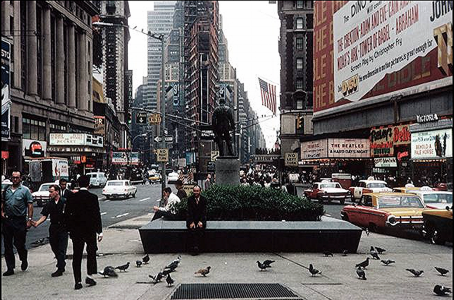
Peter Glenville‘s Becket, a truly great film, opened on a reserved-seat basis at Loew’s State (B’way and 45th) on March 11, 1964. It was still playing there when Richard Lester‘s A Hard Day’s Night moved into the Astor on 8.12.64 — exactly five months later. And for a few short weeks they played opposite each other in the very heart of Times Square — literally a stone’s throw apart.
Which film is the more highly regarded today? A Hard Day’s Night, of course — better known, a genre groundbreaker, “the Citizen Kane of jukebox musicals,” etc.
But also because Becket is, to this day, still a generally underseen, certainly under-appreciated drama about ethics, political maneuvering, and the delusion and corruption of power, not to mention having been the very first mainstream Hollywood film that, five years before the Stonewall riots, explored something very close to an actual love affair between dudes…albeit a sexless one.
Gavin Newsom is a shrewd, fleet-of-mind, left-moderate governor with mostly good deeds on his record (along with a few not-so-good calls…nobody’s perfect). Yes, a bit slippery but he’s primarily a sensible, pragmatic fellow (“good on his feet,” Shapiro admits) who genuinely believes in democracy and playing the game more or less honorably, and certainly much more honorably than The Beast. He’s really “wrong”, I believe, in terms of trans kids and school involvement in potential trans-kid scenarios, but otherwise he did pretty well with Ben Shapiro earlier today.
I watched Mattfleck’s The Rip this morning on the iPhone 15. Half of it, I mean. Smartly written, well cut, reasonably decent. Until the Joe Carnahan guns start blazing. Automatic weapon shoot-outs are boring. The fewer bullets, the better. Shane understood that.
I’ve got enough to chip in my share for the Cannes pad ($1300) and buy the NYC-to-Nice air fare with a few hundred left over, but hater sentiments are apparently gaining steam or at least are thriving.
I’ll keep the current campaign going until, say, Valentine’s Day and see where things are at that point. If the donations haven’t moved I’ll have to figure out the Venice situation in March or April. One step at a time, I’ll get there, etc. Not the end of the world but I feel a bit hurt or…what’s the word?….drained?
Thanks so much to the longtime supporters who’ve quickly and generously coughed up over the first three or four days, and a pained congratulations to the haters who’ve been slugging it out in the HE batting cage for free for all these years and who currently have zero interest in turning the other cheek….there’s not much I can say at this point except “gee, I love you too” and I’ll never effing back off.
But I fucking gave up. “Interesting” and in some ways fascinating in a surreal sort of way, but too long, too labrynthian, too complicated, too many odd tangents. distractions and trail-offs. Plus I’ve never been a fan of King’s rural, inelegant writing style.
A decade ago I tried watching JJ Abrams’ Hulu adaptation when it first popped on 2.15.2016, partly because I knew James Franco (whom I came to know slightly around 15 years ago) and Chris Cooper would be excellent. And they were. But I gave up after two or three episodes. Again, too labrynthian, etc.
Last night I finally watched the last three episodes, and holey moley! I found myself melting down from the dance-hall ending with old Sadie (Constance Towers**) giving her “Texas Woman Of The Year” speech….touching, affecting…hell, devastating. Absolutely one of the most poignant sum-up poems about the pain and joys of life to be used in a filmed drama.
One one level, the finale of 11.22.63 radiates a kind of yogi wisdom about letting things play out according to their own roulette wheel scheme and basically letting the chips fall.
On another level it says “if there’s a choice between saving the life of your beloved, blonde, true-heart girlfriend (young Sadie is played by Sarah Gadon) and preventing President John F. Kennedy from suffering a bloody, brain-splattering death in Dealey Plaza, the blonde wins. Partly because letting Kennedy live means George Wallace will be elected president in ’68.
** Shock Corridor, The Horse Soldiers, Sgt. Rutledge, married to John Gavin…still with us at age 92.
Old Sadie Dunhill’s poignant speech at the finale:
“We did not ask for this room or this music. We were invited in. Therefore, because the dark surrounds us, let us turn our faces toward the light. Let us endure hardship to be grateful for plenty. We have been given pain to be astounded by joy. We have been given life to deny death.
“We did not ask for this room or this music. But because we’re here, let us heed the words of the great David Bowie — ‘let’s dance.’”
Director Magggie Gyllenhaal and actor Jessie Buckley finished The Bride! (Warner Bros., 3.6), a social-justice re-imagining of The Bride of Frankenstein which began filming in March 2024.
Soon after wrapping Buckley flew to England to begin work on Hamnet, which began lensing in July 2024 (London, Herefordshire and the village of Weobley).
The Bride! was originally set to open on 9.26.25 and then 10.3.25, but then Warner Bros. distribution apparently freaked and bumped it into a 3.6.26 opening.
The Bride! will probably be applauded by feminist wokey lah-lahs, but it’s obviously going to tank theatrically as far as Joe and Jane Popcorn are concerned. That spilled-inkwell tattoo on Buckley’s right cheek…nuff said.
Will HE’s Kristi Coulter bend over backwards to praise it, or will she bring out the tough love?