Bad Bullets

Every so often, sometimes inadvertently, movies comment about themselves. Sometimes amusingly, sometimes not. In George Miller‘s The Road Warrior, you’re expected to chuckle when the Humungous says after lots of high-velocity mayhem, “There’s been entirely too much violence.”
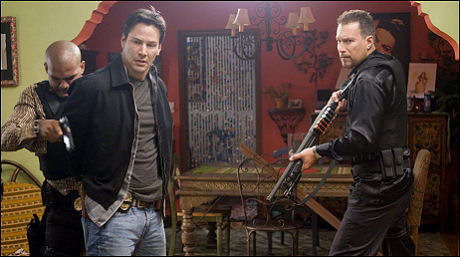

Keanu Reeves (center) in David Ayer’s Street Kings (Fox Searchlight, 4.11)

In Chapter 27 , the recently-released drama about the build-up to the killing of John Lennon by Mark David Chapman (Jared Leto), it’s hard not to smirk when Leto, speaking in a strongly actor-ish southern drawl, says he can’t stand movies in which actors seem to be showing off.
Another such moment happens in David Ayer‘s Street Kings (Fox Searchlight, 4.11) in which someone — Keanu Reeves or Forest Whitaker, I forget which — says, “Too many guys have been shot.” Which, from my perspective, was certainly one of the problems with the film, if not the problem. Few things irritate me more than a crime film with an excessive body count. It’s not an absolute law, but it tends to be true more often than not: the less gunshots a crime thriller has, the better it tends to be.
I don’t know for a fact that Street King‘s co-screenwriter James Ellroy has problems with it also, but telling L.A. Times staffer Scott Timberg, in a 4.6 article about his relationship with Hollywood, that he wouldn’t discuss it certainly indicates a reservation or two. Ellroy shares screenplay credit with Kurt Wimmer and Jamie Moss. If I were a betting man, I’d wager that Ellroy isn’t much for accomodating himself to the views and visions of others.
There may be several crime thrillers that have worked just fine with gunshots galore, but I can’t think of any right now. Back in the ’70s and ’80s the prevailing rule was that any crime thriller with a big car chase was definitely suspect, and quite possibly bad. (Because a film looking to ape the legendary car chases in Bullitt and The French Connection always seemed to be doing just that.) Too much burned rubber = a lack of style and imagination.
One more thing: when Forest Whitaker is a good film, like The Crying Game or The Last King of Scotland or The Great Debaters, he’s a champ and a prince. But when he’s in a bad or problematic one, like Street Kings or Vantage Point or Species, he seems to almost make it somehow worse.
Maybe it’s because Whitaker is such a committed whole-hog type who’s intensely into whatever he’s acting. Put him in a crummy film and he always seems to be saying to the viewer, “Man, I’m not gonna rest or hold back until you understand — completely, totally, without a doubt — that this movie I’m acting in right now is pretty damn awful. I’m not gonna leave you alone about this. I’m gonna hammer and hammer and make it hurt. You will be in pain by the time I’m finished with you.”

Minghella Gathering

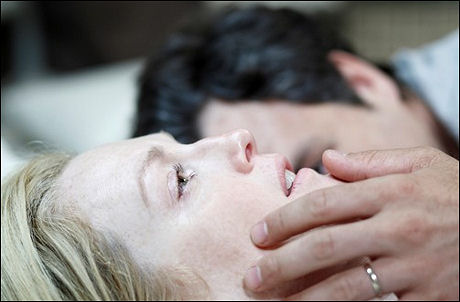
An “amazing gathering of film luminaries” are attending a weekend of mourning in and around London for the late director Anthony Minghella. A three-hour Catholic service was held this afternoon St. Thomas More church in Swiss Cottage, a suburb of London. Elegant and heartfelt words were spoken about Minghella by Talented Mr. Ripley costars Matt Damon and Jude Law, English Patient author Michael Ondaatje and costar Juliette Binoche, and Minghella’s producing colleague Harvey Weinstein (who also delivered a message on behalf of the ailing Sydney Pollack, who was Minghella’s producing partner).
Dominic Minghella (the director’s brother), Cold Mountain costar Renee Zellweger and Truly Madly Deeply costars Alan Rickman and Juliet Stevenson also attended. Gordon Brown and Tony Blair, the present and former Prime Minister of the UK, were there as well. Ditto widow Carolyn Minghella, daughter Hannah Minghella, an exec at Sony, and son Max Minghella, an actor.
Also attending was Richard Curtis, who recently collaborated with Minghella on the screenplay of The #1 Ladies’ Detective Agency, which was partly shot in Botswana. Bishop Trevor Mwamba, an Anglican bishop from Botswana who met Minghella during the shooting of Detective, spoke at length, and cathartically. John Seale, who shot English Patient and Ripley, was there. Ditto producer Saul Zaentz, editor-producer Walter Murch (who came from Argentina, where he’s working with Francis Coppola on Tetro), and Working Title honchos Tim Bevan and Eric Fellner.
There was a big Minghella dinner party last night at the Groucho Club, a ilm-industry watering hole on Dean Street in Soho. Harvey Weinstein is giving a dinner as we speak at Lucio’s restaurant.

Saturday numbers

In its second weekend, Robert Luketic‘s 21 has dropped only 30% and will be the weekend’s #1 film. It’s expected to do roughly $16,634,000 by Sunday night.
Tracking had indicated George Clooney‘s Leatherheads, which opened nationwide yesterday, would earn something in the $15 to $20 million range, but it will only make $13,845,000 for the weekend. Something happened out there, enthusiasm didn’t build, people had second thoughts or actually read reviews. (Time for the Saturday morning tut-tutters to write in and say if I knew how to read tracking I would have known all along that Leatherheads was a shortfaller waiting to happen.)
Nim’s Island, a family film that opened yesterday, will be the #3 attraction with roughly $12,500,000…decent. Dr. Seuss’s Horton Hears a Who is fourth with $7.5 million. The Ruins, which opened yesterday, is fifth with a projected $7.5 million, give or take. Superhero Movie! is off over 60% from last weekend’s debut with a projected $5.2 million. Drillbit Taylor is seventh with $3.5 million. Tyler Perry’s Meet the Browns will end up with roughly $3.2 million by Sunday night. Shutter will be ninthg with $2.9 million and 10,000 B.C. will be tenth with $2.7 million, give or take.
On the limited opening front Wong Kar Wai’s My Blueberry Nights, playing on six screens, will take in about $81,000 total, or $13,000 a print. And Martin Scorsese‘s brilliant Shine a Light, which I saw a second time last night at the Universal Citywalk IMAX, is only going to make about $1.3 million on roughly 350 screens, which translates to roughly $4000 a print. The IMAX theatre I saw it in last night was close to capacity. Go figure.

Can’t Trust ‘Em

Yesterday a Variety story painted another portrait of 20-somethings who don’t want to know from film critics. Except this time it was columnist Anne Thompson, and she was basing her reading on first-hand experience as a part-time USC instructor. She described her film criticism students as “film-obsessed and hardly representative of their non-cinephile peers” but says they “can’t name a working critic other than Roger Ebert, and that’s thanks to his TV fame.

“They scan Rolling Stone or Entertainment Weekly, but they don’t know critics Peter Travers or Owen Gleiberman. They check out film rankings at Rotten Tomatoes or Metacritic and dip into some reviews, but they haven’t found a particular film critic they trust to steer them straight.
“These young film lovers are just as likely to look up old (yes, even b & w) movies for their Netflix queue as new ones. On the Internet, the long tail prevails.” She mentions pajiba.com called Trading Places an “under-appreciated gem”…what? A pretty good studio comedy, okay, but a gem?
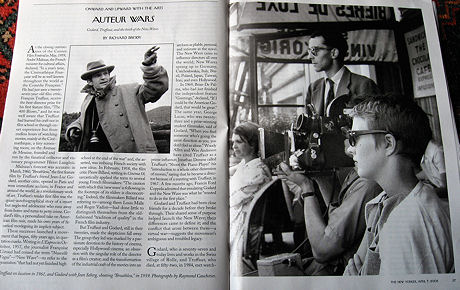
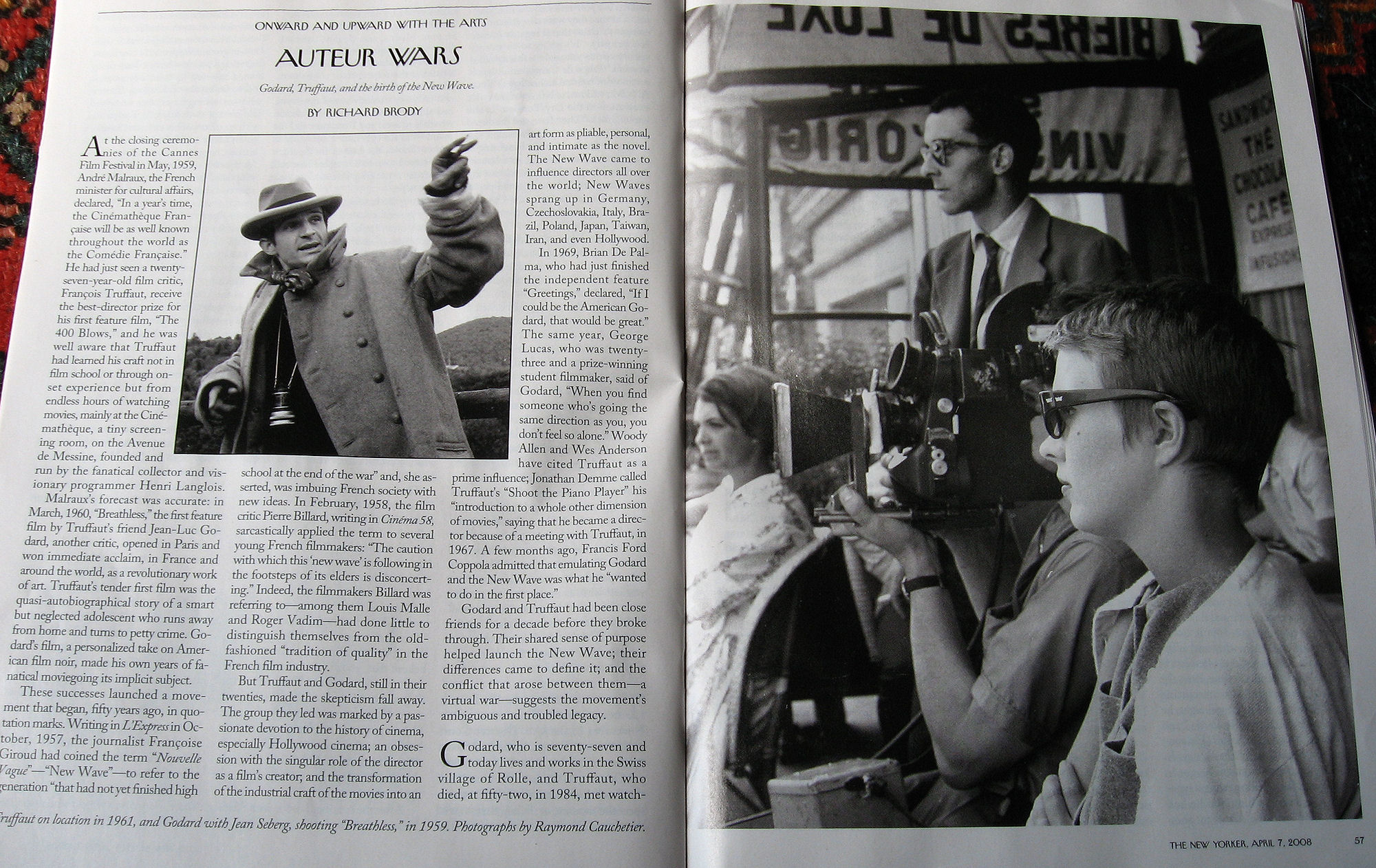
“They admire the auteurs Wes Anderson and the Coen brothers, can parse Hitchcock’s Psycho with the best of them, and have studied Francois Truffaut and Jean-Luc Godard. But they don’t read newspapers, and never will. Many of them don’t even frequent like-minded blogs that share their cinephilia.”
Really? I’ll be a guest at Charles Fleming‘s USC class on April 7th (along with James Rocchi). Before setting a date Fleming told me I’d “been asked for, by name, by the students.” He was applying the usual flattery, of course, but even if you cut the b.s. down by 50% what he said sounded moderately encouraging: “I ask the students every year, on the first night, where they get their entertainment reporting, and whom they admire,” he wrote. “Your name came up several times. There was delighted surprise when I said that I knew you and that you’d often come down to talk to my students.”
And yet a voice tells me that what Thompson is reporting is closer to the truth. “Students — and today’s youth auds in general — more often get their movie info straight from the studio marketing departments,” she writes. “These kids go to YouTube, Yahoo Movies and Apple to find trailers. As they surf the Web, bits of movie flotsam and visuals planted by the studios on MSN Movies or IGN or JoBlo eventually cross their eyeballs. But they also listen to their friends more than any authority figures, and distrust obvious studio hype.”
20 year-old USC film criticism student hitting on brunette classmate: “So do you like any, like, old black-and-white 1930s or 1940s films? Any comedies or…?”
Brunette: “Oh, totally. Well, you know…some. But it’s like, I mean, like….depending? I mean, I like, of all people, I really like…uhm, Jean Arthur? Because she’s, like, so, I don’t know, her personality is, like…kinda crazy but…you know, spirited? I saw this movie about guys flying airplanes in a jungle somewhere. I think it was, like, somewhere in South America? Venezuela or Columbia and she’s this singer who comes on a boat and meets these guys in a bar who fly the planes? They, like, deliver the mail and they’re, like, hitting on her, and then…wait a minute, what happens? Um, one of the guys gets into a plane and crashes it and Cary Grant — Cary Grant, oh…my….God! And he was, like, I read somewhere, gay? — anyway he gets, like, mad at her because the guy who crashed the plane wanted to get back to the bar so he could buy her another drink..?”
Thompson explains that “these kids’ boomer parents, average age 55 to 65, are the ones who still read movie critics and follow their guidance when there’s something for them to see.”

Blindness teaser

A just-posted teaser trailer for Fernando MeirellesBlindness (Miramax, 9.19), which may screen next month at Cannes (according to one trade magazine report), appeared a few minutes ago.


Julianne Moore, Mark Ruffalo

Based on the Jose Saramago novel with a screenplay by Don McKellar, the futuristic drama costars Julianne Moore, Mark Ruffalo, Alice Braga, Danny Glover and Gael García Bernal. Meirelles is of course known for having directed City of God and The Constant Gardener.
“When a sudden plague of blindness devastates a city, a small group of the afflicted band together to triumphantly overcome the horrific conditions of their imposed quarantine,” the company synopsis reads.

Pressure Is On Soderbergh

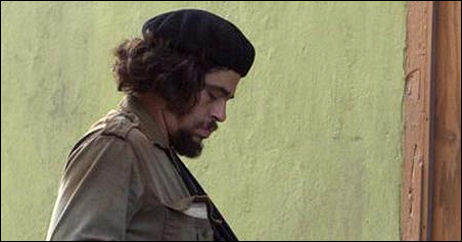
I’ve heard some credible-sounding information from a couple of solid guys about The Argentine and Guerilla, Steven Soderbergh‘s Cannes-bound Che Guevara films. And the situation, they’re telling me, is more or less as follows:

(1) The second of the two films, Guerilla, which deals with Guevara’s failed attempt to incite a revolution in Boliva in 1967, is pretty much done, largely, I gather, because principal photography was completed on this one before it was on The Argentine, which is about the triumphant Cuban revolution from ’56 to late ’58. (I’ve written the films’ producer Laura Bickford to clarify this and other matters.)
(2) Right now, I’m hearing, Soderbergh is jacked and sweating bullets in a Manhattan editing facility getting The Argentine into showable shape in time for Cannes. One guy says he’s been told by a Warner Bros. source that Soderbergh is determined to get the film[s] done in time for Cannes. Another guy told me he’s heard the chances of The Argentine being “ready-ready” are “less than 50%.” And yet Soderbergh, he adds, repeating what the Warner Bros. guy passed along, is said to be confident he can have The Argentine in some kind of decent shape by the mid-April deadline, or roughly ten days from now. Of course, he could always screen The Argentine as a not-quite-completed work in progress a la Apocalypse Now.
(3) It’s been deemed crucial in the view of various players, including Wild Bunch topper Vincent Maraval, the film’s Paris-based financier who’ll be selling the distribution rights to an as-yet-uncommitted U.S. distributor, that The Argentine and Guerilla should be shown in Cannes as a single unit consisting of two parts. Soderbergh has said he’d wants the films to come out in tandem or something close to the same time (i.e., maybe a couple of weeks or a month apart).

(4) It’s also very important to get The Argentine done for Cannes because it’s the more “up”-ish of the two…more exciting, more rousing. It’s about struggle and success. Well written as it is, Guerilla is pretty much about struggle and failure. Peter Buchman‘s Argentine script seemed complete on its own terms, but Guerilla, I thought, needed the Argentine counterweight.
(5) A potential buyer confides that “it’s a tough deal…looks like a tough deal. Two Spanish-language films, no dubbed English versions, gritty subject matter, possible rancor in some sectors of the U.S. — the right-wing Cubans in Miami, say — when the two films open.” The upside, he adds, is you have a likely Best Actor contender in Benicio del Toro‘s performance, and possibly other award-level attributes, including, obviously, the two pictures themselves for Best Picture.
“”All you have to do is sell it to all those kids who’ve hung that Che poster on their college bedroom wall,” he said.
Variety‘s John Hopewell reported from the Berlin Film Festival two months ago that Wild Bunch’s hottest draw — very possibly the most talked-about film at this year’s Berlin festival — was Soderbergh’s two-pic Che, an action bio of large artistic ambition. Screened in Soderbergh’s presence, 10 minutes of excerpts, mainly of first-part Argentine, had buyers talking bullishly about a work with the makings of a modern classic.

“Three U.S. buyers are circling Che, said Berlin reports. The number is most probably significantly higher than that, though Wild Bunch’s Vincent Maraval said [that] Wild Bunch was in no hurry to close a U.S. deal.”
The grapevine says the most likely U.S. buyer at this stage is Warner Independent. And no, Focus Features is not involved at this stage. A rumor got started along these lines a year or so ago, but I’ve been told Focus is not connected.
Hey, how about showing the two films as a gargantuan Lawrence of Arabia-styled two-parter with an intermission, running at least three or three and a half hours?

Mea Culpa Laughs

I remember reading about a comic bit performed by George Bush at the ’04 or ’05 Gridiron Club dinner about looking around for WMD’s that didn’t exist, like he was looking for a lost wallet. The fantasy rationale Bush had used for starting the Iraq War and causing the deaths of thousands of Iraqis and U.S. troops and bringing untold pain into the lives of millions had devolved into joke material. By admitting he’d been full of it he won people over…hilarious.

In the same vein Hillary Clinton tried joking her way out of telling that whopper about dodging bullets in Bosnia on Jay Leno last night. Is that how it works now? Sell a lie as fact and get nailed for it, but all you need to do to turn it around and improve your public standing is deliver a “funny” mea culpa in the right forum? Does this mean Iran’s President Ahmedinjad could theoretically go on Late Night with David Letterman one day and make a joke about having been a former Holocaust denier? Why not, given the system we clearly have in place?

Shine Tonight

As I said in my initial review of Shine a Light, which opens today (and, to repeat once again, must be seen in the IMAX format), it’s hard to get into the big standards that “Shattered,” “Start Me Up,” “Honky Tonk Women,” “Jumpin’ Jack Flash,” etc. The highlights of Martin Scorsese‘s concert film are the less well-known, mid-rangers like “Tumblin’ Dice,” “Live With Me,” “As Tears Go By,” “Champagne and Reefer,” “Faraway Eyes” and “She Was Hot.” If there are You Tube/Shine a Light videos of these performances, it’s news to me.

Behind Barbed Wire

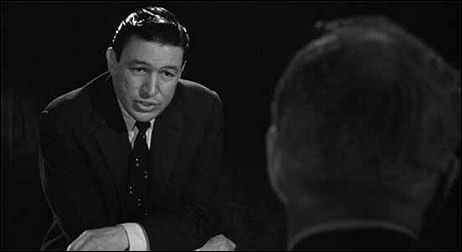
The Harry Ransom Center, an arts and culture study and archive branch of the University of Texas at Austin, has put up over 50 videos of “Mike Wallace Show” interviews from 1957, plus a selection of audio-only revisitings and transcripts. What a weird, constricted, almost repulsively narrow-minded world it seems to have been back then. Or at least, as far as what’s implied by Wallace’s questions and the answers he gets.

Wallace smokes constantly during the interviews and hustles Phillip Morris cigarettes like there’s a stern-faced Phillip Morris account executive standing just out of camera range. Where would Wallace have been financially back then without cigarette advertisements? He also sold Parliament cigarettes like there was no tomorrow.
The only half-agreeable clip I took the time to watch is of Wallace asking Kirk Douglas, who was then filming The Vikings, about hiring former Nazis and Communists. Douglas, obviously feeling a bit threatened but standing up nonetheless, basically replies that he doesn’t believe in persecuting people for past alliances, mistakes and/or errors of judgment. Good answer. Douglas and director Otto Preminger brought the curtain down on the black list three years later by openly working with screenwriter Dalton Trumbo.
Wallace later asks whether European or American women makes the best wives. These two politely joshing males could be talking about cars or haberdasheries or washing machines.
We’re all products and members of our immediate environment, but the people in these videos seem to be living in a kind of gulag — the Leavenworth State Prison and Siberan salt mines of 1957-style propriety and conformity. The implications of a guarded, button-down, autocratic world in these videos are positively stifling. And to think that I wasted over 45 minutes watching the damn things.
When I think of 1957 I think of the vitality and reach and yearnings of Elvis Presley, Paths of Glory, the original Broadway production of West Side Story, the debut of “American Bandstand,” Chuck Berry, Eugene O’Neill‘s A Long Day’s Journey Into Night, Fats Domino, Jack Kerouac, Jerry Lee Lewis, Night of the Demon with Dana Andrews, Mickey Mantle, Moose Skowron, the Dodgers leaving Brooklyn, Bob Dylan at age 16, Sayonara, The Tin Star, the original 3:10 to Yuma, the death of Humphrey Bogart, A Face in the Crowd, The Bridge on the River Kwai, A Hatful of Rain, Ben Gazzara in The Strange One, Little Richard, Twelve Angry Men, etc.
There are faint echoes of these events, artists, athletes and creations in the Wallace videos, I suppose, but the world that’s mainly conveyed is one of arch attitudes and forced viewpoints, and above all a cautious, corporate mentality filled with people who weren’t really on to what was starting to happen back then, and certainly not about where things would be in a few short years.
Thanks to HE reader Mike Gaertner for passing these time-wasters along. “Another notable moment,” he writes, “is when Wallace attempts to make Tony Perkins the poster boy of the beat generation (???). Perkins seems very uncomfortable when Wallace asks to him discuss On the Road and jazz music (Tony apparently haing ben a fan of both). You can almost sense Perkins hoping a studio publicist would swoop in from the side to save him from having to reveal his bizarre side-life to middle America.”

Stuck in the Mud

Average Joes don’t want to know from Leatherheads reviews — Thursday’s tracking suggests that George Clooney‘s period football comedy will do about $20 million this weekend — but if they did they’d be sullen. The Rotten Tomatoes creme de la creme has given it a lousy 33% positive and the non-elite has passed along a dispiriting 53% positive.
That said, it’s only fair to acknowledge that Leatherheads has a guy-buried-in- mud gag in the final act that’s pretty good. Even though I’ll bet Clooney stole it from a similar bit in Henry Hathaway‘s North to Alaska. During a big slapstick street fight at the end, Ernie Kovacs, playing a card-shark villain, gets thrown into a pond of quicksand-like mud and is half-submerged. Then a big wooden barrel rolls on top of him and buries him completely. Not that there’s anything wrong with theft. The best artists do it.
Like I said on 3.31, a comedy “without a serious foundation can feel too much like a jape, and so the mood humor in Leatherheads has a kind of ceiling. You want to give yourself over to it, but you can’t. The movie won’t let you. Because it only wants to make you feel good and spritzy, after a while it almost makes you feel a little bit bad. Even though it’s mostly ‘likable.’ A curious effect.”

House Brought Down

The hearts of many Los Angeles-based, Hollywood-covering journalists were broken (mine included) this morning when a Michael Cieply N.Y. Times piece reported in today’s edition that Paramount had screened Ben Stiller‘s Tropic Thunder the night before last.

It takes me a while to process these things. I guess I succumbed to a kind of fog or numbness. An hour or so after I first read the article I found myself wandering the streets of West Hollywood, wondering who I was and what my life amounts to if I can’t get into an early-bird screening attended by “several hundred Hollywood agents, managers, publicists and reporters,” for Chrissake.
I called Paramount publicity to kvetch and was told I’m on the list for the next screening. Paramount is planning several, apparently.
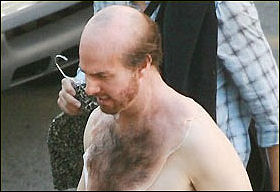
Cieiply reported that Tom Cruise “brought down the house with his surprise portrayal of a bald, hairy-chested, foulmouthed, dirty-dancing movie mogul of the kind who is only too happy to throw an actor to the wolves when his popularity cools. The joke being that Cruise was essentially playing Viacom/Paramount honcho Sumner Redstone, who terminated Cruise’ s on-the-lot production deal in August ’06.
Ceiply adds a little rah-rah by declaring that Tropic Thunder is (a) a “raunchfest” and (b) is “shaping up as one of the studio√ɬ¢√¢‚Äö¬¨√¢‚Äû¬¢s best prospects for the summer. Besides Cruise, it costars Stiller, Robert Downey Jr., Jack Black, Matthew McConaughey and Nick Nolte.