“Keep Away…The Sow Is Mine!”

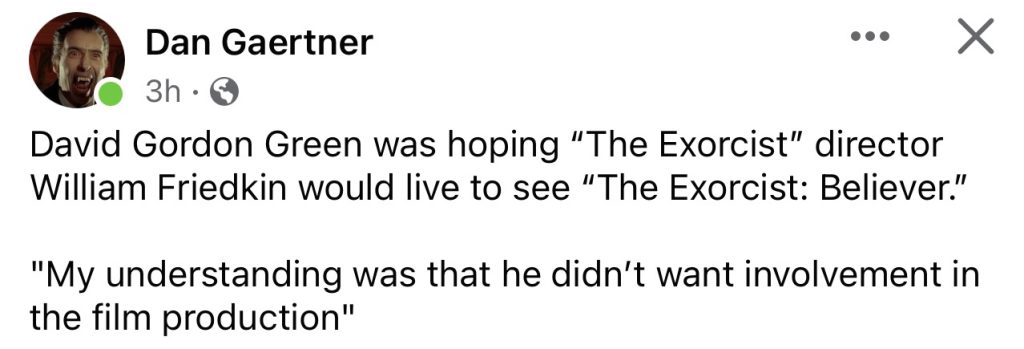
I would rather stick needles in my eyes than see David Gordon Green‘s The Exorcist: Bologna.

I have, however, read the Wiki synopsis. The fate that befalls Ellen Burstyn‘s Chris McNeil character is cruel and humiliating.

A half century ago Burstyn emerged from William Friedkin‘s The Exorcist with pride and dignity. That’s gone now.

Torturing of Ellen Burstyn“, posted on 7.6.21:

Leslie Odom: “Excuse me…are you Chris MacNeil? My God, it’s you! How are you? Are you good? I’m asking because my daughter’s been possessed by Pazuzu or some cousin of his and I’m wondering if you’re up for kicking that demon’s ass like you did back in the early ’70s.”

Burstyn: “I’m fine, thanks, but I didn’t do anything. I persuaded a Jesuit priest named Damien Karras to exorcise the demon, and he asked an older priest, Father Merrin, to help him. I didn’t do a thing. All I did was scream and weep and plead for help.”

Odom: “Yeah, but you know all about demons and shit, right? You know how to deal with the moving beds and green vomit and all that. You’re experienced.”

MacNeil: “I don’t know anything. I just went through a horrible ordeal a half-century ago, and now I’m almost 90. Find your own exorcist.”

Odom: “But I need your help.”

MacNeil: “What’s wrong with you? Look at me…what am I gonna do?”

HE commenter Jeff Jinx: “Anticipating another mind-numbing, CGI shit-fest. The power of green compels them.”

Guarded Guy

The conventional time to memorialize poor Chris Reeve would be 12 months hence — the 20th anniversary of his death. The Superman star and quadriplegic crusader passed almost exactly 19 years ago — 10.10.04. Three days later I wrote a piece called “Guarded Guy.” Hollywood Elsewhere was only two months old at the time. Here’s an excerpt:

I had an experience with Reeve in 1980, when I was a pup journalist living in New York. It began with an interview piece I wrote about him for a New Jersey weekly called The Aquarian, the main subject being Somewhere in Time, which I had a thing for at the time, or more particularly the beautifully shot finale. (I wrote about this in ’17 — reposted below.)

Reeve and I met for the interview at a restaurant on upper Columbus Avenue. I had done my homework and prepared a lot of deep-focus questions, and I think he enjoyed our talk. Sonia Moskowitz, a gifted photographer whom I was seeing at the time, sat in for the interview and then took some photos of Reeve (plus one of him and me) outside the restaurant. Then we went back inside to sort out the bill.

I was a bit green back then, but I’d done a few celebrity interviews and knew that the basic rule was that the studio always picked up the tab. I assumed this would be the case but there was no Universal publicist at the restaurant to cover the check, and I didn’t know what to do because my Aquarian editor had never talked to me about expenses, and I didn’t have the cash to cover it on my own.

I thought Reeve (wealthy actor, right?) might step up to the plate and get his money back from Universal. It was that or somebody would have to leave a personal check or wash dishes. Talk about embarrassing. When I told Reeve I was a bit light I could see he was irritated. We kind of hemmed and hawed about it on the sidewalk, I offered everything I had (about $15 bucks), and he finally dug out his wallet and said, “Well, all right” and paid the balance.

When I wrote my piece I threw in a couple of graphs at the end about this bill-paying snafu. I thought it was both amusing and humanizing on some level that a successful big-name actor who’d played Superman was capable of getting flustered about paying a check, just like anyone else.

A week or two later, just as the Aquarian piece came out, I went with a couple of friends to see Reeve in The Fifth of July. We visited his dressing room to say hello after the show, and as an ice-breaker I asked if he’d seen the article. Bad question. Reeve hadn’t liked my closer and said so. He was scowling at me. I felt like I was suddenly in the Twilight Zone. I thought I’d written about the restaurant-tab thing with humor and affection. I’d figured this plus the fact that the overall piece was highly flattering would have charmed him.

To soothe things over I wrote him a note the next day saying I was sorry he had that reaction, that I really thought the humor I got out of our check-paying episode made it a warmer, fuller piece, and that I hoped he wouldn’t hold a grudge.

A few weeks later I ran into Reeve at an invitational party at a Studio 54-like roller skating joint in Chelsea. As soon as he spotted me he came right over, smiling, and said, “Hey, Jeff. Got your note…everything’s cool…don’t worry about it.” We shook hands, he smiled again and said “peace,” and that was that.

What this told me about Reeve is that he was gracious, obviously, and able to handle embarassments and whatnot. It also told me that deep down he was into dignity and protocol and doing things a certain way. I think that attitude bled into his acting on a certain level, and that’s why he wasn’t quite Marlon Brando.

Read more

Son of “Somewhere In Time” Tragedy

HE-posted on 7.31.17: I’ve never called Somewhere In Time a great or even a top-tier film, but it did develop a cult following about a decade after it opened, and it has — or more accurately hadone of the most beautifully executed single-shot closing sequences in a romantic film that I’ve ever seen, and one that almost certainly influenced the dream-death finale in James Cameron‘s Titanic.

I’m speaking of a longish, ambitiously choreographed, deeply moving tracking shot that’s meant to show the viewer what Reeve’s character, Richard Collier, is experiencing on his passage from life into death. I saw it at a long-lead Manhattan screening of Somewhere in Time 37 years ago, but no one has seen it since.

That’s because some psychopathic Universal exec (or execs) had the sequence cut down and re-edited with dissolves. The version I saw allegedly no longer exists. All that remains today is the abridged version.

The sequence was a single-take extravaganza accomplished with a combination crane and dolly. It happened as Reeve’s character, Richard Collier, is dying on a bed in a Mackinac Island Grand Hotel room. His spirit (i.e., the camera) rises up and above his body, and then turns and floats out the hotel-room window and into a long, brightly-lighted hallway and gradually into the waiting embrace of Collier’s yesteryear lover, Elise McKenna (Jane Seymour).

I asked about this sequence when I happened to run into Somewhere in Time cinematographer Isadore Mankofsky at the 2004 Newport Beach Film Festival. I told him how much I admired it, etc. Mankofsky said that as the film was about to be released some executive at Universal decided that the shot went on too long and trimmed it with a couple of fade-edits.

This was vandalism, pure and simple. The people who caused this sequence to be destroyed should be identified and shamed and if possible pilloried in front of Universal Studios.

Mankofsky told me that as far as he knew the original cut of this closing sequence no longer exists, but he wasn’t entirely sure.

Wimpiest Director Statement of All Time?

According to 2023 Hamptons Film Festival correspondent and HE friendo Bill McCuddy, Elizabeth Chai Vasarhelyi, the co-director of Nyad, doesn’t believe in directorial authority, at least as far as her relationship with her lead actors is concerned.

She and her co-director husband Jimmy Chin were apparently more into the idea of allowing their Nyad costars, Jodie Foster or Annette Bening, to take charge on the acting and go wherever their instincts lead them, regardless of any possible directorial viewpoints.

“I would never tell Jodie Foster or Annette Bening what to do,” Vasarhelyi said during some kind of post-screening q & a. “But they are the difference between fiction and non-fiction. The emotional story, the instincts, the craftmanship are very similar. You just have a lot more resources in fiction.”

I immediately wrote McCuddy and asked, “Did Vasarhelyi actually say this?”

Can anyone in the HE community imagine David Fincher saying, “I would never tell Jodie Foster or Annette Benning what to do”?

What is Vasarhelyi, some kind of pushover or kiss-ass?

Nobody did double backflips over Nyad in Telluride, I can tell you. It was respected but no one was going “oooh! oooh! oooh!”

Costner’s Western Epic

A pre- and post-Civil War saga of the expansion and settlement of the American West.

Or perhaps a 21st century version of How The West Was Won…something along these lines?

There’s been some confusion about how many parts but I guess it’s down to two.

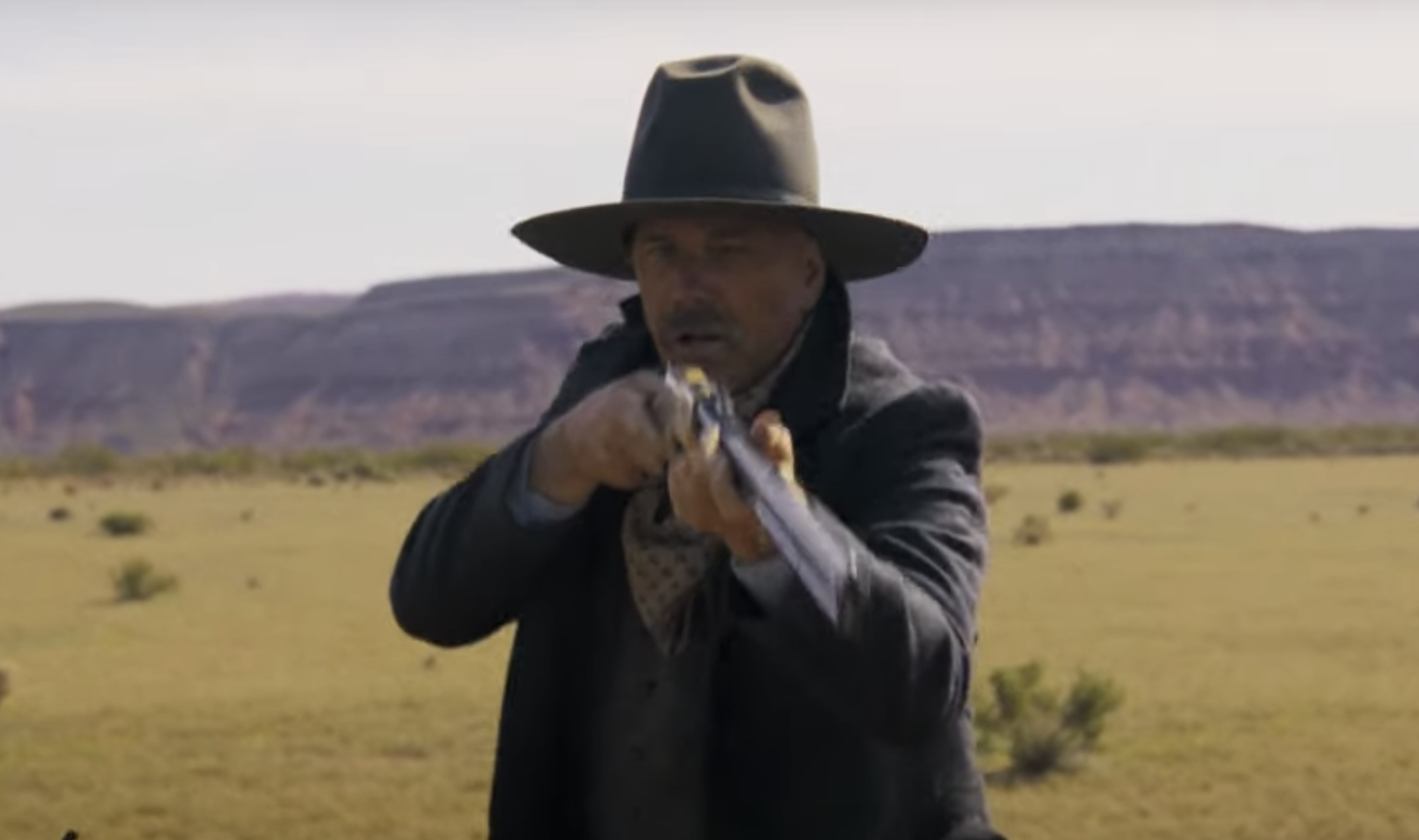
An apparently questionable passage from Kevin Costner‘s Wiki page reads as follows: “In August 2022, Costner began production on Horizon: An American Saga, a Western epic that will be split into at least four films, each just under three hours in length“…uhhm, no?

“Costner plans on the films being released over a series of months,” the excerpt explained. “Costner will act as director of the project and said the film was [first] proposed as an event television series. Production on the first film was expected to last at least 220 days, but was completed by November 2022. Production of the next films was underway by May 2023.”

The Horizon Wiki page calls it “an upcoming two-part American epic Western film co-written, produced, directed by and starring Kevin Costner. Costner also leads an extensive cast comprising of Sienna Miller, Sam Worthington, Jena Malone, Abbey Lee, Michael Rooker, Danny Huston, Luke Wilson, Isabelle Fuhrman, Jeff Fahey, Will Patton, Tatanka Means, Owen Crow Shoe, Ella Hunt, and Jamie Campbell Bower.

“Described as a two-part event, Chapter 1 will be released on June 28, 2024. Chapter 2 will later be released on August 16, 2024.”

Read more

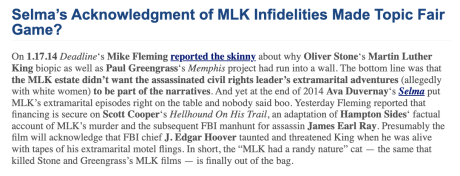
Rock’s MLK Biopic: Great Man With Feet of Clay

Chris Rock knows that his forthcoming Martin Luther King biopic, reported yesterday by Deadline‘s Mike Fleming, can’t be hagiography.

This partly means that it has to get into MLK’s infidelities with white women, which the FBI’s J. Edgar Hoover, armed with with secretly recorded motel-room tapes, tried to blackmail King with.

Years ago Oliver Stone and Paul Greengrass wanted to explore this aspect in their own respective King biopics, but both projects stalled. (Greengrass’s was titled Memphis.) On 1.17.14 Fleming reported the skinny.

If Rock paints a saintly, over-reverent portrait he’ll put everyone to sleep. Surely he understands this.

The fact that Rock’s untitled film is based upon Jonathan Eig’s “King: A Life” suggests that Rock will be taking at least something of a warts-and-all approach.

The book has been described by its publisher as an “intimate portrayal of King as a courageous but emotionally troubled individual who demanded peaceful protest while grappling with his own frailties and a government that hunted him.”

An 8.14.23 Amazon review by Bill Emblom states that Eig’s book “covers the adulteries that King was involved in…[the ones] that Hoover wanted to ensnare him in through bugging his phone or room at the Willard Hotel in Washington.”

Football star and actor Jim Brown was into white women also. Was this due to Brown being a somewhat frail, emotionally troubled guy, or was it because his tastes simply led him in this direction? Remember that Spartacus scene in which Laurence Olivier‘s Marcus Licinius Crassus says he enjoys both snails and oysters? Were Crassus’s appetites an outgrowth of his being an emotionally unstable fellow? As J.J. Hunsecker once said, “Are we kids or what?”

Steven Spielberg will executive produce via his Amblin with Kristie Macosko Krieger producing.

Read more

Gentle Reminder

Five and two thirds years ago (1.14.18) I posted a piece called “New Oscar Bait Hinges on Tribal Identity,” in which I attempted to gauge the pulse of Hollywood’s award-season wokesters.

Stand-out comment #1 was from filmklassik: “A bit cheeky to say ‘never ever again’ (because who the hell knows?), but yeah, in this particular cultural moment it is all about Tribal Identity. And what’s disturbing is, we have a whole generation now for whom Tribal representation is, to use one critic’s word, numinous. The under-40 crowd has invested Race, Gender and Sexuality with a kind of cosmic significance. It doesn’t mean a lot to them — it means everything to them. Indeed, much of their conversation and writing seems to always come back to it.”

Stand-out comment #2 was written by Dan Gaertner: “Will Jeff Wells, Sasha Stone and Tom O’Neil be around in 5 or 10 years? To the new millennial film/award race culture, they’re dinosaurs from another dimension. They don’t approach film, art, or awards in the same fashion. They are tuned into a completely different frequency.”

HE to Gaertner [10.6.23]: Sasha and I are definitely still around, and to our way of thinking we aren’t dinosaurs but sensible, feet-on-the-ground realists and straight talkers. Tom O’Neil used to be a tough nut, but he joined the wokester cabal eight years ago when Jay Penske purchased Gold Derby. O’Neil became a Gold Derby consensus manager more than an occasional opinion guy.

Similar Performance Seven Years Ago

Nearly seven years ago I noted something about Lily Gladstone‘s emoting as Jamie, a lovestruck ranch hand, in Kelly Reichardt‘s Certain Women. I noted that Gladstone’s quiet performance, which won her a Best Supporting Actress prize from the Los Angeles Film Critics Association (LAFCA), “registers in a demure, low-key way,” but is “more or less a one-note thing, expressive but largely non-verbal.”

Does that description remind anyone out there of a more recent Gladstone performance?

[“Unrequited Love is The Only Kind That Lasts,” posted on 12.6.16] For one brief moment yesterday, Lily Gladstone‘s performance as a smitten horse stable worker in Kelly Reichardt‘s Certain Women became a thing. Okay, it’s still a thing today. Perhaps her pop-through will gather a certain esteem between now and the announcement of Oscar nominations in January. Gladstone’s performance certainly registers in a distinct, low-key way, and it’s at least conceivable that Academy and guild members will take notice and vote for her. If, that is, they can get through Reichardt’s film, which has struck some (myself included) as a “watching paint dry” experience.

I didn’t need reminding but I’ll bet a lot of people had never given Gladstone’s turn a second thought until the Los Angeles Film Critics Association gave her their Best Supporting Actress award — a decision that seemed questionable if not eccentric given that it necessitated a blow-off of Michelle Williams‘ world-class emoting in Manchester By The Sea.

I certainly realized that Gladstone was a big stand-out element after watching Reichardt’s film at last January’s Sundance Film Festival. But her performance is more or less a one-note thing, expressive but largely non-verbal — “I’m a Belfry-residing stable hand who’s sad and isolated but deeply intoxicated with the idea of having Kristen Stewart as my lover, and I can’t wait for her next biweekly law class so I can sit there and ignore her teaching so I can just sink into her beauty.”

Gladstone freaks when Stewart’s character decides to stop commuting from Livingston to teach the Belfry class, and so she drives all the way to Livingston herself to tell Stewart that she’s got it bad for her — a confession that Stewart obviously doesn’t want to hear, much less deal with.

Read more

Lighting Is Almost Everything

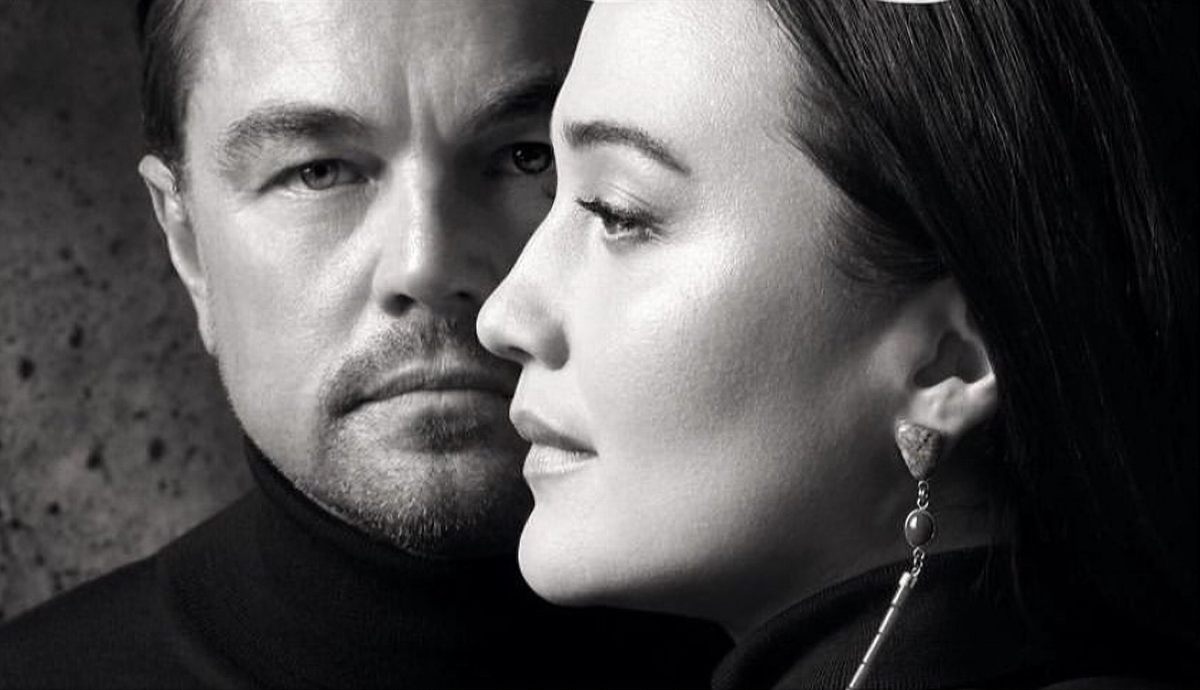
This striking Vogue cover photo is about as good or glammy as it will probably ever get for Lily Gladstone…photography, lighting, the right angle, wardrobe…it all came together.

Leo looks great also…pushing 50 in actuality, he looks like his mid to late 30s.

After being attacked by Bobby Peru for allegedly diminishing Gladstone and her Killers of the Flower Moon performance, I responded thusly:

My conveying an honest, thought-through reaction to Gladstone’s KOTFM performance is not an act of diminishment. It’s a fairly rendered opinion.

My choosing to ignore the New Academy Kidz mindset…an attitude that rewards social-justice bonafides over traditional acting or film-making standards…this is not an attempt to diminish Gladstone. The white-guilt wokester choke hold has been an active political ingredient since 2016 or ’17, certainly by ’18.

My stating plainly that Gladstone talks with a rural (aka “shitkicker”) Montana accent…that’s a fact. You can call it diminishing but I wouldn’t point fingers if someone said that I speak with a slight northern New Jersey twang (which I do). Was it diminishing to say that JFK spoke with a Boston accent**? Or that Stephen King speaks with a reedy Maine accent? Or that Flannery O’Connor sounded like Savannah? Or that Jimmy Carter has a rural Georgian way of speaking? Or that LBJ sounded like the Texas hill country?

My stating an obvious political fact, which is that wokesters like Clayton Davis are promoting Gladstone for Best Actress, and that this is primarily about an opportunity to celebrate her Native American identity — my calling a spade a spade in this regard is not a form of diminishment. It’s a fact.

I’ve said over and over that Gladstone is good enough in KOTFM but she’s certainly not wowser. Mainly because all she mostly does is glare and seethe and lie in bed. Because the script doesn’t give her any big crescendo moments. She doesn’t even get to slap Leo’s face or sharply condemn what he and his evil uncle have done to some of the oil-rich Osage natives.

** It would be diminishing if I wrote that JFK spoke with a pretentious Hahvahd or Boston Irish clam-chowder-slurping accent.