

Agreed — this Verizon FiOS commercial is the cleverest, most likable piece of filmmaking from the hand of Michal Bay since The Rock. Because it has a theme. Because it’s half-sell and half-personal confession. By embracing his rep as the shallowest big-name director around, Bay has almost transcended it. He’ll make his first truly rich and mature (and possibly even moving) film ten years from now. Maybe sooner.
Why is “The Bucket List” succeeding?
Let’s just take a moment to acknowledge the strange success of The Bucket List. Four out of five of the top critics hated it, and the damn thing keeps selling tickets. It will make $5,191,000 this weekend for a cume of $82 million. Other than the old saw about average audiences having no taste, a view supported by decades of abundant evidence…why? They like the CG travel footage? There’s one good bit in the entire film, which is when Jack Nicholson says that “I believe more people die of visitors than diseases.”
What happened to “Cloverfield”?
Features of Hasbro’s Cloverfield monster: (a) 70 points of articulation and incredible life-like detail; (B) Authentic sound; (c) 14 inches tall; (d) 10 parasites; (e) Two interchangeable heads; (f) Statue of Liberty head accessory. The Cloverfield monster is available exclusively through HasbroToyShop.com. Limited quantities are available. Includes 3 AAA batteries. Price: $99.99.

What finally happened with Cloverfield? It was at $71,915,658 domestic as of 2.3 and has sold well overseas, but why did the U.S. box-office plummet so radically after the first weekend? Was it the crazy-cam photography, which reportedly made some people sick? Or was is the nonsensical-inexplicable monster to some extent? Flesh-colored, huge ears, 20 stories tall, long spindly arms…pretty damn absurd.
In a cool way, I mean. I genuinely enjoyed the absurdist approach because it made the monster more of an emotional/psychological construct than a pseudo-literal one that might have barely passed muster by movie-logic standards (i.e., the ones that have explained all past movie monsters). But maybe people might have gotten into it a bit more if the monster had been a old-fashioned Godzilla-like super-reptile with flippers and claws and the ability to breathe fire.
Don’t even start with the spoiler whinings. I don’t want to hear even one peep. The movie was seen by millions and now the Hasbro people are marketing the image online. Just shut up. You know who you are.
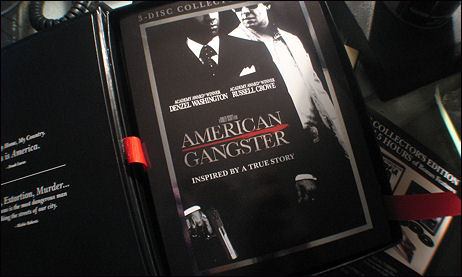
“American Gangster” DVD
The unrated extended (i.e., 18 minutes longer) version is out Tuesday, two- and three-disc packages and on worthless HD-DVD. The 176-minute version will screen at the Westside Pavillion on Tuesday night, followed by a Ridley Scott q & a.
“George” back on B’way
A freshly conceived London presentation of my all-time favorite Stephen Sondheim musical has been in previews since last January, opening later this month. Directed by Sam Buntrock, said by a friend who caught it last week to be brilliant and dazzling. Playing at least until May 18th. Any first-hand reports?

Docs’ Day in the Sun
To me, the most interesting thing about Caryn James‘ 2.15 N.Y. Times article about how the Oscar nominees for Best Feature Documentary are “where the action is” — politically charged, focused on conflict, urgent messages — is the flames-of-hell photo from Charles Ferguson‘s No End in Sight.

The richest quote comes at the end when James asks Ferguson if the nomination [is] having any effect on his film. He says he has no evidence of this but adds: “If the film wins, there will be one effect. I will have about 60 seconds to say something about Iraq to 200 million people, and I will.”
Dead, Dead…Deader Than Dead
The HD-DVD death-gong was heard ’round the world a month ago with that hilarious Hitler video, but this 2.15 CNN Money report about Wal-Mart giving the hard-luck Toshiba machines the heave-ho is worth noting as a kind of magic-marker underline.
Par Vantage + “Mary”
All well and good that Paramount Vantage is apparently intending to distribute Philip Noyce‘s Mary, Queen of Scots, which will begin filming this spring, but…naaah, forget it. Each movie is its own novel, journey, river, song, etc. And plenty of time will have elapsed between this late ’09 release and The Other Boleyn Girl, which is out on 2.29.

Apple high-def vs. Blu-ray
Fortune‘s Philip Elmer-DeWitt offers a quality comparison between downloaded high-definition movies from Apple TV vs. Blu-ray DVD. Short verdict: Blu-ray is slightly better, but Apple isn’t far behind.


Apple TV image (l); Bluray image (r.)
Jamie Bell “Jumper” factor
Enough people are writing that Jamie Bell steals (or almost steals) Doug Liman‘s Jumper that I’m actually thinking about paying to see it this weekend from beginning to end instead of the previously mentioned catch-a-few-minutes’-worth plan. 20th Century Fox never invited me to see it at a screening. I might have gone if they had, but something more important (like taking a nap on the couch) might have come up.
The Lives of Loudmouths
Rule #5 in David Poland‘s Ten Rules of the Oscar Season (posted yesterday) states that “critics only matter when unanimous,” that they “can’t really kill or make an Oscar movie unless they are united in a clear, loud voice (even if that clear, loud voice is not a vast majority, just the right loudmouths).”
In other words, a sufficient number of loudmouths with a unified theory (this is right out of the handbook of Nikolai Lenin) can sway the industry masses? I don’t think he means that. All loudmouths can do is start a conversation, which the industry sometimes listens to and sometimes not, or picks up on or doesn’t pick up on. I recall at least two or three major-soapbox loudmouths beating the Dreamgirls drum pretty loudly in late ’06 and early ’07, but we know what happened there.
In any case, he says, “this year we saw what we haven’t seen since 2002, [which is] critics muscling a film into the Best Picture race.” Referring, of course, to There Will be Blood. Which, agreed, is an “honorable thing.”
But what other films have been strong-armed into Oscar contention circles by impassioned critical support, and which have been torpedoed and sunk by critical sneers? I could run a list but I’m wondering which films stand out in this regard in the minds of HE readers.