

“No, I went to 80 countries, you know. I gave contemporaneous accounts, I wrote about a lot of this in my book. you know, I think that, a minor blip, you know, if I said something that, you know, I say a lot of things — millions of words a day — so if I misspoke, that was just a misstatement.” The fourth time on this topic, in fact.
Mood Lardo
On one level this Chapter 27 one-sheet is fairly off-putting. Who wants to spend a whole movie with the creepy fat guy who killed John Lennon? (Who, by the way, is portrayed in the film by a guy with too-dark hair, which I found hugely annoying.) It also suggests an extra-intense commitment by the marketers for Peace Arch, the film’s distributor. They must know what this one-sheet is saying to people. Hardcore, man.

Pinapple vs. Thunder
A friend who passed along PDF copies of the scripts for Pineapple Express, which I’ve read, and Tropic Thunder, which I haven’t, shared a short opinion. “I think the Pineapple Express script is funny — if a bit underwhelming — but Tropic Thunder is surprisingly primitive,” he said. “It’s a really uninspired execution of a terrific premise. Here’s hoping they improvised some better material on set. In an odd coincidence, the final acts of both scripts are very similar. Strange.”
I don’t want this to turn into a huge spoiler thread by those who’ve read both, but is there any kind of consensus among readers? Without divulging anything particular, I mean. Write me privately if you wish.
Nathan Lee Clipped
The Reeler‘s (and not, in this instance, Defamer‘s) Stu VanAirsdale reported an hour ago that another New York City film critic — the Village Voice‘s Nathan Lee — has been whacked for “economic reasons.” Lee was a Voice staffer for a grand total of 18 months.
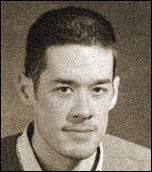
“My employment at the paper ends immediately,” Lee said in an e-mail earlier today. “Someone else, alas, will be tasked with specifying the precise shade of periwinkle frosting atop the cupcakes in My Blueberry Nights. And so I am, as they say, ‘looking for work,’ though presumably not as a staff film critic as such jobs no longer appear to exist.”
Defining Terms
“Yeah, I’m writing something. I’m going to direct it at the end of the year. And no, I haven’t told anyone what it is yet. It’s a comedy and a drama [book adaptation]. Think Thank You for Smoking, but instead of political it’s corporate.” — a quote from Jason Reitman to MTV, posted earlier today. I’ve always been under the impression that Thank You for Smoking was both political and corporate, as the two being are obviously linked in all walks of life. A good portion of it was obviously about the corporate culture of the tobacco industry. Reitman probably means the new film won’t have any Senator characters or scenes of Congressional testimony.
Transformative Moments
“Most men occasionally stumble over the truth, but most pick themselves up and continue as if nothing happened.” — a Winston Churchill quote used by educator-consultant Pamela Gerloff at the start of a 3.23 essay about how really big thoughts and moments, like those contained in Barack Obama‘s Philadelphia speech last Tuesday, are waved off or attacked by most listeners, for the most banal and petty of reasons.
Death Be Not Proud
In a 3.31 New Yorker piece called “Out of Print: The Death and Life of the American Newspaper,” Eric Alterman notes that in a recent episode of The Simpsons, “a cartoon version of Dan Rather introduced a debate panel featuring ‘Ron Lehar, a print journalist from the Washington Post.’ This inspired Bart’s nemesis Nelson to shout, ‘Haw haw! Your medium is dying!’ “‘Nelson!’ Principal Skinner admonished. “But it is!” came the young man’s reply.
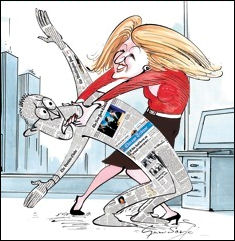
IlIustration by Gerald Scarfe
“Nelson is right,” Alterman writes. “Newspapers are dying; the evidence of diminishment in economic vitality, editorial quality, depth, personnel, and the over-all number of papers is everywhere. What this portends for the future is complicated.” But Alter comes up with a tight and sobering assessment later in the piece.
“We are about to enter a fractured, chaotic world of news, characterized by superior community conversation but a decidedly diminished level of first-rate journalism,” he says. “The transformation of newspapers from enterprises devoted to objective reporting to a cluster of communities, each engaged in its own kind of ‘news’ — and each with its own set of ‘truths’ upon which to base debate and discussion — will mean the loss of a single national narrative and agreed-upon set of ‘facts’ by which to conduct our politics.
News, in short, “will become increasingly ‘red’ or ‘blue.’ This is not utterly new. Before Adolph Ochs took over the N.Y. Times, in 1896, and issued his famous ‘without fear or favor’ declaration, the American scene was dominated by brazenly partisan newspapers. And the news cultures of many European nations long ago embraced the notion of competing narratives for different political communities, with individual newspapers reflecting the views of each faction. It may not be entirely coincidental that these nations enjoy a level of political engagement that dwarfs that of the United States.”
Arianna Huffington, co-founder and editor-in-chief of the Huffington Post (which just surpassed the Drudge Report in readership), tells Alterman that the online and the print newspaper model are beginning to converge: “As advertising dollars continue to move online — as they slowly but certainly are — HuffPost will be adding more and more reporting and the Times and Post model will continue with the kinds of reporting they do, but they’ll do more of it originally online.”
She predicts “more vigorous reporting in the future that will include distributed journalism — wisdom-of-the-crowd reporting of the kind that was responsible for the exposing of the Attorneys General firing scandal.” As for what may be lost in this transition, she is untroubled: “A lot of reporting now is just piling on the conventional wisdom — with important stories dying on the front page of the New York Times.”
Weekend Tracking
21 (Sony, 3.28), the Kevn Spacey-Robert Luketic-Jim Sturgess-Kate Bosworth movie about MIT kids taking the casinos for millions, will be the only big performer among the new films this weekend. It’s tracking at 67, 48 and 23, which means $20 million and then some.
David Schwimmer‘s Run Fat Boy Run, which snuck last weekend, is at 39, 28 and 6. Kimberly Peirce‘s Stop-Loss, a vital, compelling, believably acted drama about an Iraq War veteran that’s running against the tide, is tracking at 62, 29 and 6. And Craig Mazin‘s Super-Hero Movie (MGM) is running at 72, 29 and 6
Pellicano-Love tape
Huffington Post contributor Allison Hope Weiner has posted a recording of a 2001 conversation between Courtney Love and Anthony Pellicano. Love was calling from the Vancouver set of Luis Mandoki‘s Trapped (which came out the following year) and looking for help from Pellicano with (a) her then-boyfriend Jim’s divorce and custody lawsuit and (b) concerns over an ex-assistant having hacked into her email account and threatened to publish all kinds of personal correspondence.
Love: “I need everything from refinement to fucking baseball bats, and I need them all under one roof.” Pellicano: “Courtney, if you come to me, that’s the end of that. I’m an old style Sicilian. I only go one way. My clients are my family, and that’s it. You fuck with my family, you fuck with me.”
Pellicano did me a dirty in ’93 (i.e., tapped into conversations I was having on my cordless phone) but it as just business. He didn’t do this to blackmail me; he was being paid to do it so somebody else might be able to, you know, theoretically “influence” me. But several years later he did me a favor for free. On some level, I think, he was saying to me, “I didn’t mean anything by that ’93 thing, not personally, and just to show you I’m not all bad, or maybe to make up for the ’93 thing on some level, here’s a small gift.”
I respected that for what it was. Doing things “the Sicilian way” obviously didn’t work out for Pellicano, but I respect the guy for at least being, after a fashion, straight with me.
And I like this line that he says to Love during their chat: “Silence is a friend that will never betray you.”
Gotta Have It
Most depression-era gangsters had coarse features — puffy, rough-looking, scarred, pockmarked — with feral, pitiless eyes. Some were flat-out ugly. Movie stars tend to have appealing, often pretty faces and are pretty much unable to walk into a room without engaging audience empathy. So there’s a Hollywood b.s. factor going in when you cast anyone genetically gifted as a gun-totin’ psychopath.
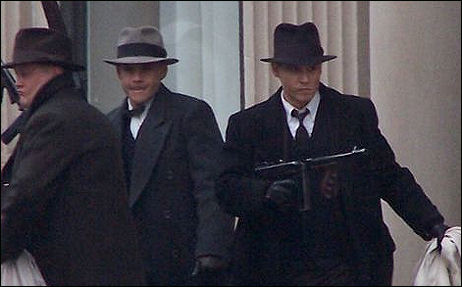
Johnny Depp during filming of Michael Mann’s Public Enemies
Like, for example, when Bonnie and Clyde producer Warren Beatty cast himself as the short, dorky-looking Clyde Barrow. This worked, obviously, because the equally pretty Faye Dunaway played Bonnie — she and Beatty at least made for a balanced fantasy — and because the film sold them as a couple of rebellious ’60s kids. But the movie star-gangster thing is basically trouble.
Did anyone believe Tom Hanks as gangland assassin in The Road to Perdition? I was able to roll with it because director Sam Mendes and cinematographer Conrad Hall did a superb job together, and because Hanks gave it hell — but nobody bought it deep down.
I’m as willing to be suckered by Hollywood flotsam as the next guy, but I know right now I’m going to have trouble accepting the dark-eyed, still boyishly good-looking Johnny Depp as the notoriously impudent and snarly-looking John Dillinger in Michael Mann‘s adaptation of Bryan Burrough‘s “Public Enemies.”
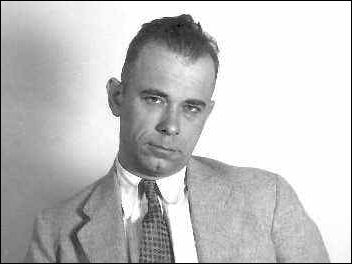
John Dillinger
Nobody is a bigger fool for Mann films than myself. I fell for the fumes in Miami Vice, and took a lot of heat for that. And I’m fairly certain I’m going to love (or at least be impressed by) Public Enemies. But Depp-as-Dillinger seems almost surreal in its physical (and possibly spiritual) wrongness. The only ’30s gangster Depp could realistically play, maybe, would be Pretty Boy Floyd (who wasn’t that pretty, by the way).
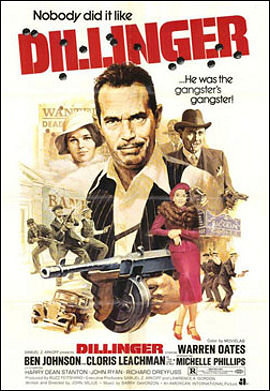
The best Hollywood facsimile of all time was Warren Oates in John Milius‘ Dillinger (’73). He looked like the real McCoy, he had the internals, and he was Warren Oates. I never saw Lawrence Tierney‘s portrayal in Dillinger (’45), but I’ll bet it was fairly on the money. I don’t think you can’t “play” a gangster. On some level you have to actually be one, or the audience will smell it.
I don’t know what this says about Jude Law, but his most convincing screen role by far was a gimpy, twitchy, odd-looking assassin in The Road to Perdition.
George Raft, James Cagney and Humphrey Bogart totally looked and acted like real toughs. But some guys just don’t have it. Look at that shot of the real Dillinger above — there’s a world of hurt and rage and vengeance in that beefy Midwestern face. There’s a reason why Pat O’Brien or Franchot Tone or Jimmy Stewart almost never played villains. (Until they got older, I mean.)
Depp is much more in the delicate, ethereal, sensitive-guy realm. There’s a reason why he was so good as Edward Scissorhands and Ed Wood and Jack Sparrow, roles that are partly about tapping into a certain otherness (including a female side) that pretty much runs away from any sort of brawny machismo. This isn’t a precise analogy, but Depp is basically a 21st Century Franchot Tone with a little perversity and eye shadow on the side.
I’m mentioning this because AICN ran some shots last weekend of Mann, Depp and others shooting a bank-robbery scene somewhere in Wisconsin. (It happened in Columbus, Madison, Baraboo…one of those.) And your first thought is that Depp and his tommy-gun-brandishing cohorts look like actors playing gangsters in their 1930s hats and overcoats. Unfair to judge from a few cheap-ass snaps, I realize, but that’s what they look like.
Public Enemies is an adaptation of Bryan Burrough‘s book,” which is about the gangsters who shot up the midwest in 1933 and ’34 — Dillinger, Bonnie and Clyde, Baby Face Nelson, Pretty Boy Floyd, Alvin Karpis and the Barker family. Mann’s film may be a full-on adaptation, although reports have so far suggested it’s mainly about the bloody and raucous crime career of Dillinger, which lasted a little less than 18 months (early ’33 until his death in July ’34).
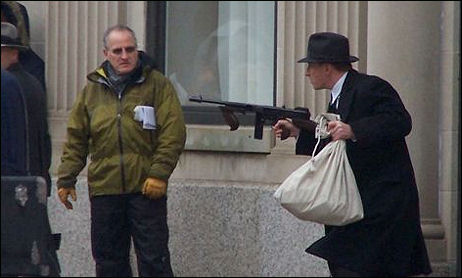
Michael Mann during filming of Public Enemies
One synopsis says the focus is on FBI agent Melvin Purvis (Christian Bale) and his attempts to stop Dillinger, Baby Face Nelson, and Pretty Boy Floyd. Marion Cotillard will play Dillinger’s girlfriend Billie Frechette. I’ve read about Channing Tatum playing Pretty Boy Floyd, Stephen Dorff as Homer Van Meter, Jason Clarke as John “Red” Hamilton, John Ortiz as Frank Nitti, David Wenham as Dillinger gang member Harry Pierpont, and Stephen Graham as Baby Face Nelson.
Principal photography on Public Enemies began in Columbus, Wisconsin on 3.17.08 and will continue in various Wisconsin and Chicago locales until late June. Some parts of the film will reportedly be shot in Crown Point, Indiana, the town where Dillinger escaped from jail.