

The Daily Mail‘s Paul Scott has written a standard Daniel Day Lewis hit-job piece. I’m not disputing the accuracy of this or that, but if I wanted to I could write a similar piece on almost any actor or non-actor you could name, and I could make that person seem just as weird and fickle. It’s not hard, believe me. You just need the will and the attitude and the rest falls into place.
Different Philosophies
“Some critics just seem to want to hate the films. If I came in with that attitude I would slit my wrists. Also I am keenly aware when reviewing a film of trying to relate its plusses and minuses to the audience I am writing for.
“I may see some virtue in some 17th century costume drama but I am not so sure the average [young-male] reader would. I will point that out. I don’t sit there and say, ‘Well I didn’t like it so it must be bad.’ I try to see what the film is trying to accomplish on its own terms and judge it on that level. I don’t try to judge every movie against Citizen Kane.” — Pete Hammond in a “Meet a Critic” interview with Rotten Tomatoes’ Jen Yamato.
Wells revision/coloration of Hammond quote: “80 to 85% of any creative endeavor with the potential to transcend entertainment and become art is second-tier, mediocre or out and out crap — that’s universal law. Ask Dorothy Parker, ask Edmund Wilson, ask Otis Ferguson. Some critics seem determined to find ways around this rule. I can see giving credit to this or that aspect of a film even if the rest of it stinks, but you can’t sidestep the basic way of things. It’s mostly junk and filler — only 10% or 15% of the movies out there are worth your time.
“I float between being a show-no-mercy type of guy and a rank sentimentalist who bends over for the right film becuase it ‘got’ me. I know you need a sense of history, perspective…you have to know from your Budd Boetticher and William Wellman films. You have to memorize dialogue from ’40s film noir films and be able to repeat these lines drunk at parties. Yet I’m keenly aware when reviewing a film that I shouldn’t be judging it from a place that’s too deeply imbedded in my own posterior cavity.
“My big breakthrough in finding a voice was to merge all I know and care about as far as movies are concerned with the personality and attitude of the middle-class New Jersey guy I used to be before I worked my way into the New York-Los Angeles film-journalist culture. Then again, if I run across a film or a performer that I feel is concurrently appealing and appalling, like Nikki Blonsky, I will point that out. I know what I’m talking about and I know myself, so while I may not say ‘Well I didn’t like it so it must be bad,’ I know when a film is a genuine affront to the Movie Gods and that it doesn’t matter at all if such a film is a hit or not. I am a fan of certain directors, writers and producers whom I know are trying like hell to do the right thing, but if a film blows chunks then dammit, you have to say that.
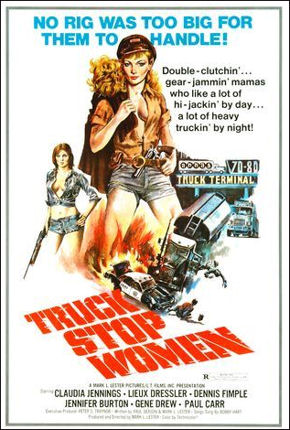
“That said, I would like to think I have the character to say, as the great Stuart Byron did many years ago, that a film like Mark Lester‘s Truck Stop Women is a more vital and essential film experience than Costa Gavras‘ State of Siege. I don’t try to judge every movie against Citizen Kane either.”
Obiter dicta
Responding to a question from Harry Knowles about whether he’s looking to shoot a horror film as his next project, Paul Thomas Anderson said “this is news to me. I thought I just made a horror film…”
Lewis on Ledger
“I hope you don’t mind if I speak about this. I feel very unsettled at the moment. I suppose it’s because I only just saw the news about Heath Ledger‘s death. It seems somehow strange to be talking about anything else. Not that there’s anything to say really except to express one’s regret and to say from the bottom of one’s heart to his family and to this friends that I’m sorry for their troubles.
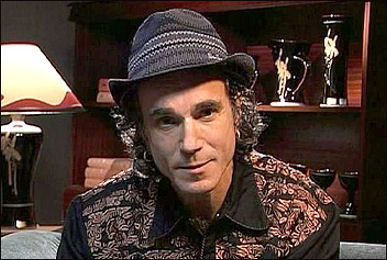
“I didn’t know him. I have an impression, a strong impression, I would have liked him very much as a man. I’d already marvelled at his work and had looked so much forward to see the work he would do in the future.” — Daniel Day Lewis speaking to Oprah Winfrey during a taping last Tuesday afternoon.
To my knowledge, Lewis has never really acted in his own very gentle and softly seductive speaking voice. Not a trace of Daniel Plainview or Bill the Butcher in the man — the opposite characteristics, if anything. There’s something faintly George Harrison-y in his tones and inflections.
Mike Russell + Marjane Satrapi
In his latest non-fiction comic-strip interview, Mike Russell speaks with Persepolis creator Marjane Satrapi.

Quantum of Solace
By calling the next James Bond film Quantum of Solace, the producers are announcing their intention to stay with the dark-flirting, psychological-emotional realism that began with Casino Royale. It will be no big deal at all to write a main credits song for this — just ignore the title. Who cares if the singer literally belts out the words “quantum of solace”? Better this than something in the vein of Goldeneye or Octopussy or whatever. It’s a title that says “if you’re looking for a check-your-brain-at-the-door thriller, look elsewhere.”
Adams vs. Fisher
I wasn’t sure about who was in the cast of Scott Frank‘s The Lookout when I first saw it early last year, so when the cute redhead showed up I was initially persuaded I was watching Amy Adams. It was actually Isla Fisher, whom I’d first noticed in ’05’s The Wedding Crashers.




Amy Adams, Isla Fisher, etc.
I’m not trying to make a big deal out of this, but they’re both redheads, they both project that bubbly-chirpy thing, they’re roughly the same age (Adams was born in ’74, Fisher in ’76), the same size (Fisher is 5′ 3″, Adams is 5′ 5″) and they definitely resemble each other. And they were both born overseas (Adams in Italy, Fisher in Muscat, Oman). That’s all, nothing more, just saying.
Fisher hasn’t lucked out with a big breakout role like Adams did with Enchanted but she’s (apparently) the female lead in Definitely, Maybe and she’s engaged to Sacha Baron Cohen. (Their daughter, Olive, was born last October.)
“Definitely, Maybe”…not sure
I got the hell out of Dodge — i.e., Park City — yesterday afternoon at 5:30 pm, slept a few hours, piddled around and then drove early this afternoon to rain-soaked Santa Barbara. Cats and dogs, cats and dogs…and I didn’t bring an umbrella. Flu gone, cough lingering…and the solution to all woes and precipitations is to hike eight or nine blocks in this scatalogical downpour from the Santa Barbara Hotel upto the Arlington theatre for the SBFF’s opening-night presentation: Adam Brooks‘ Definitely, Maybe (Universal, 2.14).

Snapped somewhere within Santa Barbara’s city limits
Maybe but Most Likely Not is my honest response as I sit in my hotel room at 6:20 pm. (The film will begin a little after 8 pm.)
I’ve been told that Definitely Maybe, a romantic whatever that costars Ryan Reynolds, Abigail Breslin, Isla Fisher, Derek Luke, Elizabeth Banks and Rachel Weisz, is surprisingly okay. But how to ignore the fact that the director is Adam Brooks, the man who gave us Bridget Jones: The Edge of Reason? And Wimbledon? (I never saw The Invisible Circus.)
Would you want to go outside and slosh around and get your feet wet and maybe usher in a return of the viral furies in order to see a Valentine’s Day attraction aimed at the girls who move their lips as they read…not Jane, which went out of business last summer….what glossy monthlies do smug, self-absorbed young women read these days?
The press kit synopsis states that Reynolds’ character, a 30-something Mahattan dad in the midst of a divorce named Will, is surprised when his 10 year-old daughter, Maya (Breslin), starts to question him about his life before marriage. Maya wants to know absolutely everything about how her parents met and fell in love.” Fine so far, but wait…where’s mom? Why hasn’t she had similar previous conversations with Maya? Who is mom? Is she dead? The press kit won’t say.
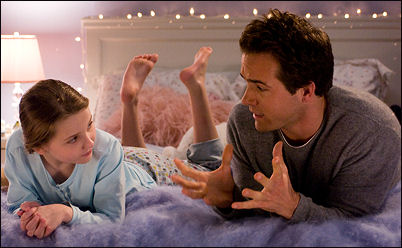
Beginning with his arrival in New York in 1992 to work on “the” presidential campaign (the press kit doesn’t hint at political leanings), Will “recounts the history of his romantic relationships with three very different women.”
He “hopelessly attempts a gentler version of his story for his daughter and changes the names so Maya has to guess who is the woman her dad finally married,” the press kit says. What? Maya is 10 years old, Will is in the midst of a divorce (presumably from one of the “three very different women”), and he’s kept his soon-to-be-ex-wife’s identity a secret from their own daughter? I could ask all kinds of inane questions, but one of the following is certain: Definitely, Maybe has a revoltingly coy premise/plot, or the Universal press-kit writer is making it sound that way.
Yeah, yeah: get out the galoshes and the raincoat and go see the damn thing.
Dargis on Mungiu’s masterpiece
Manohla Dargis‘s N.Y. Times review of Cristian Mungiu’s 4 Months, 3 Weeks & 2 Days is one of the best she’s ever written. I haven’t been this gob-smacked by Dargis since she wrote three and half years ago about Michael Mann‘s Collateral:

4 Months director Cristian Mungiu, star Anamaria Marinca.
“In 4 Months, 3 Weeks and 2 Days, a ferocious, unsentimental, often brilliantly directed film about a young woman who helps a friend secure an abortion, the camera doesn’t follow the action, it expresses consciousness itself. This consciousness — alert to the world and insistently alive — is embodied by a young university student who, one wintry day in the late 1980s, helps her roommate with an abortion in Ceausescu’s Romania when such procedures were illegal, not uncommon and too often fatal. It’s a pitiless, violent story that in its telling becomes a haunting and haunted intellectual and aesthetic achievement.
“You may already have heard something about 4 Months, which was awarded the Palme d’Or at the Cannes Film Festival last year, only to be shut out from Academy Award consideration a few weeks ago by the philistines who select the foreign-language nominees. The Oscars are absurd, yet they can help a microscopically budgeted foreign-language film find a supportive audience. And “4 Months” deserves to be seen by the largest audience possible, partly because it offers a welcome alternative to the coy, trivializing attitude toward abortion now in vogue in American fiction films, but largely because it marks the emergence of an important new talent in the Romanian writer and director Cristian Mungiu.
“In interviews, Mr. Mungiu has resisted some of the metaphoric readings of his film (say, as an attack on the Ceausescu regime) and resisted making overt declarations on abortion. I’ve read more than once that the film is not about abortion (or even an abortion) but, rather, totalitarianism, a take that brings to mind Susan Sontag‘s observation that ‘interpretation is the revenge of the intellect upon art.’ This isn’t to say that 4 Months, 3 Weeks and 2 Days isn’t also about human will and the struggle for freedom in the face of state oppression, only to suggest that such readings can be limited and limiting. Mr. Mungiu never forgets the palpably real women at the center of his film, and one of its great virtues is that neither do you.”
Juno Reality Check
Cody: “In my opinion? The best thing you can do is to find a person who loves you for exactly who you are. Good mood, bad mood, ugly, pretty, handsome, what-have-you…the right person will still think that the sun shines out your ass. That’s the kind of person that’s worth sticking with.”
Wells: “You want it straight, Juno, or fluffy? Let’s try straight. The very best thing you can do is to find a person who loves you for exactly who you are. Good mood, bad mood, ugly, pretty, handsome, what-have-you…the right person will still think the sun shines out your ass. That’s the kind of person that’s worth sticking with. And the odds of finding that person…? Heh-heh…yeah…well.”
Ledger’s death wasn’t merely tragic
“Everyone knows life is cruel and unfair. But it shouldn’t be this cruel and unfair.” — “Renaissance Blogger” posting on N.Y. Times “City Room” page on the death of Heath Ledger.
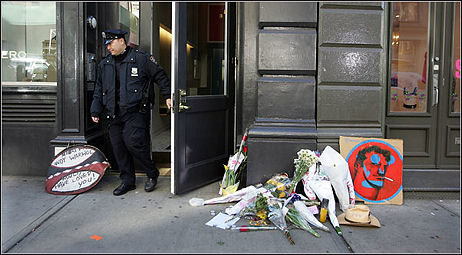
But we all suspect that anyone truly committed to life, health and longevity doesn’t end up dead at age 28 with prescription pills found near his naked body. Ledger didn’t die because a tree fell on him. His death, accidental or otherwise, almost certainly came from somewhere in his own head — his back pages, his behavior, his struggles, and perhaps his failure to pay attention to dosage recommendations on prescription bottles.
There’s that strange video clip making the rounds (taken from an I’m Not There interview) in which he says he feels “good about dying” because he’ll live on through his daughter, Matilda. What 28 year-old father with a two year-old daughter and his whole life ahead of him would even consider such a thought?
There’s that Daily News report by Alison Gendar, Edgar Sandoval and Tracy Connor saying that “friends told investigators that Michelle Williams booted Ledger from the Brooklyn home they shared with their 2-year-old daughter, Matilda, because of a drug problem, a police source said.” N.Y. Times “City Room” blogger Sewell Chan, quoting the Daily News story, extends the quote by saying the breakup was “because of a drug problem that only got worse after he left.”
There’s the anonymous quote give to Daily Mail that Ledger “adored his daughter Matilda, and when Michelle called it quits, he missed Matilda so much that he was thrown into a deep, dark depression.”
There’s a suggestion that heavy medicating was part of his life, as indicated by today’s TMZ report that “two of the medications found at Ledger’s apartment were Xanax and Valium, both anti-anxiety drugs. Cops also found Ambien, along with several medications prescribed in Europe.”
Ledger “had a taste for portraying troubled, brooding, self-destructive young men,” N.Y. Times critic A.O. Scott wrote in an appreciation piece that went up this morning. “The anguished second-generation prison guard in Monster’s Ball, the heroin addict in Candy, the unhappy film star in I’m Not There, the self-torturing Ennis del Mar in Brokeback Mountain. But the temptation to blend their fates with Ledger’s own should be resisted at all costs. Those roles should be seen less as expressions of some imagined inner torment than as evidence of resourcefulness, creative restlessness and wit.”
My head agrees with Scott about resisting such notions, but my gut isn’t so sure. His death didn’t just happen. It came from within. Genuine accidents in life are few and far between.
High-fiber & dead-earnest
“I’m at Sundance right now, and after seven years of covering the festival for various outlets, I’m still taken by surprise whenever I hear the public perception of the Sundance Film Festival, as it’s so alien to the reality of actually being here,” writes San Francisco Chronicle columnist/blogger James Rocchi.
“I asked a friend of mine, as a Rorschach test, to say the first thing she thought of when she heard the words ‘Sundance Film Festival,’ and her reply was as swift as it was blunt: ‘boring and pretentious.’ And yes, when you mention Sundance, most people do think of the sort of high-fiber, hyper-earnest movies that most moviegoers would rather die than see. And there are strong, sincere films up here at Sundance that might lead to that perception — wrenching dramas, hard-to-watch documentaries, and, yes, even earnest failures.
“But really, that perception’s not the total reality. Light movies also play Sundance; funny movies also play Sundance; gripping thrillers also play Sundance. Once made its North American debut up here; so did Napoleon Dynamite. So did 28 Days Later. And so did Narc.”