

Everything is piling on and I’m dropping balls and starting to fall behind, filing-wise. I’m on my first coffee and today’s first film, Carlos Moreno‘s Perro Come Perro (a.k.a. Dog Eat Dog), starts in less than an hour. I’ll try and elaborate on a couple of things later this morning. Probably. Most likely. Maybe not.
At 6:15 pm last night I saw Marina Zenovich‘s finely studied, exquisitely sculpted Roman Polanski: Wanted and Desired, which doesn’t take Roman’s side of the mid ’70s unlawful sex with a minor scandal that led to his leaving this country as much as it slams the judge who ignored justice in his handling of the case.
HE readers of this column have never shrunk from trying to permanently blacken Polanski’s rep from here to eternity, as well as try to mischaracterize my feelings about his crime, which was horrible but needs to be considered in light of the many details of the case, and of course proportionately. Bottom line: Roman Polanski gets a pass from me. Just as he’s got a pass 11 years ago from the woman he violated when she was 13. Let it go, tub-thumpers. I’ve seen Repulsion eight or nine times, and I’m good for at least another nine. And his Macbeth totally rules, and so do all the others except for Frantic. Polanski is a genius and a near-God. Case closed.
Then came Randall Miller‘s Bottle Shock, which tells about the commercial birth of the Napa Valley wine industry in the mid ’70s. I’m going to take a pass on this one for now, but it has a splendid Alan Rickman performance.
Then came the Great Park City Blackout — a total power failure that darkened every street light, restaurant, wine bar and homie saloon in the downtown area. For about a half hour, starting around 10 pm or so. I was walking up the street in the eclipse-like gloom, illuminated only by car headlights, and loving the pandemonium when suddenly the lights came back on to cheers and whoo-whoos…and then the power went off again about four or five minutes later.
Later…
Dan Rather in attendance
I spotted Dan Rather walking around the Park City Marriott a couple of hours ago. I should have cornered him, asked what’s doing, taken his picture…but I’m a notorious wimp when it comes to such opportunities. Unlike Rather, I presume. Let’s face it — in the old days Rather would have looked down his nose at covering this festival and schlepping around like the rest of us. We’re living in a new world.
“Stranded” at Sundance
My only Sundance screening today (so far) has been Gonzalo Arijon‘s Stranded, the doc about the Uruguyan plane-crash survivors who were forced to resort to cannibalism after landing in the snow-covered Andes mountains in October 1972 and being stuck there for 72 days.
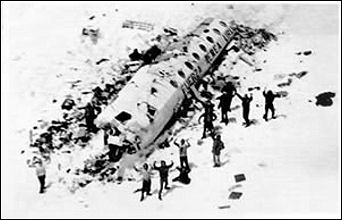
Stranded is partly a first-hand, looking-back, talking-heads doc, partly a revisiting of the crash scene and partly a grainy, dialogue-free re-enactment. It’s touching from the start, and holds you all through its 122-minute length. (The Sundance program notes are incorrect in saying it’s 113 minutes long.)
This famous saga, dramatized in Frank Marshall‘s Alive (’93) as well as Piers Paul Read‘s “Alive: Sixteen Men, Seventy-two Days, and Insurmountable Odds–the Classic Adventure of Survival in the Andes,” is about how 16 young men (most members of a rugby team) managed to survive over a 72-day ordeal, partly by eating the flesh of those who’d been killed.
I was told earlier this month it’s as good as — certainly in the realm of — Kevin McDonald‘s Touching The Void, and I’m in full agreement. Right away you sense this is no run-of-the-mill revisiting. The emotionally delicate tone and complex layers and shadings imply from the get-go that Arijon has the hand of a poet-maestro.
The doc’s unique aspect is not only talking to many of these survivors (kids at the time, now in their 50s and 60s), but also joining them on a trip back to the site of the crash for some reliving and reflecting.
Everyone has a morbid curiosity about this story, and while I admire Arijon’s sensitivity a part of me wishes he had been a bit more blunt about the particulars of being forced to eat dead friends, relatives and loved ones in order to survive. What does human flesh taste like? Are certain sections of the body more appetizing than others? (I’ve always heard that the ribs are slightly more choice.)
Starnded will show four times at Sundance, and is also booked to show at Roger Durling’s Santa Barbara Film Festival at the end of the month. The full title is actually Stranded: I’ve come from a plane that crashed on the mountains.
Manohla vs. “Cloverfield”
A view of Cloverfield that is probably a tad more representative of general gorilla sentiments than this review by N.Y. Times critic Manohla Dargis. As if.
Bin Laden, Redford, Falco

Snapped at Sundance press lounge, Park City Marriot — 1.18.07, 12:05 pm
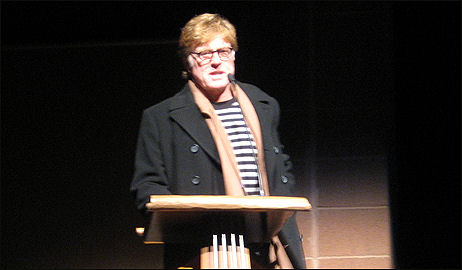
Eccles Theatre, 1.17.08, 6:10 pm
New “Cloverfield” numbers
What happened to those Cloverfield projections in the mid 20s? Smashed on the rocks. Fantasy Moguls Steve Mason is reporting that over the 4-day Martin Luther King holiday weekend J.J. Abrams‘ hand-held monster film “will likely finish in the $39 million to $42 million range. 27 Dresses starring Katherine Heigl appears to be headed for a solid $17 million to $20 million while Mad Money, the first film from Overture, will probably finish with less than $10 million.
Breakfast hour
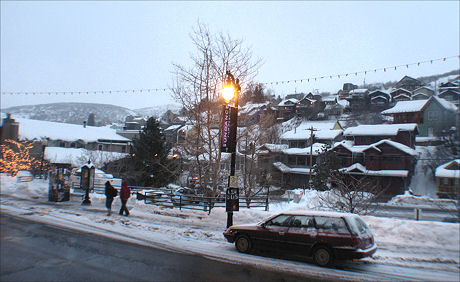
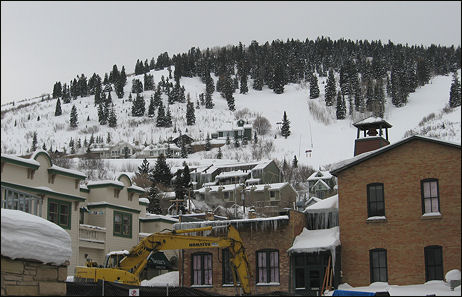
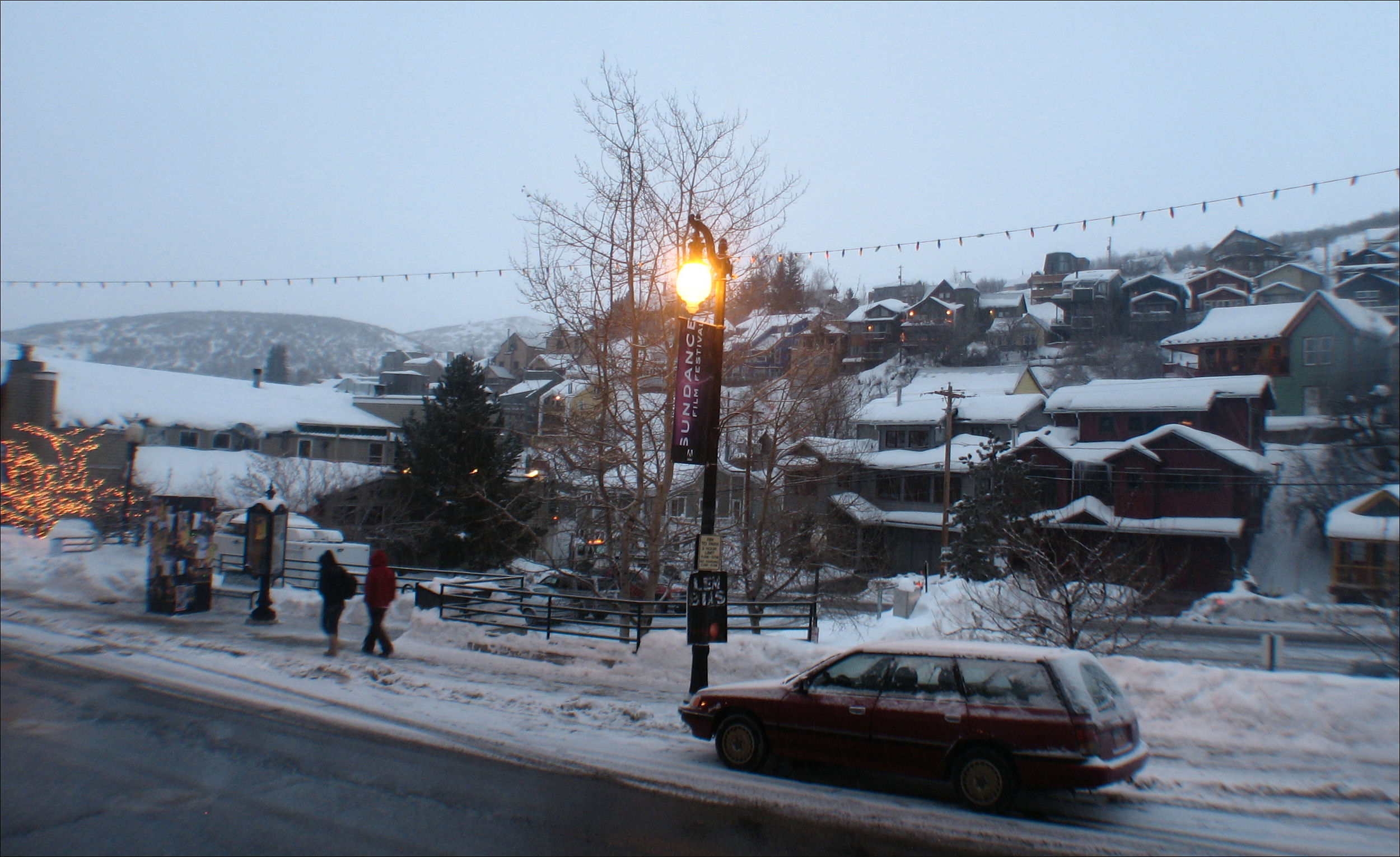
Breakfast hour — the photo doesn’t show it but tens of thousands of delicate little snowflakes are falling upon Park City as we speak — Friday, 1.18, 7:50 am.

“In Bruges” in a bar
Martin McDonagh‘s In Bruges (Focus Features, 2.8) is a much, much better film than the trailer suggests. It’s a classic “surprise” package — looks like nothing but fastballs, is actually about curves, sliders and change-ups. As bright and fully considered as a good play (no surprise) with affecting portions of heart, compassion and symmetry. And laughs — it’s a very funny piece.
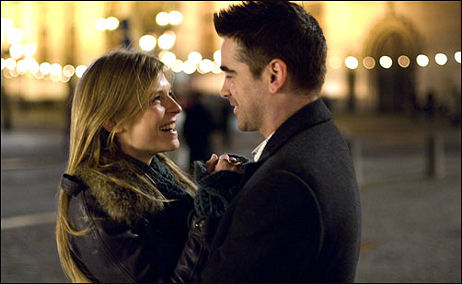
I’ve just come from the opening-night screening of this fascinating, above- average intellectual crime romp at Park City’s Eccles Theatre, and I’m waiting for the after-party to start at 10 pm.
The In Bruges trailer isn’t an out-and-out lie, but it ignores what’s really fine and special about the film. Critics and bloggers are supposed to spread the word (and I’m doing that right now) but why didn’t Focus let me see this film last Monday? I wouldn’t have to be sitting in a bar and banging this out right now.
We’re living in a twisted marketing world today. Got a gangster film that works for adult viewers as well as action fans? Keep the critics from seeing before it plays Sundance, and do everything in your power to persuade the adults in the ad campaign that this movie is not for them — sell only to the under-30 adrenaline junkies. Sell it as a hyper, funny, gun-crazy Guy Ritchie or early Quentin Tarantino crime film. Thematic richness be damned. Skillfully written characters, moments of tenderness, oddball humor…fuck all that! Just go for the guns, guys and popcorn.
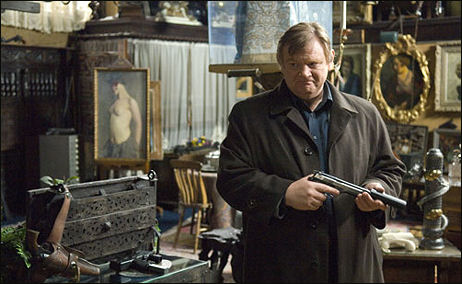
In Bruges has a good amount of gunplay and blood in the third act, yes, but it’s mainly about tourism, morality, character, good writing, humanity and terrible guilt. It’s about standing up for what you believe (even if it hurts), and also about on-the-fly whimsy and joy and weirdness and pretty girls and pretty views.
Did I mention that it’s funny and sometimes hilarious? I did?
In Bruges also delights because it offers another deeply touching performance by Colin Farrell, playing a young screw-up who develops a conscience and a soul along the way. It’s a revelation for those who may have thought Farrell was on the ropes. He’s found his thing — he magnificent at playing morally tortured losers. This on top of his enormously touching turn as a somewhat similar character in Woody Allen‘s Cassandra’s Dream tells me he’s turned a big corner.
McDonagh, a famed playwright in London and New York circles, has composed a delightfully skewed, carefully balanced watercolor crime movie. And shown at the same time that he knows from visual energy and how to make a scene or shot really come off.
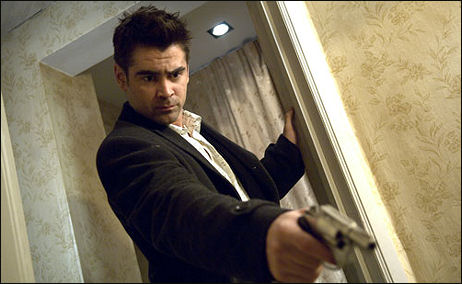
This is the best opening-night Sundance film I’ve ever seen. I know that’s not saying much because the tendency is always to play soft audience pleasers, but In Bruges is a lot more than just “pleasing” or “entertaining.”
Costars Brendan Gleason and Ralph Fiennes are awesome as well — funny, vulnerable, thoughtful. The supporting cast, in fact, is one of the biggest pleasures because every character has angularity, intrigue, particularity. I’ll get into this a bit more tomorrow, but this has been a delightful Sundance start.
Sundance press conference
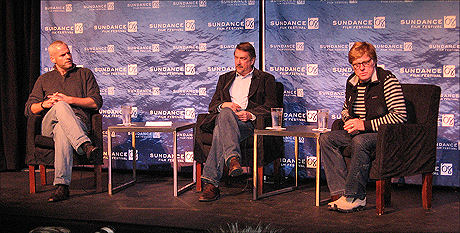
In Bruges director-writer Martin McDonagh, Sundance Film Festival director Geoff Gilmore, founder-honcho Robert Redford — 1.17.08, 2:20 pm — opening-day Sundance Film Festival ’08 press conference.
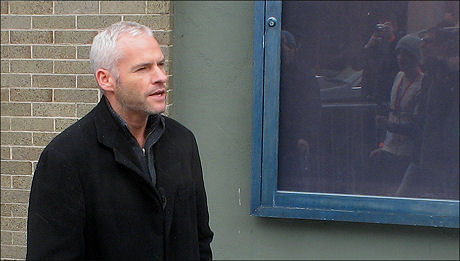
In Bruges director-writer McDonagh outside Egyptian theatre following press conference — Thursday, 1.17.08, 3:15 pm


DGA deal announced
This afternoon’s announcement of a “tentative” three-year deal between the Directors Guild and the Association of Motion Picture and Television Producers means the heat is really on the Writers Guild negotiators to arrive at some kind of similar agreement with the AMPTP. On strike since 11.5, the WGA apparently hasn’t even had back-channel talks going on with the AMPTP since talks collapsed on 12.7 over producer demands that the guild abandon six of its proposals.
If the WGA guys have any balls at all, they’ll disparage the DGA deal and get out their shovels and dig deeper foxholes and lob fresh grenades. Their manhood and dignity is on the line. Is it better to die standing up than to survive on your knees, or is it better to live standing up rather than die on your knees?
Being a little out of the loop with Sundance, I thought I’d check in on Nikki Finke‘s Deadline Hollywood Daily to see if she has some idea what the writers think about the DGA deal (which, according to Variety, boosts the residuals formula for paid internet downloads by double the current rate and establishing residual rates for ad-supported streaming and use of clips on the Internet) and whether they can live with a similar terms. But Finke is on vacation until 1.22 — great timing!
Thomson’s upward diss of “Atonement”
All is not lost, Joe Wright! Venerated critic David Thomson is standing by you, stating that the [Best Director] Oscar will go to Atonement in a 1.16 Guardian piece. He calls it, however, “a film that reeks of class and moral uplift and which matches the terrible state of our culture in one way only: its spuriousness.
“I am certain that Wright will be nominated for directing Atonement, and just about as sure that in fifty years he will be written off,” he declares. “The key to the direction of Atonement is its Dunkirk shot — immense, detailed, a long tracking shot which finally includes all you ever knew or thought about Dunkirk, but which feels like a shopping list where all the items are ticked off. It’s industrial assembly not direction. And it could easily win!
“Moreover, in all these predictions I am guessing what will be nominated and what will win, not what should win according to justice. Why? There is no justice. In fifty years, God willing, There Will Be Blood will stand out as a classic and Julian Schabel‘s The Diving Bell and the Butterfly will look like the transitional work in Schnabel’s career. But not very many people have seen either film, and Best Director tends to go to a reasonable success.
“For myself, I don’t see how David Cronenberg can be excluded for Eastern Promises, and I take it for granted that the Coen Brothers will be recognized for No Country for Old Men. Both films are very violent, yet directors somehow are allowed to be violent.
“Both films have a lot to say about the place of violence in our culture. They seem like genre movies — tales of lurid crime — but they are also questions about what decency can do now. And I like directors who ask awkward questions.”
Lundegaard notices we’re a divided nation
In a 1.15 Huffington Post-ing, MSNBC movie columnist Eric Lundegaard laments that Best Picture Oscar nominees have become, box-office-wise, a smaller niche market than horror films or urban comedies. Which underscores, he says, that we have no “national cinema,” which is to say quality-level but highly popular movies that “we’re all aware of and can enjoy and reference.”
Because — shocking disclosure! — we’ve become two moviegoing nations sharing a common land mass. The good movies are supported (most of the time) by the educated quality-seekers, film geeks and the elites, and the “popular” movies are sometimes enjoyed by same (thank goodness) but are mainly carried on the shoulders of the mostly tasteless rubes.
Lundegaard offers a decade-by-decade listing of no. 1 annual box office hits that were also nominated for Best Picture. There were 7 in the 1950s, or 7 out of 50 Best Picture nominees. There were 8 in the 1960s, and 9 in the ’70s. And then along came the blockbuster phenomenon (i.e., high-concept movies aimed at the lowest common denominator in order to get the biggest opening weekend), the infantilization of movies (the Spielberg-Lucas effect from Star Wars and Jaws) and the resultant expiring of Hollywood’s golden age, which lasted from the late ’60s until sometime in the late ’70s or early ’80s.
There were only 3 Best Picture nominees that were also #1 box-office champs in the 1980s. There were also only 3 in the 1990s, and there’s been only one since the turn of the century.
“From 1950 to 1979, in other words, the most popular film of the year was almost always nominated for Best Picture,” Lundegaard writes. “In the three decades since? The reverse. Since 1983, it’s only happened five times: Rain Man in 1988, Forrest Gump in 1994, Titanic in 1997, Saving Private Ryan in 1998 and Lord of the Rings: Return of the King in 2003.
“What isn’t so familiar is how bad it’s gotten in this decade,” Lundegaard states. “Let’s widen the parameters. How rare is it when at least one of the best picture nominees isn’t among the year’s top 10 box office hits? Since 1944, it’s happened only five times: 1947, 1984…and the last three years in a row: 2004, 2005, 2006. What was once a rarity has now become routine.”
Well, of course, naturally…come on. This is the Age We Live In — a time of great divide between those smart and rousing and finely woven films that truly matter and will be enjoyed by people of quality 20 or 50 or 100 years from now, and the big-studio downmarket dumb-ass movies that are aimed at the culturally and educationally challenged. We are Gorilla Nation with tiny little slices of chimp and orangutan culture in the cities…and Lundegaard is only just waking up to this?