With the opening of David Gordon Green’s TheExorcist: Believer (Universal, 10.6) just around the corner, I’m reposting an observationfrom2020 — an observation that in all of his Exorcist interviews over many decades the late William Freidkin never once mentioned, which I found astonishing.
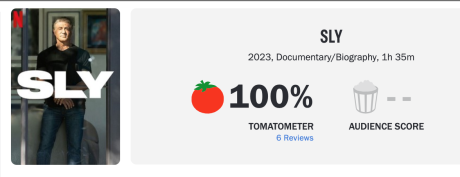
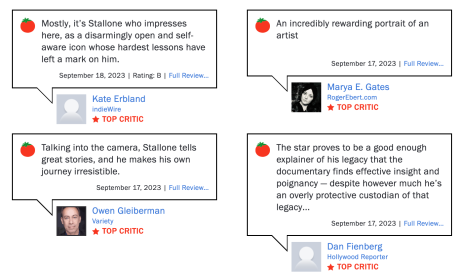
A generally shared view about Thom Zimny and Sean M. Stuart‘s Sly (Netflix, 11.3) is that Sylvester Stallone comes off as refreshingly candid and self-aware. Which is one of the nice things about being a wealthy, senior-grade celebrity with nothing to lose — you can let it all hang out and the reactions are cool and agreeable from every corner.
I got to know Sly a bit from the mid ’80s to early ’90s, and he was a lot less charming and forthcoming back then, lemme tell ya. Then again who isn’t careful (i.e., wary of predators and smart-asses) when their career is going great and the pressure is on?
Just under a half century ago Sly was a struggling actor near the end of his rope who gloriously broke through with Rocky, and after that he made exactly…what, six quality movies during his whole career?
Mostly he’s played taciturn, dead-eyed action heroes who glare and seethe. He tried like hell and did the best he could to stay in the game, but after Rocky the only films he can really and truly be proud of in a quality vein are First Blood (’82), Demolition Man (’93), Judge Dredd (’95), Cop Land (’97) and Creed (’15). (He also scored with some amusing voice work in 1998’s Antz.)
Mainly Sly stayed in his tried-and-true machismo realm and went for the box-office rather than reviews or awards. That’s not a felony of course, but it’s not exactly the sort of track record that would normally bring an industry audience to their feet.
I worked under Sly in ’85 and ’86 when I was employed as a writer/publicist for Bobby Zarem and Dick Delson, who had formed a p.r. partnership and had landed Stallone as their star client. I knew his vibe, hung in his orbit, watched him train and box, visited his home once or twice, did what I was told. But there wasn’t a lot of openness from the guy. He struck me as guarded and sullen and certainly not open to clear-light engagement, at least when it came to low-on-the-totem-pole guys like me.
When I was over at his place one evening I noticed an original Francis Bacon painting hanging in his foyer, and I said with some excitement, “Whoa, Francis Bacon!” I imagined this remark could result in…I don’t know, 20 or 30 seconds of shared appreciation for Bacon’s brilliance? Stallone’s total reply: “You got it.”
In ’92 I interviewed Stallone on the Italian Cliffhanger set (i.e., Cortina d’ampezzo) for the N.Y. Times. And a couple of years earlier I’d helped bring industry attention to a pair of screenplays that led to two of his better projects — Peter Lenkov‘s Demolition Man (’93) and Alexandra Seros‘ The Specialist (’94).
In ’88 and ’89 I was working for a going-nowhere production company, but I knew that The Specialist was a really top-notch script. (The ideal stars would have been Steve McQueen or Robert Duvall in their heydays). When it became clear that the guy I was working for wouldn’t move on it aggressively, I took The Specialist to the Intertalent guys (Bill Block, Tom Strickler) and they signed Seros and eventually helped set the film up as a Stallone vehicle at Warner Bros. Alas, the Luis Llosa-directed film, which costarred Sharon Stone, didn’t turn out as well as it could have.
I also semi-discovered (or was certainly among the early fans of) Demolition Man through a relationship with Lenkov, and when I again realized it wasn’t going to be made expeditiously by my employer I took it to Nina Jacobson, who was then working for Joel Silver. The film was eventually produced by Silver. Directed by MarcoBrambilla, it turned out reasonably well.
Half-decent but less than fully satisfying Stallone films: TheLordsofFlatbush (’74), Rocky II, Rocky III (’88), F.I.S.T. (’78), Cliffhanger, Assassins, Daylight, the new Rambo (’08).
Stallone shortfallers & stinkers: Staying Alive (’83 — director), Rhinestone (’84), Cobra, Over The Top, Lock Up, Tango & Cash, Oscar, Stop or My Mom Will Shoot.
Visit to the Cliffhanger set, on or about 5.20.92 in the Italian Dolomites, about 90 minutes north of Venice — a little below 30 degrees, elevation of 11,000 feet, maybe a bit less.
In early 2003 (or was it late ’02?) I pitched a big Matrix story to Rolling Stone‘s Peter Travers. With The Matrix Reloaded due to open on 5.15.03, I had gotten hold of a copy of the Wachowskis’ script and was looking to scoop the world with a few plot points (including the hair-raising freeway chase sequence) but without spoiling the whole thing. (Naturally.) I’d also picked up some odd domestic details about The Wachowskis, who were then called Larry and Andy and known for being extra-reclusive.
Travers was interested in running a scoop of this kind. We sat down and talked it over at a Manhattan eatery. I didn’t know for a fact that Travers had briefed Rolling Stone publisher Jann Wenner, but it would have been odd if he hadn’t.
The Reloaded script had been passed to me by former Silver Pictures executive Dan Cracchiolo, who had worked for the company’s founder, Joel Silver, between the mid ’90s and early aughts. Dan had struck out on his own a year or so earlier, although I suspected that things may have soured between Silver and himself over possible drug issues — Dan’s, I mean.
I had been especially chummy with Silver between mid ’92 and early ’94, but then relations chilled. (The reasons are too complex to recite here.) The occasionally tempestuous Silver was the real-life model for Saul Rubinek‘s “Lee Donowitz” character in True Romance. (It’s also been said he was at least a partial model for Tom Cruise‘s “Les Grossman” in Tropic Thunder.)
In any event I met with Travers to discuss the shape and tone of the Reloaded article — a few Wachowski morsels, a few plot leaks but not too many, etc. I tapped it out and sent it along. The article definitely worked on its own terms but of course it had to be fact-checked and whatnot. Which meant calling Silver, of course. It was my understanding that Silver hit the roof and called Wenner to yell and scream.
The next thing I knew the piece had been killed. When I called and wrote Travers to ask what happened he wouldn’t respond…silencio. I presumed it had been killed by Wenner. I can’t recall if I was paid a kill fee. I only know that the Rolling Stone vibes were pretty good before I turned the piece in, but after it was killed I was Nowhere Man.
So I sold the article to Empire magazine, and it wound up running right around the time of the May opening of The Matrix Reloaded. Nobody liked the film that much, and everyone hated The Matrix Revolutions.
If the 66 or 67 year-old Joe Biden was in the White House today and preparing to run again next year, no one would be talking about age impairment at all.
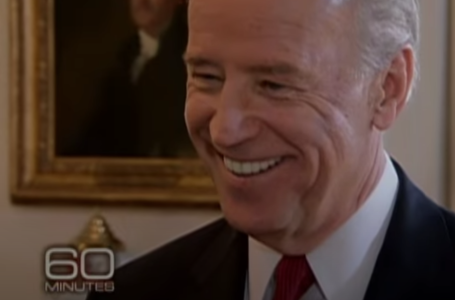
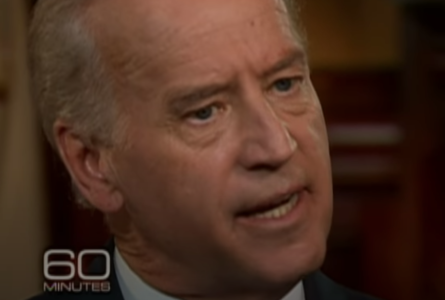
Watch him in this 60 Minutes / Leslie Stahl profile, which ran sometime in the spring of ’09. Biden was pretty much at full strength back then, or 14 years ago…alert, mentally agile, vigorous, quick with a response. Obviously an older guy but nowhere close to today’s doddering version. Voters don’t want a shuffling slowpoke President who’s unable to speak a sentence without slurring or stumbling or muttering. There’s a huge difference between 2009 Joe and the 2023 version…this is what people don’t like.
This isn’t to argue that A Beautiful Mind is a better film that Oppenheimer — it isn’t in most respects. But I felt so completely swept up in James Horner‘s Oscar-nominated score, and particularly by the opening passage (“A Kaleidoscope of Mathematics“), that I couldn’t help myself…I felt melted down from the get-go. It still gets me emotionally.
What I’m saying in effect is that Horner’s music is better than Ron Howard’s film. There have been many scores that have qualified as such — mood symphonies that succeed on their own terms better than the films.
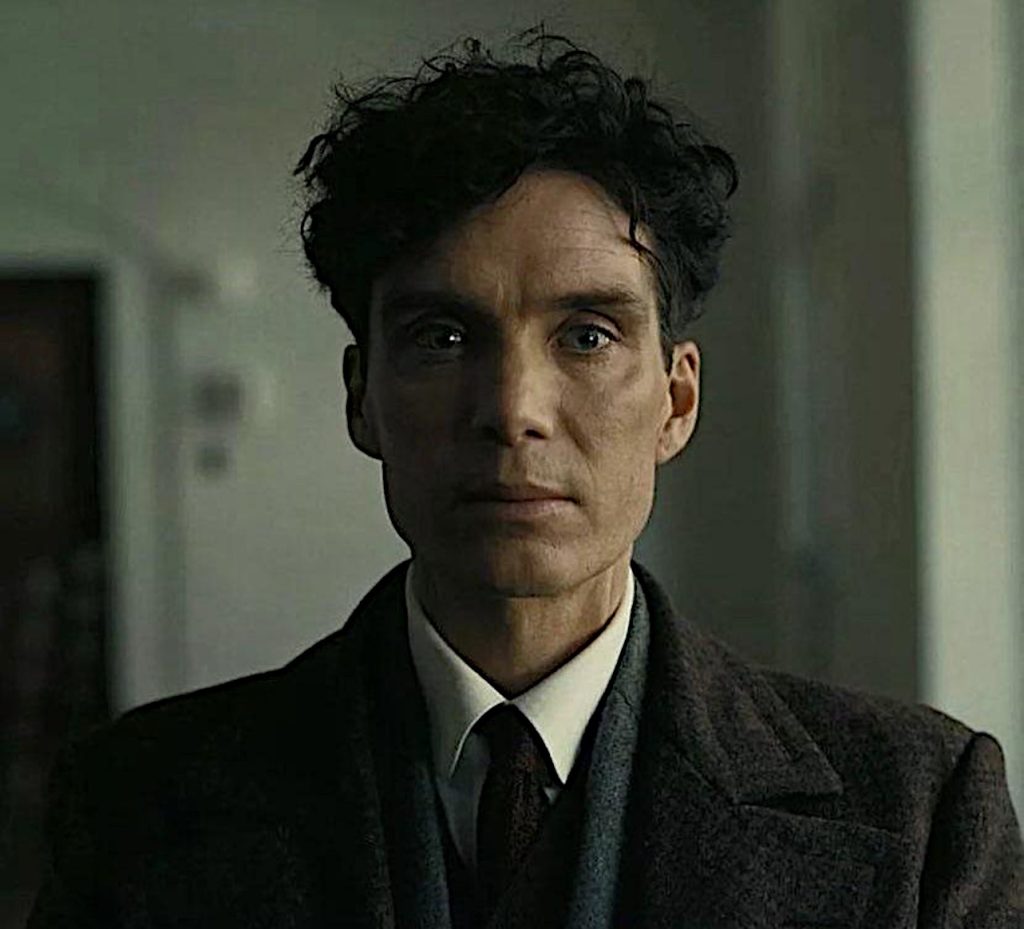
I’m dreaming of Cillian Murphy and his 1930s curly moptop haircut and that same damn look he wears throughout Oppenheimer in every damn scene, and I just can’t watch it a third time, I tell you…Ican’tgoagain! Isn’t it enough that I’ve sat through it twice? I awake at 3:30 am and my pillow is damp. It’s a dense and accomplished film but it doesn’t breathe and it feels like work. I struggled so hard the second time…please, not a third. I’ve paid my dues, leave me alone, etc.
My reservations aside, I think it’s really great that Oppenheimer has performed as well as it has. It’s one of the best things that has happened theatrically since the all-but-total devastation ushered in by the pandemic.
I’ve never derided Oppenheimer as any kind of bad or less than immaculate film. It’s clearly a top-tier smarthouse thing — brilliant, ultra-cerebral. It’s never less than “impressive.”
I just found it strenuous and chilly and rigid…an under-oxygenated forced march with a lot of overly wound-up, perturbed academics and a few upper-level bureaucrats.
Not to mention the arduous company of two very angry, brittle and neurotic women who constantly seethed and lashed out. When Florence Pugh’s subordinate character (Oppie’s Communist lover) committed suicide, I honestly felt relieved. I muttered to myself “one down, one to go.”
The world agrees that Nolan should henceforth steer clear of sex scenes. I didn’t believe that Murphy’s Oppie was even capable of sexual thoughts, much less arousal and much, much less actual coitus.
Thank God for Matt Damon’s brass-tacks “what are the basic dynamics?” scenes with Murphy.
It’s quite the vivid, you-are-there symphony and I felt genuine respect and even awe at times for Nolan’s herculean efforts, but at the same time I felt trapped. It started to wear me down, man, and you’ll never convince me that omitting the horror of Hiroshima and Nagasaki was the right way to go.
And I really didn’t care for Murphy’s company. I tolerated his frozen eyes and aloof, twerpy manner but I kept saying “what is it with this fucking guy? I’m stuck hanging out with a Martian.”
If you’re checking your watch at the one-hour mark (as I did during my initial 70mm IMAX viewing at AMC’s Lincoln Square) and going “dear God, there’s another two hours to go”…if you’re saying that to yourself there’s something wrong.
Yes, it improves during the second hour and I felt more and more sorry for the poor guy when the D.C. wolves did their level best to taunt and persecute him, but Oppie cooked his own goose by alienating Truman (I’ll never forget that look of rage and disgust on Gary Oldman’s face) and failing to understand that longstanding sympathies and allegiances with Communists would land him in trouble, especially given that he’s repeatedly warned about this throughout the first two-thirds.
I just found Oppie an extremely odd duck and quietly arrogant to boot. If I didn’t know the whole story backwards and forwards I would’ve felt no investment in his fate whatsoever. I felt much more rapport with Russell Crowe‘s John Nash in A Beautiful Mind (’01) or Eddie Redmayne‘s Stephen Hawking in The Theory of Everything (’14).
American Fiction, TIFF: 2:44 Drew Barrymore: 12:42 Lauren Boebert: 18:26
TIFF People’s Choice Award: 34:12 Russell Brand + Me Too: 35:37 Kristi Noem/Corey Lewandowski affair + Biden and Harris 50:36
Best Picture + Pot Au Feu: 63 mins Killers of the Flower Moon: 70 mins Mississippi Burning: 72 mins The Parallax View: 75 mins JFK and anti-government/paranoid movies: 83 mins
…is “what an arrogant, exhibitionist, beyond-egotistical low-rent moron…not to mention that ridiculous Venice canalwatertaxiincident…talk about the very personification of déclassé.
Director-writer friendo: “Drew Barrymore’s reaction to the backlash isn’t unexpected, as she’s more a pleaser than a disruptor. Who knows what the next shoe will be but Drew will need to be careful not to dig herself into a deeper hole.
“Barrymore wants to be liked so she caved, but the reality is this: is it really worth pressing ahead with a daytime talk show when you’re being called a scab with craven, third-tier guests getting catcalled by protesters outside?
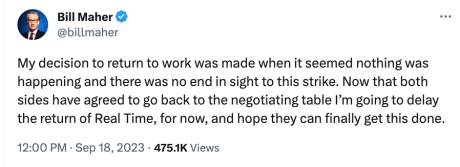
“Bill Maher, who isn’t scabbing but greenlighting a hollowed-out version of his show sans writer’s input, probably won’t blink, especially since he’ll most likely have political pundits on his show and can justify Real Time (until the WGA strike is finally settled) as being a late-night version of Face the Nation or Meet the Press minus comedic wraparounds.
“He’s also a defiant guy and will revel in the headline-making persecution from the WGA.
“Five months is too long for a showbiz strike and there was no end in sight until top showrunners started questioning WGA leadership, as well as Maher opting to autonomously take care of his own business. Now, it seems, the WGA strike could wrap up by Halloween.”
HE to director-writer friendo: “The WGA strike could wrap up ‘by Halloween’? Why not within the next couple of weeks? Why Halloween? Why not Thanksgiving?”
Director-writer friendo: “I said Halloween because it takes time to draft language, present the proposal, get a vote, etc. Plus the AMPTP would want to then negotiate with SAG before Thanksgiving hits. This is just a conjecture, of course, since Apple TV just suspended two high profile deals. This could go either way, but a deal with the WGA means the AMPTP will want to get SAG resolved so films like Deadpool 3 can resume.
“Someone needs to ask why David Young mysteriously stepped aside for negotiating a WGA deal. Probably because he and Carol Lombardini know how to make deals, are strong union people, and the WGA wanted a strike. Young probably offered a reality check on mandatory staffing.”


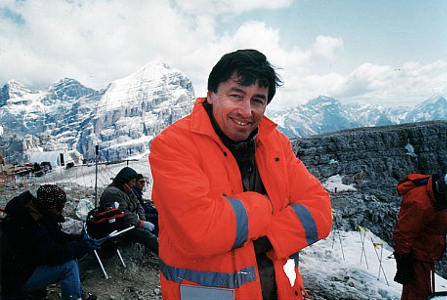 Visit to the Cliffhanger set, on or about 5.20.92 in the Italian Dolomites, about 90 minutes north of Venice — a little below 30 degrees, elevation of 11,000 feet, maybe a bit less.