Reality Check on Feinberg’s Best Picture Spitballing

The Hollywood Reporter‘s Scott Feinberg has posted his first spitball projection of the Best Picture Oscar race (alng with other projections in other categories).

HE truth bullet” commentary represents the kind of bottom-line reality check that Feinberg isn’t allowed to pass along at this stage, as he’s obliged to be diplomatic.

BEST PICTURE FRONTRUNNERS:

Oppenheimer (Universal) / HE truth bullet: Academy members have no choice but to nominate Chris Nolan‘s film because of the great reviews and excellent box-office. The bottom line is that despite its many commendable aspects, Oppenheimer is overly dense (i.e., it doesn’t breathe) and is rather punishing to sit through when you watch it for the second time. Plus Nolan wimped out by avoiding the horrors of Hirsoshima and Nagasaki.

The Holdovers (Focus) / HE truth bullet: A well-written, perfectly acted, old-fashioned ’70s relationship film…pure crowd pleaser, total home run, flawless within its realm.

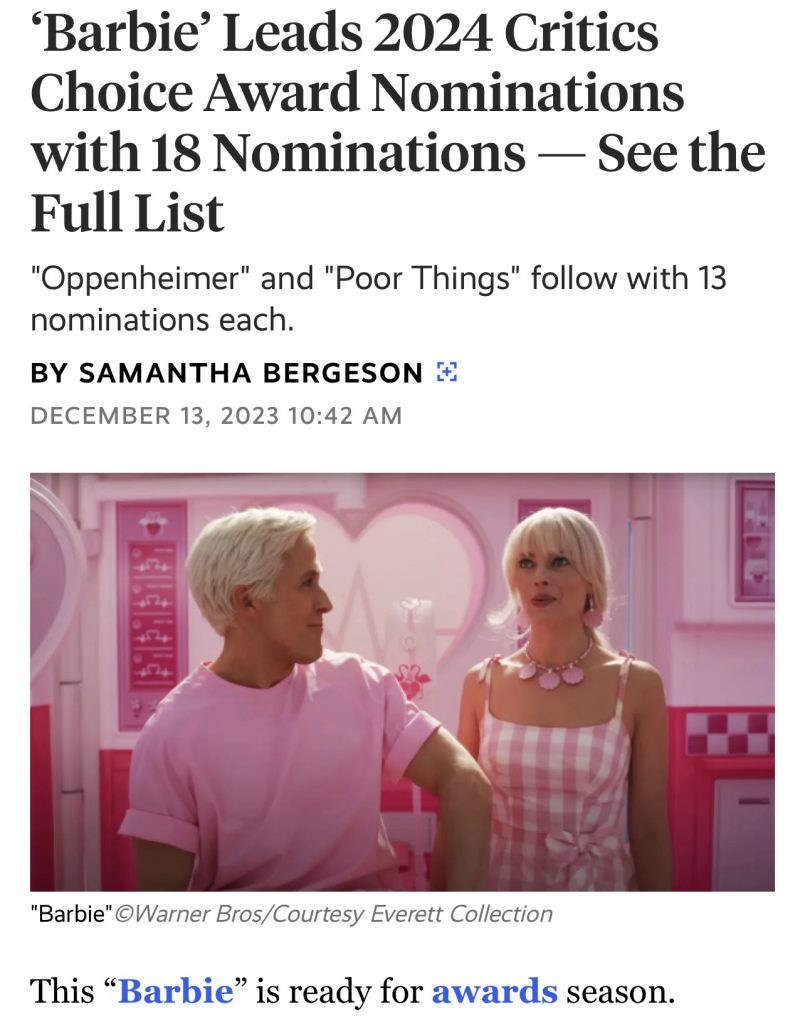
Barbie (Warner Bros.) / HE truth bullet: Guaranteed to be nominated for the box-office explosion aspect alone, and it might even wind up winning, especially given its popularity among the quarter-of-an-inch-deep New Hollywood Kidz. But it’s pure feminist candy and is really too misandrist when you step back and think about it. Best Picture Oscars should be about more than just the mere earning of big money.

Poor Things (Searchlight) / HE truth bullet: A glint-of-madness feminist fantasy…wildly imaginative, Terry Gilliam-like sexual Barbie with actual fucking going on. The sexual current will put off some within the 45-plus community.

Killers of the Flower Moon (Apple/Paramount) / HE truth bullet: A highly respectable historical drama as far as it goes, but far from a home run. No strong point of view about anything. HE gives it a respectable B or B-minus.

The Zone of Interest (A24) / HE truth bullet: Searing moral perceptions by way of alluded-to Nazi horrors, but overly dry, chilly and oblique. Yes, I know — “oblique” is the basic idea.

Past Lives (A24) / HE bullet: Forget it — an unsatisfying, wafer-thin non-romance that lacks nutritional value. Not happening.

American Fiction (Amazon — haven’t seen it)

Anatomy of a Fall (Neon) / “Good’ European courtoom drama but too long, too protracted, no real surprises, doesn’t really pay off.

Nyad (Netflix — haven’t seen it but Oscar action sounds like a stretch).

Read more

Pain, Torment and Loss All Over

Director friendo #1 on the economic impact of the WGA and SAG/AFTRA strikes: “People are losing their homes. It’s happening all over town. I know a couple with two kids who’ve been forced to move out of their home and into a one-bedroom apartment. It’s awful. Writers, actors, crew people…everyone dependent upon any sort of industry-based income. Everything stops.”

“This is what the producers want, of course. They want to see this kind of desperation, this kind of pain.”

Director-writer friendo #2: “Indeed, people are suffering all over town, and not just below the line. The WGA was hellbent on a strike in a very different economic climate with transmuted players. Streamers aren’t vertically integrated studios.

“Yes, people are sinking. Some institutions are working with the casualties of this strike, which is akin to war, whilst others can’t due to still not recovering from the pandemic. Landlords need their rent and many didn’t receive the Covid subsidies.

People are losing homes, cars and savings. Some are downsizing while others are fleeing the state or transitioning into other fields if they’re lucky.

“One young woman I met on the picket lines had been on a writing staff, but is now bartending again. That’s a job she’d left behind after becoming a writer.

“There is massive collateral damage from this strike.

“Nevertheless, with the dissolution of a traditional TV business and the marginalization of feature films, side hustles will soon become the primary sources of income for many…if they’re lucky.

The WGA has a link on their page so striking writers can apply for food stamps. That speaks for itself about the state of things.

“Part of the problem is that WGA leadership, people like David Goodman and Patric Verrone, are outsiders steeped in animation. They’re not industry players like John Wells was.

“If someone like Chuck Lorre was a Guild president, the odds of avoiding a strike are always greater.

“I seriously doubt the WGA anticipated a strike would last this long, but they’re intractable in their positioning and this strike was preordained long before it occurred.

“The WGA guys couldn’t strike last time due to the pandemic, but were hellbent this time.

“When Goodman was previously Guild president, he fixated on eliminating packaging fees at the expense of other issues of greater importance.

Goodman, Verrone and others enjoy being at the bargaining tables with power players because they’ll never meet these CEOs through their respective oeuvres.

“Of course artist need protections and more money, but they also need to be in a healthy business, which this isn’t. The corporations and conglomerates ruined it.

That wouldn’t have occurred if the companies hadn’t thought of art as content. And a bottom line mentality also means that their content creators are disposable. They’re not thought of as artists wherein talent relations are important.

“Instead, the oligarchs are punishing creative serfs, determined to insure that this is the last strike in a very long time.

“Negotiating wise, the WGA has yet to send a more detailed response to what’s considered egregious about the last offer, but it appears the CEOs and AMPTP are desperate to try to mostly hold the other unions to the same deal the DGA received. That won’t work for writers and actors, since both have different needs.

HE: “What are the principal differences between what actors and writers want?”

Director-writer friendo #2: “There are many differences since writers originate projects while directors =execute them. Directors don’t create TV shows, as one example, but the directors of pilots tended to get perpetual fees. James Burrows is a wealthy man.

“I would surmise AI doesn’t pose a threat to directors since it’s a tool that can budget and storyboard. AI replacing writers and actors are different scenarios.

“One wants more guarantees, and both want more residuals and transparencies from streamers.

“There are also new provisions being sought for free work and online auditioning, but it’s all bupkis. Everybody wants more money.

Read more

Too Dumb to Fully Get “Dumb Money”

Last night I caught Craig Gillespie‘s Dumb Money (Sony, 9.15), which had its big premiere in Toronto a few days ago.

It’s based upon Ben Mezrich‘s “The Anti-Social Network“, a 2021 non-fiction account of the GameStop short squeeze, which principally happened between January and March ’21.

The key narrative focus, of course, is class warfare.

Dumb Money is a Frank Capra-esque tale of a battle of influence between financially struggling, hand-to-mouth Average Joe stock investors vs. elite billionaires who tried to reap profits out of shorting GameStop.

The legacy of the 2008-through-2010 recession and movies like Margin Call (’11), The Wolf of Wall Street (’13) and The Big Short (’15) resulted in considerable hostility towards Wall Street hedge fund hotshots.

The venting of this anger was enabled by the ability of hand-to-mouth, small-time traders keeping up with fast market changes through social media investment sites like R/wallstreetbets.

I’m too dumb to fully understand the intricacies of the term “short squeeze**,” but I understand the broad strokes.

I didn’t love Dumb Money, but I paid attention to it. It didn’t exactly turn me on but it didn’t bore me either. I didn’t once turn on my phone. I was semi-engaged.

Paul Dano‘s performance as Keith Gill, the main stock speculator and plot-driver, is fairly compelling. The costars — Pete Davidson, American Ferrara, Seth Rogen, Vincent D’Onofrio, Nick Offerman, Anthony Ramos, Sebastian Stan and Shailene Woodley — deliver like pros.

I spent a fair amount of time wondering why the 39 year-old Dano is heavier now than he was as Brian Wilson in Bill Pohlad‘s Love and Mercy, for which he intentionally gained weight. The real Gill is semi-slender or certainly not chubby.

Clearly Margin Call, The Big Short and The Social Network have far more pizazz and personality.

** “A short squeeze is a rapid increase in the price of a stock owing primarily to an excess of short selling of a stock rather than underlying fundamentals. A short squeeze occurs when there is a lack of supply and an excess of demand for the stock due to short sellers having to buy stocks to cover their short positions”…huh?

The Albatross That Is Kamala Harris

Please go to the 8:37 mark in this discussion between CNN’s Anderson Cooper and Rep. Nancy Pelosi, who recently declared she’ll be running for re-election in 2024:

Anderson Cooper: “Is Vice President Kamala Harris the best running mate for [President Joe Biden]?”
Nancy Pelosi: “He thinks so, and that’s what matters.”

In other words, Pelosi doesn’t think Harris is the best option but doesn’t want to rock the boat or stir up trouble.

Nakedly Honest Pelosi Translation: “Obviously she’s unpopular and not respected, and is therefore a terrible albatross for this president, but he appears to believe that he’s stuck with her and so we’re stuck with them both and it’s awful.

“People are truly terrified that President Biden, who, if re-elected, will be 82 when he takes the oath of office in January 2025, may become incapacitated or fall ill or worse sometime during his second term and that Harris will become president. If President Biden, in conversation, was as sharp and lively as myself, it would be a different story. But he can barely get through two or three sentences without stumbling.

“This is a truly terrible situation to present to American voters — a shuffling, muttering, forgetful, fuzzy-brained president, obviously diminished by age as we speak and sure to diminish further as the years takes their inevitable toll….a president who may or may not go the distance, God forbid, and so a vote for Biden-Harris is an automatic vote for a potential President Harris, and in the minds of tens of millions of voters, including a likely majority of Democrats, that is a terrible proposition to put forward. So obviously she is not the best running mate for President Biden.

“Honestly? Joe himself should give serous consideration to hanging up his holster and letting the far more age-appropriate Gretchen Whitmer or Gavin Newsom step in to the breach. But he won’t do that, of course. He can he drooling and half-conscious in diapers and pushed around a wheelchair and he won’t quit.”

“Poor Things” Is Sexually Perverse “Barbie”

Friendo: “Poor Things + Barbie = same story. Imagine if Barbie was about a sexual awakening after she gets her VAG.”

HE: “[A critic friend] said Poor Things was like Barbie directed by the Marquis de Sade.”

Friendo: “Okay but I say Russ Meyer.”

Best TIFF Films

This morning I asked World of Reel‘s Jordan Ruimy about the best films he’d seen thus far the 2023 Toronto Film Festival, and he listed six — Alexander Payne‘s The Holdovers, Richard Linklater‘s Hit Man, Cord Jefferson‘s American Fiction, Azazel JacobsHis Three Daughters, Hayao Miyazaki‘s The Boy and the Heron and Kristoffer Borgli‘s Dream Scenario.

HE: “The Holdovers and Hit Man aside, would you describe the other three as triples, homers, ground rule doubles or line-drive singles?”

Ruimy: “I think they’re all triples or homers.”

A couple of hours later Ruimy listed 12 allegedly top-tier films hat he’d seen in Toronto — the above six plus Michel Franco‘s Memory (HE automatically endorses all Michel Franco films), Errol Morris‘s The Pigeon Tunnel (which I saw and loved in Telluride), Kitty Green‘s The Royal Hotel (Australian outback animals making life hell for two female bartenders….forget it), Bertrand Bonello‘s The Beast, Harmony Korine‘s Aggro Dr1ft (forget it), and Anna Kendrick’s Woman of the Hour.

Allen Hate Balloon Is Deflating

Three days ago (9.10) London Times columnist Hadley Freeman posted a thoughtful, paywalled essay about Woody Allen that’s certainly worth reading. I usually post excerpts from articles that I approve of, but this time I’ve pasted the whole thing.

By striking terror in the hearts of industry cowards and thereby suppressing the distribution of Allen’s Coup de Chance (even as a streaming title), Woody haters are perpetrating a social and cultural crime that is absolutely loathsome and pernicious.

After 31 years of this, it’s really time to back off and let it go. Lord knows their punitive point has been made over and over. They are the witch dunkers of Salem.

And as difficult as it may seem, they all need to once again attempt to understand a basic truth that all mature societies understand. A work of art or art-tinged commerce, like a movie or a play, is one thing, and the private behavior of its creator, however imperfect (and who among us is?), is something else entirely. They are two parallel twains that can not and should never meet.

Just To Be Clear

My Cannes Killers of the Flower Moon review, tapped out on my iPhone 12 outside an old-town eatery, amounted to a B or a B-minus.

What I wrote between bites of pizza and salad under a damp awning wasn’t a pan. I don’t regard Killers as a weak or poorly crafted film (from a technical standpoint) at all. It’s not. I regard it as a solemn, diligent, semi-haunting, very well made film that “doesn’t quite get there.”

Repeating: Flower Moon isn’t a bad film or a failure. It’s somewhere between a B and B-minus. But it never really tags one. Albert Pujols‘ bat never really goes crack. You know that feeling when a film is moving along at a steady professional clip and then the big crescendo is supposed to happen but it just kind of trickles off? A film that rumbles along in a steady, workmanlike and then cruises to the finish line without setting off fireworks? That’s Flower Moon.

Nothing Wrong With Being An Infectious, Finely Crafted Crowd-Pleaser

HE to World of Reel’s Jordan Ruimy: “Whadaya mean by saying that The Holdovers is ‘far from Alexander Payne’s best film’?

“It is one of his best, and it’s very carefully rendered…every line and and every shot lands just so…each and every brushstroke contributes exquisitely to the whole…c’mon, man, don’t be a snob!”

Here’s my abbreviated Telluride review.

Marty Admits to “Flower Moon” Woke Rethink, Dismissal of “Birth of FBI” Concept

In a 9.12 Time cover story by Stephanie Zacharek, Killers of the Flower Moon director Martin Scorsese has confirmed what costar Lily Gladstone told Variety‘s Zack Sharf nine months ago, which was that Flower Moon, a sprawling crime epic about the FBI’s investigation of the Osage Nation murders in 1920s Oklahoma, was given a woke rewrite — one that de-emphasized the FBI nailing the bad guys and emphasized the perspective of Osage Nation and the pain their community had endured.

“After a certain point, I realized I was making a movie about all the white guys,” Scorsese tells Zacharek. “Meaning I was taking the approach from the outside in, which concerned me.”

In a 1.20.23 article, Gladstone explained to Sharf, Variety‘s resident wokester lobbyist and spokesperson, that Scorsese had basically re-thought the 1920s saga, which had begun as a kind of “birth of the modern FBI” story.

This is how Scorsese’s adaptation of David Grann’s 2017 novel began, according to what costar Leonardo DiCaprio told me at a San Vicente Bungalows party in late 2019.

The basic plot, Leo said, would focus on former Texas Ranger Tom White (whom Leo was intending to play at the time), and his having been ordered by top G-man J. Edgar Hoover to take over the Osage murders case and make sure the bad guys pay the price.


But eventually Scorsese and screenwriter Eric Roth concluded that a “birth of the modern FBI” tale wouldn’t be woke enough (i.e., too white-guy oriented), and that their film hadn’t sufficiently considered the Osage native point of view of the killings and the investigation of same.

Gladstone told Sharf that Scorsese “worked closely with the real-life Osage Nation to ensure his movie would properly represent the community.”

The result was that “the Osage Nation ended up positively changing Flower Moon from what Scorsese [had] originally planned.”

“The work is better when you let the world inform the work,” Gladstone explained to Sharf. “That was very refreshing how involved the production got with the [Osage Nation] community. As the community warmed up to our presence, the more the community got involved with the film.

“It’s a different movie than the one [Scorsese] wanted to make, almost entirely because of what the community had to say about how it was being made and what was being portrayed.”

HE antagonist Glenn Kenny, for one, didn’t like the thrust of Gladstone’s statements, which was that Scorsese had altered course out of concern that Flower Moon would be perceived as too white-guy oriented (a la James Stewart in Mervyn LeRoy‘s The FBI Story, which I rewatched and riffed about on 7.16.23).

“That’s Gladstone’s perspective,” Kenny argued, “shaped through that of Sharf, and in any event has nothing to do with reshoots. Scorsese and company were getting Osage input from well before the cameras started rolling.

Kenny to HE: “Look, man, I know how precious the ‘Native Americans strong-armed Scorsese into going woke‘ narrative is to you, and I know you’re gonna stick with it through thick and thin, but just don’t pretend too much insider knowledge here.”

HE to Kenny: “So Gladstone misstated Scorsese’s creative strategy (i.e., before the alleged Osage Nation re-think) in order to celebrate the Osage Nation’s strength as a culture and to emphasize that their perspective on the 1920s murders was, thank God, crucially included at the 11th hour?

“You’re saying, in other words, that Scorsese had understood the entire Killers equation from the get-go, as had original author David Grann, and that neither of them needed woke tutoring as far as the Osage perspective was concerned? And that DiCaprio was full of shit when he told me in late ’19 that the film would be about the birth of the FBI?

“Gladstone, in short, was spinning her own impressions last January, and Sharf, a go-along wokester parrot, played along?”

Kenny to HE“: “Maybe so.”

HE respects Scorsese for dealing straight cards by confirming what Gladstone conveyed to Sharf last January.

To hear it from Zacharek, Marty is basically saying, in effect, “I knew we had to respect the Osage Nation viewpoint, first and foremost, and so we did that.

“I also knew, to be perfectly honest, that our movie wouldn’t be approved by the wokester chorus if Eric and I didn’t ease up on the ‘FBI agents as white saviors’ theme, and so we decided to woke it up and make the kind of of film that Lily and the Native American community in general wanted to see.”

Scorsese elaboration by way of HE interpretation: “It just seemed like a politically sensible and sensitive thing to do…now I can say with a proud and straight face that I’ve made a Scorsese-style woke film about Native American genocide in 1920s Oklahoma, and I feel completely at peace with this approach because the facts required it.

“In the final analysis these are the times in which we’re living, and I knew that the wokesters had dismissed The Irishman because it was too white and too goombah Italian and wasn’t in the multicultural swing of things like Parasite, and so I adjusted our approach so that Native Americans would approve, and that wokesters wouldn’t give us a hard time.”

Read more

Age Gaps Don’t Necessarily Matter

Most of us are okay with on-screen romantic pairings between older guys and younger women. Five- or ten-year gaps are fairly common in real life, of course, with many women preferring the relative security of guys who (a) are more emotionally secure or at least less hound-doggy, (b) have been around the block a few times, and (c) earn better-than-decent incomes.

In other words movie romances about 10 to 20 year age gaps are generally accepted, especially if the older guy looks fit and trim (flat abs, decent muscle tone, no jelly belly) and hasn’t allowed thinning hair or bald spot issues to get out of hand, and still has that old sparkle in the eye, which generally translates into a suggestion of sexual vigor.

25-year gaps are pushing it but even they can pass muster, depending on the chemistry and charm factors.

If you like the older guy for his spiritual and emotional qualities, falling in love with a compatible younger woman (and vice versa) can seem like a good thing all around…thematically such pairings suggest renewal and revitalization…a second chance at life.

But in order to accept or approve of such relationships moviegoers have to be able to imagine the couple still happening five or ten years down the road. There has to be a credible future of some kind.

In North by Northwest, for example, Cary Grant‘s Roger Thornhill is supposed to be mid to late 40ish (although Grant was actually in his mid 50s), while Eva Marie Saint‘s Eve Kendall was presented as being in her early 30s. It wasn’t hard to imagine Thornhill and Kendall having a sexually active (perhaps even kinky) relationship ten years hence, although I couldn’t see them raising kids.

In As Good As It Gets, Jack Nicholson‘s Melvin and Helen Hunt‘s Carol appeared to be a good quarter-century apart, and communal instincts told most of us that Melvin, a wealthy author who was around 60, would always be more than a bit loony, with or without mood stabilizers. I saw them lasting no more than a couple of years, if that.

In Quentin Tarantino‘s Jackie Brown (’97), Robert Forster‘s Max Cherry, a mid 50ish bail bondsman, seemed roughly a decade older than Pam Grier‘s titular character. (In actuality Forster was only seven or eight years senior.) They were so similar in terms of age, attitude and attractiveness, in fact, that their mellow romantic attraction barely qualified as an “age gap” thing. It was obvious that Max was not only in love with Jackie but easygoing and accepting. You knew they would never fight about anything.

I’m discussing age gaps because I happened to land this morning on hollywoodagegaps.com, and because I recently encountered an unusual romantic couple in Phillip Noyce‘s Fast Charlie (Screen Media), a droll, character-driven genre thriller that will open in October following a Mill Valley Film Festival debut on Sunday, 10.7.

There’s a quarter-century gap between Pierce Brosnan‘s Charlie, a civilized, soft-drawl hitman who loves fine cooking, and Morena Baccarin‘s Marcie, a taxidermist with a world-weary, Thelma Ritter-ish attitude about things, and yet they fit right together. Like Max and Jackie, Charlie and Marcie are all about ease and compatibility.

An adaptation of Victor Gischler‘s “Gun Monkeys” with a screenplay by Richard Wenk, Fast Charlie (which costars the late James Caan in his final performance) delivers a fair amount of gunplay, albeit the understated, no-muss-or-fuss kind. It’s a reflective, character-driven story of cunning and desire (not just romantic but epicurean) on the Mississippi bayou.

All to say that if you’re rooting for the couple in question and want their relationship to build into something, age differences tend to recede.

Way-too-extreme age gaps in age and temperament: James Stewart and Kim Novak in Vertigo, Sean Connery and Michelle Pfeiffer in The Russia House, John Wayne and Capucine in North to Alaska, Wayne and Angie Dickinson in Rio Bravo, Humphrey Bogart and Gina Lollabrigida in Beat Hhe Devil, Cary Grant and Audrey Hepburn in Charade, Robert DeNiro and Amy Brennaman in Heat, Daniel Day Lewis and Vicky Krieps in Phantom Thread, Clark Gable and Marilyn Monroe in The Misfits.

And yet I believed in a future for Cary Grant‘s John Robie and Grace Kelly‘s Francie in To Catch A Thief. Go figure.