After last night’s AMC Danbury showing of Masters of the Universe (technically an earlybird thing as the film doesn’t open in AMC theatres until this afternoon), I drove right back to Wilton and filed my review. And now it’s up. Fast turnaround!
My poor math skills ensured that I would get Nicholas Galitzine‘s age wrong — he’s 32, not 22. I informed my editors of the error this morning; presumably they’ll be fixing it soon.
I also failed to include a pretty good kicker paragraph, although I sent it along 90 minutes ago. Here it is:
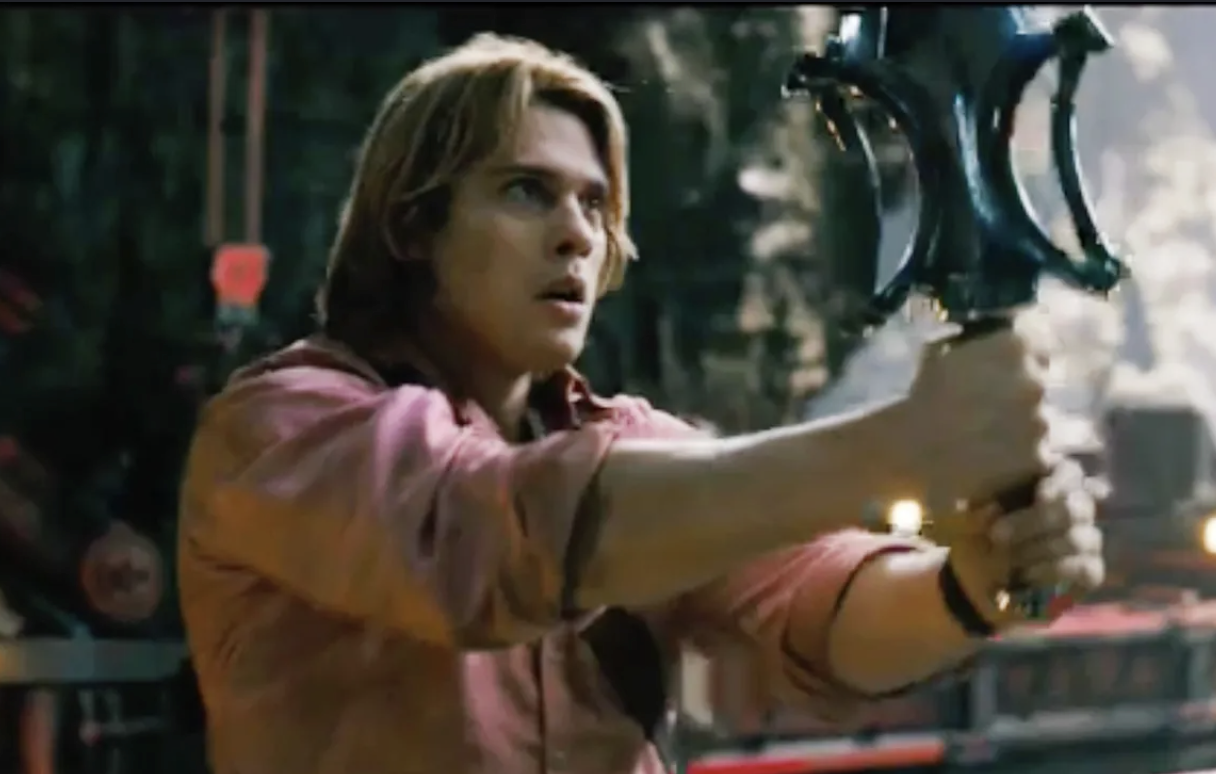
Possible omen: There’s a big Castle Grayskull scene in the second act — a dramatic surge moment — in which Galitzine’s Adam finally abandons the uncertainty and becomes He-Man, wielding the Power Sword and affirming his destiny. The AMC Danbury crowd came alive at this very moment…energy wave!…and at that moment I noticed, three rows in front of me, an actual Power Sword being raised in celebration. Some guy cos-playing with a plastic, full-sized replica, probably bought 40 years ago in Toys ‘R’ Us, and pumping it in the air. Go, He-Man! Hilarious!
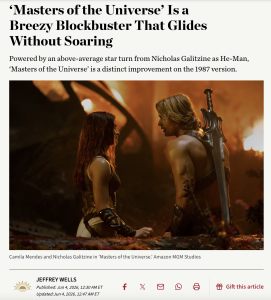
As I’ve been told I can share the New York Sun article and given the standard compression edits that always happen prior to publication, I thought I’d post the original HE version. Compare and evaluate.
“Honey, I Shrunk the Skeletor,” finished last night around 11:30 pm:
My thirtysomething sons, Jett and Dylan, were never into the Masters of the Universe Mattel universe…not yet born during the heyday. And they never saw Gary Goddard’s Cannon-produced, nearly 40 year-old Masters of the Universe (’87)…still unborn, probably wouldn’t have cared if they had been. And so I wasn’t parent-punished into buying the action figures or watching the kiddie cartoon serial.
But I was a Cannon Studios employee when Goddard’s film was being shot at Culver Studios in the early fall of ’86, and I damn well visited the massive Castle Grayskull set, you bet…a lavish undertaking which ate up two full sound stages. My eyes and heart were sorta kinda dazzled as I strolled around with the unit publicist, muttering wisecracks and wondering why the place felt so quiet.
Because it was empty, that’s why. So no casual run-ins with a bare-chested, sword-bearing, heavily-costumed Dolph Lundgren (He-Man) or a dark-cloaked, masked-up Frank Langella (Skeletor). And yet the film hadn’t wrapped so where was everyone?
I knew that the financially squeezed Cannon had been forced to lose several script pages and things were being re-strategized. Perhaps some of the battle sequences were being shot in and around SoCal instead of on the fantasy planet of Eternia.
I couldn’t put my finger on it, but the sound-stage vibe felt a bit off. Hesitant, uncertain…who knew?
I dragged myself to a screening when MOTU opened on 8.7.87, and I knew right away I couldn’t be fully honest with any of my fellow Cannon-ites. Because it obviously blew chunks. It was critically savaged, became a box-office bomb. ($22 million to produce, $17.3 million earned). The tone was half-jape, half-solemn. Lundgren struggled with his dialogue but Langella seemed to enjoy the scenery-chewing. Courteney Cox, James Tolkan and Meg Foster costarring…whatevs.
Now there’s a brand-new Masters of the Universe from Amazon and director Travis Knight (Bumblebee)…thinner, slighter and much more expensive. Between $170M and $200M.
So why remake an ‘80s stinker, and particularly one that feels out of synch with the here-and-now? We’re living in an era of hit indie strange-os (Obsession, Weapons, Backrooms). IP sequels aren’t what they used to be in the teens, and nobody cares about MOTU merch…long gone. Mattel obviously connected with Barbie, sure, but that was a misandrist, pinker-than-pink, auteur-driven one-off.
So why watch this thing, I asked myself? Why submit to punishment? Because a movie journo has to occasionally man up and take the pain. And that was my attitude as I slipped into a special early-bird screening at the AMC Danbury.
Guess what? Knight’s newbie is a feck-it movie, a mild breeze…good-natured, light-hearted and completely divorced from any notion of dramatic engagement. Every line and every scene delivers a jack-off vibe. It’s got that good old “nothing matters, it’s all a goof so forget the story and let’s just have fun” attitude…a Guardian of the Galaxy thing, only a wee bit lighter, a touch more throwaway.
I didn’t care about the story or anybody or anything, and that was fine. Because it didn’t irritate me or tick me off. This film doesn’t fly — it glides. I was sitting in a convertible with the top down and a cold beer in my hand, and I don’t even drink. (Sober since March of 2012.)
And guess what? 32 year-old Nicholas Galitzine, as Adam Glenn and He-Man — the former an easygoing, blonde-haired, earth-residing dude who wears black jeans, a pink Brooks Brothers shirt and whitesides but doesn’t want to get sucked into a mediocre life as an HR guy, and the latter character the former Prince of Eternia who lives to wield the mythical Power Sword…Galitzine is a slam-dunk star in this thing, at least during the first half to two-thirds. (I succumbed to slight boredom during the last third.)
Galitzine is certainly ten times the actor that Dolf Lundgren** was in the ’87 version. Having bulked himself up for this role, Galitzine is relaxed and unassuming and always conveying an intelligent vibe. I liked him immediately because he’s always settling things down, always letting you know this this big, carefree Amazon film is into chilling, bruh, even during the violent battle scenes…shoulder-shrugging, mellow-vibing….no worries because it’s all meaningless bullshit.
Deep down this movie is total helium…a stone that doesn’t skim across a pond as much as levitate above it. Compared to it Guardians of the Galaxy feels like Arthur Miller’s A View From The Bridge, and The Empire Strikes Back plays like Shakespeare’s The Tempest.
I don’t know if Masters of the Universe is going to tank or succeed, but if I, a grumpy hater of empty-brain-pan CG-driven popcorn cinema, can make peace with it then maybe others can too. And I’m speaking as someone who hated Chris Pine’s Dungeons and Dragons.
Possible omen: There’s a big Castle Grayskull scene in the second act — a dramatic surge moment — in which Galitzine’s Adam finally abandons the uncertainty and becomes He-Man, wielding the Power Sword and affirming his destiny. The AMC Danbury crowd came alive at this very moment…energy wave!…and at that moment I noticed, three rows in front of me, an actual Power Sword being raised in celebration. Some guy cos-playing with a plastic, full-sized replica, probably bought 40 years ago in Toys ‘R’ Us, and pumping it in the air. Go, He-Man! Hilarious!
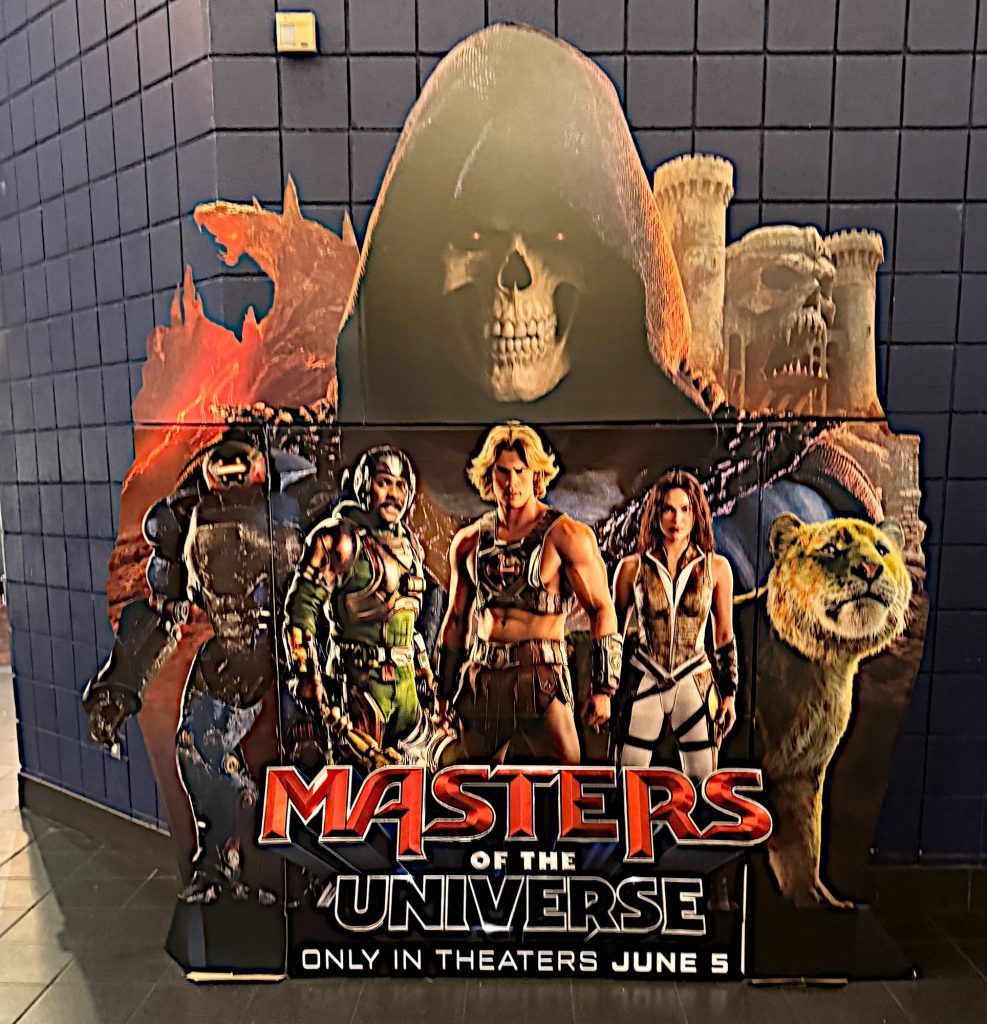
All hail Jared Leto as Skeletor, a skull-faced, buff-bod, baddy-waddy who delivers (you guessed it!) a put-on, jizz-whiz performance. Ditto Camila Mendes as Teela, a foxy, no-nonsense warrior (a butchier Princess Leia); Idris Elba as Duncan / Man-at-Arms, a recovering alcoholic superhero who mans up when the going gets tough; Allison Brie as Evil-Lyn, a brittle-ironic suck-up worshipper of Skeletor; Kristen Wiig as the voice of Robot; and, last but not least, Morena Baccarin as “the Sorceress”. (Except Baccarin is a much better actress than this pan-flash character allows her to be — I loved her in Phillip Noyce’s Fast Charlie.)
** Lundgren cameos during the first half-hour or so, and does a good job of it.