And you can’t beat that 125-minute running time….seriously.
Oliver Stone‘s head is roughly 50% larger than Bill Maher‘s. Okay, 40%.
Friendo: “I love how Stone smokes a few tokes of Maher’s joint — it loosens him up a bit.”

And you can’t beat that 125-minute running time….seriously.
Oliver Stone‘s head is roughly 50% larger than Bill Maher‘s. Okay, 40%.
Friendo: “I love how Stone smokes a few tokes of Maher’s joint — it loosens him up a bit.”
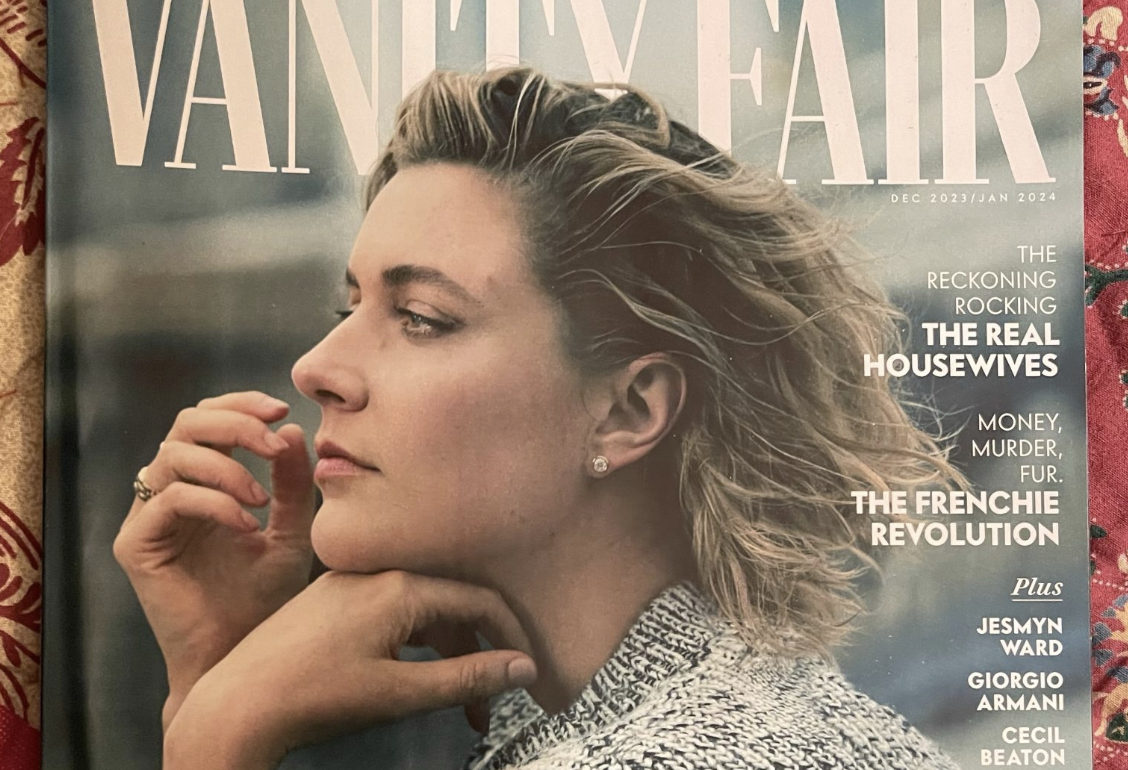
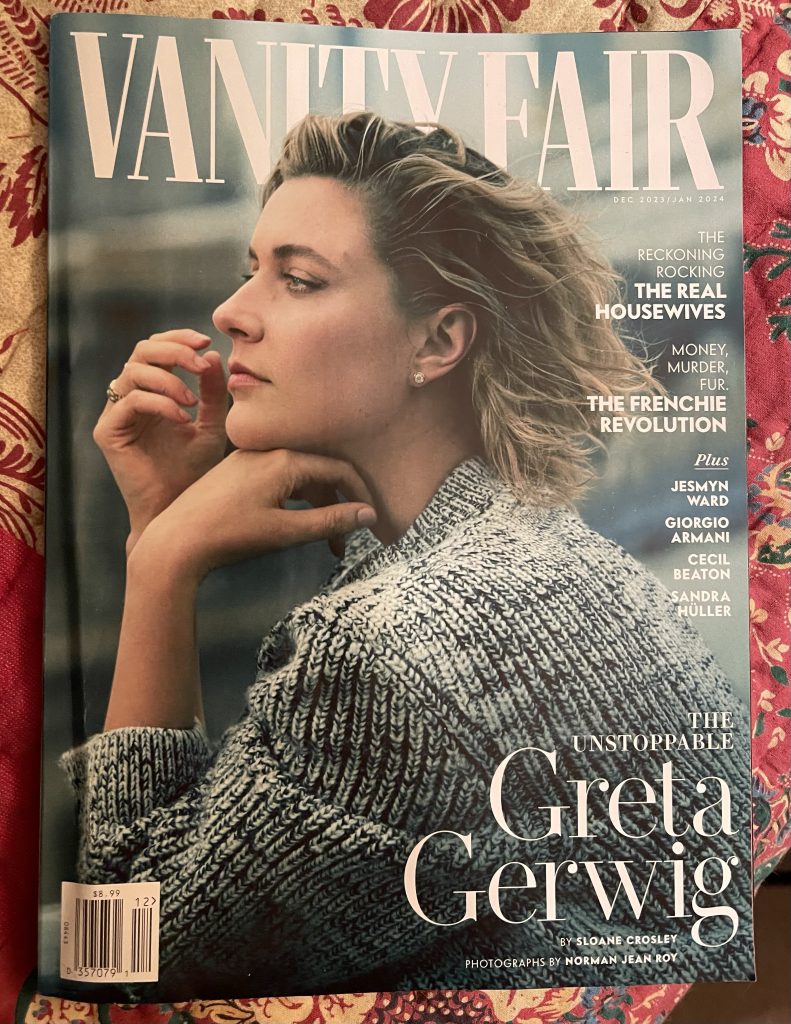
Barbie’s phenomenal summer success wasn’t/isn’t enough. Greta Gerwig wants Oscar ratification on top of all that. Even while Yorgos Lanthimos and Emma Stone’s Poor Things (i.e., Barbie meets Radley Frankenstein Metzger Satyricon) nibbles away at the mystique. Perhaps last summer will have to do?
Friendo: “Greta appears to be sniffing her fingers.”
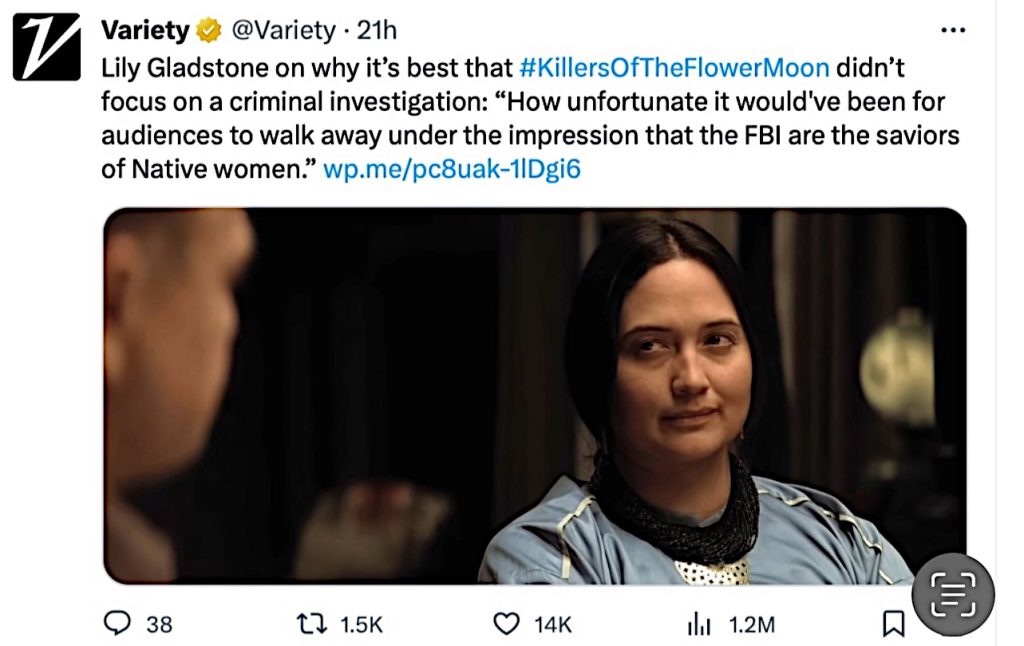
…but if Killers of the Flower Moon had resorted to the same dishonest-but-effective Hollywood tactics that Alan Parker’s Mississippi Burning deployed (depicting Tom White in roughly the same fashion as Gene Hackman’s charismatic FBI tough guy, well-crafted villain performances, sprinklings of historical bullshit, an emotionally satisfying resolution)…
If Team Killers had adopted an old-fashioned Alan Parker-like approach it wouldn’t have been as virtuous, but the popcorn crowd would have enjoyed it more.
I’ll never watch Killers again (twice was enough) but I could watch Mississippi Burning any day of the week.
White’s FBI team weren’t “saviors”, but they sure as hell busted William “King” Hale and Ernest Burkhart.
HE to Academy member who saw Poor Things at Fox Zanuck on 11.18: “Do you agree that Poor Things is basically Barbie meets Frankenstein? Or, if you will, Barbie meets Terry Gilliam + multiple orgasms + Fellini Satyricon?
“A feminist journey of self-realization and self-fulfillment in which Barbie channels Radley Metzger?
“What did the proverbial room seem to think or feel about it? It was speculated back in Telluride (where it was rapturously received, to put it mildly) that the older Academy crowd might have problems with it.
“Jeff Sneider tweeted that he didn’t like it. Bill McCuddy told me the same thing, Perhaps it’s not as ‘Academy-friendly’ as some believe”?
Academy member to HE: “The somewhat younger crowd (average age around 45 ) went wild for the film. After a slow start they seemed to resist the tone, but they were eventually mesmerized by the film’s audacity.
“Emma Stone was applauded repeatedly during the q & a. She expressed her complete trust for her director as a key part of her willingness to repeatedly bare all.
“There was no mention of the screenwriter or screenplay during the q & a.
“And YES, it’s Barbie on steroids. Ten nominations, seven wins. Academy-friendly.”
The Film Stage’s Luke Hicks, filed on 9.1.23:
Posted on 10.2.23: Barbie and Poor Things are almost exactly the same movie — an attractive, spirited and completely naive (or childlike) young woman in her 20s encounters the big, bad, male-corrupted world for the very first time and somehow finds her way through the thicket, and emerges at the end of the tale with an emboldened, seen-it-all, “done with that bullshit” feminist attitude.
The only difference is that Poor Things is somewhere between throbbingly and obsessively sexual in an early ’70s sense of the term, and Barbie is plastic-ironic PG-rated by way of the Mattel corporation and a determination to be gay without actually being “gay”. Plus the only sexual act Barbie engages in, at the very end, is asking about birth control (“I’m here to see my gynecologist”).
Poor Things is obviously more perverse, not to mention more wildly imaginative in a Terry Gilliam kinda way, and Barbie is certainly slicker and more superficial in a consumer-friendly, vaguely toothless, wind-up-doll sort of way.
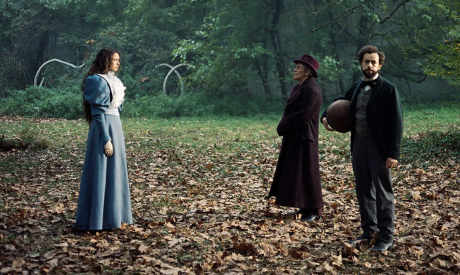
But when you get right down to it and boil out the snow, they’re pretty much the same movie, and this will factor heavily into the final voting for the Best Picture Oscar.
THR‘s Scott Feinberg, posted on 9.3.23: “While more than a few [Telluride] attendees found Poor Things — which I will only describe as Frankenstein meets Barbie, and which Searchlight will release on Dec. 8 — a bit too weird, and/or risqué and/or lengthy for their taste, the critical response to it has been off the charts.”
Critic friendo: “I agree completely [about the Barbie-Poor Things parallels]. I would add, however, that both movies are show-offy yet half-baked. In this context I’m almost enjoying the pile-up of woke piety — the Poor Things splooge fest.”
From Anthony Lane’s 11.17.23 Maestro review:
“Felicia Montealegre is the last character whom we see in Maestro, and the first actor’s name in the end credits is that of Carey Mulligan. This is her movie, and Bradley Cooper, to do him justice, knows it.
“How Mulligan can manifest such sweetness of nature without a trace of cloying, let alone mush, beats me. I spy a ghost of Julie Andrews in Mulligan’s smile, at once forgiving and brisk, and what she establishes, in Felicia, is the perfect ratio of rose to thorn. Hence the film’s best sequence, which is shot in one take, with no music and no camera movement at all. Mr. and Mrs. Bernstein talk, just the two of them, in a room overlooking Central Park West, during a Thanksgiving Day parade. The conversation stiffens into repartee, and then into rage. ‘If you’re not careful, you’re going to die a lonely old queen,’ Felicia cries.
“Behind them, through the window, we glimpse the huge head of a Snoopy floating by. Amid the Pax Americana, here is war.
“The movie does feature a death, though whose I will not reveal. Suffice to say that, in its wake, some viewers will have to be mopped up from the floor of the cinema. The looming pain is both sharpened and soothed not by Mozart or Mahler but by the sight of the Bernstein children larking around to Shirley Ellis’s ‘The Clapping Song.’ This is where Maestro scores.
“Spurning a fruitless bid at comprehensiveness, Cooper has conjured something as restless and as headlong as his subject. (‘I’m always just barely keeping up with myself,’ Bernstein once said.) To and fro we go, from the incisive bite of black-and-white, for the dawning of Bernstein’s fame, to the rich ironic glow of color in his later, grander, and less contented years; from the furious bliss of ambition to a kind of exhausted peace. And if Leonard Bernstein never got to star as Tchaikovsky in a Hollywood biopic, opposite Greta Garbo as the composer’s patron — a project that was seriously mooted in 1945 — then let us not lament too long. The guy had other things to do.”
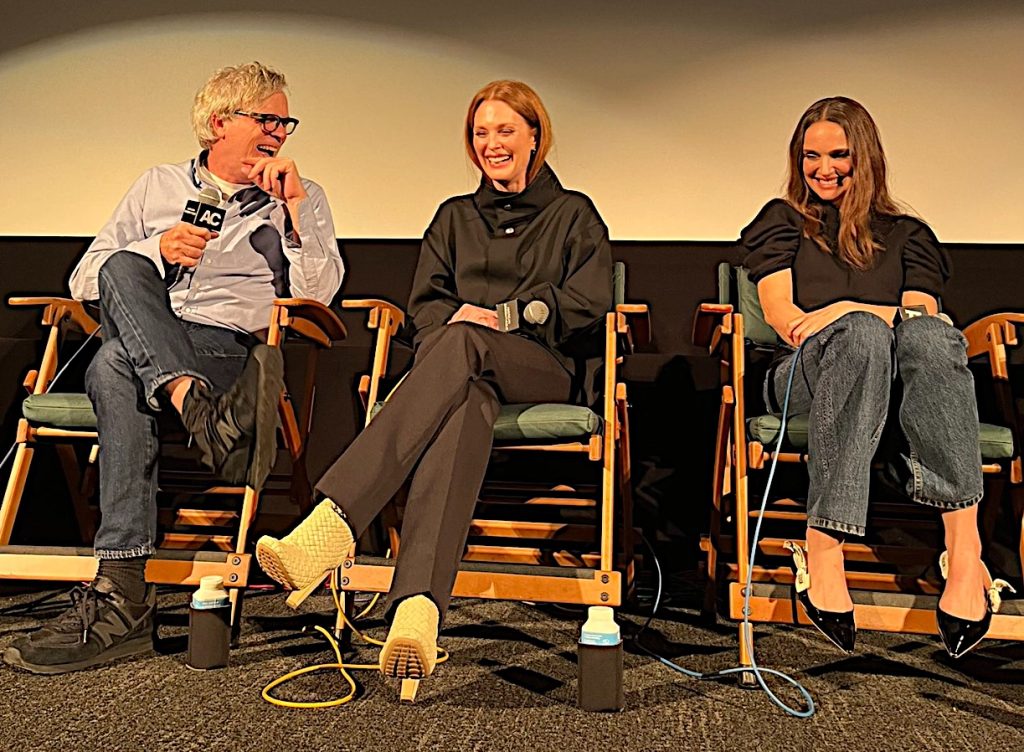
…in the sense that I would never, ever wear black schlubbo lace-up sneakers to a post-screening q&a. I would never wear those ugly-ass shoes anywhere. Look at Julianne Moore’s off-white, bubble-wrap, super-spiked heels (don’t know designer) and Natalie Portman’s shiny black uptown pumps with those angel wings-or-amulets-or-whatever-they-are stuck to the sides. Grade-A.
Just to clarify or simplify by comparing Blitz the Ambassador‘s The Color Purple (Warner Bros., 12.25) to Steven Spielberg‘s 1985 adaptation of the same 1982 Alice Walker novel, it shakes out as follows:
(a) Fantasia Barrino plays Whoopi Goldberg (the lead role of Celie Harris Johnson), (b) the Oscar-touted Danielle Brooks plays Oprah Winfrey (Sofia), (c) Taraji P. Henson plays Margaret Avery (Shug Avery) and (d) Colman Domingo plays Danny Glover (i.e., the cruel shithead called Albert “Mister” Johnson).
Fantasia Barrino talks about how after saying "No" to producers Scott Sanders and Oprah Winfrey ("Queen O"), it was director Blitz Bazawule that got her to say "Yes" to playing Celie in #TheColorPurple @Variety pic.twitter.com/96A2RywuYJ
— Clayton Davis (@ByClaytonDavis) November 18, 2023

The 60th anniversary of JFK’s murder in Dealey Plaza is four days off (11.22.23). Ditto the theatrical premieres of Maestro and Napoleon.
I haven’t taken the time to watch Barbara Shearer‘s JFK: What The Doctors Saw (streaming on Paramount +), but I’m not buying the occipital head wound claim. Never have, never will.
Two and a half years ago I explained very carefully why this dog won’t hunt. My argument is contained in seven irrefutable paragraphs.
Posted on 7.2.21: “I’ve watched many, many interview videos with those Parkland doctors, particularly around the time of the 50th anniversary (i.e., 2013), and not a single interviewer or moderator followed up with an obvious follow-up question, to wit:
“’Nobody’s challenging the accuracy of your first-hand observations,’ the doctors should have been asked, ‘but how do you explain the bizarre lack of ANY visual evidence in the Zapruder and Nix films…why is visual evidence that shows a rear-of-the-head blow-out…why is this supposed evidence completely missing in the Zapruder and Nix films? How do you explain this?”
“One could also mention the fact that LIFE’s Richard Stolley — the man who arranged for LIFE’s purchase of the Z film and who saw the raw Zapruder footage in Dallas right after it came out of the lab — it’s surely significant that Stolley never once mentioned any discrepancy between the raw Z film and the various color versions that eventually became ubiquitous after the Z footage was aired by Geraldo Rivera in the late ‘70s.
“Think of all the people who were ostensibly involved in the alleged alteration of the Z film…those at that alleged CIA secret Kodak lab in Rochester, not to mention Bethesda doctors who took pictures of Kennedy’s head wound during the autopsy, and how they all somehow managed to ignore or cover up the gaping occipital head wound WHILE AT THE SAME TIME creating ostensibly fake images of the top of the head and right temple wounds…
“Remember also how the blood and cranial brain matter somehow caught the sun’s reflected glare in Dealey Plaza in the Z film, and how difficult it would have been to fake this…
“Remember also that Jackie Kennedy’s white-gloved right hand touched the rear of JFK’s head right after the fatal shot and yet her glove wasn’t soaked in blood…
“And then imagine the number of people involved in this alleged conspiracy to hide and deceive, and ask why none of them — NOT ONE ALLEGED CONSPIRATOR — blurted out any kind of deathbed confession. People are generally terrible at keeping a secret, especially over a period of several decades. And yet every last photographic conspirator kept their yaps shut for decades on end. EVERY LAST ONE stuck to Moscow Rules to their last dying breath.”
This is one of my favorite passages from Roger Donaldson‘s The Bounty (’84). It contained Daniel Day Lewis‘s third screen performance, and the first that attracted limited attention.
The seven notable films that Lewis appeared in during the ’80s are my all-time favorites of his — The Bounty, My Beautiful Laundrette, A Room with a View, The Unbearable Lightness of Being, Stars and Bars amd My Left Foot, which resulted in his first Best Actor Oscar. (I’ve never seen Eversmile, New Jersey — has anyone?)
The increasingly choosey DDL made only five films in the ’90s, although all of them were utterly first-rate — The Last of the Mohicans, The Age of Innocence, In the Name of the Father, The Crucible and The Boxer.