Review rules

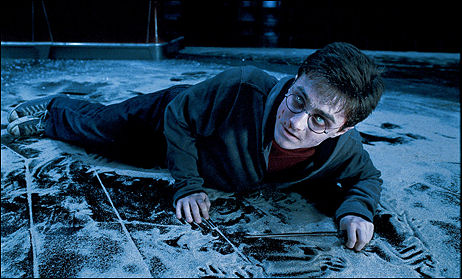
I posted a somewhat negative review of Harry Potter and the Order of the Pheonix two days ago, but I took it down 45 minutes later after a Warner Bros. publicist reminded me that an embargo demand (printed on the invitation, she said) stated no reviews until opening day — Wednesday, 7.1. Now I don’t wanna pickle, but I was scratching my head and feeling a little confused as I did the obedient thing.

It had seemed to me that the Potter cat was out of the bag last Friday with reviews already posted from Variety‘s Todd McCarthy, the Hollywood Reporter‘s Kirk Honeycutt, Time‘s Richard Corliss, Rolling Stone‘s Peter Travers, New York‘s David Edelstein and Emmanuel Levy.
And I mean particularly on top of last Tuesday’s David Halbfinger piece in the N.Y. Times that talked about the increasing trend of major publications going earlier and earlier on reviews, in part because of a kind of domino effect created by this site and Movie City News and other online sites going early-ish on reviews of certain films.
Halbfinger began his piece, in fact, by saying that Harry Potter and the Order of the Phoenix “does not open in theaters in the United States and Europe until July 11, but the reviews are already rolling in.” He also stated that “the odds that the New York Post and the N.Y. Daily News will hold their…reviews until the movie hits theaters are, roughly speaking, zero.”
Pheonix reviews aren’t a big deal. The big deal is whether or not J.K. Rowling will kill off Harry in the seventh and final novel, which comes out 7.21. Still, I’m wondering how to play this. I’m thinking if the N.Y. Post or the N.Y. Daily News run their reviews on Monday or Tuesday, then I’ll go that day also.

Edelstein on “Phoenix”

“Having confidently proclaimed that David Chase would learn the lesson of John Updike‘s Rabbit and not kill off Tony Soprano too early (Come on, folks, he’s dead, dead, dead), I’m loath to predict what July 21 — and the final Potter book — will bring. But the film of Harry Potter and the Order of the Phoenix is the best enticement imaginable. It rekindles the dread, the ache in your stomach that says, ‘He can’t die!’ — and at the same time, ‘How can he defeat everything racist, repressive, and murderously Fascistic in the world without making the ultimate sacrifice?'” — from a current review by New York magazine’s David Edelstein.

Taylor on “Factory Girl”

I’ve been dinged here and there for speaking highly of the early, funkier version of George Hickenlooper‘s Factory Girl, and for pushing Sienna Miller for Best Actress. So it’s satisfying to note that contrarian tough guy Charles Taylor has reiterated his support of this embattled film in a well-reported history in today’s N.Y. Times that covers the ride from inception to production to theatrical release.


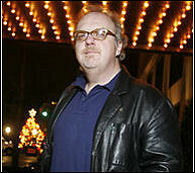
George HIckelooper, Sienna Miler

“On July 17, thanks to DVD, the public will get to see the fuller version that Hickenlooper, Harvey Weinstein and producer Holly Wiersma were frantically working with last December,” he says. “It’s not the documentary-style cut that Hickenlooper, a documentarian himself whose credits include Hearts of Darkness and Mayor of the Sunset Strip planned when he originally laid out his vision of the film to Wiersma. But it does flesh out the somewhat truncated version that eventually made it into theaters.
“The new version confirms the mixture of empathy (for Sedgwick) and cold-eyed appraisal (of Warhol) evident in the theatrical version. And it confirms the extraordinary power of Miller’s fearless performance, as well as deepens the storytelling.”

Spielerg & Farnsworth

The motive behind Steven Spielberg‘s co-financing and co-producing the forthcoming Broadway presentation of Aaron Sorkin‘s The Farnsworth Invention, about a boy genius named Philo T. Farnsworth who invented television in high school in 1927 only to be ripped off by RCA’s David Sarnoff over the patent, seems obvious. Spielberg is looking to produce and perhaps direct a film version. The golly-gee-gosh American-ness of that name — Philo T. Farnsworth sounds like the cousin of Clem Kadiddlehopper — and the theme of an innocent genius being hoodwinked by big-city tycoons is right up Spielberg’s alley. The question is how different will the movie be (if it gets made) from Francis Coppola‘s Tucker?

Bloggers AFI Ballot

Allan Bacchus of Daily Film Dose is attempting to recreate a new AFI Top 100 American films list, but one based upon the fanboys/cinephile/blogger point of view. He’s using the same guidelines and procedure as the AFI (enabling a ‘shadow’ list to be created) and is inviting HE readers to participate. A ballot can be be downloaded from the blog posting. He’s looking for 1500 voters, which is what the AFI had. It would be good if a significant percentage of the 1500 voters (presuming he accumulates that many) could be drawn from rank-and-file online journo-bloggers.

“Wilson’s” aftermath

HE reader Nate West took exception yesterday to my description of Charlie Wilson’s War — the reading of Aaron Sorkin‘s script, I meant — as “a feel-good ride.” He said that a line I used about the admirable actions of the three main characters (played by Tom Hanks, Phillip Seymour Hoffman and Julia Roberts) having consequences that reverberate throughout the world today is an oblique reference to a certain catastrophic 21st Century event.
“The real story of Charlie Wilson’s War isn’t about victory,” he concluded. “It’s about blowback. Perhaps those seeking a feel-good ride aren’t interested in such ironies.”
My answer was yes, it’s mostly a feel-good ride…until the last 19 or 20 pages. Yes, it’s about blowback, as in “no good deed goes unpunished.” Which, of course, is the most common definition of irony in the book.
Truth be told, I’m not quite sure how I feel about the ending. It’s striking and of course it delivers a turn in the road — call it an end-of-the-third-act thud — and it’s obviously truthful. It’s just that I don’t know what the movie is saying about the journey of our three characters except the obvious, which is that they performed craftily and wonderfully until the whole thing turned around or metastasized several years later at which point they were left with very mixed and confused feelings. Which will be true for the audience also, I suspect.
But it’s a hell of a good ride (and wonderfully written in that smart, sassy, Sorkin-esque way) for the first 136 pages. And that ain’t hay.

“Charlie Wilson’s War”

I took another stab last night at reading Aaron Sorkin‘s script of Charlie Wilson’s War, and now, on page 32, I’m finally feeling the heat of it. (I don’t know why I couldn’t get into it before.) I’m particularly revved about what Philip Seymour Hoffman will do with the part of Gust Avrakotos, a Middle Eastern intelligence operator. The script is a pleasure to read, but Hoffman’s part is delicious. It’s like ice cream.


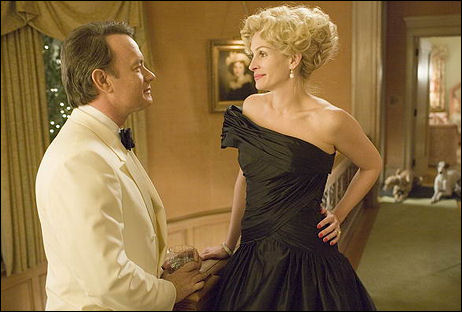
Tom Hanks, Julia Roberts in Charlie Wilson’s War

Charlie Wilson’s War is the true story of how a play-it-as-it-lays, cruise-along Texas Congressman (Tom Hanks), Hoffman’s CIA agent and a rich Houston socialite named Joanne Herring (Julia Roberts) joined forces to lead “the largest and most successful covert operation in history,” according to one synopsis.
The efforts of these three, it says, “contributed to the fall of the Soviet Union and the end of the Cold War, with consequences that reverberate throughout the world today.”
I finally saw Charlie Ferguson‘s No End In Sight last night, a brilliant but devastating doc about the Bush administration’s disgusting mismanagement of the situation in Iraq following the March 2003 invasion. The pain and rage we’ve caused over there is incalculable. I came out of this film seething with anger at the Bushies. It made me want to see them strung up. And now along comes this big-studio upper about Americans — three likable renegades — doing the right thing and making it up as they go along and changing history.
Charlie Wilson’s War is based on truth, but it reads like a feel-good ’80s nostalgia ride for people who want to remember a time when Americans were effective in that area and even liked, as opposed to how things are today in Iraq and Afghanistan.
The MIke Nichols film is about Charlie, Gust and Joanne travelling the world (Joanne not as much — Roberts’ role is smaller than Hoffman’s and much smaler than Hanks’) and forming unlikely alliances among Pakistanis, Israelis, Egyptians, arms dealers and lawmakers. “Their success was remarkable,” it says here. “Funding for covert operations against the Soviets went from $5 million to $1 billion annually. The Red Army retreated out of Afghanistan.
“When asked how a group of peasants was able to deliver such a decisive blow to the army of a superpower, Pakistani President Mohammad Zia ul-Haq responded simply, ‘Charlie did it.'”

“Frankenstein” in Seattle

The first out-of-town, pre-Broadway run for the stage musical version of Mel BrooksYoung Frankenstein begins at Seattle’s Paramount theatre on Saturday, 8.4, and closes Saturday, 9.1. The tickets are steep ($175 for orchestra/mezzanine) but they’ll be nowhere near as outrageous as the prices New Yorkers will pay when it starts previews at the Hilton Theatre on 42nd Street on 10.11. (The official opening is on 11.8.) I’m told that premium seats will go for $450 on weekend nights and $375 on weekday nights. I could not in all good conscience part with that much money to see a Mel Brooks musical. I’m happy just watching the DVD of the 1974 film.

The costs of “Ultimatum”

The ad slogan for The Bourne Ultimatum (Universal, 8.3) is “this summer Jason Bourne comes home.” But if the Universal marketing guys were to dream up a slogan that honestly characterizes the financial realities behind the making of the third Bourne flick, it might read “the more money an action franchise earns, the more money the next installment will cost. Just ask Jason Bourne.”
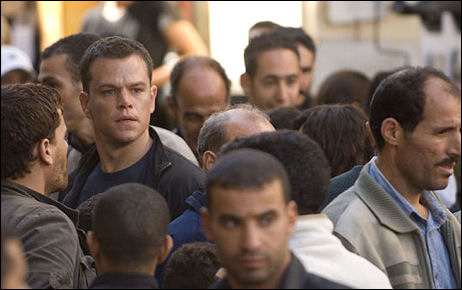
That’s a fairly dull slogan so let’s stop cute-ing around and get down to brass tacks. I was told last night that The Bourne Ultimatum, which is locking its final release print over the holiday, has cost more than the first two Bourne films combined, or $175 million. (The Bourne Identity and The Bourne Supremacy both cost $75 million each to shoot, per IMDB and Wikipedia.) The Universal position is that Ultimatum cost $130 million. Big gap there.
I really and truly don’t give a toss how much The Bourne Ultimatum cost. All big-studio movies seem to end up costing a fat pile, and it’s hard to sustain an interest in such things when everything is $100 million this and $200 million that. I just want the film to be good, and a slightly prejudiced friend of Ultimatum tells me it’s “flat-out great, and that’s what should matter most of all.
“One of the things that distinguishes the Bourne films is that authentic, you-are- there, on-the-ground subjective shooting style — that near-verite trademark feel,” he says. “The production visited Morocco, Paris, London, Spain, Berlin and New York, but the Bourne series is not one of those metastasizing, ever-inflating behemoths like some other franchises. [Director Paul] Greengrass has become an even more accomplished director since the last go-’round and his virtuosity is one of the things that is a hallmark for Ultimatum.”
Okay, but I don’t want to experience the same heebie-jeebie, super-shaky handheld photography and spazzy machine-gun cutting that was used in two or three of The Bourne Supremacy‘s action sequences. Some moviegoers went with it, and some (including myself) found it infuriating. I was saying to myself, “Stop whipping the camera around and cutting everything so fast…it’s too much work to follow what’s going on!”
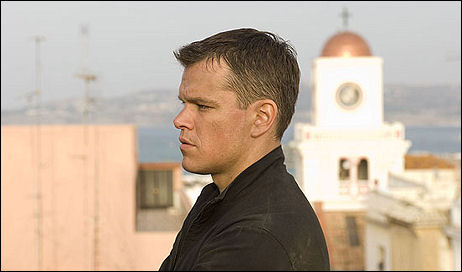
Where were we? Oh, yeah, the higher costs. I’m told that the engorged Ultimatum tab is due to an alleged 35 days of extra shooting above and beyond the original principal photography schedule. (The Bourne Ultimatum began shooting on 10.2.06.) “They weren’t happy with what they had so they kept going back in stages and adding or re-shooting this and that,” is how it was conveyed to me by an off-the-lot source.
This sounds like a pretty good thing from an audience perspective. The more exacting and perfectionist Greengrass and producer Frank Marshall were, the better the final film is likely to be…right?
I tried to get my Universal insider to confirm or question the “extra 35 days of shooting” story, and he replied that “none of that can accurately be told. It’s not a matter of ’35 extra days’ or the schedule starting on this day and going until that one. There were hiatus breaks built into the schedule as well, so it can’t be said that it started here and shot till then. The hiatuses were built in to accommodate the unorthodox schedule.”
All he would say beyond this is that “‘additional’ stuff was shot in all locations. The same was true of Supremacy and Identity.”
Universal’s Bourne Ultimatum website says Identity and Supremacy have earned over $500 million in global box office. Wikipedia says Supremacy did $288,500,217 worldwide and Identity did $213,925,107 million. Supremacy, in other words, made almost four times as much as it cost to shoot (i.e., $75 million), and Identity earned almost three times as much as it cost to shoot (i.e., ditto).
Boil it all down and the higher budget figures (be it the official $130 million or the alleged $175 million) suggest that Ultimatum can’t be the breadwinner that the first two films were.
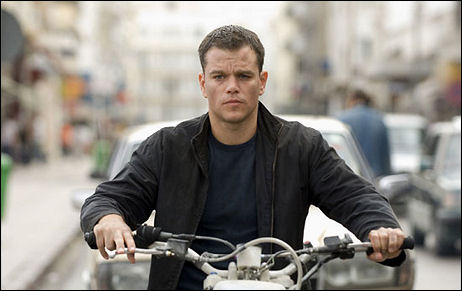
The Ultimatum friend argues that using a budget-gross ratio formula “loses steam when you consider the nature of franchise revenues and how this series has built considerably from first to second film and how those ancillary revenue streams — everything from DVD to TV, etc — are different for the third in a successful series.”
I told him that I absolutely love that shot in the Ultimatum trailer of Damon jumping from one building to another in Tangier with the camera jumping right along with him. “A very cool CG shot,” I said. But it’s not that, I was told. “The cameraman actually followed the jump and caught that as a practical,” the Universal guys says.
With a crane, I presume he meant. The shot is so smooth and flotating it’s hard to believe it’s not a digital creation. I’ve watched it five or six times this morning. The guy just wrote back and said “not a crane — the cameraman made the jump himself off the roof!” To which I replied, “Oh, come on…!!”