

Allan Murray and Sean Haines‘ “Paris in Jail” parody video is…not bad. Amber Hay, who plays the jailbird heiress and voices the vaguely catchy song, is slightly more hoochy-kooch than Hilton herself. Here’s the “Hurry Up!” version of same.
Caro dissing Farrelly Bros. “Kid”
Pop Machine‘s Mark Caro rips into the Farrelly Brothers‘ The Heartbreak Kid (Dreamamount, 10.5.07) with Ben Stiller in the Charles Grodin role.
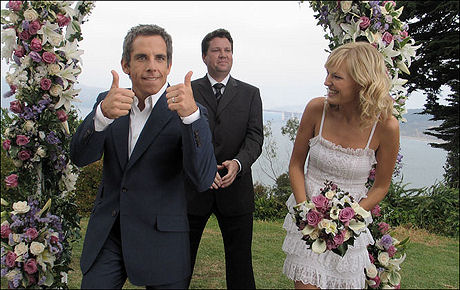
Going by the trailer, Caro suspects the feature may be a cowardly, slapstick-shallow, hopelessly dumbed-down non-echo of Elaine May‘s original The Heartbreak Kid (1972), which was funny but at the same time traumatic, angst-y and occasionally cruel. My favorite scene was the abrasive after-dinner confrontation between Grodin and Eddie Albert (i.e., playing Cybil Shepherd’s dad), in which Albert tried to buy Grodin off.
Caro understands, of course, that every remake of a film made in the ’60s, ’70s or ’80s has to be cruder and dumber than the original. He realizes that today’s under-35 moviegoer need things to be broader, louder, blunter, etc. “Hit me with it!…no, pour it over my head!” works much better than “nudge me in the ribs” or “whisper it in my ear.” Nonetheless, Caro is pissed.
Hurt in “The Incredible Hulk”
It’s always somewhat depressing when a masterful older actor who’s enjoying one of those rare late-period career grooves accepts a straight paycheck job as a villain in an empty-ass franchise flick.
I mean, just reading the damn trade stories about same deflates your world. Oh, that’s right, you tell yourself — I forgot that what a pleasure it is to watch amazingly talented performers punch a clock and debase themselves. Every so often, life requires us to bend over and hold our noses in order to pay the bills, but it’s extra-gloomy when guys like William Hurt succumb.
Here’s an indication of what Hurt is facing and why he’s more open than usual to straight-paycheck jobs.
Secrecy is repugnant
I’m trying to imagine the mass incomprehension and shock waves that would result if a U.S. President were to deliver such a speech in today’s paranoid climate. Forget the nostalgic aspect — just try to imagine a U.S. President actually speaking these words. The mentality behind it is so far above and beyond the realm of the current White House occupant that the speaker sounds almost like someone from another planet, or certainly like a being created from a wholly different gene pool.
Spielberg and Hilary
More proof positive that Steven Spielberg doesn’t get what’s going on out there, and lives in a rich-older-liberal-guy realm that allows for only brief glimpses and glancing comprehensions about the political and cultural truth of things.
Spielberg’s powers of perception about the shape of shifting sands are obviously dwindling, which means, of course, that Indiana Jones IV won’t be as good as Indiana Jones and the Last Crusade, much less Raiders of the Lost Ark, because if you’re missing stuff in one arena, you’re almost certainly missing stuff in other realms. You’re either sharp all around the track or you’re not.
Hilary is a shrewd, tough, savvy politician — I respect her as far as it goes — but she is Old News, she is the ’60s and the ’90s, and she will certainly bring the Democrats down to defeat in November 2008. Rudy Giuliani, if he’s nominated, will most likely beat her, and Fred Thompson, who will probably be the Republican nominee (he essentially announced last night on Jay Leno) will absolutely whip her ass.
Validity of “Sicko”
Michael Moore‘s Sicko is “agitprop,” says Toronto Star national affairs columnist Thomas Walkom, but “it is fundamentally accurate. Moore is making a film for Americans, and what he is telling his compatriots is very simple and very true: that America’s refusal to embrace some kind of universal health care system makes absolutely no sense.
“Nor, outside of the U.S., is this a remotely controversial point. In Canada, no one except for a few diehards in the right-of-center Fraser Institute lionizes the U.S. system. Dr. Brian Day, the incoming head of the Canadian Medical Association, is a vigorous critic of Canadian medicare. But he touts French or German medicare, not the U.S. model. Ditto Preston Manning, the former Reform party head. He says he wants a two-tier system that would keep the existing universal system.
The reason is simple. Universal public medicare works – which is why every industrial country outside of the U.S. employs some form of it.
“For those who choose to read the scholarly literature, the evidence is overwhelming. Americans spend more per capita on health than any other nation in the world and get worse results. This is not just Michael Moore talking; it is the Organization of Economic Co-operation and Development. When Moore says Canadians live on average three years longer than Americans, he is correct. When he says infant mortality rates are lower in this country than the U.S., he is right there too.
“It’s not just Canada. United Nations figures show that a baby born in Havana has more chance of surviving than one born in New York City. The British live longer than Americans as do the French and Japanese. Is it simply coincidence that all of these countries, save the U.S., have some form of universal public care system?”
Moore in Sacramento
“There’s no room for the concept of profit when it comes to taking care of people who are sick. Those questions of ‘how will this affect our bottom line? How will this affect our profits?’…these are immoral questions, and they should never be asked. We have to eliminate the private health care companies from the health care system. It’s time for them to go!” — Sicko director Michael Moore speaking at a very recent health care rally in Sacramento.
Esquire covers (Jolie, Johansson)
The hottest Esquire cover in several years, perhaps decades. I bought a copy in Newark airport last week, but until yesterday a thumbnail capture wasn’t viewable on the Esquire site….slackers.
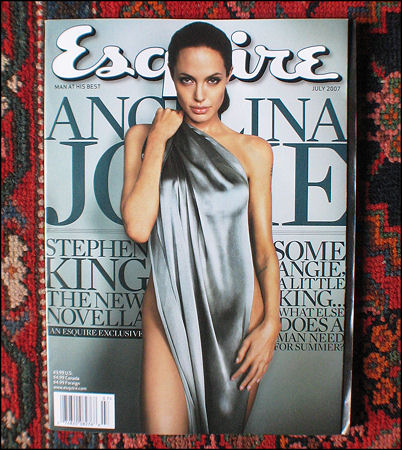

The Jolie cover, of course, in no way makes up for the magazine’s (and particularly editor A.J. Jacobs‘) surreal, shark-jumping, bordering-on- deranged obsession last year with Scarlett Johansson. Esquire has been on indefinite probation status because of this. If it weren’t for those “What I’ve Learned” pieces, I would be boycotting the magazine right now over this. The only thing that will make up for the Johansson fixation right now is an online mea culpa statement from Jacobs and an apology from the editors.
Joe Queenan said it in the Guardian last December and I tried to explain the same thing last March: Johansson is over. Until she lucks into another semi-startling, Match Point-level part or re-invents herself in some other way.
Johansson’s acting repertory, Queenan said, “consists of staring intently at the person she is speaking to, keeping her lips spread apart, and hoping no one will notice that she is no threat to Meryl Streep, and not all that much of a threat to Hilary Duff.”
Radical Honesty
A 66-year-old Virginia-based psychotherapist named Brad Blanton, profiled by Esquire‘s A.J. Jacobs, “says everybody would be happier if we just stopped lying. Tell the truth, all the time. This would be radical enough — a world without fibs — but Blanton goes further.
“He says we should toss out the filters between our brains and our mouths. If you think it, say it. Confess to your boss your secret plans to start your own company. If you’re having fantasies about your wife’s sister, Blanton says to tell your wife and tell her sister. It’s the only path to authentic relationships. It’s the only way to smash through modernity’s soul-deadening alienation. Oversharing? No such thing.”
Signature of damnation
The day after that perplexing Sopranos finale, I compared it in one respect to the ending of Alfred Hitchcock‘s The Birds. Now MCN’s Larry Gross has compared it to unexpected killing of Janet Leigh in Hitchcock’s Psycho:
“There’s a famous choice in movie narrative that nominally offers resolution but in fact destroys the possibility of conclusiveness even more monstrously than this Soprano’s finale. That is the murder of Janet Leigh in Psycho, [which] did not emanate as an inspiration, from the psychological necessities of the character of Marion Crane in that movie, nor was it in any meaningful way a ‘resolution’ of her story.
“It was in fact the most aggressive insult to ‘meaning’ in the history of cinema. Marion Crane‘s death is precisely as black and arbitrary as the black screen that ended The Sopranos as a series.”
Gross also weighs in on did-Tony-get-hit?: ” Chase is not tantalizing us with specific narrative issues. There’s no one in the story left to kill Tony and the danger of a cop bust has already been covered in the scene with his lawyer. Tony’s anxious fearful looks to the door are not narratively specific. They are signatures of his soul’s perpetual divided state, as Michael Corleone‘s blank impassive stare was the signature of his damnation.”
Dowd on Chase
N.Y. Times columnist Maureen Dowd is calling Sopranos creator David Chase “an apocalyptic tease” and claiming that last Sunday night he “gave us a gimmicky and unsatisfying film-school-style blackout for an end to his mob saga, a stunt one notch above ‘it was all a dream.’ It was the TV equivalent of one of those design-your-own-mug places.
“Even though I loved the first few years of The Sopranos, Chase always struck me as passive-aggressive,” she opines. “The more fans obsessed on his show, the longer his hiatuses would grow and the slower his narrative velocity moved. His ending was equally perverse, throwing the ball contemptuously back at his fans after manipulating them and teasing them for an hour with red herrings — and a ginger cat.
“Surely, after eight years with this family, we deserved some revelation better than ‘life goes on…or not.'”
Obama would beat Republicans
“New York Sen. Hillary Rodham Clinton maintains a solid lead at 33%, followed by Illinois Sen. Barack Obama at 22%. [And] yet despite Clinton’s lead, Obama is the strongest Democrat in hypothetical match-ups with Republicans in the general election, running even or well ahead of the GOP’s top contenders. Obama would defeat Giuliani, 46% to 41%, the poll found. Clinton, in a showing that could spark concerns among some Democrats, does not fare as well. Against Giuliani, the poll found she would lose by 10 percentage points.” — from Michael Finnegan‘s L.A. Times story about a recent Times/Bloomberg poll.