“Black Book,” Verhoeven

A curious blend of wartime realism, undercover- spy suspense and almost exploitation-level sexuality, Black Book (Sony Pic- tures Classics, 4.4 in NY and LA) is Paul Verhoeven‘s strongest and most fully-felt film since Robocop (’87) and before that Soldier of Orange (’77). This World War II thriller — a surprise — is one of the three genuinely first- rate ’07 films so far, along with Zodiac and The Lives of Others.
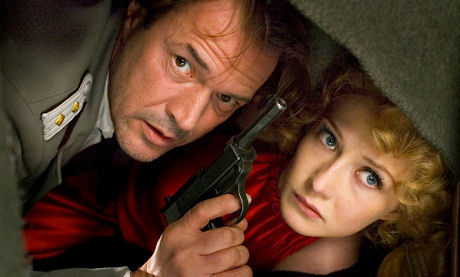

Sebastian Koch, Carice Van Houten in Paul Verhoeven’s Black Book

Set in late 1944, it’s basically a revenge piece — a saucy Dutch lady named Rachel Stein (Carice van Houten) bonds with the Dutch resistance in order to stick it to the Nazis who murdered her parents in cold blood. (For profit, as it turns out.) She goes undercover as a worker at SS headquarters, and eventually as the lover of a local SS commander (Sebastian Koch), which is further complicated when she falls for the guy in earnest.

It was a smart move for Verhoeven to return to the Dutch turf from whence he came. It obviously made sense from a spiritual as well as a “back to roots” perspective. Over the last 20 years he’s been one of the biggest envelope-pushers in the realm of the salaciously sexual (Basic Instinct, Showgirls) and the ultra- violent (Starship Troopers, The Hollow Man), but there’s been a sense for some time that Verhoeven’s well has been running dry. I said to myself a long time ago (somewhere between Showgirls and Starship Troopers) that he’s probably “over” — wrong!

Black Book is a stab in the direction of Roman Polanski‘s The Pianist — a WW II drama partly fuelled by Verhoeven’s own experiences while growing up under the Nazi occupation.

Black Book is tight and well-crafted and finely tuned, but yet it’s clearly a cranked- up thing. It doesn’t strive for the stark realism or solemnity of The Pianist — it’s an entertainment about intrigue, sex, betrayal and the constant possibility of sudden violent death at the hands of the bad guys.
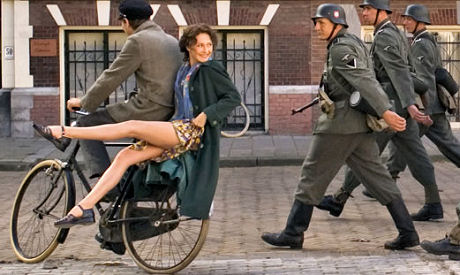
And even that’s not what it seems. There are one or two plot turns that remind us that even in World War II, one of the most clear-cut, good-vs.-evil conflicts of the 20th Century, filthy lucre rules and the defining of good vs. evil will always flow from that.

Verhoeven’s feverish plotting and energetic shooting and cutting keep it all going, and Van Houten’s spunk and sexiness provide much of the flavor and panache, Black Book has a few sex-and-nudity scenes (par for Verhoeven) and that’s always agreeable, although the notion of hot bods and fired-up loins argues strenuously with the horrific realities of Nazi-occupied Holland. In my head, at least.

Koch, the conflicted playwright in The Lives of Others, plays a decent Nazi who’s lost his family and has succumbed to a resigned sadness about the scheme of things, and hence a kind of humanity. (Buy it or don’t.) Halina Reijn, who plays Rachel’s sexually active friend (she’s the lover of a flabby-bellied Nazi pig), holds her end up nicely.

I just wish I could find a website that tells the real story, or the one that inspired Verhoeven and co-writer Gerald Soeteman to write the Black Book screenplay.
Minkler apologizes

A lot of heat has been coming down on sound-mixer Michael Minkle for dissing sound-mixer Kevin O’Connell who’s been Oscar-nominated and lost 19 times, last Sunday night during an Oscar press conference. “I think Kevin should go away with 19 nominations,” he said. “Kevin is an okay mixer, but he should take up another line of work.”

A lot of industry people have voiced anger at Minkle for these words. Editor Walter Murch allegedly sent out an e-mail yesterday condemning Minkle for his words, and now Minke himself has sent out an e-mailed apology (which was sent to be by a big-city reporter who wants anonymity):

“Gentlemen, Friends, and Colleagues,

“A very unfortunate situation has developed because of my stupid answers to some inappropriate questions. I did not seek this spotlight√É‚Äö√Ǭ≠ — the press did, as they have in the past. It was wrong of them to ask the questions, and wrong, wrong, wrong of me to answer them the way that I did.

“I apologize to all of you for creating a messy situation, and exposing the appearance of any dissention among our ranks.

“The press has been asking me questions about Kevin since 2002. They continue to hound me with the same questions again and again, and this time I lost control, using bad choices of words and bitter sarcasm. The award should be about the work—period.

“It is always my concern to preserve the Oscars’ significance to the filmmaking community and its international audience. My thoughts got away from me at an emotional time, and that I regret.

“My response to the last question was off-the-cuff sarcasm meant as humor. However it seems that it has caused even greater reaction…shock. I wanted to end the questioning and those words came out. Not funny. I am very sorry. The time and place was wrong for any of it.

“Adding sentiment to this unfortunate situation has of course been the sorrowful passing of Skippy O’Connell.” (He means Kevin O’Connell’s mom, who died last Sunday night.) ” My sincere condolences go out to the entire O’Connell family.

“I have been in communication with Kevin directly, and I wish the best for him in the future. I am sure that he will receive his due recognition on that same stage very soon, and I will be the first to congratulate him.

“In my career, I’m sure that I have accidentally hurt people, but I’ve never intentionally sought to do harm. I ask forgiveness from them. I have given shots and taken some, but I don’t believe that at any time, true malice was the objective.

“I appreciate you sharing your personal thoughts with me, as I always have. I now thank you for allowing me to share mine with you.

“Respect to all, Michael Minkler

Loder and Fincher

David Fincher has spoken with MTV.com’s Kurt Loder about some future projects — an Elliot Ness movie, a possible remake of a ’70s Michael Sarrazin movie with one of the worst titles in history — The Reincarnation of Peter Proud — and a World War II film that Robert Towne is writing (which Towne forgot to tell me about yesterday when I asked him what’s doing in terms of new projects)

Loder: “You obviously have an affinity for the serial-killer genre. I’d imagine you don’t want to make a career of it, but you are considering making a film version of Torso, aren’t you?”

Fincher: I’m interested in that [but] I’m not interested in the serial killer thing, I’m interested in Eliot Ness. I’m interested in the de-mythologizing of Eliot Ness. Because, you know, The Untouchables was only two or three years of the Eliot Ness story. There’s a whole other, much more sinister downside to it. And so that’s of interest to me. We want to make it the Citizen Kane of cop movies.

“I also want to make a CG animated movie. And I’ve been talking about doing a remake of a movie I really liked in the ’70s, The Reincarnation of Peter Proud. Ever see that? And there’s a World War II movie that Robert Towne is writing that I really love. All kinds of stuff.”

If Fincher eventually does the Peter Proud remake, he will have made two films with fanciful lame-ass male names in their titles — “Benjamin Button” (as in The Curious Case of Benjamin Button) and P.P. The titles are so hateful they’re probably going to work as roadblocks on some level. If I were Paramount, I would call the Brad Pitt movie Button — a little twee but preferable to the original F. Scott Fitzgerald title.

Never won a Best Director Oscar

This is a little bit bizarre. I’m almost shocked. 13,127 IMDB readers voted to nominate “the best contemporary American director who has never won a Best Director Oscar“, and the two biggest vote-getters were a couple of signature-style “attitude” guys — Quentin Tarantino, a dedicated lazybones and wallower in all things exploitation-y who peaked 13 years ago with Pulp Fiction, and Tim Burton, whose artistic focus from the late ’80s to mid ’90s (Beetlejuice, Batman, Edward Scissorhands, Ed Wood) spoke for itself and obviously contrasts with the fact that he’s been sliding downill since, the lowpoint so far being Charlie and the Chocolate Factory.

David Fincher got about a third of the votes that Tarantino got (804 compared to 2777), and Michael Mann — a hard-tack adventurer who’s constantly probing and testing himself, an auteur of the street and macho-ville, a guy who stands head and shoulders above Tarantino and Burton in the eyes of the Movie Gods — ranked sixth with 775 votes. It’s significant that visual flair, punchy attitude-dialogue and a certain fast-foodish, blue-collar commonality are more highly prized and admired than other directors who are really and truly up to something, but whatever. People like what they like and that’s fine, but there’s no accounting for taste.

Terrence Malick ranked eighth with 562 votes, Wes Anderson eleventh with 344 votes, and Alexander Payne 14th with 163 votes…gimme a break.

“Zodiac” premiere

They didn’t know what they had,” a guy said last night at the Zodiac premiere. “Big studios almost never get it [i.e., the value of any film they’re about to release]. Until it makes money. Then they’re delighted.”


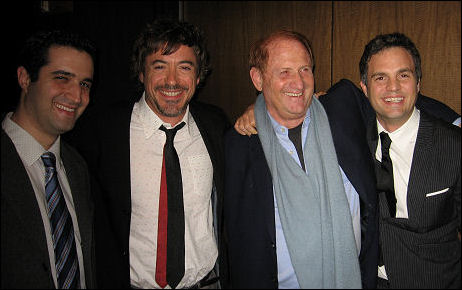
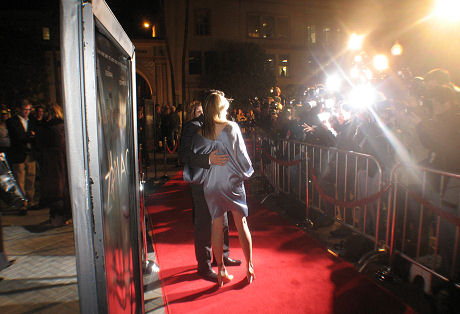
A significant portion of the Zodiac team — (l. to r.) producer Brad Fischer, costar Robert Downey, Jr., producer Mike Medavoy, costar Mark Ruffalo (r.) — at last night’s modestly-proportioned premiere on the Paramount lot.

He was speaking of the Paramount execs who decided not to release Zodiac in late December of last year, a move that eliminated any chance of the film appearing on just about every ten-best list from the big-gun critics (which would have happened, no question) not to mention the potential winning of some Best Picture honors from critics groups as well as acting nominations for at least two of the three Zodiac leads — Robert Downey, Jr. and Mark Ruffalo.

(This is not to disrespect the work of costar Jake Gyllenhaal, who’s less overtly actorish in Zodiac and much more burrowed into the soil and milieu than he’s ever been — I think it’s his career best. The fact that he’s outmaneuvered by Ruffalo and Downey in terms of style, swagger and authority is nothing to feel badly about.)

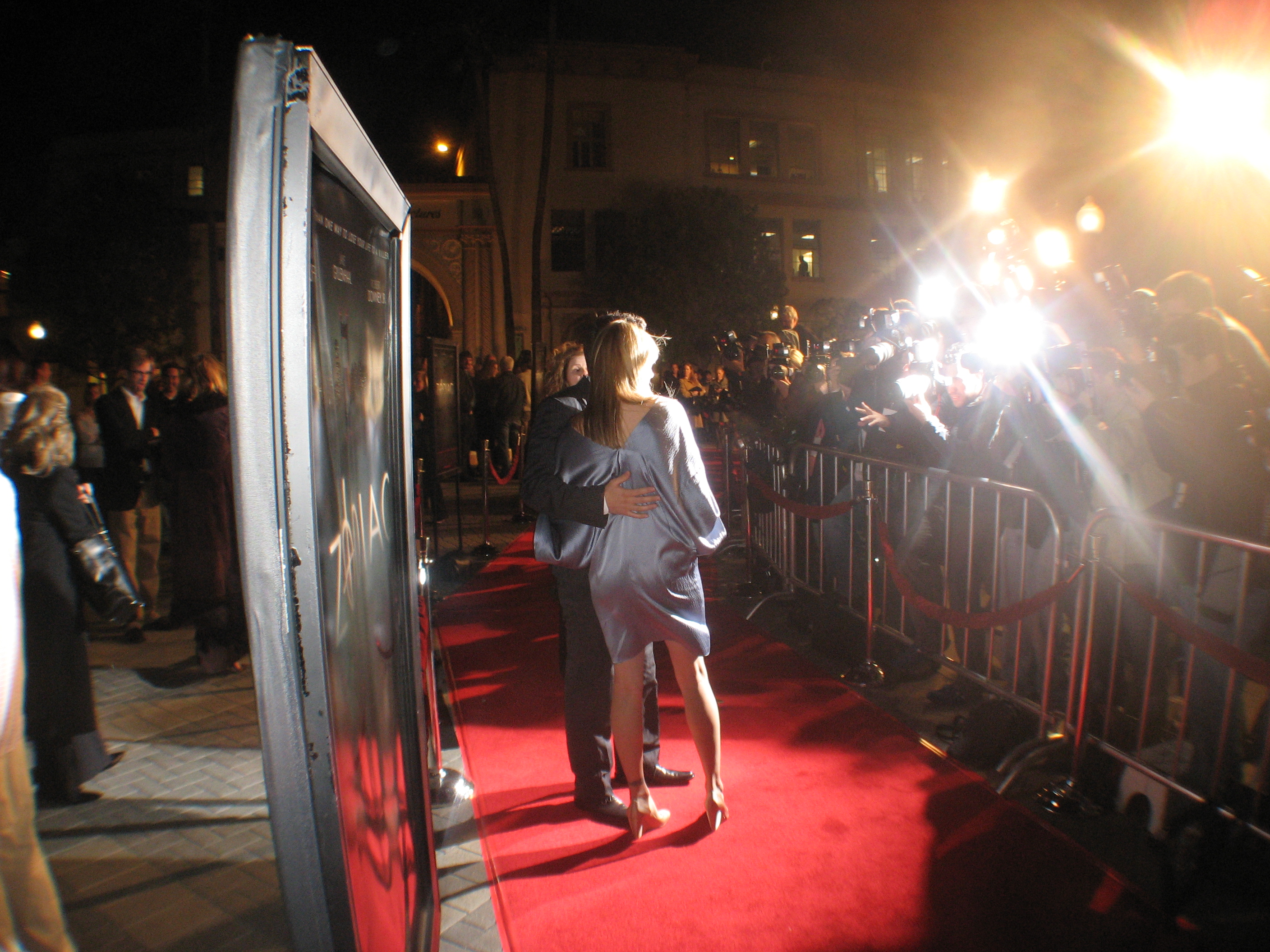
Downey, Ruffalo, producers Mike Medavoy and Brad Fischer, costars Donal Logue (extremely slimmed down) and Philip Baker Hall, various other cast members and Paramount marketing chief Gerry Rich attended the premiere. It was a no-frills event — no food or booze afterwards. A large mob of paparazzi did their usual hoot-and-holler outside the big Paramount theatre (i.e., on the eastern side of the lot). The screening started almost a half-hour late.

The state-of-the-art digital projection and sound were awesome. Zodiac looked perfectly fine when I saw it projected on film at the smaller Sherry Lansing theatre on the Paramount lot two or three weeks ago, but I was stunned and mesmer- ized by how exquisite it looked last night. (I kept saying to myself, “This is per- fect…perfect.”) I don’t even know if Zodiac is being digitally projected in commer- cial theatres, but if it is, make a point of seeing it this way if at all possible.


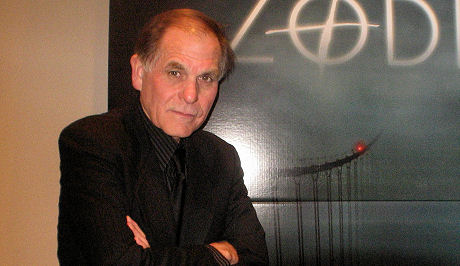
“Zodiac” book author Robert Graysmith

I spoke briefly to Robert Graysmith, the author of the two Zodiac books as well as the real-life guy Gyllenhaal plays in the film. He told me about the day he went to meet — stare at, confront — suspected Zodiac killer Arthur Leigh Allen, and how Allen later pulled alongside his parked car when he was in the driver’s seat — so close Graysmith couldn’t have opened his door if he tried — and just idled and eyeballed him, oozing malevolence.

I also spoke to Bryan Hartnell, a successful attorney who was stabbed several times in the back by the Zodiac killer at Lake Berryessa on 9.27.69. Unlike his then-girlfriend Cecelia Sheppard, who was also stabbed numerous times (not just in the back but in the chest and abdomen) and died the next day, Hartnell obviously recovered and is doing just fine. He said he wasn’t particularly trauma- tized or even upset by revisiting his horrific near-death — not last night anyway. Very cool, composed and matter-of-fact…”glad to be here!”

Dargis on “Zodiac”

David Fincher‘s magnificently obsessive new film, Zodiac, tracks the story of the serial killer who left dead bodies up and down California in the 1960s and possibly the ’70s, and that of the men who tried to stop him,” says N.Y. Times critic Manohla Dargis in today’s edition. “Set when the Age of Aquarius disappeared into the black hole of the Manson family murders, the film is at once sprawling and tightly constructed, opaque and meticulously detailed. It’s part police procedural, part monster movie — a funereal entertainment that is an unexpected repudiation of Fincher’s most famous movie, the serial-killer fiction Seven, as well as a testament to this cinematic savant’s gifts.”

Coyote

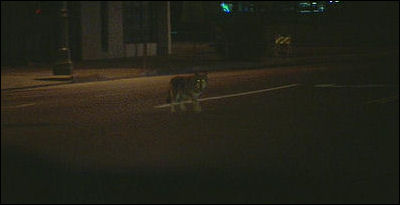
I had a Collateral moment about ten days ago that I forgot to mention. It’s significant because (a) it’s straight out of a key scene in Michael Mann‘s film and (b) it’s never once happened in the 24 years I’ve lived in this town. I’m talking about a face-to-face with an unperturbed, zen-like coyote. Every animal I’ve ever been close to outside of a zoo has exuded some degree of caution or fear, but not this guy. He was in some kind of zone and couldn’t have cared less.

It was around 10 pm. I’d just turned right onto a dark side street off La Brea south, somewhere between 3rd and Sixth Street, and there he was in the middle of the street. He seemed utterly indifferent to my slowing down and lowering the window and snapping a photo. He stood there for 10 or 12 seconds, and then sauntered over to La Brea. For a second I worried about him getting hit by a car.” Then I thought, not this guy…coyotes know how to survive this town better than me. He crossed La Brea like a champ and disappeared into an alley.

Duelling Amigos, cont’d

Slate‘s Kim Masters is commenting that the Alejandro Gonzalez InarrituGuillermo Arriaga feud is still happening because of a statement by joint statement by Babel collaborators (Inarritu among them) in Mexico’s Chilanga magazine that attacks Arriaga, to wit: “It’s a shame that in your unjustified obsession to claim sole responsibility for the film, you seem not to recognize that movies are an art of deep collaboration.” But magazines sometimes take a while to come to press, and for all we know this letter may be several weeks old.

I’m saying this because roughly 30 days ago in Santa Barbara I observed what looked like “a reapprochement between formerly feuding collaborators Inarritu and Arriaga. Inarritu went up to the sitting Arriaga and gave him a hug; Arriaga reciprocated with a couple of comradely slaps on the back. Then they left the room together and stood alone out on the brick patio, shooting the shit for nearly ten minutes, no evident tensions whatsover. I thought to myself, ‘This would make a historic photo…the duelling amigos back together again’…but a voice told me to stay away.”

Bad post-Oscar choices

Premiere‘s Stephen Saito on the the 20 Worst Post-Oscar Career Choices of all time. Cuba Gooding is absolutely “da man” in this regard, but Saito reminded me about Richard Attenborough, Roberto Benigni, Halle Berry, Adrien Brody, Michael Cimino, Faye Dunaway, Sally Field, Louise Fletcher, Brenda Fricker, Cuba Gooding Jr., Louis Gossett Jr., Helen Hunt, Gwyneth Paltrow, Sydney Pollack, Susan Sarandon, Mira Sorvino, Kevin Spacey, Hilary Swank, Marisa Tomei and Robin Williams.

Flimsy 3-D glasses?

Jeff LeedsN.Y. Times piece is about James Cameron and Jimmy Iovine having “formed a venture that will produce concerts and films in 3-D,” fine.

But the headline — “A Comeback in 3-D, but Without Those Flimsy Glasses” — is bit confusing since there’s no mention of the 3-D process that Cameron and Iovine are working with being viewable without 3-D glasses. There’s a sentence in the piece that says that the Cameron-Iovine glasses “now resemble standard sunglasses, and musicians may be able to make their own designs.”

Oh, I get it — the new glasses are no longer “flimsy”. What, like they were in the early to mid ’50s? The glasses I wore to watch the IMAX 3-D portions of Superman Returns weren’t in the least bit flimsy; they were made of rugged, fairly thick plastic and felt almost like ski goggles. How old is the Times editor who thought up that headline?

Cruise, “Catcher,” crazies

I recognize the venality, but I couldn’t help chuckling at a certain reader response to Gawker’s report that Tom Cruise is “in contract for an apartment at the Dakota” for something close to 20 million bucks. Allusions/ parallels between Katie Homes and Mia Farrow‘s manipulated/imprisoned character in Rosemary’s Baby aside, a guy wrote, “I’m going to start passing out copies of The Catcher in the Rye to all the local crazies.”