

The Los Angeles Film Critics Association meets today sometime around midday and will announce its decisions by 5 pm or so….perhaps earlier. The New York Film Critics Circle will gather at 9 ayem Monday morning. In years past a NYFCC webmaster has posted the winners in tandem as they’ve been decided upon…which I’ve always loved. I’m arranging to record a chat with NYFCC chairman Marshall Fine tomorrow afternoon around 2.
Douglas rabble rouses
The great Kirk Douglas turned 90 today, and instead of the usual sentiments — “It’s been a wonderful life…I love my grandchildren…I’m looking forward to many more happy years” — he’s released a rabble-rousing statement about a crying need for GenY to do something about the “mess” we’re living in. Damn straight. (The Reeler’s Stu VanAirsdale passed this along.)
HD-DVD vs. Blu Ray
Cymfony, an independent market analytics firm, has released figures from an extensive study showing that Blu-ray is lagging far behind HD DVD in positive opinion, says this Dark Horizons sum-up. According to Yahoo, the report distinctly cites that unlike many studies in this field, Cymfony’s was not sponsored by any manufacturer or other organization affiliated with either of the formats. It claims that “the buzz for HD DVD is 46 % greater than that for Blu-ray, and that’s among both high-def early adopters and the gaming community.”
Lane on Gabler on Disney
To New Yorker film critic Anthony Lane, writing about Neal Gabler‘s “Walt Disney: The Triumph of the American Imagination” (Knopf; $35), the most striking aspect of Snow White and the Seven Dwarfs “is the macabre punch…the poisoned apple rolling from the outstretched hand, the witch transfigured from a snotty Joan Crawford figure to something yet more disturbing.
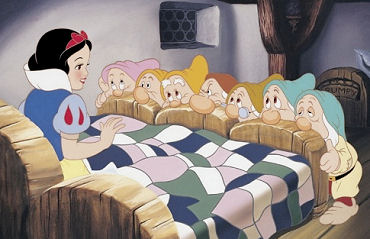
“As for the sight of the threatened girl haring through the forest, pursued by a posse of swirling leaves, with the branches clawing at her clothes, it possesses not just the sharp-toothed, half-Teutonic atmosphere that Disney could reliably conjure from his artists; it is also edited with a violent sophistication that chops straight into children’s dreams. For a moment, it looks like Eisenstein.
“It is no surprise, then, to learn that the director of Battleship Potemkin and Ivan the Terrible was a Disneyphile. “The work of this master,” Eisenstein claimed, “is the greatest contribution of the American people to art.”
Joe Queenan on “Flags”
The reason Flags of Our Fathers failed “was because the genre was tapped out. First, Hollywood paid tribute to the men who died at Normandy [via Saving Private Ryan]. Then it paid tribute to the men who died at Pearl Harbor [via Michael Bay‘s film]. Then it made a side trip to Iraq with Three Kings and Jarhead.
“But by the time Clint Eastwood got around to paying tribute to the men who fell on Iwo Jima, movie audiences were getting emotionally worn out by all this patriotic gore. Moreover, the young people who go to movie theatres today are [having] a hard time relating to a battle that took place 61 years ago This isn’t Flags of Our Fathers, it’s Flags of Our Grandfathers.” — the crochety Joe Queenan writing in today’s Guardian. (Except it was viewable last night, which means it’s basically a Friday, 12.8 piece, which means HE is behind the curve.)
The other reason Flags failed is because nobody gave that much of a shit about the war-bond tour scenes. Guys feeling fraudulent about making personal appearances across the country in order to raise money for the war effort didn’t strike anyone as being especially painful or arduous, even.
Hollywood Reporter cheer
When it’s time to cut jobs to make way for fresh hires, why do so many companies always whack people right before the holidays? Because they want them off the payroll before the new year begins for…what, tax reasons? I’ve seen this happen again and again, and it’s absolutely heartless. Not only did Hollywood Reporter management decide to slash five employees earlier this week, but they’ve also cancelled their annual holiday party. Nice people!
$7000 per month
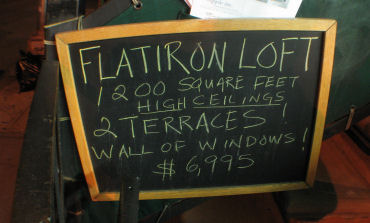
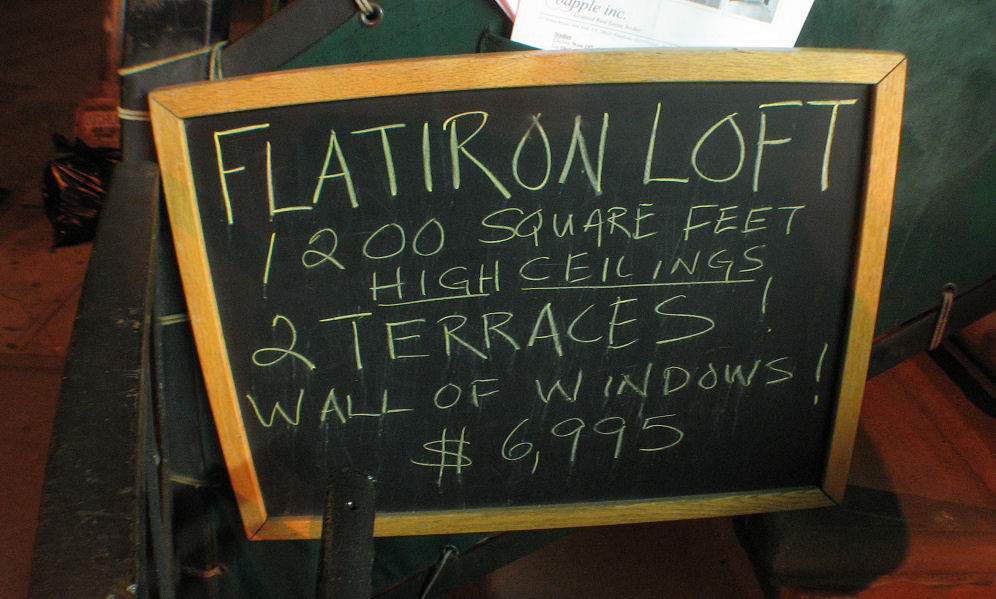
$7 grand a month for an atmosphere of warmth and well-being — snapped on West 3rd or 4th (I forget) — Friday, 12.8.06, 9:45 pm
LAFCA predictions
Nobody knows anything about tomorrow’s Los Angeles Film Critics Association voting, the results of which should be known by 5 pm or so. Nonetheless, I have a couple of hunches. LAFCA’s Best Picture winners are occasionally contrarian in one of two ways — they try and help out the proverbial little guy (i.e., a highly regarded “critics film” that has had trouble at the box-office or received insufficient support from its distributor), or they simply honor the cinematic merits of a film with an almost perverse disregard for the herd mentality, even if the winner has a shortcoming or two.
If this is a contrarian year (and the ingredients are in place in that there’s no one film with a big head of steam), that means they may go political and give it to Todd Field‘s Little Children, which New Line has only marginally supported since it opened, or (my personal hope) Alfonso Cuaron‘s Children of Men, a thrillingly composed tour de force that’s facing tough odds at the box-office, or, even more perversely, Jean-Pierre Melville‘s Army of Shadows, a 1969 film about the French resistance that has gotten several raves from big-gun critics.
If none of these three can build a big-enough consensus and LAFCA still wants to go contrarian, the big prize will go to The Departed. Pound for pound and move for move, no film provided as much sheer revved-up delight. The bizarre Catholic-guilt ending aside, it’s almost a complete 100% popcorn high, albeit in a sophistica- ted, high-end way. Plus it’s the Martin Scorsese film everyone’s been waiting for since Goodfellas. The fact that Scorsese probably has the Best Director prize in the bag may mean LAFCA will go elsewhere for Best Picture…who knows?
I heard from two big-wheel critics yesterday, and one of them wrote:the following: “Frankly, it’s wide open. I’ve been chatting with several members, and there’s no clear front runner or front-runner group. I’ve heard about everything from Army of Shadows to Flags of Our Fathers to Letters From Iwo Jima to Dreamgirls” — say what? — “to The Departed to United 93 to you-name-it. (Not to mention Volver, Babel, The Pursuit of Happyness, Apocalypto, et. al.)
“Anyone claiming on any website regarding any voting org (LAFCA or otherwise) that there’s a front-runner is either lying, has an agenda or is misinformed — or a bit of all three. I like it when it’s wide open since this allows the voting group to get more creative and move away from the dull middlebrow toward something more interesting. I love the stuff I’m hearing about Army of Shadows — that would throw the Hollywood types into a tizzy, and it would be eminently well-deserved.”
I suppose the Best Picture prize could also go to Letters From Iwo Jima. As good as it is — it’s a far better film than Flags of Our Fathers — it doesn’t quite have the startling high-throttle quality that I feel a Best Picture winner ought to possess. But then I’m not a voter. I’m just sitting here in a warm Brooklyn apartment.
Strouse, Cusack, Iraq, death
N.Y. Times writer David Halbfinger writing about Grace Is Gone, “a tiny, taut and” — the filmmakers hope — “affecting entry” in the dramatic competition at next month’s Sundance Film Festival. Directed and written by James C. Strouse (whose first script was Lonesome Jim, which Steve Buscemi directed), it stars John Cusack as a man whose wife is killed in battle in Iraq, leaving him the task of breaking the news to their two young daughters.
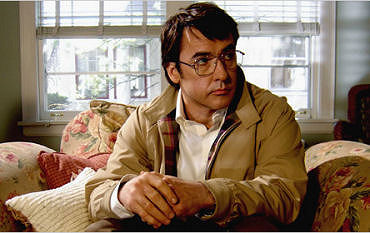
“I really think it can be deadly to have an agenda in telling fiction,” Strouse says. “I wanted to connect with people on an emotional level. And I thought the best way to do that was to try and play it as straight and true as I could. There was always the hope that this could somehow be above the argument, and challenge your opinions, whatever they are — to not let anyone off too easily.”
Strouse — what is that, a WASP-y re-spelling of “Strauss”?
Saturday’s figures
Mel Gibson‘s Apocalypto is being projected to win the weekend with $14,913,000 as of Sunday evening….a little over $6 grand a print. The tracking indicated less, and while the 14 % negative rating may have hurt some, it didn’t hurt much. The weekend’s big loser is Ed Zwick‘s Blood Diamond, a fifth-place finisher expected to tally $7,936,000, or a little over $4000 a print. For a movie that cost $80 to $100 million to shoot, less than $8 million on the first weekend means the game is basically over except for the Leonardo DiCaprio Best Actor heat.
Happy Feet will end up with something close to $13,284,000, down around 24% from last weekend, for a second-place finish. (Obviously a very good hold.) As expected, Nancy Meyers‘ The Holiday is doing better than Thursday’s tracking indcated. It’ll end up with something like $12,319,000, which is pretty good for this time of year. Casino Royale will be fourth with $8,788,000, Deja Vu will be sixth with $5,582,000, Unaccompanied Minors in seventh place with $5,238,000 (a wipeout), The Nativity Story with $4,686,000 (going nowhere), the ninth-place Deck the Halls with $3,845,000 and Santa Claus 3 rounding out the pack with $3,150,000.
Why “Factory Girl” Delay?
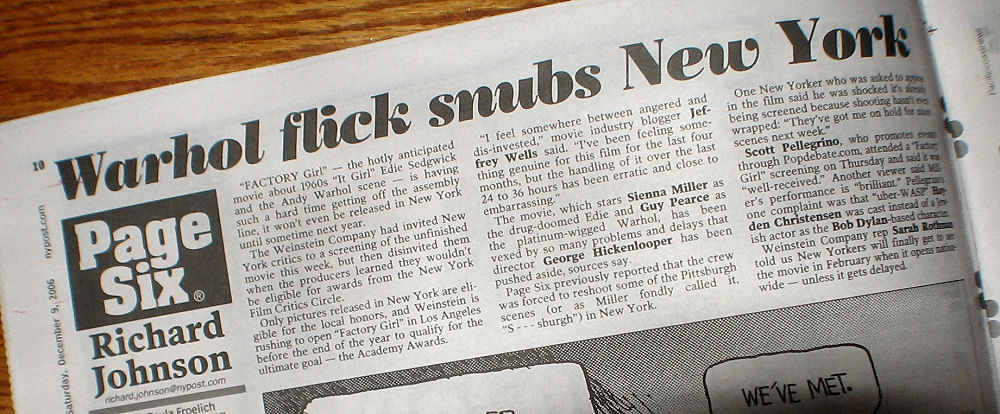
Saturday morning’s “Page Six” is running a lead story this morning about the Weinstein Co.’s last-minute decision not to open George Hickenlooper‘s Factory Girl in Manhattan, thus taking it out of consideration for local awards and ten-best lists. A day or two ago I got this message from a friend who’s right in the thick of it: “The reality is the movie just isn’t ready to see. We’ve shot 25 pages of new material and Harvey [Weinstein] is trying to rush the movie out and there just isn’t enough time. There’ve been a few screenings but the film is in no shape at all to show. It’ll get there but it’s taking time. All good things need time, and it’s never fair to the film or the filmmaker to rush, rush, rush…and for the sake of what?”
Incisive filmmaking
“Mel Gibson‘s Apocalypto. Just saw it. Actually paid. Good news: no Jews, lots of Mayans. No circumcisions but lots of other incisions. When Gibson directed and yelled ‘cut,’ a lot of guys in the cast took him literally.” — Marc Wallace, a loyal Manhattan reader,.