“As dull as Phil Angelides‘ campaign has been, I believe that he would better represent the interests of more Californians than Schwarzenegger could ever hope to,” Alec Baldwin wrote on The Huffington Post two days ago. “Schwarzenegger is not a leader. Like Bush, he is a front man for a group of powerful interests and he is reading from a script.”
And yet Baldwin has decided not to narrate a documentary by director-writer Dan Cox and co-writer Jerry Decker because he feels it pushes certain back issues — Arnold’s father’s Nazi associations, for one — too forcefully. “The makers of Running With Arnold hammer Schwarzenegger over his private behavior and his record as governor,” Baldwin declares. “But Schwarzenegger deserves to be treated fairly and the film’s images of Nazi rallies were over the line.”
I asked Cox about seeing this film a while, and then again a couple of days ago. He said copies will be going out to the press fairly soon. I’ll reserve comment until I see it, but journalists have been doing stories about Arnold’s dad’s Nazi affiliations back in Austria for a long time, and it seems fair to get into this — although there’s something about the stink of Naziism that always seem to warp or overbake an inquiry when it’s mentioned. I don’t know what the “private behavior” stuff is about, but I can guess — and if I were doing an Arnold doc I would definitely leave that shit out.
Friends of “United 93”
Here for the record is a list of “The Friends of United 93” — myself plus Toronto Star critic Peter Howell (who gave it 5 points on MCN’s Gurus of Gold chart), Sasha Stone (7 points), Lou Lumenick (8 points), Anne Thompson (9 points) and Susan Wloszczyna (10 points). There are no friends of United 93 among Tom O’Neil‘s “Buzzmeter” forecasters at The Envelope. Joiners?
Fire at Universal
“Sure, a welder’s unfortunate error is a completely plausible explanation for the conflagration, but we won’t completely rule out the possibility that God Himself sparked the blaze, hoping that an unanticipated setback of this scale might help the producers of a movie inspired by one of His favorite Bible stories reach their goal of making The Most Expensive Comedy Story Ever Told.” — Defamer‘s Mark Lisanti on yesterday’s fire at Universal Studios, possibly (no callbacks yet) on Stage 27 where the “ark” set for Evan Almighty has been constructed.
Raving lunatic
There’s no such thing as entirely “normal” behavior these days. The world of 2006 is ten times loonier than, say the world of 1956. Egoistic oddballs, twitchy eccentrics, depressives, Courtney Love, people with hair-trigger tempers and substance-abuse problems. I can honestly claim to know at least two women who would stand a good chance of being rounded up and thrown into Bedlam if they were suddenly time-tripped back to Charles Dickens‘ London.
In such an environment, an escapee from a local mental hospital wouldn’t seem all that curious, much less threatening. Unless he was homidical and foaming at the mouth, he’d be seen as just one more nutter with ongoing issues. And so the idea of making a movie about a couple of characters trying to identify which person “among several plausible candidates” is the true escapee from a nearby mental hospital doesn’t exactly light the room on fire. Not by today’s standards. Even if you do the movie in “period.”
Tom Cruise wasn’t blown out of the Paramount water last summer by Viacom chief Sumner Redtone…well, he was, but the decision to evict apparently originated with kvetching from Sumner’s wife, Paula. That’s one of the semi-intriguing reveals in Bryan Burroughs‘ Redstone profile in the December issue of Vanity Fair:
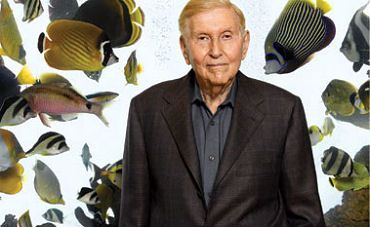
“Paula, like women everywhere, had come to hate him,” Redstone declares. “The truth of the matter is, I did listen to her, but I make business decisions myself.”
“And in terms of business, Redstone claims he felt Cruise was actually costing Paramount money. Cruise’s production company, which the actor operates along with producing partner Paula Wagner, was paid $10 million a year to create movies for Paramount, and until this year had a sterling track record, led by the first two Mission: Impossible movies, which grossed around $500 million each worldwide. (Overall, Cruise’s films with Paramount have grossed $3 billion worldwide at the box office.)
“It’s the performance of Mission: Impossible III, however, that Redstone seized upon as he and his wife soured on Cruise’s public utterances. The movie did excellent business, earning just under $400 million worldwide, but Redstone felt the actor’s extracurricular behavior prevented it from making more. A Cruise spokesperson declined all comment.
“When did I decide [to fire him]?” Redstone asks. “I don’t know. When he was on the Today show? When he was jumping on a couch at Oprah? He changed his handler, you know, to his sister — not a good idea. His behavior was entirely unacceptable to [my wife,] Paula, and to the rest of the world. He didn’t just turn one [woman] off. He turned off all women, and a lot of men… He was embarrassing the studio. And he was costing us a lot of money. We felt he cost us $100, $150 million on Mission: Impossible III. It was the best picture of the three, and it did the worst.”
“The deal with Cruise/Wagner Productions was scheduled to lapse at the end of August. Redstone indicates he decided to cut ties to the company sometime last spring, waiting until the July time frame to notify Tom Freston and Paramount’s C.E.O., Brad Grey. ‘I made my decision without their support; I didn’t tell anyone for months,’ Redstone says. ‘But [eventually] I made my position clear to Tom and Brad, that he should be off the lot. They had some concerns.’
“In fact, Freston and Grey realized that ‘firing’ an actor with Cruise’s visibility and track record, a highly unusual if not unprecedented move, would trigger a severe backlash in Hollywood’s creative community. Still, it was Redstone’s company, and they were his employees.
“‘This wasn’t just Sumner — he had a right to feel the way he did,’ says a person involved in Paramount’s deliberations. ‘I mean, women didn’t go see the movie, because of Tom Cruise’s behavior. It showed up in the research.’ Freston and Grey, this person says, had put a lowball bid on the table to renew the contract — $2.5 million, by all accounts — and everyone involved realized that both sides would probably allow the deal to quietly lapse.
“‘The negotiations had started when Sumner weighed in,’ this person says. ‘Brad had to get rid of the offer, which is a hard thing to do. They were working toward that. They understood where Sumner was coming from. They really did. They were trying to pull [the offer] back, and when they were trying to do that, Sumner went public. That’s when everything hit the fan.'”
“Fire” exit polling
Focus Features asked for the usual exit-polling to be done regarding last weekend’s opening of Phillip Noyce‘s Catch a Fire. Viewers exiting L.A.’s AMC Palisades Center and Pacific Sherman Oaks Galleria, Baltimore’s Muvico Egyptian 24, Houston’s AMC Studio 30, Seattle’s AMC Pacific Place and Kansas City’s AMC Studio 30 were polled and the usual ironies prevailed.
Everyone who saw it liked it quite a lot, but not enough people saw it overall. So who or what do we blame? The material, obviously — nobody wanted to see an ’80s apartheid movie. I half-felt that way when I went to see it the first time, but I came away enthused. Everyone’s been having the same reaction, it seems. You just have to see it.
Catch a Fire “died” last weekend — a gross of $2,023,397 for the three-day weekend on 1,306 screens, for a per screen average of $1550 — and yet (a) the film drew a well-above-average response with rating/recommend scores spread somewhat evenly across all four quadrants, (b) 56% of the audience described the film as “better than expected”, (c) the performances were rated “excellent” by 62% of the audience and “very good” by an additional 30%, (d) the film “played better to non-Caucasians (who made up 60% of the audience) vs. Caucasians although scores among the latter were still above average, and (e) the film played above-average in all six markets.
In terms of demographics, the audience was ethnically mixed and split fairly evenly between male/female and over/under 35. Specifically: 52% were 35-plus, 53% were female, 44% were African American (highest in Baltimore at 69%), 40% were Caucasian (the whitest audience being in Kansas City at 65%), 7% were Hispanic, 5% were Asian, and 53% had college degrees. What’s with the fucking Hispanics and Asians?
The primary sources of the audience’s information were TV spots (38%…overweight guys channel-surfing while sitting in Lazy Boys), the trailer (22%), word-of-mouth (15%), reviews (14%), newspaper/magazine ads (7%), radio spots (5%), and the internet (3%). This shows you how hip and plugged the over-35s are with the internet….not!
Lane vs. Borat
“Sacha Baron Cohen is one of the few British Jews to venture successfully into the comedy of shock,” writes New Yorker critic Anthony Lane in one of the oddest Borat reviews I’ve read so far. “[The] defense of Borat as an unwitting scourge of the reactionary — unearthing Midwestern beliefs no less parochial than those he left behind in Kazakhstan — is sound as far as it goes. But the movie goes further. It is equipped, like an F-15 Eagle, to engage multiple targets at once.”
And here’s where the curious umbrage kicks in. I can’t quite figure where Lane is really coming from deep down, but he isn’t very pleased with what Cohen’s up to, that’s for sure.
“If you can’t bear to hear Alan Keyes — whom Borat interviews, and who, like most of the participants, has no idea what he is dealing with — described as a ‘genuine chocolate-face,’ then for pity’s sake stay home. As for the scene in which Borat smooches a blond woman before introducing her as his sister, the ‘number-four prostitute in all of Kazakhstan,’ it is, like most of the film’s lavatorial gags, both daring you to gawk and forcing you to look away.
“What game is Baron Cohen playing, exactly, when he shows mock footage of an annual Kazakh ceremony known as ‘the Running of the Jew,’ in which children kick a giant egg to bits, to stop ‘the Jew chick’ from being hatched?”
Clint talks to Patrick
Patrick Goldstein‘s “Big Picture” column is about the non- battle in today’s media culture between the pornography of self-exposure vs. modesty and reticence, and how two of the fall’s best films — Flags of Our Fathers and The Queen — “honor” the latter.
Really? I didn’t get the idea that Queen director Stephen Frears was “honoring” Queen Elizabeth II at all. The film doesn’t appprove or disapprove of her insulated cluelessness in the wake of the August 1997 death of Diana, Princess of Wales — it’s saying that the old-school sensibilities of Elizabeth Windsor and those of her generation no longer permeate the culture, and this was an event that made this clear. The Queen is saying “she doesn’t get it” over and over — in what way is that an honoring?
And while we sympathize with the glum-faced soldiers who went on that war-bound tour in Flags of Our Fathers, the bottom line reality is that they’re….kinda boring! We have to climb up that paper mache thing?…gee, I don’t think this is right…we should be back on the battlefield with our buddies…thank you, sir, this sounds like a good opportunity…strawberry syrup, please… yes sir…buy war bonds!…tell them I’ve gone fishing, son. They’re all good fellows, but they have no spunk in them…they’re stiffs.
Then I got to the end of Goldstein’s piece and realized what was going on.
Goldstein writes, “When I ask Eastwood where he keeps his Oscars — the showbiz equivalent of Bradley’s wartime medal — he points to a corner of the room. ‘There’s a couple behind my desk over there. They’re just sitting where they were put after the event.’ He shrugs, already a little uncomfortable talking about his achievements. ‘I appreciate the honor, but the question is — how far do you want to carry it?’
Eastwood, straight-arrow that he is, is telling Goldstein what’s on his mind. He’s also saying however much money Flags makes, he’s at peace with what it is, and proud of it. And, clever dude that he also is, he’s subtly telegraphing that he’s not that concerned if Flags of Our Fathers will collect a bunch of Oscar noms or not (although it’s a moderately safe bet it’ll get one for Best Picture…I think).
By saying he’s into the “thing” of it, rather than the things that may come out of it (money, awards), Clint is media-positioning himself and his film as being imper- vious or indifferent to failure, or the perception of same.
Soderbergh, Guevara, Lawrence
The usual simplistic knee-jerk responses have flooded in since last night’s summary and posting of a link to Michael Fleming ‘s piece about Steven Soderbergh‘s plan to shoot back-to-back Che Guevara films as of May ’07. I ran a response in “comments” this morning, but just so everyone sees it…
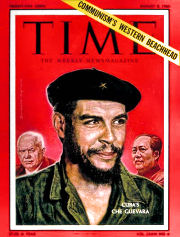

I gave this a think-through last night and came to the rudimentrary conclusion that The Argentine and Guerilla combined are are going to resemble parts I and II of Lawrence of Arabia — the promise, the dream and the mixed glory in the first section, and the bitterness, madness and despair that manifests in the second. Presumably there will be much more to these two films than what I’ve just summarized, but it took me just under 15 seconds to figure out the basic strategy — it’s fairly obvious — when I read Fleming’s story last night.
When the Soderbergh-del Toro-Guevara flick was just a single-film project (i.e., for the last several years), it was just Guerrilla — about how Guevara’s revolutionary fervor led him to quit his Cuban posts and embark upon a failed attempt to spark a revolution in Bolivia. It’s a story about failure, isolation…listening more and more to the sounds of your own rhetorical spinnings to the exclusion of real-world reality to the extent that it invites pathetic self-destruction.
As Christopher Hitchens once wrote, “Che’s iconic status was assured because he failed. His story was one of defeat and isolation, and that’s why it is so seductive. Had he lived, the myth of Che would have long since died.”
Because it’s largely about Che’s and Fidel Castro’s glory period (i.e., fighting and winning the Cuban revolution, which everyone marvelled at the world over…Batista’s allegiance was strictly with the moneyed elements who provided for him…he cared not for the poor), The Argentine will be about the hard climb up the mountain and then the reaching of the summit and throwing one’s hat in the air and dancing beneath the diamond sky with one hand waving free.
So The Argentine is the upper and Guerilla is the downer. Up the mountain, down the mountain. I doubt if Soderbergh, del Toro and Buchman will make the two films as black-and-white simplistic as this, but this is clearly the basic scheme.
Even the folks in charge of the withered Cuban propaganda ministry would have trouble framing Guevara’s Bolivian episode in a positive light. Give Soderbergh, del Toro and Buchman a break and assume, as any reasonable person would, that they’re certainly not going to attempt to glorify Guevara in part 2…no way. These are intelligent artists making this film. Show a little respect.
They’re primarily attracted to Guevara’s life for the arc that it represents (everyone of any spirit strives for something fine and shining in this world and some achieve it, and then the dream fades and the muddled, sometimes bitter reality kicks in), for the highs and the lows, to the Lawrence of Arabia angle. Because this is the story that will captivate audiences 100 or 500 years from now.
Soderbergh’s Guevara films
Variety‘s Michael Fleming is reporting that Steven Soderbergh and Benicio del Toro are finally, finally about to begin shooting their long-delayed Che Guevara biopic, for Chrissake. Both of them. And both, for the most part, to be shot in Spanish…hooray for that! (For a while there I thought the linguistic tradition of Richard Fleischer, Jack Palance and Che would make a comeback.)
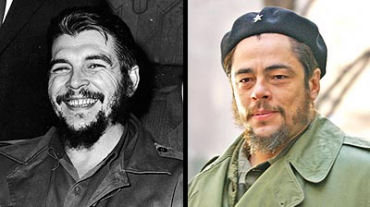
Soderbergh will shoot the two films — The Argentine and Guerrilla — in Mexico and various South American locations, including Bolivia. Del Toro will play Guevara; Javier Bardem, Franka Potente and Benjamin Bratt have been attached to this thing for eons.
Laura Bickford (Traffic) is producing. The Wild Bunch is the main financier along with Spain-based Morena Films and broadcaster Telecinco. The films will cost a grand total of less than $70 million. Talks are under way with domestic distributors. (James Schamus!) Laura Bickford (Traffic ) is producing.
Both scripts have been written by Peter Buchman, Fleming reports. Buchman and Del Toro have been working with a translator to put the dialogue into Spanish.
The Argentine will begin before the Cuban revolution with Castro, Guevara and a band of exiles reach the Cuban shore from Mexico in 1956. Within two years, they mobilized popular support and an army and toppled the U.S.-friendly regime of dic- tator Fulgencio Batista. Guerrilla begins with Guevara’s trip to New York, where he spoke at the United Nations in 1964 and was celebrated, blah, blah. Soder- bergh has already shot that opening footage with Del Toro and Julia Ormond, who plays TV journo Lisa Howard.
Valiant death
“Cowards die many times before their deaths; the valiant never taste of death but once.” — Julius Caesar (Act II, Scene II, 32-37)
Travolta Hairspray
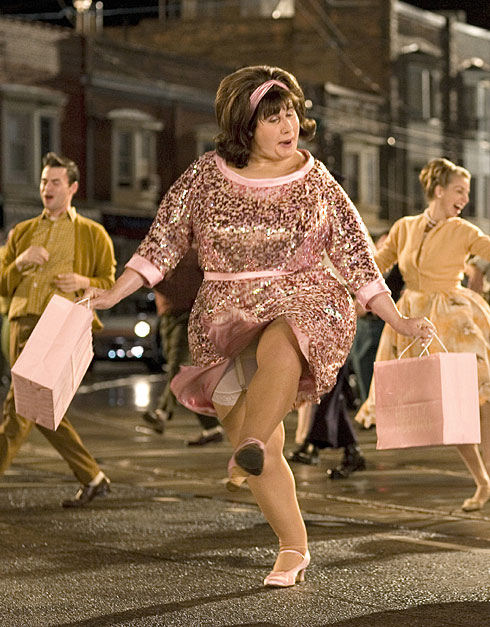
USA Today‘s Suzie Woz flew to Toronto to watch John Travolta in a drag fat-suit sing and prance around to “You Can’t Stop The Beat”, a musical number in Adam Shankman‘s Hairspray. “It’s good,” Travola told her. “The effect that I caused is fun and all, but it’s a lot of work, man.” The film costars Michelle Pfeiffer, Christopher Walken and Nikki Blonsky. The filmic re-do of the Broadway musical (based on the ’88 John Waters film) will continue to shoot through early December, and is slated to open next July.
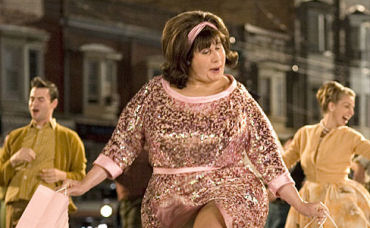
John Travolta as the “generously proportioned” Edna Turnblad — the role created by Divine in the non-musical original film and by Harvey Fierstein in the Broadway show