

It just feels strange to be churning stuff out day after day and not acknowledge the storms of death, hate and rage in Lebanon and Israel right now, and the gathering feeling (as articulated by Newt Gingrich this morning) that if you link all the Middle East conflicts together, what’s starting to take shape could arguably be called the beginning of World War III. The correct pronunciation of Hezbollah, by the way, requires an emphasis on either the second or third syllable, but not the first. Read this Wikipedia Hezbollah page — the key sentence is the final one: “Some argue that Hezbollah is being used by Syria and Iran as a proxy against Israel.”
Heat wave
The current heat waves all over the country, with many areas affected by tempeatures of 100 degrees-plus and with most meterologists saying the heat will continue well into the coming week, have nothing to do with global warming. It just gets really hot in mid-July… that’s all. Enough with the anti-free-choice, anti-American-way-of-life crap propaganda being spread around by Al Gore and the pinko lefties at Paramount Vantage. Just turn on the a.c., pop open a cool one, turn on the tube and chill.
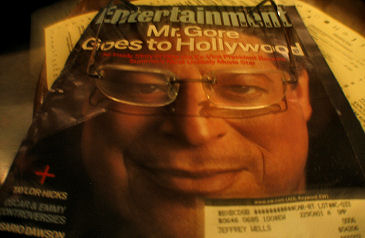
Current issue of EW sitting on small table at Typhoon, the good-timey, Asian-flavored place with great views of the Santa Monica Airport runaway. Typhoon is owned by Brian Vidor, son of director Charles Vidor (Love Me or Leave Me, Gilda, Cover Girl) who wasn’t related to King Vidor. Pic snapped on Saturday, 7.15, 10:15 pm.
Wolverine parody trailer
Just came across this old, old (6.23.06) YouTube parody trailer for an imagined Hugh Jackman/Wolverine movie called X-Men 3: The Last Standing Ovation. The basic thread is that the creator of the trailer is a semi- homophobe smart-ass. He feels that Jackman’s having sung and danced in three stage musicals (as “Curly” in Oklahoma!, as “Billy Bigelow” in Carousel , and as the girlymanish Peter Allen in The Boy from Oz) compromises the macho-stud element in his Wolverine performances. That’s is…that’s the whole thing. (Meanwhile that 6.1.06 Wolverine script — written by David Benioff, with revisions by David Ayer — is sitting on the desktop unread. Because I’m lazy, distracted, undisciplined, etc.)
Sunday numbers
Apologies for yesterday morning’s box-office typo — the projected Pirates 2 weekend total should have been $58,317,000 — not $50,317.00. This morning’s projected Pirates 2 figure for the weekend is $60,598,000, with a slightly higher overall cume of $255 million. Little Man will continue to edge out You, Me and Dupree with respective hauls of $21,910,000 and $21,338,000. Poor Superman Returns is now likely to finish at $10,881,000 (just over $750,000 higher than yesterday’s projected total of $10,058,000) with a slightly revised overall tally close to $163,000,000. The Devil Wears Prada‘s new projected weekend total is about $50 grand shy of $10 million — $9,947,000 — or about $420,000 higher than yesterday’s projected tally of $9,526,000.
Flags and Black Sands
A friend tells me Exhibitor Relations isn’t listing Red Sun, Black Sand, Clint Eastwood‘s Japanese-language war film lensed last spring as a companion piece to Flags of Our Fathers (Paramount/ DreamWorks, 10.20), as a December release. (They always wait for an official announcement.) Coming Soon.net isn’t listing it on its December release page either, and Rotten Tomatoes isn’t even acknowledging that Black Sand is a film Eastwood has directed. And there isn’t a damn thing about it on both the Paramount and DreamWorks websites.

And yet the IMDB is running a presumed release date of December 2006, and this column is heavily dug into a belief that Red Sun, Black Sand (which stars Ken Watanebe as General Tadamichi Kuribayashi) will indeed open in December. How can it not? Two movies made in tandem by the same fast-working director about the battle of Iwo Jima — one about the Americans, one about the Japanese…and Paramount/DreamWorks is going to release only the American version on 10.20? Okay, it’s possible…but does anyone believe it’s at all likely?
I wouldn’t think Paramount’s Oscar consultants and marketers would stand for a separate ’07 release for Black Sand. (They’ll at least insist on a year-end platform debut.) They know that a sequential double-whammy in the same year will make a Best Picture nomination for one of the two Eastwood films all but guaranteed. I mean, unless they both put people to sleep.
Apologies for yesterday morning’s box-office typo — the projected Pirates 2 weekend total should have been $58,317,000 — not $50,317.00. This morning’s projected Pirates 2 figure for the weekend is $60,598,000, with a slightly higher overall cume of $255 million. Little Man will continue to edge out You, Me and Dupree with respective hauls of $21,910,000 and $21,338,000. Poor Superman Returns is now likely to finish at $10,881,000 (just over $750,000 higher than yesterday’s projected total of $10,058,000) with a slightly revised overall tally close to $163,000,000. The Devil Wears Prada‘s new projected weekend total is about $50 grand shy of $10 million — $9,947,000 — or about $420,000 higher than yesterday’s projected tally of $9,526,000.
Dayton, Faris, “Sunshine”
A well-deserved N.Y. Times piece about Little Miss Sunshine directors Valerie Faris and Jonathan Dayton, who are very married, very talented and who finish each other’s sentences.
There’s just this one tiny odd note in Franz Lidz‘s piece that I’m sure Dayton is regretting to some extent already. It comes when Dayton refers to a former roommate named Frank H. Sprague, “a perpetual 30 year-old college student [whose] extended academic career had spanned 22 years…[and] was one of those people who really did what you’re supposed to do in life but never reaped any of the benefits,” inside whom “there was a whole universe hidden.” Sprague ended up dead a few years ago “in a derelict Hollywood studio apartment,” Lidz reports. And then right after this sentence he quotes Dayton as saying Sprague “died in his underwear clutching a Hershey bar.”
Whoa. No matter how much of a loser or a dilletante Sprague might have been, it’s disrespectful to dismiss him that way. The use of the words “clutching a Hershey bar” doesn’t feel right.
“Fountain” poster
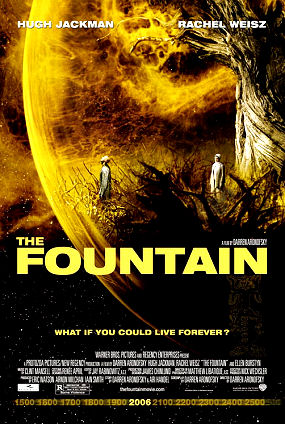
Given the imaginative, heavily visual, time-trippy story and all, you’d think that Darren Aronofsky‘s The Fountain (Warner Bros., 10.13) would be receiving some kind of promotion with the fans at Comic Con next weekend. Here, in any event, is the poster by the way of joblow.com.
Smith talks to Olsen
“At the end of the day I can only do what I can do,” Clerks 2 director-writer Kevin Smith says to L.A. Times writer Mark Olsen in a 7.16 piece. “You read a lot of reviews where people say, ‘You should stretch. He should learn to stretch as a filmmaker.’ After a dozen years now, don’t they get it? This is what I do, this is the storyteller I am.
“Do I let myself off the hook by saying, ‘I’m just not that talented?’ Probably. But also I think it’s important to know your limitations. I’ve kind of embraced mine. And I’ve had seven films’ worth of practice to figure that out.”
I don’t entirely believe this. The reason Smith is great on the college-lecture cricuit is that he’s excellent at au contraire-ing — arguing, debating, puncturing balloons. And to me that means he could write a really superb play about a GenX marriage gone bad — a latter-day “Who’s Afraid of Virginia Woolf with a little 2006 “My Dinner with Andre” thrown in. Smith is married and has gone through some trying married-couple stuff…this has to have happened. All he has to do is put it into shape. A play first, and then a low-budget film.
Smith has said he’s too content with his life and too mild-mannered go to in this direction, but as Montgomery Clift’s Pvt. Prewittt says to Burt Lancaster’s Sgt. Warden in From Here to Eternity, “A man should be what he can do.”
Lewis, Schrader clowns
“We’ve had Life is Beautiful and Jakob the Liar,” a 7.12 Guardian item reads, “and now the list of movies mixing clowning with the Holocaust is to grow with Adam Resurrected, a Paul Schrader film that will adapt a book by Israeli novelist Yoram Kaniuk.” The item says “the story [is about] on a Jewish circus clown” — to be played by Jeff Goldblum — “who is kept alive by the Nazis to entertain his fellow Jews as they march to the gas chambers.”
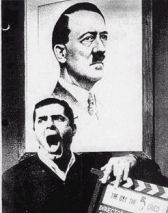

Jerry Lewis (l.) in a faked photo (I think) suggesting it was taken on the set of the unreleased The Day The Clown Cried (1972); (r.) Paul Schrader, who is reportedly looking to direct Adam Resurrected, which sounds very similar to Lewis’ film.
“Obviously-no-shit-Sherlock, this calls to mind that early ’70s Jerry Lewis fiasco called The Day the Clown Cried, an unseen, never-distributed film that Lewis starred in and directed. The dark drama is described by a Jerry Lewis website as being “about a German clown who was arrested by the Gestapo, interred in a concentration camp, and used to march Jewish children into the ovens.”
But maybe they’re not quite so similar. An Amazon.com description of the Kaniuk book says it’s about “a former circus clown named Adam Stein who was spared the gas chamber so that he might entertain thousands of other Jews as they marched to their deaths,” but it takes place after World War II and is about how Stein “is now the ringleader at an asylum in the Negev desert populated solely by Holocaust survivors…alternately more brilliant than the doctors and more insane than any of the patients, Stein struggles wildly to make sense of a world in which the line between sanity and madness has been irreversibly blurred.”
Lewis’s Clown flick has long been regarded as on the worst all-time debacles and pratfalls ever suffered by a major “name” director, which Lewis definitely was in the late ’50s and ’60s.
“In 1971, producer Nate Waschberger asked Lewis to direct and star in The Day the Clown Cried, based on Joan O’Brien’s book by the same name, about a German clown who was arrested by the Gestapo, interred in a concentration camp, and used to march Jewish children into the ovens,” tjhe site’s description reads.
“Jerry lost close to 40 pounds to play the role. The shooting began in Stockholm, but Wachsberger not only ran out of money to complete the film, but he failed to pay Joan O’Brien the money she was owed for the rights to the story. Jerry was forced to finish the picture with his own money.
“The film has been tied up in litigation ever since, and all of the parties involved have never been able to reach an agreeable settlement. Jerry hopes to someday complete the film, which remains to this day, a significant expression of cinematic art, suspended in the abyss of international litigation.”
According to Film Buff Online, Harry Shearer, one of the very small handful of people who has actually seen Clown in rough-cut form, described it thusly in an interview on “The Howard Stern Show”: “If you say `Jerry Lewis is a clown in a concentration camp’ and you make that movie up in your head, it’s so much better than that. And by better I mean worse. You’re stunned.”
“Clerks 2” backstories
The personal histories of Clerks 2 co-stars Brian O’Halloran and Jeff Anderson, by way of N.Y. Times contributor Kevin Cahillane.
TIFF poster
The 2006 Toronto Film Festival will run from 9.7 (a little more than seven weeks from now) through 9.16, and I guess I’ll be running some kind of preliminary rundown sometime around August 7th (maybe a week later). Wait…here’s something definitive: the poster looks cool. It’s all part of a gathering desire to extract my head from the summer mentality. If only Clint Eastwood ‘s Flags of our Fathers and Mel Gibson‘s Apocalypto had stuck to their August release dates….water under the bridge.


McKellen Live
L.A. Times Envelope reporter Elizabeth Snead on Ian McKellen`s “A Knight Out in L.A.”, his live one-man show that will have two performances at the Freud Playhouse on the UCLA campus on Saturday, 7.22 and Sunday, 7.23. (Conflicting with Comic Con!) The shows will benefit the Los Angeles Young Actors’ Company. “I’m delighted to be back onstage in Los Angeles supporting the work of the Los Angeles Young Actors’ Company,” McKellen told Snead. “The show lets me revisit favorite parts, tell a few stories, and present Gandalf onstage for the very first time! My aim is that the audience enjoy themselves as much as I shall, all in aid of the best of causes.”