

“I read the World Trade Center script a few weeks ago, and Andrea Berloff‘s comment — ‘it’s a boy down the well saga with no politics’ — is pretty much the entire film in a nutshell. The guys (Nic Cage, Michael Pena) are buried under the rubble by the end of the first act, and remain there for over an hour of the film. In many ways, the structure is like that of Apollo 13, cutting away from the guys and their fear of losing their families and wives, and then to wives on the outside, freaking out and not getting any answers. Maggie Gyllenhaal‘s character is showier in this light than Maria Bello‘s, as she is pregnant and on edge much more throughout. There was a bookend device that I really hope gets tossed, something akin to the one used in Saving Private Ryan, putting it in a ‘now’ context that [struck me as] irritating. The only spots where it could become anything resembling an ‘Oliver Stone movie’ is when the script takes these slightly trippy routes of surrealism, as Cage’s and Pena’s characters slip in and out of delirium thinking about the last time they saw their wives. These could be played out as interesting fantasy elements. One thing is certain — this won’t be the ‘collapse of the towers’ film many may expect. In fact, the actual collapse occurs from the guys’ point of view in the lobby, amidst mass confusion while they consider the explosion to be a car bomb. And it’s a little while after that where we get a shot of the towers collapsing on CNN or something whern some character is watching the tube.” — Kris Tapley
I didn’t mean to misunderstand, but Josh Lucas is not going to get his head cut off (and some FX prosthetics guy down the road is not going to have to create a severed Lucas head) for a movie about murdered Wall Street Journal reporter Daniel Pearl , which will be based on the Bernard-Henri Levy book “Who Killed Daniel Pearl?” Lucas will play a guy investigating Pearl’s killing. Kip Williams (The Door in the Floor) will direct for Beacon Pictures next fall, working from a script by Peter Landesman that uses a fictionalized Pearl character. (Beacon reportedly doesn’t want to infringe on a film project based on a book by the journalist’s widow, Marianne Pearl). Pic will shoot Morocco, Dubai, India, Libya and Tunisia.
“Let’s be honest: There is no theatrical movie business any more, and there hasn’t been for a long time. Except for the biggest Hollywood movies and sleeper independent films, theatrical is a loss leader. You get reviews and publicity and generally lose money or break even if you’re lucky. It’s all about DVDs and the other so-called ancillaries.” — publicist, public speaker and streetcorner provocateur Reid Rosefelt responding to Robert Cort‘s “Straight to DVD” op-ed piece in Saturday’s New York Times.
Let no one suggest that the new website for Paramount’s World Trade Center (Paramount, 8.9) isn’t extremely tasteful. You gotta figure that Oliver Stone‘s movie will be in this groove also. That piano music on the site’s soundtrack seems to be promising this. And God help us. Allah, make it not so. “Delicacy” is not what anyone wants from Stone. You go to a Stone film, you’re looking for probing, provocation and the jangling of nerves. I’m still flinching over screenwriter Andrea Berloff ‘s comment that the film — the story of a couple of firemen, John McLoughlin (Nicolas Cage) and Will Jimeno (Michael Pena), who got trapped in the rubble of the World Trade Center on 9.11.01 — is “a boy down a well saga with no politics…this is a small story…we’re in the hole with these two guys for practically the whole movie.” I’m thinking right now of Leonard Frey‘s “Harold” character in The Boys in the Band, and his proclamation, “Give me librium or give me meth.” To me, Stone is essentially a meth-head who’s been straightjacketed into making an apparently librium-minded 9/11 movie (I don’t mean boring or low-energy — I mean not edgy or jittery or politically provocative) because he had to somehow demonstrate his commercial viability after the failure of Alexander . (Apologies to Andrea Peyser for zoning out earlier today and using her name instead of Berloff’s.)
A DaVinci dispatch from a journalist friend called “Deep Pope,” to wit: “I have a pet theory that The Da Vinci Code may be in some kind of trouble. At the very least, Sony seems to be worried about it.
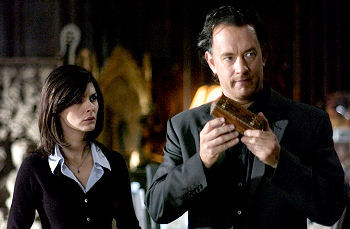
The studio is shopping around an inordinate number of advance interviews for the film, it seems to me. Paul Bettany, Ian McKellen, Alfred Molina and Akiva Goldsman are being offered to journalists for interviews, but the catch is, you can’t see the movie yet. So you have to ask questions based on knowledge of the book and what you’ve see in the trailer. Suggests to me that maybe Sony doesn’t want the movie compared to the book too soon. Plus members of the Hollywood Foreign Press Association are being shown 35 minutes of the film tomorrow (i.e., Monday, 5.8). They’re then getting a sit-down with Tom Hanks — don’t know if it’s a press conference or round table. Is it necessary to stroke the HFPA members outside of Golden Globes season? Why the preferential treatment for this film? Surely no one at Sony thinks there will be any Oscars out of Da Vinci Code? Or are they just trying to goose whatever global press the HFPA can scare up before word gets out on the movie? Does any of this seem normal to you? They didn’t do this for Spider-Man, as I recall.”
I spoke to Heath Ledger after Universal’s post-Golden Globes party at the Beverly Hilton last January, and he said that the plan — his and Michelle Williams’, that is — was to take a year off (huddle-down time with the baby) and possibly move to Amsterdam. Now comes news that Ledger will replace Colin Farrell in the lead role in Todd Haynes‘ I’m Not There , a movie about Bob Dylan that’ll start filming this summer . There goes Ledger’s vacation, right? Six actors will play Dylan in the film — Ledger, Richard Gere and Christian Bale are but three of them.
The trade reviews of Poseidon — Brian Lowry‘s in Variety and Sheri Linden‘s in the Hollywood Reporter — both complain about the lack of character shading and/or revelation and the generally streamlined approach. They don’t seem to get it. It’s a good thing that Poseidon cuts to the chase and is over in 100 minutes or so. Nobody wants emotionalism or depth of character slowing things down or gumming things up.
I was sufficiently engaged, aroused, riveted by Poseidon when I saw it on a modest-sized screen on the Warner Bros. lot a while back, so I’m figuring (okay, hoping) I’ll be extra-charged when I see on an IMAX screen on Tuesday, 5.9, at the AMC Leows Lincoln Square.
“The more troubling conclusion” regarding the disappointing Mission: Impossible II weekend earnings “could well be the much-discussed cultural shift in the way we see movies,” says MCN box-office analyst Len Klady. “The 20% theatrical decline may find itself shifting into ancillary revenue arenas, and if that’s the case what can be expected for upcoming summer releases and future production plans by the majors?”

Massachucetts clouds, as they appeared late Saturday afternoon above a high-school track meet near Weston, about 17 miles west of Boston

Fair warning: I’m coming out with a piece a week from today about the Death System in disaster films (i.e., who dies in these movies, and why?), with a particular focus on a possible reason for two significant departures-expirations in Poseidon. The article will run Sunday evening, 5.14. I’m saying this now because it’ll involve a spoiler (two of them, actually), and I don’t want to hear any complaints.
“And pity the poor actors [in Poseidon] who suffered from vertigo as they had to navigate their way across a narrow plank high above the ground with flames licking their heels. ‘It was not for the faint of heart,’ [a production associate] says. Instead of having nets below, the actors were attached from above to safety cables, which won’t be visible on film.” — from Robert Welkos‘s L.A. Times piece (5.7) on the making of Wolfgang Petersen’s Poseidon , which opens Friday (5.12). “Pity the poor actors”? It’s apparently time once again to repeat something that Werner Herzog has been saying for a long time, which is that nobody out there pities the poor actors or anyone else who has worked on a big-studio film because nobody believes in the reality of anything they’re seeing on-screen these days, least of all eye-popping effects in big-budget films. Alongside William Goldman‘s famous “nobody knows anything” line, there should be another line about big-scale visual effects: “Nobody believes anything.”