More Chris Doyle-trashing-Martin Scorsese stuff, this from a fall ’05 issue of Filmmaker magazine. (Thanks to JD for passing it along.)

Cinematographer Christopher Doyle

More Chris Doyle-trashing-Martin Scorsese stuff, this from a fall ’05 issue of Filmmaker magazine. (Thanks to JD for passing it along.)
I’m a tiny bit surprised to read that Pedro Almodovar‘s extremely fine Volver is favored to win the Palmes D’Or this evening. My reading in Cannes was that it was in a neck-and-neck race with Alejandro Gonzalez Innaritu‘s Babel, but whatever. The difference between the two is that the air starts leaking out of the Volver balloon towards the end after it “gives up the ghost”, while Babel holds true and steady all the way, and ends on a sublime and touching note.
Shiloh Nouvelle Jolie-Pitt — definitely one of those born-to-affluent-hip-parents names, but it has a nice lyrical ring to it — the other side of the valley from Jason Lee‘s naming his kid Pilot Inspektor. Brangelina’s child arrived last night — Saturday, 5.27 — in Namibia, Africa.
Hollywood Wiretap has relayed a surprising trashing of Martin Scorsese‘s modus operandi these days as well as his forthcoming The Departed, not from some renegade blogger but from the deeply respected cinematographer Christopher Doyle. Doyle reportedly spoke to Hong Kong-based writer Saul Symonds, and his comments were passed along by Grady Hendrix, who writes an Asian film blog for Variety. Doyle is quoted as saying that “it makes me very sad to see Marty and so many others genre-fying and gentrifying himself into mediocrity. Granted, mediocre is not just a Western ailment…but it would seem the disease is malign and endemic.” This is a variation of a criticism that many have thrown at Scorsese over the last ten years or so (starting with his Daniel Day Lewis doilies-and-cufflinks movie), but to hear it from Doyle, who served as visual consultant on Infernal Affairs, the Hong Kong police drama that The Departed is based upon, is more than a bit startling.
I don’t precisely recall when I started hearing good things about The Break-Up (which immediately makes my recollection a bit suspect), but it was sometime in February or March. It was vague but positive, and if you’d told me that come late May this Vince Vaughn-Jennifer Aniston dramedy (can it really be called an out-and-out comedy after Brian Lowry‘s Variety review?) would be getting slapped around pretty badly by critics and entertainment reporters, I would have said, “Really?” I’ve liked what I’ve been hearing about this thing for a long time — a fairly rough but realistic blow-by-blow of the end of a relationship. Yes, I reported some tracking figures a while back, and was criticized for saying “it’s finished” and for not reading them in context, but the numbers were the numbers and I didn’t “have it in” for the film. I hate “romantic comedies” and I’ve worshipped Vaughn’s rat-a-tat-tat schtick since Swingers. But the pile-on beatup syndrome has definitely kicked in, the two spear-points being that the Break-up is (a) too harsh and unfunny and (b) the ending is some kind of compromised fudge job. Ann Donahue‘s Premiere piece projects a $25 to $30 million opening for the film, says, having seen it, that “for anyone who has been through the thermonuclear ending of a relationship, there are a number of scenes that may strike a little too close to home.” But from what I’ve been reading about the ending, it sounds okay to me. Kate Kelly‘s Wall Street Journal piece on the film’s troubles (which I can’t link to) describes the finale as Vaughn and Aniston running into each other long after their breakup “and each on the arm of a new partner that resembles the old one.” That strikes me as life-like (people do tend to go for the same type) but not necessarily hopeful in terms of them getting back together.
Priced at only $20 bills, Ridley Scott‘s four-disc “director’s cut” DVD of Kingdom of Heaven, which streeted last Tuesday, seems like one the greatest values and bargains out there right now…an absolute must-own for folks like me, certainly. The truckloads of material seem staggering…not just Scott’s preferred 194-minute cut, which I reviewed out of a commercial showing at Laemmle’s Fairfax last January, but a motherload of extras including a three-hour, six-part documentary called “The Path to Redemption”. If the doc is anything like the one that accompanied the DVD of Scott’s Matchstick Men, it’ll be well worth it. Last January I wrote that Kingdom‘s theatrical cut “was a painterly, politically nutritious meal that felt more than a touch truncated and a bit shy of playing like a true epic-type thing. The longer cut makes it into a fuller, tastier, more banquet-y type deal…sweepier and more sumptuous and better told….certainly a finer and more substantial film. And this fact makes 20th Century Fox’s decision to release its shorter, runtier kid brother seem more than a little distasteful. Only an idiot could have watched both versions last spring or late winter…whenever it was that Fox and Scott sorted things through…and not realized that the longer version was the distinctly better film.”
Kevin Smith on the wowser, emotionally rousing response to Clerks II after Friday night’s Salle Debussy showing in Cannes, which ended with an eight-minute standing ovation…guess I shoulda stuck around. The word “triumphant” does not seem wholly inappropriate.

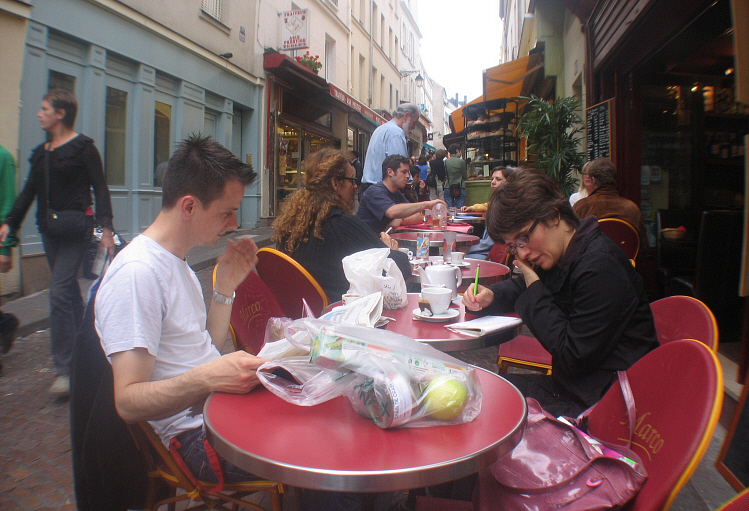
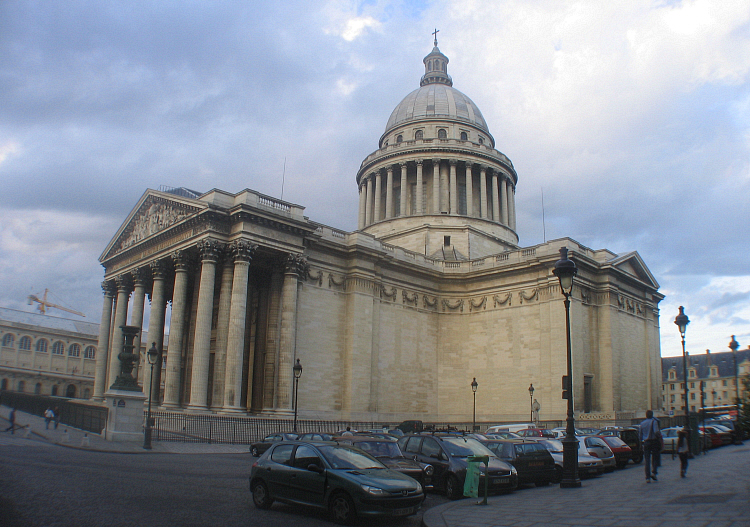
And with not much else to do or say today (i.e., having decided to mostly take the day off and just wander around), a passel of non-movie-related pics: (a) lean over the catch of the day on a bed of ice, and the aroma fills you up and does more than intoxicate, at a fish market on rue Lepic — Saturday, 5.27.06, 3:25 pm; (b) sanitation engineers on rue Lepic…the sound of clinking-clattering glass is shattering –Saturday, 5.27.06, 3:30; (c) Snapped in front of the Pantheon, looking west — Saturday, 5.27.06, 7:36 pm; (d) Snapped at a small cafe on rue Mouffetard — Saturday, 5.27.06, 8:55 pm; (e) Brad Pitt wristwatch ad in Friday’s print edition of the London Times; (f) a postively captivating floral delight on rue Lepic — Saturday, 5.27, 3:40 pm; (g) Ben Sliney, the FAA chief who played himself in United 93, looking about 20 pounds lighter with a cool haircut and a great tan (like he wants to be in more movies perhaps?…he was real and likable and solid as a rock in the film) at Friday’s Cannes press conference for the Paul Greengrass film; (h) Brass plaque on sloping hill street approaching the Pantheon; (i) Pantheon glimpse on way back from dinner — Saturday, 5.27.06; 9:40 pm; (k) Notre Dame — Saturday, 5.27.06, 7:55 pm; (l) The Louvre has a soul all its own, but for the time being it half-feels like a Ron Howard-Tom Hanks tourist attraction — Saturday, 5.27.06, 5:35 pm; (m) Montmartre windowsill — Saturday, 5.27.06, 3:55 pm; and (n) with the AC cord suddenly failing to power up the laptop and no wi-fi in the closet-sized studio I’m crashing in, here’s Hollywood Elsewhere’s publishing headquarters for the next few days; naptime under a tree in small park adjacent to St.-Julien-le-Pauvre — Saturday, 5.27.06, 6:40 pm.
This is definitely burying the lead, but the $65,000-per-screen opening of An Inconvenient Truth on 4 screens, which MCN’s Len Klady is calling “the strongest exclusive opening of the year,” lifts my heart more than the $44.6 million Friday that X-Men 3 achieved…although you really have to say “wowza!” ’bout that. And yet (and I know what this is going to sound like, but I have to say it) there’s something a wee bit disspiriting…just a wee bit…about an okay-but-far-from-thermonuclear Brett Ratner downgrade performing this well. I don’t mean the champagne shouldn’t be passed around (a projected $120 million weekend is a hell of a number), and I really do understand how sourpussy this sounds, but…screw it….congrats to Ratner and Fox and the rest of the team . I just wonder sometimes (more than sometimes) where people’s heads and souls are at. The ticket-buying public, bless ’em, has just given a hearty frat-house slap on the back and a Times Square-sized flashing green light to Hollywood’s fuck-it, cheese-it-up, downgrade-it, the-fans-won’t-know-the-difference mentality as far as tentpolers are concerned. The X-Men 3 triumph isn’t a negative thing at all — it’s fine, it’s good, it’s money-money-money…but I’m feeling a somewhat muted response about it. I can say “okay, good take,” etc., but I can’t in all good conscience go wheee!
“So did those who boo perhaps have a Yankee accent? Or British, Italian, or Austrian? Who can say? The important point is that Marie-Antoinette was not hated. The daily ‘critics’ jury’ of Screen International, a cross-section of nine international critics, gave it 2.44 points out of a possible 4; it’s tied for fifth out of 14 films. In another poll, Michel Ciment rated it worthy of the Palme d’Or. I’ve also noticed that opinions on the film seem to be growing more favorable as time passes .” — Roger Ebert in his 5.25 column. All due respect to Roger, Michel Ciment and the others who admired Coppola’s pic, but this is not the truth as I knew, gauged and assimilated it in Cannes. My reaction and those of several journalists I spoke to after the film ended was one of aesthetic and moral revulsion. I stand absolutely by my original observation that this is “arguably one of the shallowest and dullest historical biopics of all time.” As I said earlier, Coppola does a pretty good job craft-wise, and she obviously has rendered a view of the French queen’s life of her own devising. The problem is that this view is atrociously lame. If Coppola were to apply the same aesthetic to a life-of-Christ movie, it would be just as bland and value-less, and it would end as Judas and the Roman soldiers enter the Garden of Gethsamene. Let’s call a spade a spade — Coppola identified with Marie-Antoinette and wanted to cut her a break.
I’m figuring more like $90-something million for the 4-day X-Men 3 gross…just a hunch.
Got into Paris five hours ago — it’s 1:07 ayem on Saturday — and the wi-fi in the apartment doesn’t work. (Merde.) It can’t work unless you provide a user name and passsword, and of course the guy who’s renting the place to to me didn’t think to provide this info. (And when I called him at his place in Brooklyn to get this vital data he went, “Uhhm…I don’t know it offhand…ask the woman who gave you the key,” etc.) But now that I’ve settled down, I love the dueling impressions on the ’06 Cannes Film Festival by the Hollywood Reporter‘s Anne Thompson and the very sage and industry-savvy David Poland on his “Hot Blog” commentary that ran in response. I’ll jump in myself sometime tomorrow when I stop fuming about the apparently dial-up-speed wi-fi in my grunge-level, pit-of-hell armpit Paris apartment not being accessible.