

“And pity the poor actors [in Poseidon] who suffered from vertigo as they had to navigate their way across a narrow plank high above the ground with flames licking their heels. ‘It was not for the faint of heart,’ [a production associate] says. Instead of having nets below, the actors were attached from above to safety cables, which won’t be visible on film.” — from Robert Welkos‘s L.A. Times piece (5.7) on the making of Wolfgang Petersen’s Poseidon , which opens Friday (5.12). “Pity the poor actors”? It’s apparently time once again to repeat something that Werner Herzog has been saying for a long time, which is that nobody out there pities the poor actors or anyone else who has worked on a big-studio film because nobody believes in the reality of anything they’re seeing on-screen these days, least of all eye-popping effects in big-budget films. Alongside William Goldman‘s famous “nobody knows anything” line, there should be another line about big-scale visual effects: “Nobody believes anything.”
In what is being called “the latest Vatican broadside” upon Ron Howard‘s The Da Vinci Code (Columbia, 5.19), Cardinal Francis Arinze, a Nigerian who was apparently a leading candidate for pope last year, has said in a new documentary that Christians should sue the filmmakers and Columbia Pictures as well as Dan Brown and the original “DaVinci Code” book publisher because these parties offend…zzzzz. The anti-DaVinci doc, due to be screened in Rome just before the 5.16 debut of The DaVinci Code in Cannes and elsewhere, is called The Da Vinci Code — A Masterful Deception. Howard has said in response, “”This is a work of fiction that presents a set of characters that are affected by these conspiracy theories and ideas. Those characters in this work of fiction act and react on that premise. It’s not theology. It’s not history. To start off with a disclaimer….” he searches for the right words. “Spy thrillers don’t start off with disclaimers.”
I just got into Manhattan a couple of hours ago, and I went right to the local bodega and picked up a copy of Sunday’s New York Post, and I saw this on the lower-left portion of the front page…
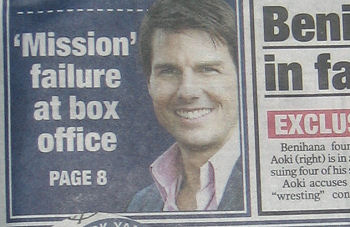
And one of the first messages I got after turning on the computer was from a friend of the film at Paramount, who reminded me that (a) M:I:3 is “Cruise’s third highest domestic opening, and that (b) the “worldwide opening weekend number is $118 million, which is up from MI2.”
Hollywood Interrupted‘s Mark Ebner is, of course, a well-known Scientology “watcher” (i.e., a euphemism for an ardent disliker), which means he probably hears from others who feel as he does, which in itself casts doubt upon this second-hand observation, posted today: “Hollywood, Interrupted just received an eyewitness report from a moviegoer who, while purchasing tickets for a Mission: Imposssible II show on Friday, May 5th, saw a woman in front of him in the ticket line purchase 900 tickets at a cost of just shy of $9,000 — all for the Church of Scientology. An ArcLight guest services rep would not confirm whether or not an excessive ticket purchase like that was made.” The reason I’m running it is because there was a seemingly verified report of someone trying to fix the results of a Parade magazine poll about whether Cruise’s image troubles were self-generated or caused by the media. Parade publicist Alexis Collado told “Page Six”, “We found out more than 14,000 (of the 18,000-plus votes) that came in were cast from only 10 computers…one computer was responsible for nearly 8,400 votes alone, all blaming the media for Tom’s troubles.”
Hollywood Elsewhere is taking the Fung-Wah bus from Boston to New York today, so nothing will post between now and 7 pm or 8 pm eastern.
Upside of Taps
From Risky Business to Mission: Impossible III, Tom Cruise had a good 23 year run…and now it’s over.
Not his career, obviously, or the power that comes from being a big star with a huge fan base — Cruise is still fairly secure in these realms. But something fundamental changed this weekend with the somewhat disappointing earnings of Mission: Impossible III. What’s over and finished now is Cruise’s rep as a nearly invincible box-office powerhouse.
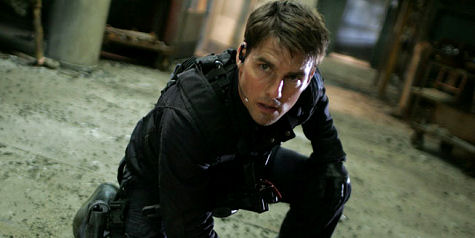
He may rebound in a year or two — not financially, but perhaps with a really good film and a superb performance. Maybe. He could luck into it. What he needs is to make another Jerry Maguire or another Born on the 4th of July — something that exudes sweat and struggle and personal growth.
But he’ll never be Mr. Financial King Shit again. Not in the realm he’s enjoyed for the last 15 years or so. Not after the bruising he took this weekend.
< ?php include ('/home/hollyw9/public_html/wired'); ?>
With the $46 to $47 million brought in by M:I:3, there is solid numerical proof that Cruise’ drawing power has diminished. The $57 million earned by John Woo’s M:I film in 2000 means a drop of $10 or $11 million for the just-opened film.
But if you adjust for roughly a 15% inflation in ticket prices since 2000, M:I:3‘s 2000 ticket price earnings is more like $40,000,000. So it’s really $57 million vs. $40 million — same franchise, same Cruise, same everything. That’s significant.

“His career is far from over and he’s still a player…but he’s not where he was,” says a veteran marketer. “I know that the people at Paramount wanted to see $300 million last summer out of War of the Worlds, and that they were disappointed with the $234 million it wound up with. It was all the Scientology shit and jumping on the couch and criticizing Brooke Shields.
“With these grosses and all the competition to come this summer I would say M:I:3 won’t do much more than $125 to $150 million in this country. It’ll be off a minimum of 40% next weekend. There’s no way it can crack $200 million domestically.”
If I know Cruise he’ll be making smart, well-rigged films for at least another two to two and a half decades, and perhaps longer than that. He’ll just have to take less money, is all. He’s been making films on a percentage-of-the-gross payment basis for a while now, and he will probably continue to do that.
Cruise is an extremely wealthy man. He and whomever he’s with as a domestic ally and his daughter Suri can live in the lap of luxury for the rest of their lives without Cruise working another day in his life. Which is an absurd proposition, of course. The guy is an energizer bunny. He’ll never stop. He can’t.
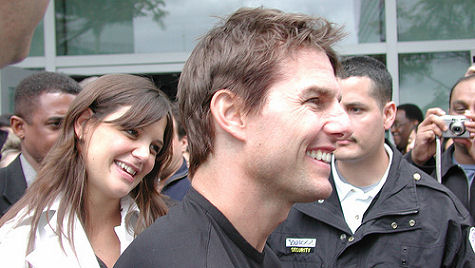
But he’s melted himself down over the last year or so. Women are said to have gone cold on him. His image isn’t quite that of a Michael Jackson-esque freak, but he seems to be in that ballpark. For now, at least. If he’s smart (and he is), he can damage control his way out of this, to some extent. Just downplay the weirdo stuff and focus on the work, the work, the work.
Next up (according to what I’ve read): the Glenn Ford role in James Mangold’s remake of 3:10 to Yuma, and (according to the IMDB) the role of renegade American pilot Billy Fiske in Michael Mann’s The Few.
Onward and upward. He’ll earn a bit less, but what’s that? This a big opportunity for the guy. He’s begun of those life passages that can lead, with the right attitude, to non-material riches.
I can’t read another article about Ron Howard, Tom Hanks and the gang shooting The DaVinci Code at the Louvre. I’m sorry, but they have to stop. I think we were all under the impression that the critique pieces about Hanks’ too long-and-too-greasy-hair (not my opinion…theirs) signified the end of the Louvre visitation articles, but no. Once my eyes locked onto the latest, written by Alan Riding for N.Y. Times, the lids began to droop. This may have been the 437th time I have looked at the photo of Hanks and costar Audrey Tatou come upon the naked bald guy lying on the museum floor, and after a while the system rebels.
French director Laurent Cantet (Going South, Time Out) has always “pursued the same obsession , which is that his characters are looking for their place in society and unable to find it,” says Cantet’s producer Caroline Benjo, speaking on the phone to N.Y. Times writer Leslie Camhi . “At the same time, he’s always questioning the horror of an economic system in which, if you don’t perform, whether it’s financially, sexually or affectively, you’re seen as subhuman .”
Team Elsewhere has finally gotten a “comments” thing installed, so from here on in it’s no-holds-barred and everyone gets heard in terms of any comments/arguments/exceptions and fuckyou-isms you may want to post following each and every posting I put up. We are truly in a new Hollywood Elsewhere era as of this evening, and I have only the great Jon Rahoi to thank for installing this and making it work. He’s one of the best creative human beings I’ve ever known in my life.
From the computer of Harry Knowles on the post- Superman Returns negative-review-of-a-script-but-not-a-movie shakedown: “Nobody from the studio contacted me in regards to damage control. When the negative alleged film review came out, I decided to contact the filmmakers to see if it was a real review, and it wasn’t. Many of the scenes this person claimed to be watching were in fact never filmed and cut out of the script months before shooting. I also felt it wasn’t an honest criticism because I had had the discussion with a film professional from a non-WB tied company that is not profiting from this film that had seen it…who was blown away. His giddy excitement in regards to the film was such that I really doubted the veracity of the criticisms that were showing up online. I did this because I wanted to at least attempt to get the truth out there. As you’ve said, Jeff — the ‘anti-Superman‘ crowd is awfully vocal. I’m not really sure why they’re so negative.” And by the way, “I don’t have a ‘great’ relationship with Bryan – I had to go through Warner Publicity to set up the 1 hour interview with him that I did for Penthouse. I do have a line of communication with the writers on the project — that’s how I know what draft got leaked and what scenes were not filmed.”
Quite obviously, N.Y. Times reporter Sharon Waxman bonded — related to, got down with, felt a certain emotional comfort with — with Little Miss Sunshine costar Toni Collette, who may have gotten over being ignored by the Academy for a Best Actress nomination for In Her Shoes but I sure as shit haven’t. The most significant part of Waxman’s piece, for me, is her reference to Collette having e-mailed a follow-up response to a question. Remember the days in which interviews were conducted solely in person, over a period of two or three meetings and sometimes even over drinks?
A tribute-to-Paul Giamatti piece by N.Y. Times guy David Carr, formerly known as “the Bagger.”