Cookie Monsters Are Due on Maple Street

I am a bad Sesame Street Cookie Monster person, or at least I was last night.

“Bad” in the sense that when I ordered a cup of Cookie Monster ice cream at Guerriero’s Gelato (476 Pleasant Valley Way, West Orange, NJ 07052), I wasn’t thinking of the teal-colored Sesame Street Muppet character but of a standard cookies-and-cream-type flavor…you know, vanilla ice cream with oreo cookies and whatnot, etc.

The Guerriero flavor menu offered various kinds of different oreo flavors (banana oreo, mint oreo, coffee oreo, samoa cookie) and I just wanted something plain and unexciting, and so, not being a Muppet person, I figured Cookie Monster would be a thicker or richer cookies and cream flavor…right? So I asked for a medium cup with sprinkles.

When I saw the teal-colored dish, I said “what’s that? I don’t want greenish-blue ice cream.”

Right away the principal server — an overweight Zoomer woman of color — began to dig in her heels and look at me like I was wacked. I had made a big mistake by not being a better Sesame Street person, granted, but all I was asking for was a different flavor. Zoomer woman didn’t want to hear it — her basic response was contrarian, and she seemed to be saying (a) you ordered this, (b) no substitutions and (c) no refunds.

When I persisted (at one point I said “I don’t give a shit” — an unwise thing to blurt out in an argument), she threw her hands up, as if to say “I’ve had it with this belligerent dick!” and went to the manager.

The manager came over and asked what the problem was. I explained and disputed a bit more, and then asked for a refund. Zoomer woman was glaring daggers and agitated, and I just wanted to get the hell out of there. Up until that instant I thought this had been a dispute over my ice-cream-flavor cluelessness, but I suddenly realized this had suddenly become a kind of cultural dispute that had something to do with my being an older white mansplainer.

The manager gave me my money back and asked me to leave, and then she tried to calm down Zoomer woman by holding her arm, but Zoomer Woman abruptly yanked her arm away as if to say “are you on his side?…don’t touch me!”

I said to Zoomer Woman, “Hey, you’re doing great there!…arguing with your own manager now! Not to mention your excellent customer relation instincts!” The manager again asked me to leave and I said “sure, no problem.”

I went to a pizza place two doors down, and ten minutes later Zoomer Woman came in with a friend and I said, “Hey, there she is!” She glared more daggers and said “don’t look at me!”

The cops weren’t called and so nobody was arrested, but I was amazed how a relatively minor misunderstanding on my part, one that could’ve been easily solved by “no problem, sir…what flavor would you like instead?”…a relatively minor ice cream thing had, in the space of 20 or 25 seconds, blown up into something else entirely.

Read more

Cruise vs. Nolan IMAX Contretemps

Following up on a Puck exclusive from Matthew Belloni, Variety‘s Rebecca Rubin has reviewed the turbulent IMAX situation — not so much a conflict as a show of temperament and agitation — between Tom Cruise‘s Mission Impossible: Dead Reckoning Part One (Paramount, 7.12) and Chris Nolan‘s Oppenheimer (Universal, 7.21).

Cruise is allegedly irate about IMAX execs having contracted with Nolan and Universal to play Oppenheimer and only Oppenheimer on all of the North American IMAX theatres for three full weeks, or from Friday, 7.21 through Thursday, 8.17.

The Cruise-Paramount tentpoler (aka MI:7) will be first out of the gate, of course, but will be presented on IMAX screens for only nine (9) days, or between Wednesday, 7.12 and Thursday evening, 7.20.

The next morning (Friday, 7.21) MI:7 gets the heave-ho and Oppenheimer steps into the booth.

There are only 401 North American IMAX screens, and only 30 of these are capable of projecting hardcore 70mm IMAX.

What could Cruise be saying to IMAX execs that would make any sense? A contract is a contract, right? Could he be saying “you guys know that Dead Reckoning Part One is going to be much, much more popular with Joe and Jane Popcorn than fucking Oppenheimer, which appears to be a high-falutin’ moral drama aimed at intellectual dweebs, and in black-and-white yet …a movie about the development of the atom bomb, which happened over 70 years ago and means very little to Millennials and GenZ.

“You know we’re going to be a much hotter ticket, so why don’t you guys just man up and tell Universal and Nolan that you’d rather play Dead Reckoning for obvious reasons?”

Even if Cruise was to say something along these lines (which would be nuts in and of itself), IMAX execs wouldn’t have a choice. Their commitment to play Oppenheimer is almost certainly iron-clad.

If I was in Cruise’s shoes I would push Paramount to commit to an emergency IMAX-only release for Dead Reckoning a week or two earlier, starting, say, on Wednesday, 6.28 or at least on Wednesday, July 5th. Imagine the want-to-see factor if MI:7 was playing only on IMAX screens for one or two weeks prior to the general release on 7.12. Crowds would be breaking down doors.

Let’s not forget that Dead Reckoning has been in the works for two and three-quarter years, and has been finished and ready to show for a good year or so, and perhaps a bit longer than that.

MI:7 filming began on 9.6.20, went through a COVID shutdown and finished a year later during September 2021.

Mission: Impossible — Dead Reckoning, Part One was initially set to open on 7.23.21. It was then bumped to 11.19.21, and then bumped again to 5.27.22, and then again to 9.30.22 — four release dates set and cancelled. The current 7.12.23 release was announced on 4.27.23.

Forget Magaro as Best Supporting Actor Contender

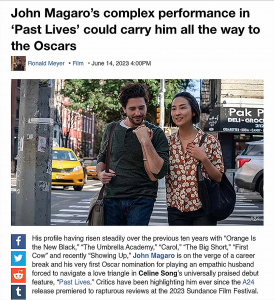
I’m afraid that the notion of John Magaro receiving some Best Supporting Actor action for his performance as “Arthur”, the trusting but slightly dumbfounded husband of Greta Lee‘s “Nora” in Celine Song‘s Past Lives…I’m sorry but that’s a likely ixnay.

Oscar noms generally don’t go to short** bearded guys who play bright, sensitive sad sacks with floor-mop hair. Magaro is a smart, expressive actor, but Arthur is essentially passive and kinda wimpy. I never thought of him as someone I’d like to emulate.

Confronted with the fact that his playwright wife is still in love with her childhood sweetheart (“Hae Sung”, played by Teo Yoo) and that she seems to be pondering the idea of switching horses, Arthur’s basic thing is “ohh, gee…I might wind up getting dumped here…well, I guess I have no choice but to play it cool and low-key and show some understanding to my dear wife and basically say ‘well, honey, I understand what you’re feeling but I hope you don’t, like, leave me for this slightly taller Korean guy…uhm, you know, whatever.”

** Magaro is somewhere between 5’5″ and 5’7″ — that’s at least one inch shorter than Humphrey Bogart and possibly the same height as Alan Ladd.

“Asteroid City” Refresh

I reviewed Wes Anderson‘s Asteroid City (Focus Features, 6.16) in Cannes just over three weeks ago. It’s opening tomorrow so I may as well re-post. I’ve said at least a dozen times that Wes doesn’t seem to want to expand or deepen his artistic reach. He makes standard issue WesWorld movies, and he’s going to stick to the brand and that’s that. Take it or leave it.

Posted on 5.23.23: Wes Anderson‘s Asteroid City (Focus Features, 6.16) would almost certainly be “another signature tableau exercise in WesWorld irony — zero emotion, wit, whimsy, staccato dialogue, a darkly humorous attitude, etc.”

Add in the other familiar signatures — formal framings, immaculate and super-specific production design, etc. — and that’s pretty much what Asteroid City is…quelle surprise!

Having been a conflicted Anderson fan for over 25 years and an Anderson friendo since ’94, it breaks my heart to say this once again, but Asteroid City is a whole lotta fun to splash around in, eye-bath-wise, but there’s almost nothing going on except the Anderson troupe reciting their lines just so.

Immaculate style (in this instance ’50s kitsch) mixed with bone-dry humor and not much else.

Yes, Asteroid City features a meaningless, blink-and-you’ll-miss-it Scarlett Johansson nude scene (nothing remotely close to that buck naked Lea Seydoux posing-for-Benicio del Toro scene in The French Dispatch).

And a delightful musical sequence featuring some wonderful Oklahoma!-like polka dancing, performed by Maya Hawke and Rupert Friend.

And a cartoonish, silly-looking alien with 1950s Warner Bros. animation department bug eyes who, in 1955, twice pays a visit to Asteroid City, the small-town site of a Junior Stargazers convention. Except the alien does nothing (no threats or love or anything in between) and has nothing to say or to teach like Michael Rennie did four years earlier…zip.

The song-and-dance sequence, which ignites with the joyful spirit of choreographer Agnes DeMille, indicates that Wes feels real affection for musicals. Perhaps if he had filmed Asteroid City as a sung-through opera?

But of course, he didn’t and probably couldn’t. Because (and again, it really hurts to say this) he’s been wrapped so tightly in his WesWorld aesthetic — dry sardonic humor, deadpan line readings, somber philosophical musings — that he can’t seem to bust out of it or has lost interest in doing so or whatever.

Remember when Wes’s characters went through actual human difficulties and occasionally expressed emotion? The kind you could relate to, I mean? Certainly in Bottle Rocket (Luke Wilson‘s glorious love for Inez, the motel maid) and Rushmore (romantic obsession, jealous rage) and more recently in Grand Hotel Budapest (bittersweet nostalgia for a certain elegant, old-world way of life that’s been washed away by time).

What is Asteroid City attempting to deal with, metaphorically or adult-behavior-wise or what-have-you?

The best I can figure is that it’s about complacency — several highly attuned, obviously intelligent characters who are, of course, nominally aware of the alien’s visit and are taken aback by this world-shaking event but can’t say or deduce or conclude anything of substance. Nothing means nothing, but they sure are surrounded by a lot of drop-dead southwestern nothingness (fake mesas in the distance, a huge tourist-attraction crater), and the film sure is an eyeful to look at. It’ll probably give you an occasional chuckle or, more likely, an LQTM moment.

Read more

Smooth and Pleasurable “Arnold”

Arnold (Netflix, currently streaming) is an engaging, charmingly sanitized doc about the life of Arnold Schwarzenegger.

His story is told in three chapters — childhood + bodybuilder (early ’50s to late ’70s), movie actor into movie star (’74 to present) and California governor (2003 to 2011).

I’ve never had any problems with Arnold’s moderately conservative philosophy (he was more or less a green Republican while serving in Sacramento), and I always felt…okay, it’s probably better to put the sexual stuff aside or into a separate box, although I’ve always loved the line “eating isn’t cheating.”

The best parts of Arnold are those the deal with his ascent — Austrian childhood, entering bodybuilding competitions at age 15, becoming a major bodybuilding champion in the ’60s and early ’70s, his small but amusing silent appearance in Robert Altman‘s The Long Goodbye (’74), and his first noteworthy supporting role in Bob Rafelson‘s Stay Hungry (’76), a laid-back comedy-slash-love story that’s always been one of my favorite ’70s films.

Watching Arnold actually led me to buying a Stay Hungry Bluray, which will arrive on Friday.

Read more

The Real Thing

I’ve long admired Treat Williams‘ lead performance as Danny Ciello, a morally conflicted detective of Italian-American descent, in Sidney Lumet‘s Prince of the City (’81). But after learning of Williams’ death a couple of days ago I did a sentimental rewatch of Prince, and it hit me why that film, despite excellent reviews, never really energized Williams’ career.

Two reasons for this: (1) Williams’ performance was more about pushing than being, and (2) he didn’t look believably Italian.

John Travolta, Robert De Niro, Al Pacino and Sylvester Stallone always had that natural Italian-American streetcorner thing going on, but Williams looked like an impostor — like a fair-skinned, baby-faced, button-nosed WASP pretending to be an Italian by way of black hair dye, and so his intense, at times strenuous performance always felt like an attempt to “act” his way into being someone other than who he actually was.

I knew several Italian-Americans guys from the tristate area in my teens, super-urban guys who wore pegged pants and pointy leather shoes, and none of them ever looked like Williams. That pinkish-white skin plus that black hair dye…no sale.

There was always something a bit curious about Williams’ facial features, which were soft and rounded and and a bit fleshy. The son of an antiques dealer mom and a corporate executive dad, Williams had a Connecticut prep school lineage. His family moved to Rowayton, Connecticut, in early ’55, when he was three. He was descended on his mother’s side from William Henry Barnum, a U.S. senator from Connecticut and third cousin of the showman P. T. Barnum. Williams was also a distant relative of both Robert Treat Paine — a signatory to the Declaration of Independence — and President Herbert Hoover.

Natural Williams (light brown hair) vs. black-hair-dyed version in Prince of the City.

Easily Among The Greatest, Especially in the ’70s

I never saw any of Glenda Jackson‘s landmark performances on the Broadway stage — not her Nina Leeds in Eugene O’Neill’s Strange Interlude (’85) nor her commanding titular turn in King Lear (’19) nor her Tony Award-winning perf in Three Tall Women (’18). And I never saw her perform anything in her 20s, and before this morning I’d never even noticed her bit as a partygoer in Lindsay Anderson‘s This Sporting Life (’63) when she was 26 or thereabouts.

It probably goes without saying that I paid very little attention to her political career, which lasted from ’92 to ’15.

All I ever knew and loved about Jackson came from her sweet-spot period, which primarily occured in the ’70s and lasted roughly a decade (’69 to ’80). It happened between her Oscar-winning performance as the eccentric and perversely feminist Gudrun in Ken Russell‘s Women in Love (’69), which was made when she was 32 or 33, and her second and final escapist comedy with Walter Matthau, Hopscotch (’80), when she was 43 or 44.

Jackson’s most emotionally relatable ’70s performance, hands down and no debating, was Alex Greville in John Schlesinger‘s Sunday Bloody Sunday (’71), a melancholy romantic triangle film that happens to be one of my all-time favorites.

Other performing highlight films from this period included The Music Lovers (as Peter Tchaikovsky’s doomed wife, Nina), Mary, Queen of Scots (as Queen Elizabeth), Bequest to the Nation, the sophisticated romcom A Touch of Class (which resulted in her second Best Actress Oscar), The Romantic Englishwoman (’75), Hedda, House Calls (her first comedy with Walter Matthau), Lost and Found (her second outing with George Segal, released in ’79), and the title role in Robert EndersStevie (’78), about the British poet Stevie Smith.

Jackson passed today (Thursday, 6.15) at her London home. She was 87.

Read more

On Verge of Letting Friedkin Thing Go

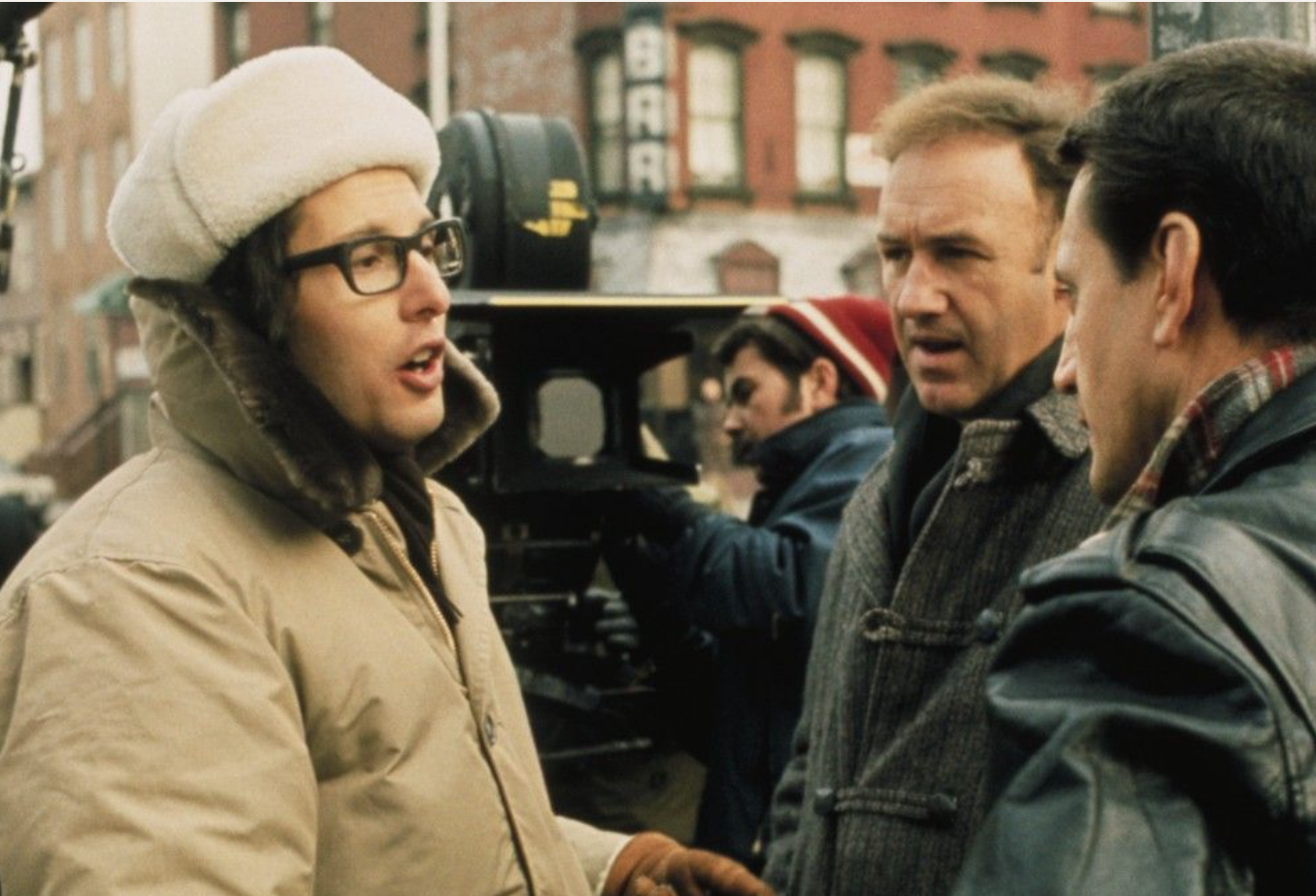
Four days ago (on Saturday, 6.10) I tapped out my latest riff about the bizarre deletion of a brief scene in William Friedkin‘s The French Connection (’71), which was apparently done (it physically pains me to type these words) with Friedkin’s approval or at his behest.

The day before (Friday, 6.9) HE commenter “The Multiplex” had reported that “in Disney’s DCP asset list the currently-streaming version of The French Connection is listed as ‘2021 William Friedkin v2.'”

This info, I noted, “is seemingly fortified by a statement from The Criterion Channel, passed along by “The Connection” in another 6.9.23 HE story titled “HE to Friedkin re Censorship Fracas.” CC’s statement said that “according to our licensor [Disney], this is a ‘Director’s Edit‘ of the film.”

I spoke yesterday to a Hollywood veteran, and one of the things I asked him was “why the hell would Friedkin betray the original artistic intent of his own Oscar-winning film by approving the deletion of a nine-second scene that uses the N-word?”

His reply: “Well, he’s entitled to do this, and the original film hasn’t disappeared — it’s available on physical media even if the streaming version is missing the censored footage.”

And then he said something interesting: “I don’t think Friedkin is playing the same close attention to this matter that you are.” I took that to mean that Friedkin may not be paying super-close attention in general.

The industry veteran then suggested that I drop the matter. “But it sets one hell of a precedent,” I replied. “What if it happens again with another important film…another woke censoring issue of some kind? I should drop that also?”

And yet I haven’t heard zip from Friedkin (I wrote him about this a while back) so in classic journalism terms the story has stalled.

I had presumed that Glenn Kenny‘s article on the matter would appear in the N.Y. Times, but my presumption, I gather, is erroneous. Some other outlet will run it this week.

This sparked a thought in my head, however, which was “why the hell wouldn’t the N.Y. Times want to run a story about this?”

The Times movie section may not have been formally pitched on this story, but why, I’m asking myself, would the paper of record blow it off? Could it be because (I’m just wildly speculating) they’ve basically become a woke activist newspaper, and they don’t want to post an article that might faintly imply some kind of vague endorsement of a nine-second scene in which the N-word is used?

The central issue is nonetheless huge and unmissable — should a half-century old classic film, raw and occasionally profane and, yes, punctuated with racist dialogue here and there, be censored in order to fall in line with current woke dictates — which are only a temporary spasm of passing cultural socialism — or should The French Connection be streamed in its original form, as most anti-censorship types would argue, out of respect for the original creative intent that was decided upon in 1971, even if the director has recently capitulated to the wokesters?

It’s one thing to include a preface or intro of some kind to a recently altered film, explaining the reasons for a deleted scene, and quite another thing to just lop off a nine-second sequence without comment or explanation. It’s too big of a deal to try and sneak this through.

The story appears to have boiled down to one about cowardice, I regret to say. A story in which a willful, hard-charging, tough-minded director — a guy I’ve admired all my life — has suddenly, in his mid ‘80s, became a squishy go-alonger and a weak sister…an obedient slave to woke commissar mandate thinking.

That’s a big effing issue with all kinds of precedent-setting implications, and the N.Y. Times doesn’t want to touch it over…what, racial profiling concerns?

Invisible Stripes

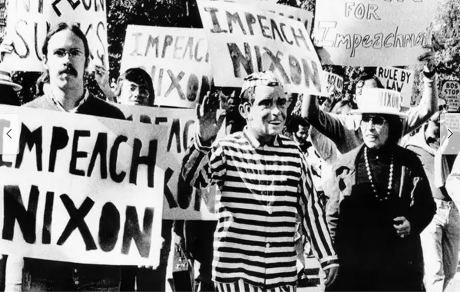
Yesterday an older placard-carrying Donald Trump protestor, dressed as a classic-style George Raft jailbird, ran in front of Trump’s SUV limousine and was quickly hustled off by security.

I immediately recalled a guy who wore the same outfit in front of the White House on Sunday, 10.21.73, or the day after the Saturday Night Massacre. — a guy in a Richard Nixon mask, I mean, holding an “Impeach Nixon” sign.

Munich Surfers Forever

“The Eisbach (German for ‘ice brook’) is a small man-made river in Munich. Just past a bridge near the Haus der Kunst art museum, the river forms a standing wave about one metre high, which is a popular river surfing spot. The water is cold and shallow, making it suitable only for experienced surfers. The wave has been surfed since 1972.” — from the Eisbach Wiki page. (Video taken on 6.22.12 around 8:30 pm.)

Read more