

Well, at least there’s one thing that works in Bewitched (Columbia, 6.24), and that’s Steve Carrell‘s third-act cameo as Paul Lynde’s “Uncle Arthur.” If only director-cowriter Nora Ephron had decided to weave Carrell into the film as a major character, things might have turned out differently. Lynde played the Uncle Arthur character (as a bitterly witty gay warlock, natch) on the original Bewitched series off and on from ’65 through ’71, and Carrell does Lynde quite well. Known mainly as an off-and-on Daily Show correspondent as well as one of Will Ferrell’s better friends (he previously costarred with Ferrell in Anchorman and Melinda and Melinda), Carrell has an obvious knack for playing acutely hyper alien-visitation characters. He’s the star of Judd Apatow’s The 40 Year-old Virgin (Universal, 8.19) and is currently shooting Little Miss Sunshine. Apparently those reports about him starring as Maxwell Smart in a feature version of Get Smart have some basis in fact.
Two Tom Cruise items have
Two Tom Cruise items have just broken that are going to enrage certain parties. Radar Online is reporting that Cruise made repeated calls and made certain overtures to Scarlett Johansson “weeks” before he began his relationship with Katie Holmes. (Johansson was reported by Upcoming Movies as being firm to costar with Cruise in Mission: Impossible 3 in July ’04.) The item, which quotes Johansson directly and says her publicist didn’t respond to calls or e-mails seeking confirmation, claims Johansson not only declined Cruise’s offer of a Scientology-fortified relationship, but that Cruise then made similar relationship pitches to Kate Bosworth (22) and Lindsay Lohan (18) “before settling on the 26-year-old Holmes.” The other item is from N.Y. Daily News gossip columnist Ben Widdicombe(i.e., “Gatecrasher”), and it says the following: “So here’s what I’m hearing about that relationship. A source VERY close to the deal is saying there’s a contract. It’s worth $5 million. It’s for five years. There will be no sex. The deal was sealed June 7. That’s what I’m hearing.” Hold on…only $5 million for five years? If I were repping Katie I would insist on at least $2.5 million per year (more?) with all kinds of extras and stock options and you-name-it.
On Scorsese’s “The Departed”
Good Stuff
It’s possible that Martin Scorsese’s The Departed won’t work, but it appears as if all the elements for a genuine Scorsese comeback are in place. An urban crime movie (Marty’s home turf), a terrific cast (Leonardo DiCaprio, Matt Damon, Jack Nicholson, Alec Baldwin, Ray Winstone, Vera Farmiga) and a really fine script.
This is probably Scorsese’s last chance to raise himself back up to the level of Goodfellas or better. If he screws this up he should just throw in the towel.

Slapdash pseudo poster art for The Departed that I would normally be too embarrassed to put up, but I can’t find anything else.
I’m saying this because I’ve finally read William Monahan’s script for this remake of Infernal Affairs, a 2002 Hong Kong crime flick about a pair of moles infiltrating the mob and the police department at the same time. Frankly? I saw it in Toronto and I found it too complex and hard to follow.
Monahan’s version is much more clearly plotted, not to mention tight and slangy and gritty in the good old east-coast street fashion. It’s also a well-constructed suspense piece.
The two moles, Billy and Colin, are respectively portrayed by DiCaprio and Damon. Billy is an angry undercover cop infiltrating the mob; Colin is a calm and collected mob guy serving as a police detective.
< ?php include ('/home/hollyw9/public_html/wired'); ?>
Jack Nicholson is playing Costello, a ranking mob boss Billy is trying to take revenge upon for an old family wound, one that’s fairly close to what drove DiCaprio’s character in Gangs of New York.
Just as DiCaprio’s Amsterdam Vallon won the affection of Daniel Day Lewis’s Bill the Butcher by being extra-snarly and game for anything, Billy wins Costello’s trust by being exceptionally loyal, smart and ferocious.
Damon’s Colin works his way up the ranks of the police department and eventually lands a job as the head of Internal Affairs and is given the job of trying to find out who the mob mole is — i.e., himself.
Costello knows there’s a mole somewhere under him, and to uncover the truth he leans entirely on Colin, whom he’s known since the latter’s childhood. All kinds of stuff goes down, and yet DiCaprio and Damon never face off until the last 15 or 20 pages.

The Departed costar Vera Farmiga
The only thing vaguely dismaying is the fact that Farmiga has the lead female role, that of a therapist who’s has sessions with both Billy and Colin. Farmiga is a very good actress (last in The Manchurian Camdidate) but she does nothing for me chemically. She’s one of those obliquely attractive museum-pretty types that everyone loves except for regular guys who buy burritos at the 7-11.
A good part of the flavor of The Departed, apart from the bounty of Monahan’s rich and robust dialogue, will, I presume, come from the performances of supporting actors Peter Mullan, Anthony Anderson, Winstone and Baldwin. These guys are aces every time out so…
Warner Bros. will release The Departed sometime in ’06. It reads like a fall movie, but it’ll probably be finished in editing by mid-fall ’05 so maybe it’ll come out sooner.
And…
I’ve got three other scripts I’m going to try to read this weekend:
* Russell Gewirtz’s Inside Man, a bank robbery-hostage drama that Spike Lee will be shooting in Brooklyn this summer, with Denzel Washington, Jodi Foster and Clive Owen in the lead roles. Universal will release it in ’06.
* Terence Winter’s Get Rich or Die Tryin’, the drama based on 50 Cent’s struggle to leave behind a drug-dealing life and become a successful rapper. The great Jim Sheridan (In America) is directing. 50 Cent is playing himself, and the costars include Viola Davis, Bill Duke and Terrence Howard (who stars in his own film about an underworld type trying to become a musician, Hustle and Flow, this summer).
* Terrence Malick’s The New World, about explorer John Smith (Colin Ferrell) and the clash between Native Americans and the British in 17th century Virginia. The subtitle is “Story of the Indies.” New Line is releasing on 11.9.
Rock My Wordsoul
Every time I get on the subway I get out my new copy of “The Rock Snob’s Dictionary” (Broadway Books), a very snide and tidy little sum-up guide about the who, what, when and why of rock-music elitism.
Last night I pulled it out on the R train going downtown from 42nd Street and when I looked up we were pulling into Cortland Street, about five or six stops farther than I wanted to go. I wasn’t very happy about that, but at least this tells you how much fun this thing is to flip through.
I read this 148-page paperback whenever I can because it’s so exquisitely written. Every sentence is a Hope diamond, chiseled and honed and phrased to perfection with just the right seasoning of know-it-all attitude…aimed, naturally, at the snobs who initially created it.
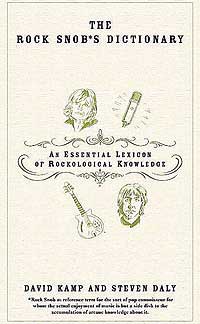
I don’t get rock music as fully as I do movies, but I understand it well enough to recognize that the authors, David Kamp and Steven Daly, who both write for Vanity Fair, know it over under sideways down.
Their definition of a rock snob, found on the book’s front cover, is “the sort of pop connoisseur for whom the actual enjoyment of music is but a side dish to the accumulation of arcane knowledge about it.”
Just go to the site and read their writing samples (which Kamp is a bit more responsible for than Daly, being the editor between them) and you’ll see what I mean.
If you care about rock music at all, you have to get this thing. I’m serious. It’s so sublime I’ve read it through twice. And there’s a nifty English school-book quality to the hand-drawn illustrations by Ross McDonald.

Why am I writing about this, apart from the fact that it was a much-appreciated gift from departing Doubleday/Random House publicist Marc Winter, who’s moving into film producing? Because Kamp and Lawrence Levi have written The Film Snob’s Dictionary, which will come out in February ’06, and this is something I imagine readers of this column will want to have.
The preview page for this book on the Random House website describes it thusly: “By helping to close the knowledge gap between average moviegoers and incorrigible Snobs, the Film Snob Dictionary lets you in on hidden gems that film geeks have been hoarding (such as Douglas Sirk and Guy Maddin movies) while exposing the trash that Snobs inexplicably laud (e.g., most chop-socky films and Mexican wrestling pictures).”
Mexican wrestling pictures? Somebody help me out here.
I called Kamp yesterday morning to talk about the currently available Rock Snob’s Dictonary ($12.95). I tried to reach him through normal channels but it was taking too long so I just found his number and called and he picked right up.
“Whenever you talk to rock people or when you read the rock press, there’s this curve that pretty much goes unexplained,” Kamp said. “People refer to Brian Eno or Televison without any acknowledgement of what these terms mean.”
Their book, obviously, intends to close the gap between snobs and Average Joe’s.
“It’s a very simple idea,” he told another interviewer who was better at asking the right questions. “Just put some things in boldface and define them: these terms that make up this code you can’t quite crack when you’re reading rock magazines or discussing music with people in your dormitory.”
Kamp and I had a nice conversation but it was kind of boilerplate (my fault) without any really great quotes coming forth.
He did tell me, however, that other Random House snob books are being worked on. He’s preparing a wine snob book now with a guy named David Lynch, who works as the wine director at Babbo, the Italian restaurant on Waverly Place. There’s also a food snob and a football snob book coming up.
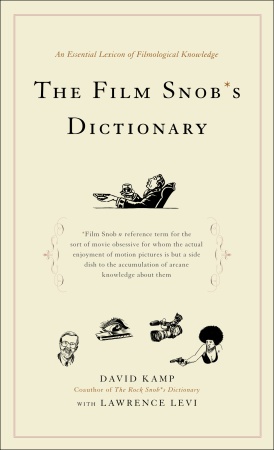
The Rock Snob’s Dictionary originated as a feature in Vanity Fair, as did some of the Film Snob material.
“I would say that [this] particular condition of rock snobbery is probably a lack of sexual intercourse,” Daly told an interviewer last month.
“Think of when a person becomes interested in rock music: the teen-into-college years,” Kamp has explained. “Politically, that’s when you’re going to change the world. It’s also when you have your most strongly held taste convictions. So you take everything very seriously, you’re very territorial. You really think these bands are the most important bands.
“At the same time, you don’t want them to be too well known, because then they wouldn’t be yours anymore — they’d be sellouts. So there’s this whole proprietary quality to rock snobbery that isn’t there even with film snobbery.
“To me, actually, film snobs are more insufferable. But rock snobs are the most, ‘this is my turf, keep off!'”
Grabs

Lexington and 61st, during Thursday’s (6.16) rainstorm around 3:30 pm.

Last Days star Michael Pitt following round-table journalist chit-chat — 6.16, Regency Hotel, Park and 61st, 5:25 pm.
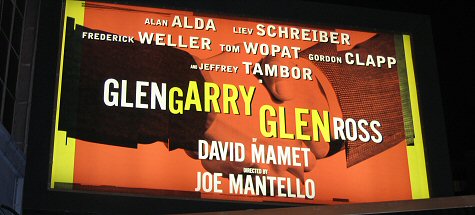
Marquee of Bernard B. Jacobs theatre, 242 W. 45th Street — 5.15, 10:25 pm.

L train heading east to Williamsburg, Brooklyn — Thursday,6.17, 11:15 pm.

Rainwater and plastic detritus flowing into drain at corner of 2nd Ave. and 62nd Street — Thursday, 6.16, 6:10 pm…during Thursday afternoon’s rainstorm.

Exterior of Longacre Theatre, 220 W. 48th Street — Wednesday, 6.15, 10:12 pm.
Tom and Katie
“Isn’t this whole Tom/Katie thing just totally creepy? I don’t fault her – she’s been swept up into his celebrity and personality, although you’d think a woman of 26 would be a bit more cautious. But Tom’s creep-out factor is through the roof!
“I’m not a fan of his as an actor but he certainly has his niche in the movie world. Still, why suddenly all of these public declarations and displays of love from this man who sues anyone who dares to encroach on his privacy in even the smallest way? And the Scientology thing just makes it all more discomfiting.
“I believe that every move Tom Cruise makes, every minute of every day, is calculated and planned. The man does not have a spontaneous bone in his body, so all of the leaping and shouting and kissing is just…icky because it seems so orchestrated.
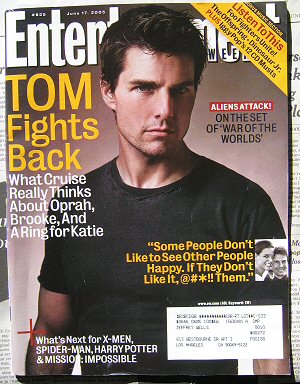
“I usually find these high profile celebrity relationships nothing more than light entertainment, because they normally play out in a predictable and harmless way. This one is just plain disturbing because Tom Cruise is so weird and Katie seemed so normal …until recently. Let’s hope the frog realizes the water is close to boiling and hops out before it’s too late!” — Lisa in Denver
“I like Tom Cruise. He’s made some good films and I applaud him for some of the roles he’s taken on. I have to confess I don’t know much about Katie Holmes, but she seems like a nice young lady. I wish them both all the best. But when you add the Scientology aspect to the mix, things start to get very strange.
“I’m all for religious freedom and tolerance, but this so-called religion strikes me as more than a little weird. My skepticism automatically kicks in because the founder of Scientology was an author of science fiction. Scientology may actually help some people handle this crazy life, but any religion that requires you to pay for the various states of enlightenment increases my skepticism.
“And then to add a Scientologist shadow (i.e., Jessica Rodriguez) to follow Ms. Holmes around, and things are certainly getting curiouser and curiouser.” — Edward Klein.
“As a pretty unapologetic Scientology basher, I can’t help but wonder how the 26 year old Jessica Rodriguez is OT-IV. Have you any idea how much money that takes? I’m not sure I’ve ever heard of anyone getting past OT III before their 30th birthday, and it takes several $100K more, plus time, to get to OT IV. Not that it really matters, but it doesn’t really jibe.
“Why, in any event, is the ‘serious’ entertainment press afraid to touch this with anything resembling a magnifying glass?
“Cruise’s publicist sister is a pussy compared to Pat Kingsley. Tom Cruise is actively proselytizing for a government recognized cult! He fired Kingsley when she disagreed with his desire to speak out about $cientology, and now he’s spitting out their ridiculous lies (Carl Jung was an editor for the Nazi papers in World War II, methadone was originally called Adolophine and named after Adolf Hitler, etc.) and being quoted in bold in major wire stories.” — Joel Sadler
“Congratulations to Cruise for finally finding love…even if it is with a woman who seems less extraordinary, magnificent and especially less of a woman than Cruise has proclaimed her to be. Holmes’ way of responding to questions reminded me of a 13 year old, but the heart wants what it wants and I’m sure Holmes isn’t on the rebound at all after calling off a five-year relationship including some years of
engagement.
“I’m not buying George Hickenlooper’s explanation that Holmes rejected the role of Edie Sedgwick in Factory Girl because of her obligations to the promotional tour for Batman Begins. The Bat movie is an already-hyped big movie with its own in-built fan base. Holmes’ role doesn’t serve as any kind of crux in the story line, and the bottom line is her role in the movie is not big enough to require her to be a key part of the promotional tour. Choosing to make a movie like the Sedgwick project or going on a promotional tour for Batman is certainly a no-brainer.
“I wonder if Cruise was under a rock during Bennifer or if he believes that he is likable enough for people not to care too much about his very public relationship.” — Akilis.
Cinderella Blues
“My gut feeling is that while Russell Crowe’s phone tag incident certainly didn’t help matters, I can’t imagine some guy in Gary, Indiana, refusing to see a movie because Crowe is a hot-head. Maybe some concerned soccer mom in Denver, perhaps, but I don’t think that would be the rule.
“If anything, Cinderella Man‘s embarrassing returns probably have something to do with the title, for one. You’ve got tough guy Russell Crowe in a boxing film and you call it Cinderella Man? Why not just call it Girly Man? I can see that guy in Gary, Indiana, saying to his buddies, `Hey, wanna go see Cinderella Man?’ and them saying back, `Cinderella what?’
“The second and biggest thing is that Cinderella Man has the unfortunate timing of following another critically acclaimed boxing movie, directed by a respected Hollywood veteran. Million Dollar Baby was a tough sell (as are most boxing films, it could be argued), but it won out commercially and critically because the quality was there.

“You and I know that a great film is a great film, no matter what the concept is, but to an average filmgoer out on a Saturday night, the quick and easy appraisal of Cinderella Man is: “Hey, didn’t we just see a boxing movie? Let’s go see Brangelina!”
“Sad, but true.” — David Scott
Wells to Scott: You’re describing or hypothesizing the behavior of a group of people committed to an instinctual, submental, “what, me read reviews?” approach to seeing movies. You’re talking about people who are flat-out refusing to use that arcane skill they were taught early in life called “reading” or deploy that trait known to many thousands of us called “curiosity” and take five minutes and go online and look into a new film.
I know…that’s out, can’t happen, forget it. But as long as it’s Gorilla Cage time out there, movies will rise or fall for gut-response reasons, and trailers and TV spots will continue to be the propelling factor in spurring people to see or not see a film, and the quality of mass-market movies will get more and more abysmal.
“I have a tough time believing that Russell Crowe’s recent headline-grabbing fracas had much at all to do with the box office slip of Cinderella Man. My guess is that those that were inclined to see it (and I’d imagine a fair share of blue hairs were in this bunch) jumped on it the first weekend, especially considering the drought of decent flicks at the local ‘plex. Nothing new here. The thing just didn’t have legs. Tweens and teens couldn’t care less, and the core audience already paid their $8.50.
“I think another big issue is the fact that the film, however well crafted, is simply predictable. We all know how it’s gonna end. It’s an age-old story we’ve all seen a hundred times. No surprises. Why bother?
“I’d venture to guess a vast majority of the paying audience doesn’t pay to see a movie for nuanced performances or beautiful picturesque cinematography or finely crafted period production design. The across-the-middle crowd just wants to be entertained and sometimes surprised. My guess is there is a huge cross section of audience that when push came to shove, wavered on seeing it because they already knew how it ends. I know I did.” — Jeffrey Wright
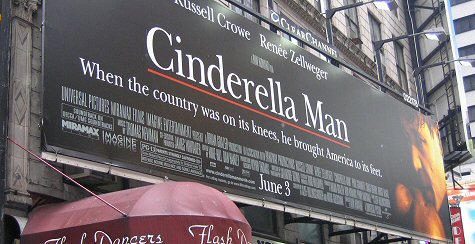
Wells to Wright: From my perspective, from any perspective that presumes a certain awareness on the part of the general public (which may be a mistake, I realize), there was simply no glaring negative attached to Cinderella Man other than Crowe’s phone-throwing incident. That was and remains the only downside to this film in actuality, dumb-ass presumptions and suspicions aside.
“Cinderella Man isn’t just entertaining, but quite touching. It isn’t depressing unless you’re a complete idiot. It uses a gloomy 45-minute setup as a springboard into a soulful, feel-good payoff that lasts for over an hour. It’s a somewhat predictable tale, yes, but most people over the age of twelve or thirteen realize that there are only so many stories out there and what really matters is the singer, not the song.
C’mon…to not see a movie because you know how it’s probably going to end is absurd. The percentage of movies that knock you flat with a surprise ending or twist of some kind is very small, and everyone knows that. What counts is how good the ride is along the way.
“It is not necessarily the culture of tabloid, as New York Times writer Caryn James has stated recently, that somewhat causes the movie experience to be tarnished due to the burring of the line between the art itself and the offscreen exploits of the actor playing the character.
“The actor as well as the film industry is arguably at fault for much of this. Many of them simply enjoy the attention for whatever narcissistic reasons they have. Ben Affleck and Jennifer Lopez. Angelina Jolie on Actor’s Studio talking openly about things that are completely insane. It’s as if these people feed off the system.
“You even said yourself that maybe they think they can follow different rules than ourselves. Christian Slater and his late-night ass-grabbing, for one example.
“For what it’s worth, if someone self-destructs there is always another fine performer to replace the burnout. Sure, some very good films may be damaged by the offscreen antics, but other movies are always there. But in general, I’d say it really doesn’t matter that a film is damaged by such activity and causes it to be dismissed. No one has to watch a film and if they do not want to view it because of the actor’s political beliefs, their criminal record, or they don’t like people with red hair, so be it. Heck, I wouldn’t choose to view a chick flick even if it did get four stars…there really is no difference.” — Phillip C.Perron.
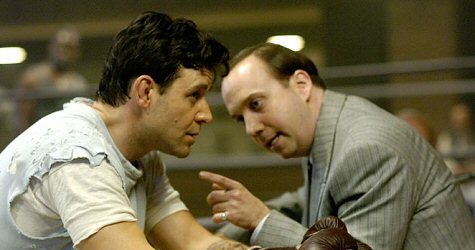
“I saw Cinderella Man last Friday night and it was obviously first rate, if a little schmaltzy. My father loved it in a way I’ve never seen him like a picture before. But he’s 73, not exactly anyone’s target audience.
“Anyway, I think the picture became a commercial disappointment for the following reasons:
1. Bad title. Yeah, I know that this was Braddock’s nickname, but so what? It’s obviously a turnoff for some.
2. Period Pieces are Tough Sells, and this period in particular — the Great Depression. And yes, the film is emotionally wrenching at times and some may think a bit depressing (that is, if they haven’t seen it). My sister is ill and hasn’t been to a movie in 18 months. Feeling well enough to go yesterday, she thought about CM, but thought it would be too depressing. She went to see Brad & Angie instead (and loved it, as did my other sister and her female friend).
3. Summer Release — Big Mistake. This would’ve been the perfect fall release, lining it up right timing-wise for year-end awards. Do you think it’ll get any now? Universal’s Nikki Rocco and Mark Schmuger must be reeling, not to mention Grazer and Howard.
4. Russell Crowe — This guy is a great actor, but his own worst self-destructive enemy. A colleague of mine, a first rate assistant director, did a picture with him years ago, before he was a star, and said he was a total prick. And my buddy gets along with everyone!
“Looks like a perfect storm of negativity. Too bad, because it really is a good picture. So is The Lords of Dogtown, which most thought would do some business. But it really tanked…hard. Don’t you love the movie biz?” — Dixon Steele, Hollywood, CA.
“I think they made a strategic mistake in opening it simultaneously with the first wave of big summer films. I believe you can open an essentially serious, quality-level picture in summer. But I think they missed the crucial lesson of Seabiscuit‘s success, which was that you open such a film mid-summer, after even the dimwits have begun tiring of the big-budget crap and are willing to search around for something with a slightly different flavor. I truly believe if Universal had waited a month, they’d have been in much better shape with this one.” — Todd.

“To suggest that Russell Crowe’s career is in trouble after the phone incident and the poor second-weekend box office returns of Cinderella Man is premature. Who would we replace him with, Brad Pitt?
“This is not condoning his actions in NYC, for which he has already apologized for and undoubtedly will have to suffer consequences. But in the end he will survive this and continue his unparalleled work. Universal should take the blame for releasing Cinderella Man at an inappropriate time. Why release the film here in June while releasing it in the fall in the rest of the world? Which marketing genius took the credit for that?” — Tommasina Papa-Rugino.
“I saw your column on the murphsplace site and noted the comment from one journalist about the possible loss of an Oscar nomination for Russell Crowe. As your column is widely read do you think you could do a favor for those of us who belong to the more fair-minded part of society, and remind the Academy’s members that they are…
“NOT PERMITTED to vote on moral grounds but only on the basis of what they have seen and heard in the cinema not what they read in the gossip columns or seen on the chat shows, and NOT QUALIFIED to sit in moral judgment of anyone (let he who is without sin cast the first stone, as a much better man than any of them once said.
“Whilst on this issue you might also try reminding your readers of the concept of the Presumption of Innocence, and how important that right is — particularly your fellow journalists who happily crucified Russell Crowe on the front pages of their newspapers without once bothering to ask whether or not he should even have been arrested.
“As to the arrest itself, let’s try for a few facts, just for a laugh…
“1. Russell Crowe was paying the better part of $4,000 per night for the use of a room which was supposed, among other things, to contain a working international telephone.

Soho’s Mercer Hotel on Prince Street.
“2. By the time of the disputed incident he had been staying there for a week and the telephone had not worked properly in all that time.
“3. The hotel had failed to address the problem in any way, despite by this point having taken nearly $28,000 from Russell.
“4. After finding the phone to be no use for making an international call yet again Russell tried calling down to Reception to sort out the problem for the 7th time.
“5. Apparently being unable to make himself clearly understood he disconnected the phone, which he was entitled to do as its licensed user having given valuable consideration (nearly $28,000) for the duration of his booking, and took it downstairs to prove that it was not working.
“6. The receptionist was apparently unhelpful and rude, to the point where Russell lost his temper, (what on earth did the man say to get such a reaction?!), and threw the telephone at the wall, from where it rebounded and hit the recalcitrant clerk. This DOES NOT constitute assault in the 4th or indeed any other degree as again there is no evidence of intent to cause injury – an absolute prerequisite when bringing a charge of assault. What it does constitute is disorderly conduct and possibly criminal damage.
“7. Why was the receptionist so rude to a man known to have a short fuse, and at a time of day (4.20am) which repeated academic research has shown to be the lowest point of the human psyche?
“8. What if any training policy and customer service policy does the hotel have and did the receptionist comply with them?
“9. Why did the hotel make no effort to provide a working telephone after receiving complaints every day for a week? What is the hotel’s equipment replacement policy and did the hotel’s staff comply with it? The Mercer’s contract with Russell included the use of a working telephone for which, and for other services including common courtesy from the hotel’s staff, he had paid nearly $28,000.

“10. Where has the figure of $1,000,000 in damages come from? No jury, American or otherwise, is going to award such a sum for a 1” long cut, which has caused no permanent damage of any kind and which will be invisible to the naked eye in six months’ time. If a jury did make such an award it would be struck down on appeal for being a perverse award, as the law requires.
“Moreover, Russell has an overwhelming case for a counterclaim of contributory negligence which could reduce any award by as much as 50%.” — Amelie Smith, London, England.
“Russell Crowe is the best actor alive today, and the unfortunate incident at the Mercer Hotel doesn’t change that. To be fair, why don’t you remind folks of Johnny Depp’s drug arrests before his Tim Burton movie opens this summer? Or Sean Penn’s…?
“At least Mr. Crowe was just trying to get in touch with his family, and had the character to own up to his mistake.” — L. Steinberg.
Bad Collars
“With regard to those bad-collar shirts at Banana Republic, you need to understand that 90% of post-college, under-35 men have to wear these things because instead of getting raises and job security, most of us work for companies that would rather let you wear khakis and golf shirts to work rather than having to pay you.
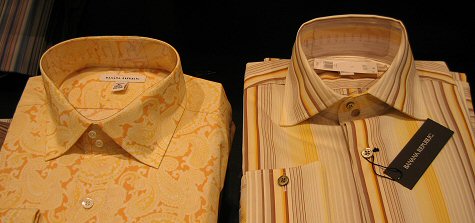
“Some of them must be aimed at an urban gay group, but the rest of us are just simply left with nothing else to wear to work. Chalk it up to trying to find pants and shirts that don’t make you look like you work at radio shack. ” — Evan Boucher.
Smiths
“I had no interest in seeing Mr. & Mrs. Smith when I first heard about it and would have happily passed on it except my wife wanted to see it and it was our anniversary, so I decided it wouldn’t kill me and besides, if I take her to see the films she really wants to see I can then get her to go to films I want to see — the give and take of marriage.
“While I didn’t loathe it quite so much as you did, it wasn’t a complete waste of our time and money. The stars were decent and it had moments. The first quarter of the film wasn’t bad, but it did get bad…very bad. After it was over we chatted about the pointlessness of it all and the stupidity of the gunfight in the store and why it had to be so over the top.

“There was a kernel of an idea in the film; it could have been something fun and maybe inventive. It seems that Doug Liman had no choice in making something good. He had lots of money thrown at them and the studio wanted something expensive big, loud and stupid. I have to wonder how much control a director has in today’s Hollywood. And why anyone would want to make something like Mr. & Mrs. Smith.
“Why couldn’t Liman have said he could save the studio some money and re-tool the script cutting out the crap and trying to make something reasonably clever and original? Obviously there was a fat paycheck involved, but don’t directors ever read these scripts and have some input on what the final product is? In this case the answer was a big no.” — Edward Klein
“I always enjoy your stuff, but please get a grip about Mr. & Mrs. Smith.
“I saw it last weekend largely because of the positive reviews from Kenneth Turan and Desson Thomson, two movie critics that I have tremendous respect for. I am a woman, but I do not read tabloids, so I’m not quite the demographic that you denigrate for flocking to the film this weekend. I wanted some adult summer fun that received pretty decent reviews, and Mr. & Mrs. Smith fit the bill.
“I also saw the heartwarming Mad Hot Ballroom this weekend so it’s not like I lack for taste.
“So keep up the good work with your website and chill on the Mr. & Mrs. Smith vitriol. Far worst things have happened to the movies.” — Quin.

Wells to Quin: Ahah…Freudian slip! “Far worse things” have happened to movies, eh? Then you admit Mr. and Mrs. Smith constitutes some kind of bad thing, right? That’s because you’re basically an honest woman and you know deep down, even though you “liked” watching it for the “summer fun” element, that movies of this type are not just bad but aesthetic pollutants…the spiritual movie-aura equivalents of pesticides in the water table.
I am telling you, Quin, that if there is any aesthetic justice in the after-life, Liman, Pitt, Jolie and the New Regency guys who produced this thing will eternally roast on a spit for their contributions to this film.
More Grabs
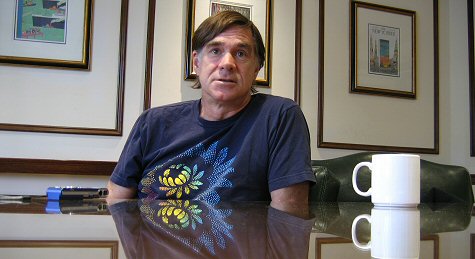
Last Days director-writer Gus Van Sant at start of one-on-one interview at Manhattan’s Regency Hotel — Thursday, 6.16, 4:15 pm.
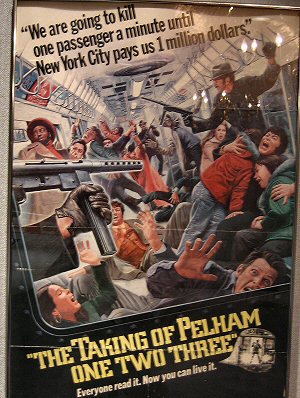
Several men execute a daring hostage-taking scheme aboard a New York subway train in order to persuade the city of New York to pay them one million dollars. Wasn’t this a joke in one of the Austin Powers films?

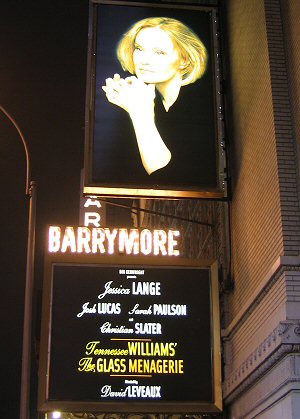
Exterior of Barrymore Theatre, 242 W. 47th Street — Wednesday, 6.15, 10:20 pm.

Last Days guitar picks…I grabbed at least five or six.

Soon-to-be-destroyed Beekman Theatre prior to all-media screening of the not-very-good but relatively inoffensive Bewitched — Thursday, 6.16, 6:25 pm.
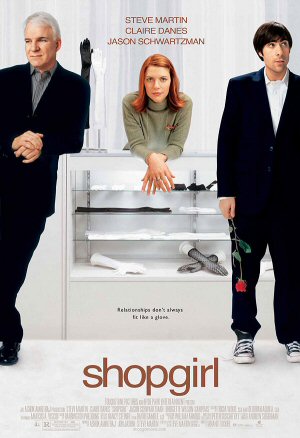
I read the hardbound version of Steve Martin’s original Shopgirl sometime in ’03 (I think) and found it concise and well observed and psychologically probing. The sadness of it — the bittersweet stuff — stayed with me. Martin wrote the screenplay, and if the movie (Touchstone, 10.21) is half as good it’ll be a fairly absorbing piece. What finally makes it, for me, is the casting of Jason Schwartzman (and not, thank God, Jimmy Fallon) as the younger guy who muscles in and makes a play for Claire Danes and basically ushers in an end to her relationship with Martin’s character, who is partly exploiting her youth and vulnerability but at the same time feels genuine tenderness and caring. The trailer isn’t up yet, but here’s the Touchstone site…just click through.
I’m a little slow at
I’m a little slow at times and maybe that’s why I’m not quite loving this first-anywhere gallery of Elizabethtown cast photos that just appeared on the film’s official site. If Cameron Crowe’s film is anything like the script (which I’ve read), Elizabethtown (Paramount, 10.14) will be a well-honed, colorfully layered story of romantic restoration on top of a quietly penetrating family ensemble piece. The idea behind these photos — a series of portraits of the principal actors in character (Orlando Bloom, Kirsten Dunst, Susan Sarandon, Bruce McGill, Alec Baldwin, et. al.) — is to say, “Hi, guys…we’ve got a really nice ensemble piece here.” What I’m saying is, if you’re giving people some visual first impressions of a film, shouldn’t you be trying to convey the emotional angles, the penetrating points, the underlying mood or tone…and not just a bunch of, you know, class photos?
That allegedly first-hand description in
That allegedly first-hand description in the Star of Angelina Jolie sounding like a “wounded animal, like someone being killed” during a gymnastic whatever during their stay at the Alfajari Villas beach resort in Kenya…man, I love that, and I don’t care if I read it first on Defamer. Item says the security guys became concerned, “grabbed their weapons,” rushed to Pitt and Jolie’s suite and “hammered furiously on the door with their clubs.” The screams suddenly stopped and a guy’s voice said, “Everything is cool guys. You can leave — we’re okay.”
Tomkat Goes to Oklahoma
Free and Clear?
On Friday, May 27, Tom Cruise took Katie Holmes to a town called Canadian, Oklahoma, partly to acquaint his newly beloved to a phase in her indoctrination into the Church of Scientology.
The Hollywood couple were in this remote corner of America’s heartland to visit a Scientology-backed drug rehabilitation center called Narconon Arrowhead, located about an hour from Tulsa on the shores of Lake Eufaula. And Tom basically took Katie through the whole this-is-Scientology, start-the-education-process thing.
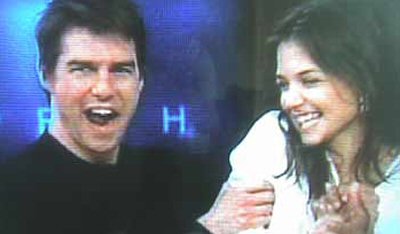
Smiles and giddiness: Tom Cruise, Katie Holmes.
Cruise’s sister and press rep LeeAnne DeVette called from Germany early this afternoon (Manhattan time) to say “yeah,” the story is true.
Details of the visit were relayed by an anti-Scientology blogger named Dave Touretzsky, who’s been called a solid and trustworthy source by two journalists I know and trust — a reputable east-coast big-city journo I spoke to this morning, and a journalist pal and book author who knows the whole Scientology scene cold.
< ?php include ('/home/hollyw9/public_html/wired'); ?>
I e-mailed the Pittsburgh-based Touretsky to get some more particulars but he didn’t respond by deadline.
The visit wasn’t denied this morning by Luke Catton, who works for Narconon Arrowhead’s public relations representative Gary Smith. “Tom’s a supporter, but I really can’t say anything and I think I should leave this up to LeeAnne to comment,” Catton said.
Holmes’ representative, Leslie Sloane of Baker Winokur Ryder’s New York office, said she’s “never been told” about the Oklahoma visit.
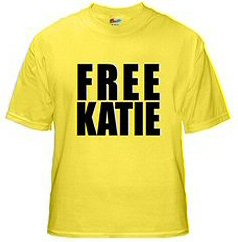
One of several T-shirts (among many different styles and colors) offered on www.freekatie.net.
According to Touretzsky, who wrote that the story came from “a hidden source” within the Narconon organization, Cruise and Holmes visited the facility for roughly four and a half hours. They left after Tom gave a speech at the weekly Narconon “graduation” ceremony.
The Hollywood couple’s brief visit ended when Cruise took Holmes by the hand and led her up to a hilly, sand-covered area next to an old wooden fence. Cruise released Holmes from his grip, an eerie Martian chorus came up on the soundtrack (“Uhhhaahhhhahhh!”), a hole in the sand appeared and suddenly Holmes was gone….
Sorry, but I felt I needed to throw in a laugh.
All Scientology inductees are sent through a “purification process,” which is apparently what Holmes is doing now.
DeVette says that Narconon Arrowhead “is not a Scientology center. It’s a secular program…it’s not a Scientology church.” She says one of the items on her brother’s agenda that day was showing the facility to a German journalist from Bild magazine.
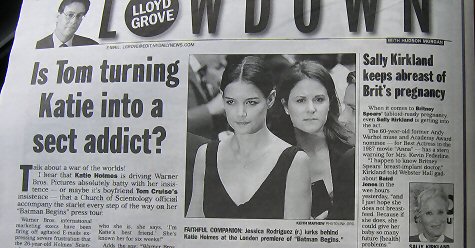
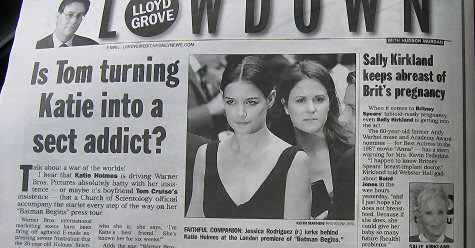
Katie Holmes (l.), Scientology babysitter Jessica Rodriguez (r.) at London premiere of Batman Begins as they appeared in photo on page 26 of Tuesday’s N.Y. Daily News, adjacent to Lloyd Grove’s column.
According to the facility’s website, Narconon Arrowhead “offers not only a comprehensive model drug treatment program in a non-traditional, non-institutional setting, but also a full training and apprenticeship or internship program for professionals interested in this new and effective approach to drug rehabilitation and prevention.”
It also says that Narconon Arrowhead “houses the Narconon network’s International Training Center,” blah, blah…but it’s a Scientology operation, okay?
If you want to know more, here are two websites exploring the whole Narconon program and history in a thoroughly nasty and negative fashion.
The more I read about it, the odder the whole Cruise-Holmes-Scientology thing sounds. I can’t fully explain or articulate it, but those hairs on the back of my neck are picking up some curious vibes.
Cruise and Holmes may be genuinely in love (c’mon…you have to bend over and at least allow for this), and there’s certainly nothing wrong with a little spiritual focus and discipline to keep a relationship on track, and I don’t know about every last aspect of the Church of Scientology, although I’ve done some reporting about it and know the general lay of the land.

Rodriguez-free Holmes on Batman Begins red carpet at London premiere.
All I know is that after reading Lloyd Grove’s column yesterday in the N.Y. Daily News about Cruise and Holmes and that Scientologist baby-sitter Jessica Rodriguez, the one who’s been following Holmes around like a bodyguard as she does publicity chores for Batman Begins …for some reason Grove’s story has uncorked images from John Carpenter’s They Live and Don Siegel’s Invasion of the Body Snatchers.
By mentioning these famously paranoid thrillers I’m obviously casting a negative light upon the Church of Scientology. But they’re a very guarded and controlling organization with a penchant for paranoia and secretiveness, and if you ask me they’ve more than earned their reputation.
And I think there’s something seriously diseased about Cruise professing to love and honor and respect Holmes but at the same time arranging, according to Grove’s column, to have her followed around by a Scientology “minder” like Rodriguez.
I just know creepy vibes when I feel them.
On the other hand, at least one story about Cruise trying to control Holmes is apparently bogus. I’m speaking of the one that ran in the New York Post about Cruise allegedly telling Holmes not to play the doomed Warhol model Edie Sedgwick in George Hickenlooper’s Factory Girl.
Hickenlooper, a friend, wrote me about this a couple of days ago and referred me to a statement he put up on the IMDB about this (see next story).

The key declaration in Hickenlooper’s statement is that the story about Cruise telling Holmes not to do Factory Girl because Sedgwick was a druggie and portraying such a person would go against Scientology beliefs is “blatantly untrue and stupid.”
“I don’t even know what Factory Girl is,” Cruise recently told an interviewer. He added, “The thing you’ve got to know about Katie is that she’s an incredibly bright and self-determined woman. She makes her own decisions.”
Okay, cool…but if that’s the case, why is Cruise allegedly paying Rodriguez, a 26 year-old Scientology upper-cruster (I’m told she’s on Cruise’s OT IV level within the organization) to “keep Katie on the path,” according to Grove’s source, as well as monitor her press interviews and encounters with people and, according to Grove’s story, give Holmes religious instruction from time to time?
In other words, Cruise believes there’s a chance that Katie might stray from the path and become…what?….infected by the skepticism of all those lurking non-Scientologists (journalists, etc.)?
There’s a report at Radar magazine’s website that refers to a Scientology magazine called Source in reporting that Rodriguez “ascended to the level of ‘New Operating Thetan IV’ (the same as Cruise) in January 2004.
“According to sources close to the Church, this means Rodriguez has joined the elite group of Scientologists who’ve been enlightened with the six-figure secrets of Xenu, the evil intergalactic ruler who implanted ‘thetans,’ or alien spirits, in earth’s volcanoes 75 million years ago, after which they escaped and invaded human bodies.
“As a ‘new OT IV,’ Rodriguez has the power to ‘control life, thought, matter, energy, space, and time,’ according to Scientology’s official site. Rodriguez has the ability to spot any ‘suppressive persons’ who interact with her celebrity charge.”
I know how strange this all sounds, but it gets a lot weirder than this…trust me. To really know and subscribe to the theology of Scientology after you get to OT III is to be suspended several feet above the earth’s surface with little Martian tentacles sticking out of your forehead.
Really…what kind of boyfriend hires someone to keep his girlfriend on the spiritually straight and narrow? I’ll tell you what kind of boyfriend does this. A control-freak boyfriend does this.
Cruise is extremely likable and engaging to all who meet him, but he is also very clenched and wired tight. He does terrific work and a few directors I know personally think he’s one of the greatest guys to work with. Nonetheless, I keep getting this sense of a guy who needs to obsessively micro-manage every last detail of his life, and who strongly believes in keeping the castle walls high and thick and well-fortified.
Maybe that’s necessary in these crazy tabloid times, but when you reach the point of hiring a twentysomething Scientology hardcase to keep tabs on your new girlfriend as a way of keeping her from saying or thinking the wrong thing, then I think you’ve really crossed the Rubicon.
Rodriguez “goes everywhere with Katie,” Grove’s source said. “She’s never more than a quarter-step behind her. When you ask her who she is, she says, ‘I’m Katie’s best friend.’ She’s known her for six weeks!”
Holmes announced at a London press conference on Monday that she’s officially converting to Scientology. Grove reported that this announcement “seemed to provoke a glare from her Batman Begins co-star Michael Caine.”
My anonymous big-city journalist friend, who’s been investigating and writing stories about Scientology for 25 years, says “there’s no such thing as conversion to Scientology. It’s a very gradual, step-by-step process. You have to do the basic communication courses, and then you have to eventually go ‘clear.’ And all Homes is right now is an initiate.
“But eventually the water will rise and she will eventually be a boiled frog. Drop a frog into boiling water and he’ll jump out. But if the frog isn’t aware that the water is slowly heating up, he gets more and more acclimated to the rising heat and then eventually he’s boiled and in the pot.”
I’d like to think Katie Holmes is going to wake up from this episode one day and roll her eyes and say to herself and hopefully everyone else, “What was I thinking?” After all, a lot of Scientology believers (not just beginners but people on upper levels) bail out.
And when she does, Homes is going to start to realize that all the Scientology skeptics and dissers — including people like Sheila Cameron, the creator of FreeKatie.net — were on her side all along.
Cameron launched the site after watching Cruise’s couch-bouncing appearance on The Oprah Winfrey Show last month. She’s been quoted as saying she’s surprised by the amount of attention the site has attracted.

“I just wanted to make a funny comment on a poorly handled media storm,” she told E! Online. “No one can deny that there is a feeling of unease about many of the couple’s public appearances, and I’m happy to create a place where people can vent on the issue from whatever side they like.”
Holmes, needless to add, doesn’t feel as if she’s a prisoner and is just sailing on the enzymes that kick in when you really connect with someone, and that’s great. If she and Tom are really in love, fine.
Holmes being receptive to Scientology “isn’t necessarily about psychological fragility,” my east-coast journalist friend comments. “Maybe she just wants to have sex with Tom Cruise and be his girlfriend and so she naturally wants to go along with the program. She used to have his poster on the wall in her bedroom, and he’s richer than God and he’s the biggest actor there is.”
And maaaybe she felt her career needed a little boost.
Holmes has also been making some changes in her professional life. Last week she canned her CAA agent, Brandt Joel, and replaced him with Cruise’s CAA reps, Rick Nicita and Kevin Huvane. This week she fired her longtime manager, John Carrabino, according to a report on E! Online.
George Says…
Director-writer George Hickenlooper (The Man From Elysian Fields, The Mayor of Sunset Strip) has something to say about Tom Cruise and Katie Homes, and it’s all groovy and glowing.
Hickenlooper is in pre-production on Factory Girl , a biopic about the tragic life of model and Andy Warhol scenester Edy Sedgwick. The film will be produced by Bob Yari, and is based from a script by Captain Mauzner and Simon Monjack.
Holmes was going to play the lead role but now she’s not, but Hickenlooper want sit known the casting didn’t go south because Tom Cruise talked her out of it because of some Scientology objection.
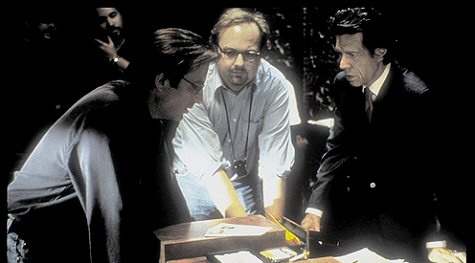
Andy Garcia, George Hickenlooper, Mick Jagger on set of The Man From Elysian Fields.
George has posted the following on his IMDB site; here’s a slightly edited version of it:
“First let me say that Katie Holmes is one of the most elegant, intelligent and charming actresses I have met during my career in film. She’s a delight to talk to and has a real old-world sophistication that I find tremendously appealing.
“This is one of the reasons I thought she would be a wonderful Edie. Katie’s own charm would capture an early moment in Edie’s life when she was living in Cambridge, was still innocent, before she went to New York and began her downward spiral.
“At the same time, I thought it would be exciting for an audience to watch Katie Holmes (who has previously played strong, girl-next-door type roles) play a character who takes this dark journey. Katie thought it would be exciting too.
“Over the course of several months, we had almost half a dozen meetings where we talked extensively about the script. On one of those occasions in New York, Katie came dressed very much like Edie. She was breathtaking. I was convinced she was my girl for the role.
“About two weeks ago, the New York Post (which has become nothing more than a muckraking tabloid) wrote a very defamatory piece about why Katie decided to ‘drop out’ of Factory Girl. They claimed that Tom Cruise didn’t want her playing a role where she would be a drug addict because that would go against his Scientology beliefs. This is blatantly untrue and stupid.

Edie Sedgwick
“If Tom Cruise felt that way, would he have ever appeared in a film like Magnolia ? Come on… Katie dropped out of Factory Girl because her commitment to doing press for Batman is overwhelming. She has an extensive press tour over the summer in Europe and Asia that would cut in to our rehearsal time.
“Shooting for Factory Girl begins in two months. Both of us felt she couldn’t balance both and that she wouldn’t have the time to do the research to take on this very demanding role, which would be very different from anything else she has ever done.
“Katie is not doing my project because she is the consummate professional, and wouldn’t want to take on a role where she couldn’t give 100%. No actor would want that, no director would want that. Tom Cruise had nothing to do with it. Cruise is a true gentleman and I feel bad about how he is currently being treated in the press. Leave the poor guy alone. He’s in love. That New York Times piece that ran about him last week was a disgrace. It felt more like Star magazine.
“Anyway, I guess it just goes to show you how cynical the media has become about love. Journalists should get lives of their own and stop destroying other people’s.”
Hickenlooper adds at the end of his statement that a piece is supposed to run [this Friday] in Entertainment Weekly about all this. In case it doesn’t, he says, here’s the straight poop.
More Grabs

Late-night eats on Kenmare Street and Lafayette Street — Sunday, 6.12.05, 11:10 pm.

McDonalds sign located in a Polish neighborhood…just checking to see if anyone’s paying attention. The sign is actually located on Canal Street just around the corner from….Chinatown! (Brilliant guess.)

Nicely renovated, freshly-painted condos on Brooooklyn’s Montrose Avenue, just west of Bushwick and a stone’s throw from my summer apartment

View of Manhattan skyline from north 6th Street, which cuts into Bedford Avenue in the western section of Williamsburg, the hip Brooklyn neighborhood that’s been totally Anglicized and yuppified and made expensive for all concerned.

Myself, web designer and Samizdata creator Perry DeHavilland at Laurel Canyon party that happened sometime in late April. I just happened to run across this, and it has nothing to do with anything.

This sturdy, German-built contraption is called a Party Bike. It’s for hire in the Times Square-Rockefeller Center area for $150 per hour (roughly $21.40 per person), and it seats seven people. Everyone pedals while the commandant controls the steering and braking. Naturally, there’s a Party Bike website.
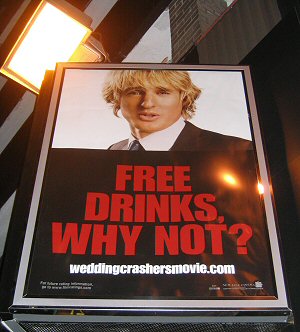
Relatively small, oddly located Party Crashers sign on 41st street between Broadway and 7th Avenue.
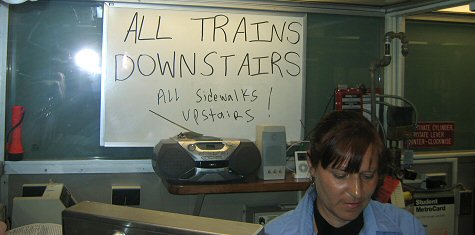
This very cheerful female MTA worker (right), working in a booth at the R station on Broadway and 40th, told me she felt she had no choice but to write this posterboard sign to help out the hundreds of tourists who’ve become totally disoriented once they walk down the subway entrance staircase.

This vertical cluster of signs, located at B’way and 43rd, looks much bigger and more…I don’t know, a lot more “whoa” than what this photo suggests.
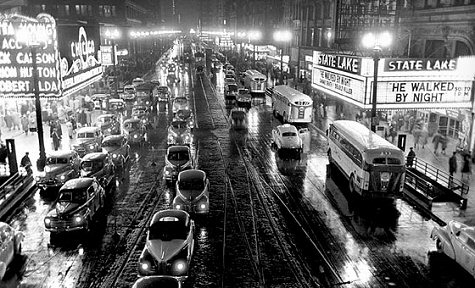
Shot of Chicago’s downtown theatre district taken by Look magazine photographer Stanley Kubrick in 1949.
James Cameron has been futzing
James Cameron has been futzing around with this and that project and not really doing anything feature-wise for so long (what’s it been, seven and a half years since Titanic came out?) that you really can’t pay attention to stories about his latest movie-to-be…I mean, this stuff is just in one ear & out the other. Hollywood Reporter columnist Anne Thompson and reporter Sheigh Crabtree have written that Cameron’s next film will not be Battle Angel, a pic based on Yukito Kishiro’s Japanese graphic novels about a “nymphette” who morphs into an action heroine, but another film called Project 880. No one at Cameron’s Lightstorm Entertainment is saying anything about what Project 880 is…and I’m not sure anyone cares. Cameron has stayed behind-the-scenes for so long he’s become The Man Who Can’t Pull the Trigger — a guy whose whole deal (apart from the TV projects and the underwater IMAX docs) is to prepare, research and develop movies to death, but never quite get around to making or releasing them. Thompson says that when and if Cameron makes either Project 880 or Battle Angel, both films would be shot in 3-D with custom-designed high-definition cameras. Well, whoop-dee-doo.
N.Y. Daily News columnist George
N.Y. Daily News columnist George Rush ran a lead item today about the Russell Crowe/Cinderella Man meltdown in today’s “Daily Dish” column…fine. (Especially since he quoted yours truly.) But in looking at how off-screen movie star shenanigans may be affecting box-office performance, Caryn James has summed up the whole celebrity-feedbag phenomenon rather nicely in today’s New York Times. She’s saying movies are no longer about the purity of the moviegoing experience — the tabloid-gossip crap is feeding into the watching of movies and vice versa. “For the average viewer in this celebrity-crazed culture, the hype and buzz are simply part of the baggage we carry into the theater along with the popcorn and the smuggled cans of soda,” she writes. “Whether Brad Pitt and Russell Crowe are playing characters in films, playing themselves on talk shows or are caught by paparazzi at unsuspecting moments, their fictional and nonfictional roles blend into one huge performance piece that affects how we watch their films, now more than at any time since the star-making business began.” This also: “Eons ago, when movie studios could fiercely control stars’ images, there was no Smoking Gun Web site to offer instant access to their arrest reports, no computers or camera-phones to spread unglamorous images. Now the media overload creates an ambient noise around movies, a sound so pervasive that even people who don’t pay attention absorb it.” In such a hot-house atmosphere, it is no stretch to acknowledge that Crowe’s real-life phone-tossing “hasn’t benefitted” Cinderella Man. It was more damaging than that, if you ask me.
Great news! After weeks and
Great news! After weeks and weeks of waiting and loads of political horseshit, it’s finally being announced that Clive Owen is committed to playing the lead role in Michael Davis’s Shoot ‘Em Up, a very hip-funny absurdist urban actioner fron New Line that will start shooting in January ’06. This is an excellent move on Owen’s part, and a major score for Davis. Anyone who doesn’t remember the 3.2.05 piece I wrote about Davis and Shoot “Em up, here it is.
The white-faced freak has walked…hooray
The white-faced freak has walked…hooray for the white-faced freak. Celebrity wins! Paving the way for more friendships with boys, more “hand-holding,” more Jesus juice, etc.
Wanna know why Mr.and Mrs.
Wanna know why Mr.and Mrs. Smith did as well as it did last weekend? Read this story by Maureen Story in today’s New York Times (“Forget About Milk and Bread. Give Me Gossip!”) I will say no more. Just read it. Remember how everyone was saying after 9/11 that the country and the culture will never be quite so frivolous again as it was before that tragedy?
Don’t you just love the
Don’t you just love the American public? More specifically, the moviegoers (let’s just say it — those really deep women out there who read the tabs and are total fools for the Brangelina mythology) who just had to see the thoroughly rancid Mr. and Mrs. Smith to the tune of $51.1 million last weekend, and thereby rewarded director Doug Liman and stars Brad Pitt and Angelina Jolie for making the biggest piece of shit of their careers?? (Variety said that “boosting Smith were older femme adults, who don’t usually turn out for actioners but do read the celeb weeklies and watch tabloid TV chronicling the are-they-or-aren’t-they star pairing.”) Let’s just be happy that the Smith success makes it that much easier for the next grossly expensive big-studio piece of shit to get greenlit. And also that all of those wise and perceptive American moviegoers (most of them under 35, I’m guessing) also decided to blow off Cinderella Man last weekend (it was down 48% from the previous weekend). The story of Jim Braddock is basically a corpse now, just waiting to get picked up and carried out of theatres because so many millions of American moviegoers didn’t show up over…what? Russell Crowe’s phone-throwing episode? Because Ron Howard’s boxing film is too quality-skewed to compete in the mindless summer season? Because Univeral didn’t push the family angle heavily enough in the ads? A good movie is a good movie, darnitall, and every indication is that those who’ve seen Cinderellla Man really like and speak well of it. It just doesn’t add up that a movie as worthy and emotionally effective as this one would just stumble and run out of gas like this.