

I identify as cisgender, fine, but I don’t think I want to identify as “cis” any more. The cisgender community (those who are not LGBTQ, trans, fluid, gender-nonconforming, whatever) represents around 95% of the populace, right? A few years ago the five-percenters decided that the 95-percenters have to identify as “cis”, which sounds like a blister or a boil. Who gave them this authority?
No offense but instead of “cis” I’d rather be known as an AUSG — an average, unassuming, straight grumpy guy who pops Cialis from time to time. What’s wrong with that?
@elder.blue_collar #question from @elder.blue_collar another installment of the insufferable ramblings of the left. Is gender a social construct? #theopendebate #fyp ♬ Morsmordre(莫斯莫多) – Crazy Donkey
Remember that Pauline Kael line that went something like “this is the kind of bad film that only a gifted director could make”? She was alluding to a strange capability among pantheon directors, which is the ability to make the occcasional stinker despite the odds favoring success.
Take, for example, Howard Hawks’ Monkey Business (’52) — a screwball comedy that leans way too far into silliness and absurdity and for the most part isn’t funny. Hawks got the mescaline comic chemistry right in Bringing Up Baby and Ball of Fire but somehow completely botched it here.
The basic unfunny idea is that an adult suddenly behaving like an adolescent is an embarrassment all around, and that “youth” is over-rated and that we’d all be better off being older and more settled and singing “we’re poor little lambs who’ve lost our way…baah-baah-baah.”
It’s about an accidentally concocted youth serum that turns everyone into an obstinate, obnoxious seven year old with no social disciplines.
Cary Grant’s seven-year-old personality is one thing, but early on he also acts like an 18 year-old who’s suddenly interested in Marilyn Monroe. It has something to do with the strength of dosage. In some cases (like Charles Coburn’s) the youth potion makes the recipient sexually frisky, or (in the case of Ginger Rogers) sexually competitve and jealous.
You know what might’ve helped? Shooting the damn thing in color. A color palette might have conveyed a certain spiritual uplift, a certain buoyancy.
Please name a few films that shouldn’t have failed given the pedigree of the talent (directors, writers, cast) but insisted on doing so regardless.
Nicole Holofcener‘s You Hurt My Feelings (A24, 5.26) is basically about an older writer named Beth (Julia Louis-Dreyfus) who feels devastated when she accidentally overhears her therapist husband Don (Tobias Menzies) confess to a close friend that he doesn’t much care for her latest book.
This is a film, in short, about the necessity of supportive lying by those close to aspiring writers (lovers, family, spouses, good friends). Writers can’t reasonably expect honest assessments from anyone close, and there’s really only one way to play it if a significant-other writer asks for constructive criticism — you’ve no choice but to be positive and supportive because any kind of mixed or mezzo-mezzo response will only poison the well or drive a wedge between you.
On top of which if you’re possessed by any kind of real talent you would naturally understand this going in. If you’re any kind of solid, perceptive, grade-A writer you should know how good you are without being told, and if you don’t know this you’re probably a second-rater…be honest.
There’s no winning in intimate situations of this sort. As a rule artists never want to hear that their child is ugly or homely or under-developed or God forbid deformed, and like I just said if a writer doesn’t know this about their own kid they’re probably mediocre anyway and not worth the hassle. People close to you will never level with you about how good your writing is, mainly because every emotional instinct in their body is telling them “go easy, be supportive, be loyal and avoid blunt statements of any kind.”
Boiled down Holofcener’s film is approvable in a moderately satisfying way. It’s a perceptive, well-layered, occasionally amusing, engagingly acted film. But it didn’t tell me anything I didn’t know going in. And it doesn’t have one of those big blow-out scenes…one of those scenes in which it all comes spilling out in one big gush.
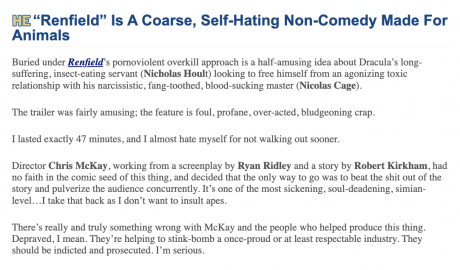
Chris McKay‘s Renfield opened theatrically six or seven weeks ago. A financial and critical bust (cost $65 million to make, earned a domestic theatrical tally of $25 million), Renfield quickly acquired a toxic reputation. My reaction wasn’t so much one of disappointment or disapproval as one of great furious anger — I felt seriously enraged. I wanted to bolt after 20 minutes or so. I didn’t quite make it to the 50-minute mark.
Thoughts from esteemed director and fellow New Jerseyan Joe Dante, received early this morning: “Bad in ways I couldn’t have imagined…it stinks…;I’m still reeling.”
HE’s brief review was written inside Leows Lincoln Square just before catching Ari Aster‘s Beau Is Afraid, which I was unexpectedly knocked out by. Renfield is streaming and about to hit Bluray, etc. HE community reactions are hereby requested.
During HE’s thrilling but arduous Paris-Cannes adventure (5.11 through 5.30) I somehow found the idea of paywalliing content a bridge too far, so everything was wide open for that nearly three-week period. So the paywall returns starting today. Thanks to subscribers for understanding and hanging in there. I’m even starting to figure out HE’s travel strategy for Telluride ’23, which is only three months off.
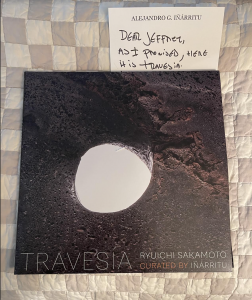
The music of the late Ryuichi_Sakamoto (1952-2023) constituted significant portions of the soundtracks of three films by Alejandro G. Inarritu — Babel (’06), The Revenant (’15) and Bardo (’22).
I’m repeating my conviction that Sakamoto’s Revenant score is an all-time grand slammer, and that Sakamoto himself is one of the greatest.
I passed along my deepest condolences to Inarritu after Sakaomoto’s death a couple of months ago (3.28.23), and soon after Inarritu offered to send me Travesia, a compilation of 20 Sakamoto compositions that Inarritu curated at the invitation of Milan Records’ Jean Christophe and Sakamoto’s manager, Norika Sora.
The two-disc vinyl album arrived at HE’s Wilton residence a few days ago.
A brief essay by Inarritu is printed on one of the vinyl sleeves. Here’s an excerpt:
“I vividly recall the sensory, emotional experience I had when I first listened to Ryuichi Sakamoto in the fall of 1983. I was with A friend, Carlos Claussel, in a car in Mexico City, trapped in traffic hell in the Perferico (i.e., outer beltway) at 3 pm. Carlos put in a bootleg cassette of a Japanese composer neither of us had ever heard of.
“At first a few piano notes arrived like some kind of fresh, light rain, and from that [came] a mantric cadence and a sweet deep voice. It felt as if fingertips were penetrating my brain and giving me a cosmic massage, [one] that went through my body and dissolved everything that might have been wrong in my life back then.
“It was the theme from Merry Christmas, Mr. Lawrence, and ever since that day a vital relation to Sakamoto’s music was within me. His work has become part of the soundtrack of my own existence.”
I don’t own a top-of-the-line vinyl turntable sound system at home (I make do with a Sonos sound bar), but a friend who lives nearby has an excellent sound system so that’ll be my way into this. Thanks to Alejandro for the gift, which I’ll cherish for the rest of my life. In early ’16 he also sent me a Revenant vinyl soundtrack album…thanks.
HE totally supports the firing of those two female Lululemon employees who chased a pair of shoplifters and then called the cops on them. Shoplifters (especially young men of color) are definitely entitled to steal stuff, and employees who chase them or try to bust them are nothing but vigilante troublemakers.
🚨BOYCOTT: Two Lululemon employees were FIRED for chasing after shoplifters and calling the police on them in Atlanta.
Lululemon said it has a zero-tolerance policy for pursuing shoplifters at their stores.
Luckily the police were able to track down the robbers, who were later… pic.twitter.com/uSYXKjDTdb
— Phillip Oliver-Holz (Alpha Male) (@ThePhillipHolz) May 29, 2023
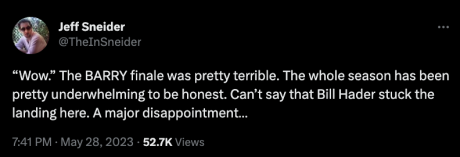
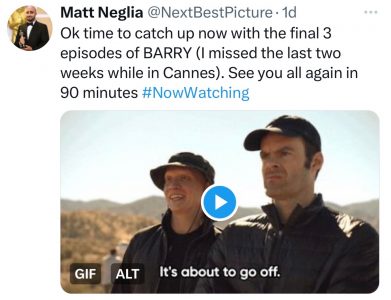
I wanted to post and discuss these Barry clips before getting on yesterday’s flight, but one thing and another kept getting in the way. I still haven”t seen the Barry and Succcession finales but at least I’m back in the zone. I totally know what happens in both finales, and it doesn’t bother me in the slightest.
I also need to see You Hurt My Feelings at the earliest opportunity.
It’s 7:20 am in West Orange, New Jersey (Jett and Cait‘s place). I woke up at 3:25 am. My French Bee flight left Orly around 7:25 pm last night; it arrived around 8:25 pm at Newark. I sat in a forward coach section…not horrible, not great. Unless you’re in first-class or business, eight-hour flights are generally agonizing as a rule.
A Memorial Day conviction, titled “Sensible Patriotism,” that I shared on 5.29.21:
I’ve always preferred the terms “those who served” or “those who fell in service to our nation” as opposed to “those who gave their lives.”
My father, a former Marine Lieutenant who battled the Japanese at Guadalcanal and Iwo Jima (and who once confessed to having downed a few belts of Scotch with some fellow officers before the assault on Iwo Jima on 2.22.45), always dismissed the wording of the latter sentiment. He found it specious.
Nobody “gives” their life in combat — they fight as best they can to achieve victory or at the very least not get killed, and sometimes fate tilts against them. That’s it — that’s all it boils down to.

Never, ever wear whitesides to an Oval Office meeting. Democratic House minority leader Hakeem Jeffries is a good hombre and a skilled operator, but in this instance he should be ashamed of himself. If you’re sporting whitesides you might as well wear knee-length beach shorts or a silky floral print shirt. We’re speaking of plaster cracks in the once-great wall of traditional civilization here. Certain sartorial instincts should be suppressed at all costs.
I mean, will you look at those light blue, horizontally-striped “happy” socks? Seriously…imagine getting dressed for the Oval Office meeting and actually saying to yourself “yeah, these socks definitely work for a White House conference about the debt ceiling…I’ll put them on.”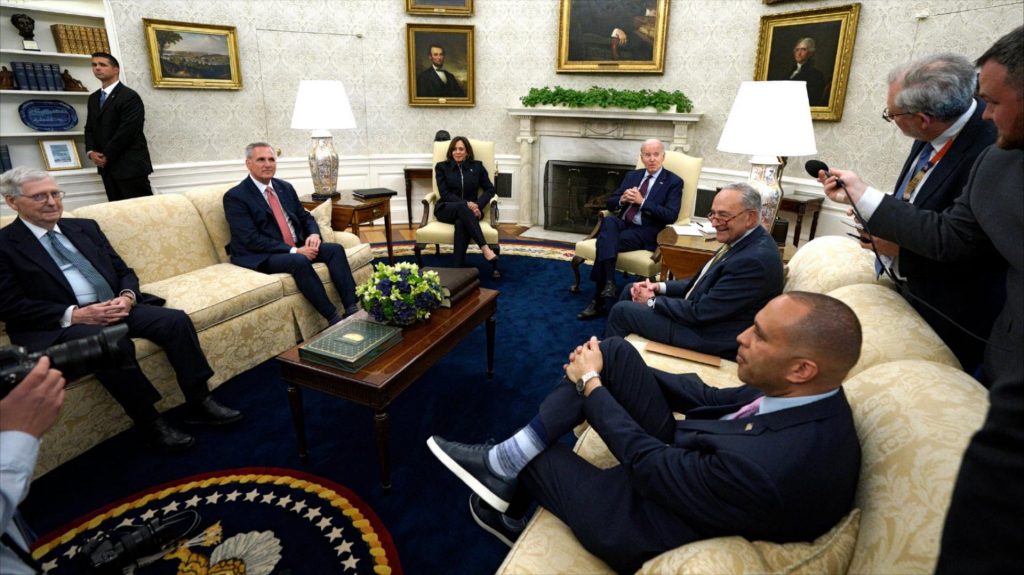
If there’s one must-to-avoid in terms of conversational observations about famous human beings, it’s deciding who’s “nice” and “not nice”.
Whenever I hear someone say that a famous person he/she has run into socially is “sooo nice” or “not nice,” I give them a death-ray look that would stop Gort in his tracks. “Nice” is welcome, of course, but overrated. What matters to me is “does a famous person I’m speaking to really mean what they say, or are they some kind of performative orangutan going through the motions?”
I don’t obsess over this stuff, mind, but a day-old Lewis Beale Facebook post brought it all back.
The thrust of Beale’s post was “oh, lordy, did Ben Kinsgley behave like an asshole when I interviewed him 30 years ago or what?” As well as “oh my God, Ian McKellen is such a sweetheart….I love the guy!…he’s a gift from God sent to earth to make all of our lives better and sweeter!”
Beale: “Ben Kingsley was interviewed a few days ago in ‘Headliner,’ a regular New York Times arts section feature, where celebrities are asked to name ten of their favorite things. The intro mentions that since Kingsley was knighted years ago, he likes to be referred to as ‘Sir Ben.’
“I interviewed ‘Sir Ben’ back in the ’90s, when I was a staff writer at the New York Daily News. I found him to be an insufferable, pompous bore. He sneered at my questions, treated the film’s publicist like dirt, and refused any posing suggestions from the staff photographer who accompanied me. He has since become my default answer when people ask me what was the worst interview experience I ever had.
“What resulted was the only truly nasty celebrity interview I’ve ever written, in which I compared ‘Sir Ben’ to the alien slime thing in the B-grade sci-fi film Species, which he was supposedly promoting.
“Not long thereafter I interviewed Ian McKellen, who had also been knighted. When I asked him if I should refer to him as ‘Sir Ian,’ he smiled broadly and said, ‘No, just call me Ian.’ He was a sweetheart.”
HE to Beale: I’ve chatted with Mr. McKellen three or four times over the years, and he’s always been a smooth, bright, learned, warm-hearted, unpretentious, cosmopolitan fellow.
There is also, however, room for edgy, prickly fellows like Kingsley from time to time. When you interviewed him he clearly had some kind of disturbance going on inside, perhaps due to the fact that he hated Species (or hated making it or both) and was ashamed to be promoting it.
Okay, he was a dick that day but does he have to be tied to the whipping post for this? Kingsley really has a wonderfully wicked and perverse sense of Don Logan-type madman humor inside, and was also beyond great in Schindler’s List (’93) and (never forget this!) masterful in David Jones‘ Betrayal (’83), not to mention Gandhi (’82) and Bugsy (‘91) and…what was that adaptation of Phillip Roth’s The Dying Animal called?
Why does oddball Ben or Kingsley-the-shithead necessarily have to be condemned? Not every person is conventionally likable in a way that you might prefer. It’s very easy and, I would argue, even somewhat meaningless to behave in a “nice” way. We all have a “nice” face or, if you will, a “nice” mask — it’s just a matter of putting it on.
Don’t get me wrong as I greatly prefer the company of nice, charming, gracious people with a twinkle in their eye, but I also accept or understand that sometimes unusual or interesting or even volcanic people are playing a different kind of game, or at least sometimes they are. They’re not evil — just possessed or mortified or their feelings have been hurt or something in that vein.
I’m a fan of both Ben and Ian…okay?