From Rebecca Keegan‘s 3.16 THR interview with Ben Affleck, the purpose of which is mainly to promote Air (Amazon, 4.5):
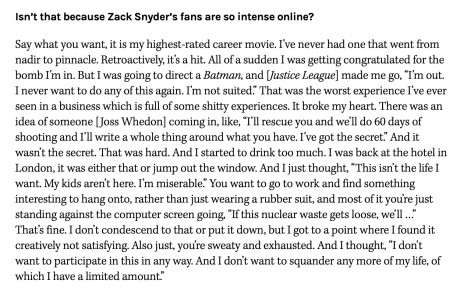

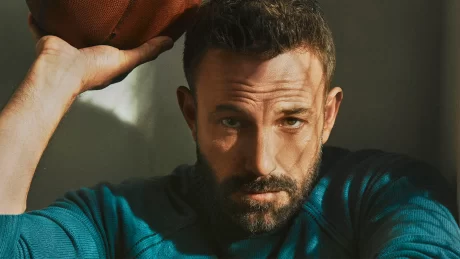

From Rebecca Keegan‘s 3.16 THR interview with Ben Affleck, the purpose of which is mainly to promote Air (Amazon, 4.5):
Could Spike Jonze’s Adaptation (’02), which stars a balding, overweight, Uriah Heep-like Nicolas Cage as a bizarrely fictionalized version of screenwriter Charlie Kaufman, be made today? I saw it again a few nights ago (4K Bluray), and yeah, it’s possible it could be made today, sure. But some characters would have to be un-whited as the film, shockingly and almost incomprehensibly, doesn’t have a single African American or Asian American face….eeeeeeee!!!! And Ron Livingston‘s Marty Bowen, Kaufman’s agent, wouldn’t be allowed to say that he fucked this or that girl in the ass.
22 years ago I reviewed Kaufman’s Adaptation script and called it ‘one of the most inventive and out-there scripts I’ve ever read.’ The main character, I explained, “is Kaufman himself, and that’s a big whoa right there. A screenplay about a screenwriter trying to write the screenplay? But it’s much more than that.
The ‘subject’ of Adaptation is an actual, one-time orchid-worshipper named John LaRoche (Chris Cooper), whose attempted theft of rare flora from a Florida state preserve eight years ago resulted in his being prosecuted by the state and, from that, a New Yorker profile of LaRoche and then a book called “The Orchid Thief” (Ballantine), by staff writer Susan Orlean (so named in the film and played by Meryl Streep).
Adaptation is primarily about Kaufman’s struggle to adapt “The Orchid Thief” into script form, but it’s also about LaRoche and Orlean and the importance of nurturing a devotion in life to something perfect and beautiful. It’s about the striving of mortals to merge themselves with the sublime — Kaufman in his way, LaRoche and Orlean in theirs. Like the screenplay, the movie is half about Kaufman’s situation and half about LaRoche and Orlean’s. But it begins and ends inside Kaufman’s head.
From Lili Anolik‘s “Warren Beatty, Pauline Kael, and an Epic Hollywood Mistake,” posted on 2.7.17 and really well written, my God:
“Didn’t that spate of Hollywood movies from 1967 to 1979, from Bonnie and Clyde to, say, Apocalypse Now, feel like a crime spree? As if the American New Wavers were pulling a fast one?
“The spree couldn’t last, of course. Sooner or later lawmen, i.e., studio men, would catch up. Or, worse, audiences wouldn’t. Times had changed.
“Kael understood this. In 1978’s ‘Fear of Movies,’ she wrote: ‘Now that the war has ended …[people have] lost the hope that things are going to be better…So they go to the movies to be lulled.’ But I’m not quite sure Beatty, who was considerably younger and had been knocked around far less, did. The chaos of the 60s and early-to-mid-70s — Vietnam, Watergate — made for an opening, though it was closing quick. Kael prophesied the end of Pauline and Warren when she wrote of the ‘new cultural Puritanism,’ as surely as Bonnie prophesied the end of Bonnie and Clyde when she wrote of the ‘sub-gun’s rat-a-tat-tat.’ (Did Kael foresee, too, the medium’s end? That the VHS revolution was just around the corner? That the 70s would be the last decade in which movies were truly a tribal experience?)
“Maybe Kael went to Hollywood, at least in part, to thwart this prophecy. Beatty had eyes for Kael, and Kael for Beatty, but they weren’t able to relate in a direct way. They’d need a go-between, a C. W. Moss.
“James Toback, who’d just made Fingers, a genuinely alarming movie about a concert pianist-cum-debt collector, would do nicely in that role since he excited them both. Writer George Malko recalls seeing Fingers with Kael: ‘She lifted up out of her seat, and even as she was settling back down, she was breathing fast.’ Toback, on screening Fingers for Beatty: ‘Warren stood after it was over and walked around in circles for a good two or three minutes.’ So Toback, quite literally, got Kael panting and Beatty erect.
“And Kael and Beatty used Toback to work each other up. Kael had socked it to Beatty for Heaven Can Wait, accused him of going commercial, selling out. It wasn’t only a review, it was a taunt. And a dare. Beatty double-dog-dared her back with an offer to produce. Kael and Beatty had been leading anti-Establishment figures for a decade-plus, which meant that they’d become the Establishment.
“By getting behind Toback, an artist, yes, but also a pickup artist, the protégé of composer Aaron Copland and orgy buddy of football player Jim Brown, they would prove that the spark hadn’t gone out of their rebel spirits, that they were still subversive, undaunted, young.
“Viewed from that angle, the crazy scheme starts to seem not so crazy after all, or possibly just crazy enough to work. Of course it was neither. It was the look Bonnie and Clyde exchanged — passionate, agonized, doomed — before the hail of bullets.”
Brian Kopppelman has been around and is seemingly well positioned as far as sussing out the straight dope is concerned. Wiki page: “Co-creator, showrunner and exec producer of Showtime’s Billions and Super Pumped: The Battle for Uber…co-writer of Ocean’s Thirteen and Rounders, producer (The Illusionist, The Lucky Ones), director (Solitary Man, the ESPN documentary This Is What They Want).
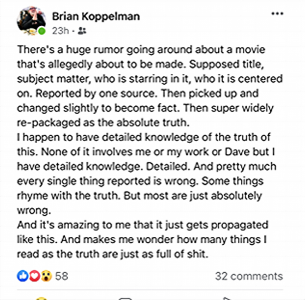
The ball is in Borys Kit’s court.
Here a podcast that Koppelman did with Tarantino, posted on 7.18.21:

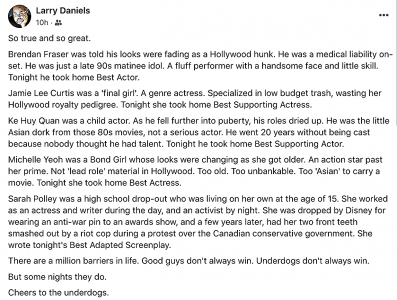
HE to Happy Larry: Your observations are “inspiring” in a certain light. Life will sometimes surprise. Unsung or less-than-stellar talents sometimes luck into unexpected rewards. And as truly grotesque as The Whale was and is in certain respects, Brendan Fraser‘s fat-suit performance was as respectable and even touching as this sort of thing gets. (Especially the white-light death scene.)
But Everything Everywhere All At Once will forever be regarded as an irksome (do I hear infuriating?) curio…a film that even the director’s own mother didn’t get and couldn’t understand the adulation for.
Did you honestly come out of that film full of “holy moley eureka” enthusiasm for Ke Huy Quan‘s performance? He was more or less fine (said his lines with urgency and proficiency, hit his marks) but he won because of (a) the comeback narrative + (b) the Asian identity pride thing + (c) because he brought big emotion to his Golden Globes acceptance speech.
Jamie Lee Curtis‘s IRS bitch performance was broad and coarse and rather absurd, like a character out of The Wizard of Oz….I felt intensely irritated by her acting (and her clownish makeup) start to finish.
Michelle Yeoh‘s athleticism and commitment to the dismayed, stressed-out character she played was also fine but again, her Oscar was about (a) Asian representation and (b) breaking the glass ceiling =plus (c) Cate Blanchett already has two Oscars.
Do you honestly think that EEAAO will be watched and re-watched by future film enthusiasts? That it will be cited by future film historians as a ground-breaker or seminal influencer? There’s a community of film Catholics who are sadly burdened with a sense of taste, and among this fraternity EEAAO is not just disliked but deeply loathed. In my humble judgment it is one of the absolute worst films to ever take the Best Picture Oscar….hands down, no question. The Movie Godz have taken note and are actually fuming as we speak.
Is there some way that we could all gather round and shame Quentin Tarantino for writing a line of Pulp Fiction dialogue in which John Travolta‘s “Vincent Vega” says “what a gyp”?
The movie is nearly 30 years old but what does that matter? Tarantino did a bad thing and needs to pay for it. “What a gyp” is derived from the word “gypsy”, and basically means “what a swindle, what a raw deal.” The cruel, racist expression alludes to the Romani people, and carries negative connotations including “defrauded or cheated.”
A message from Whoopi Goldberg regarding today's episode of #TheView. pic.twitter.com/PIvwYRWMsy
— The View (@TheView) March 15, 2023
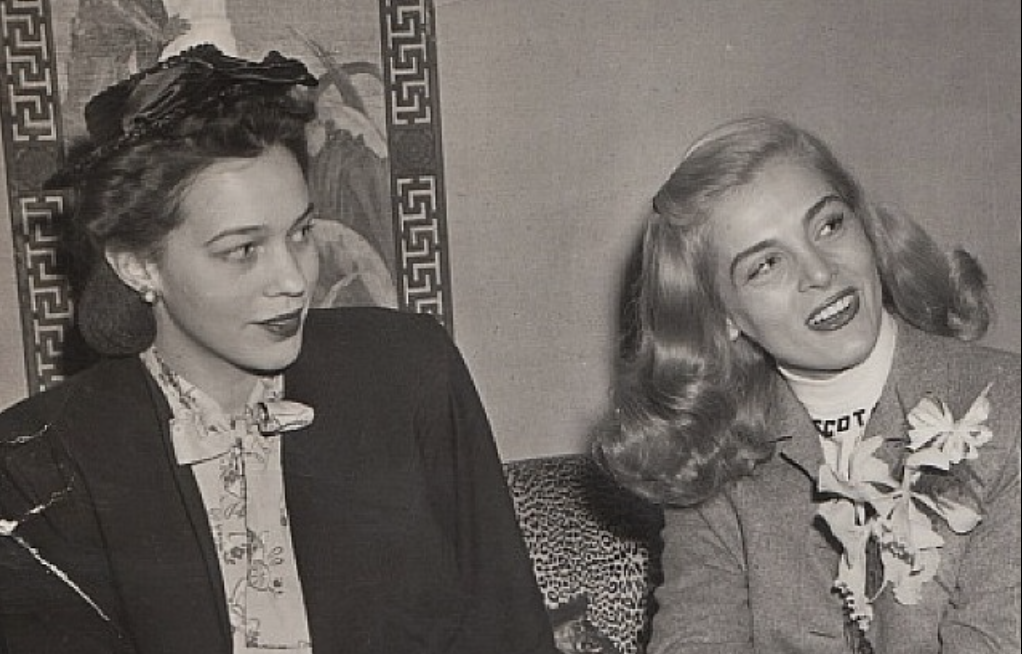
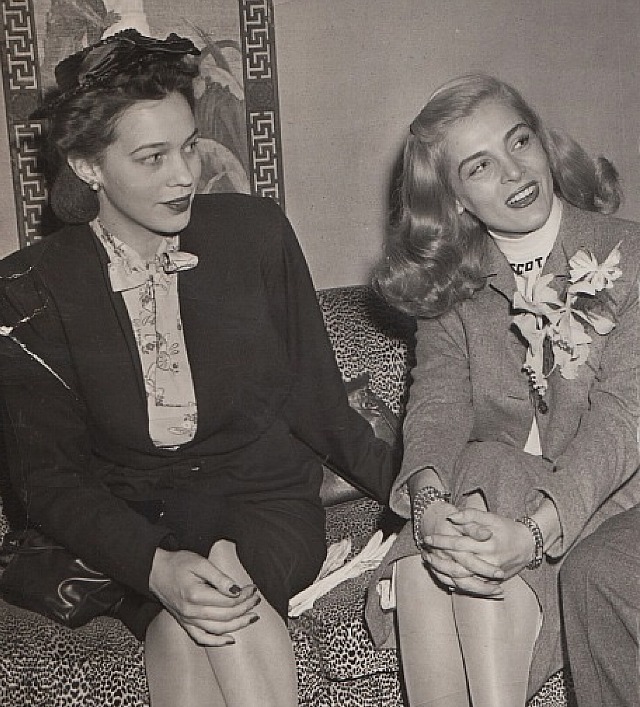
Dead Reckoning (’47), a noirish hriller in which Humphrey Bogart and Lizabeth Scott costarred, stinks. I caught it once and probably never will again. Scott, a femme fatale type with a smoky voice, never appeared in a really good film, not even during her mid to late ’40s heyday. You could argue that her most appealing performance was in Loving You (’57), and in that she was a second-banana to Elvis Presley.
I would plunk down whatever for this real-life, utterly convincing Disney-made Star Wars lightsaber, and I’m speaking as someonme who totally abandoned the mythology after The Phantom Menace came out, or roughly 24 years ago. What will Disney charge? Minimally $750, I would think, and possibly a grand. Maybe $1500.

All my adult life I’ve been in love with Joni Mitchell‘s “Free Man in Paris.” But what I’ve especially loved all those years has been based on a misunderstanding, and right now I feel sick about this.
I’ve always adored the notion of Mitchell referring to herself as “a free man in Paris” as she describes her life as being partly defined by people less powerful or wealthy than herself hitting on her for help….”in it for their own gain”, “calling me up for favors.” Isn’t that the way of the world pretty much? Struggling or less powerful folks asking for help from wealthy, powerful people they might happen to know, looking for gimmes and whatnot? And Mitchell’s delightful, whimsical gender substitution…only an X-factor creative woman would call herself a “free man”, I’ve told myself all these years…a brilliant leapfrog notion…make your own rules, go your own way.
This morning I suddenly realized, to my immense disappointment in Mitchell as a lyricist, that “Free Man in Paris” is about David Geffen, with whom she travelled to Paris back in ’73 or whenever it was. I had simply never read up about the song; it had never occured to me that the tune was about another person’s experience, and Geffen’s yet! Jesus, I’m crestfallen.
This is almost as bad as my realization a few years back that I had misunderstood a key lyric in Mitchell’s “Refuge of the Roads.” I had thought that a line in the first verse went “hard of humor and humility, he said will lighten up your heavy load”….”hard of humor” as in hard of hearing….genius!
In fact Mitchell’s actual lyrics read “and we laughed how our perfection / would always be denied / ‘heart and humor and humility’ / he said ‘will lighten up your heavy load’ / I left him then for the refuge of the roads.” I’m so bummed out I can barely think, much less write.
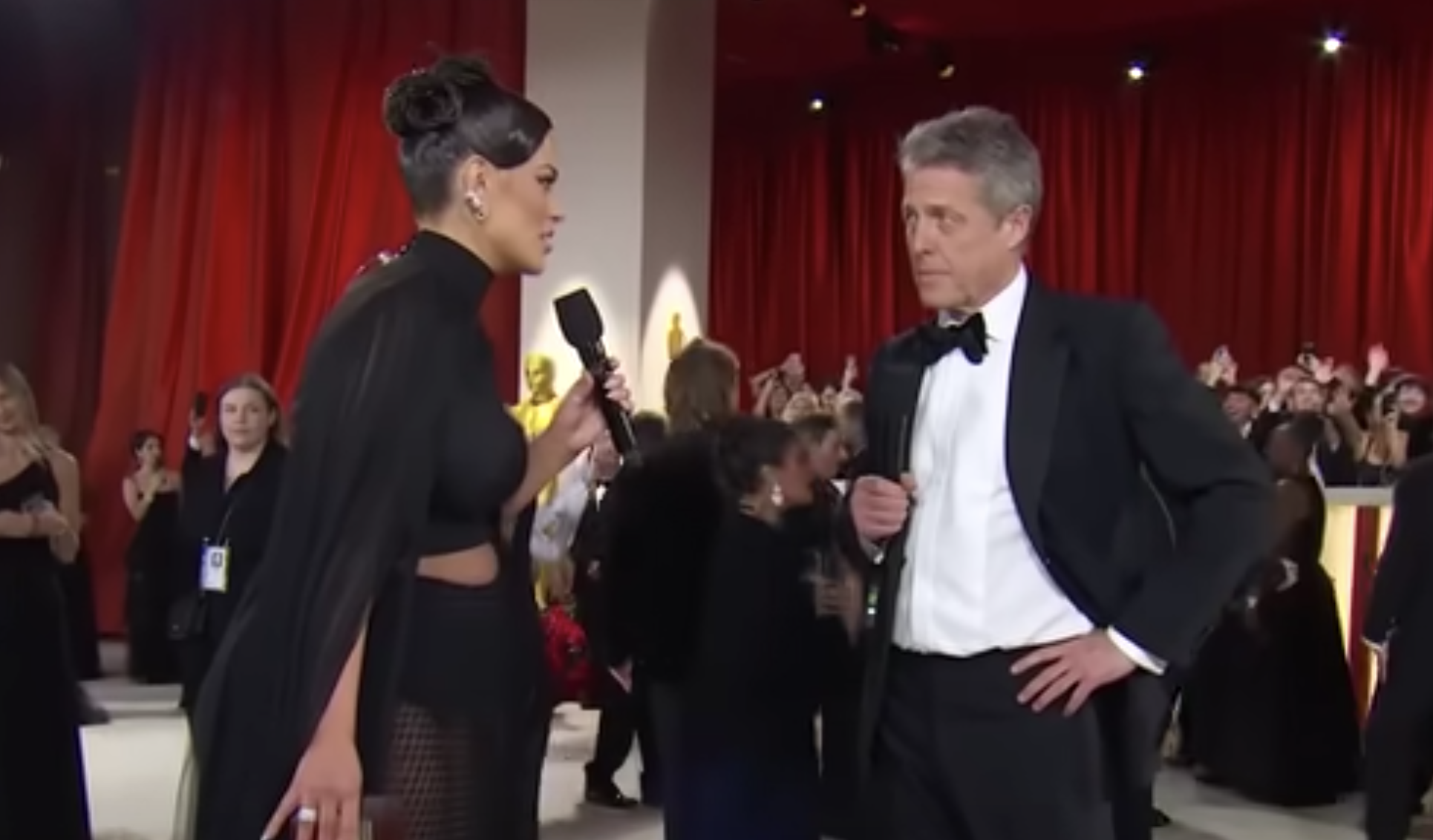
Dr. Todd Grande: “At a ceremony filled with many people who are insincere, hypocritical and obsequious, it was refreshing to see somebody with a sharp sense of humor and who was generally disgusted with grandiose and extravagant displays of wealth and power. Ashley Graham should thank Hugh Grant for the education [that he provided]. Graham’s reaction of feigning comprehension as well as her tedious questions actually supported Grant’s original characterization of the Academy Awards as ‘Vanity Fair.’ She ended proving his point, which should represent her only successful endeavor during that interview.
“Grant’s witty and annoyed behavior was a metaphorical slap that far exceeded the dramatic value provided by Will Smith….Hugh Grant accomplished more without using violence. He reminded people that sometimes small talk can be so small [that] it should not be tolerated.”
Apparent fact: When Hugh Grant said that Sunday night’s Oscar congregation was like “‘Vanity Fair‘”, Ashley Graham thought he was referring to Vanity Fair‘s website/magazine or the VF after-party. God help her, but the poor woman had apparently never heard of William Makepeace Thackeray.
Graham undoubtedly knows who Thackeray is now, of course, and will almost certainly never again be at a loss for words when the subject of his novel, “Vanity Fair”, comes up.
Grande again: “‘Vanity Fair’ expresses a desolate view of the human condition…the term is generally used to describe the frivolous behavior of wealthy people and condemns shallowness…Hugh Grant‘s comment was not meant as a compliment to the Oscars. [Grant’s] reference to a 19th Century English novel might have been a bit esoteric for a lighthearted, superficial, feel-good interview before an awards ceremony…[which leads to the question] why did Grant presume that Graham” — a superficial, under-educated Millennial know-nothing — “would be familiar with the reference to Thackeray’s novel? Unfortunately a general lack of interest in the arts is fairly common these days. Grant was somewhat rude, yes, but at the same time he was authentic.”
Pete Hammond: “Who knew a Canadian biopic of an infamous smartphone could be this entertaining, even poignant and moving? BlackBerry is all that and more.
“In the hands of co-writer, director and co-star Matt Johnson, this long and winding tale of the rise and fall of the BlackBerry, the revolutionary device that first combined a computer with a phone all in one, is at once wonderfully funny, suspenseful and ultimately tragic. Here is a business story that has it all, and has much in common with other movies that focus on iconic tales of new-age businesses like The Social Network, Moneyball and The Big Short. Those movies had the likes of Aaron Sorkin and Adam McKay behind them, and this one ought to really put its chief architect Johnson on the cinematic map.
“Centering on nerdy and inventive Mike Lazaridis (a terrific and never better Jay Baruchel) and Jim Balsillie (Glenn Howerton — sensational), Johnson’s film starts in 1996 with the emergence of this unheard of idea of a phone that can also send and receive emails with its keyboard built into a magical device no one in the tech world had achieved before these Canadian dreamers actually found a way to make it work.
“Johnson and co-writer Matthew Miller turn the story of [the BlackBerry’s] brisk rise and meteoric fall into a kind of breathless tech fever dream, a relentless but addictive downbeat human comedy about the struggle to stay on top in a fast-moving industry.
Hammond again: “Audiences in the film’s core 30-60 age bracket will likely have David Fincher’s 2010 drama about the rise of Facebook — and perhaps also Danny Boyle’s 2015 Apple drama Steve Jobs — in mind, and BlackBerry doesn’t suffer by comparison.
“The big difference is that BlackBerry filters out the white noise to focus entirely on the workplace. We have no idea if the film’s two central characters, tech genius and RIM co-founder Mike Lazaridis (Jay Baruchel) and the company’s hard-nosed, borderline psychotic business head, Jim Balsillie (Glenn Howerton), are in relationships with anyone. We see Balsillie at home alone for a few brief seconds; the rest of the action takes place in the workshop and boardrooms.
“But first it is Lazaridis and his freewheeling, loopy but tech-smart buddy Douglas Fregin (played endearingly by Johnson himself), along with their unsophisticated tech-y friends, who are out to convince the world they can deliver on the promise of their then unnamed invention. Once they bring a sharp and uber-aggressive businessman, Balsillie, into their company Research In Motion, an idea from nerd-land turns into a reality — especially when Balsillie manages to convince Bell Atlantic, particularly chief skeptic John Woodman (Saul Rubinek), of its value for their servers.