The team “HBO Max” has finally and officially been killed. Earlier today Warner Bros. Discovery officially announced Max as the big new hunka-chunka streamer. It launches on 5.23.
Max will be available in three separate versions, but why would anyone want Max Ad-Lite ($9.99/month or $99.99 annually)? Max Ad Free ($15.99 or $149.99/year) delivers (a) two concurrent streams, (b) 1080p HD, (c) up to 30 offline downloads and the usual 5.1 surround sound blah blah. Max Ultimate Ad Free ($19.99 or $199.99 per year) will offer (a) four concurrent streams, (b) up to 4K Ultra HD resolution, (c) 100 offline downloads and (d) Dolby Atmos. $200 bucks a year for “up to” 4K resolution?
In HE’s book, there is no competitor to John Hurt‘s performance as the Roman emperor Caligula in BBC’s I Claudius, which was shot on video in ’76.
I’ll allow that Jay Robinson‘s Caligula in The Robe and Demetrius and the Gladiators (’54) was enjoyably grandiose in a campy sort of way, but Hurt was much more wicked and perverse, and that wonderful snappy voice has never been used to greater effect.
For years I’ve been searching YouTube for his great death-of-Caligula scene (starting at the 42-minute mark in “Hail Who?“, which originally aired on 11.15.76). Today I finally found it. What’s magnificent is how Hurt doesn’t shout in anger or fear but weeps like an hysterical, deeply disappointed child.
For those who live in a cocoon of protective ignorance and are indistinguishable from ostriches who bury their heads in sand when fearful, this article contains historical spoilers:
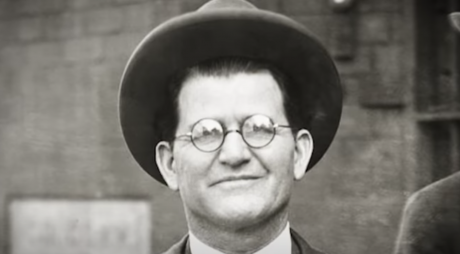
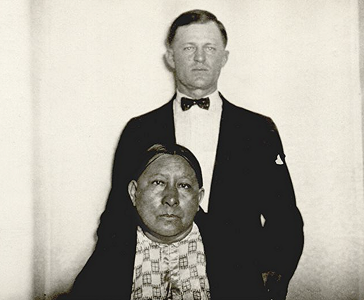
Most of the Osage murders happened in the early 1920s, when the principal bad guy, William Hale (1874-1962), was in his late 40s. And in the below photo he looks it — dark hair, not too middle-aged, fit and trim for a somewhat older guy.
Sentenced in 1929 to a life term for only one of the many killings he was responsible for, Hale was paroled in July 1947 and died at age 87 in the second year of the JFK administration.
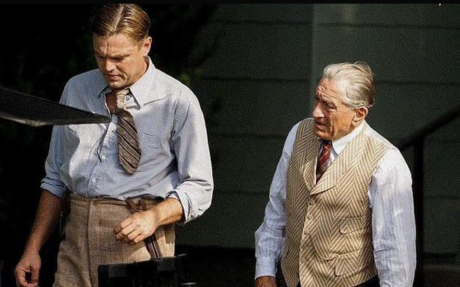
In Martin Scorsese‘s Killers of the Flower Moon, which will be shown on 5.20.23 (a bit more than four weeks hence) at the Cannes Film Festival, Hale is played by Robert De Niro, who was 77 when filming began in April 2021.
Will anyone care that De Niro was 30 years older than the real-deal Hale was in ’21? Or that Leonardo DiCaprio, who plays Hale’s homicidal nephew, Ernest Burkhart (1893-1986), was around 47 and 48 during filming, and therefore Hale’s precise age at the time of the century-old killings? Burkhart was around 28 when the murders began to happen.
It’s not that crazy, of course, for actors to play a decade or two younger or older than actual historical figures they’re portraying. Viewers never give a damn one way or the other, and I will try like hell to get past this when I catch Scorsese’s film next month. Because I want to go with the flow.
But at the same time an actor being 30 years older is, I feel, a bit of a bridge too far. If you’re casting older, you should stay within a decade or two. Otherwise the general disregard for history and biology undermines the verisimilitude. If you’re going to cast a name-brand actor is his late 70s to play a guy in his late 40s, you’re free to throw caution to the winds by casting a guy in his mid to late 80s…why not, right? Scorsese could’ve theoretically cast Clint Eastwood as Hale.
He could just as easily have cast an actor in his late 20s, say, to play Hale…who cares, right?
We are living in the age of the male blanc dangereux, or, if you will, the homme fatale.
If there’s one thing the mainstream media and entertainment industry agree upon without hesitation, it’s that 40-plus white guys have enjoyed too much power for too long and need to be brought down.
The view is that too many of these ayeholes are anti-woke or not woke enough and therefore bad news, and that they need to ride in the back of the bus for a while and learn how it felt for marginalized people for too many decades.
Aside from your basic wokequake and #MeToo factors, I wonder if this viewpoint was in some way triggered by (or is perhaps a delayed reaction to) the ’90s femme fatale wave. All of those films about scheming, black-hearted women with ravenous sexual appetites, blah blah. What intelligent woman wasn’t quietly furious about (or at least hugely irritated by) these films, one after another after another?
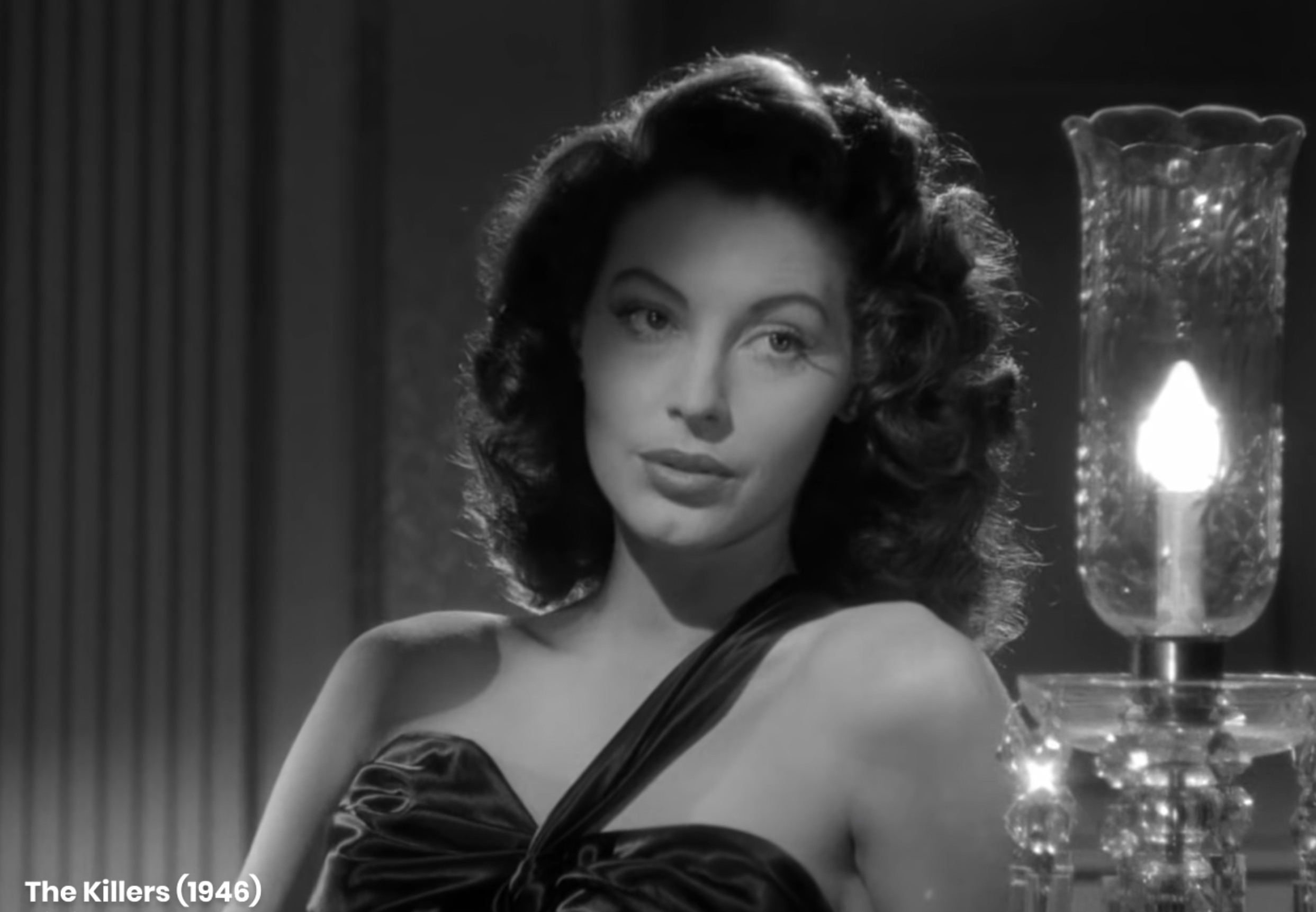
The first crop of femme fatales, of course, arose with the film noirs of the late ’40s to mid ’50s. Lana Turner in The Postman Always Rings Twice, Barbara Stanwyck in Double Indemnity, Jane Greer in Out of the Past, Ava Gardner in The Killers, Lizabeth Scott in Dead Reckoning, etc.
The second manifestation happened 25 years later with Lawrence Kasdan‘s Body Heat (’80) and particularly Kathleen Turner‘s greedy and conniving Matty Walker. This wasn’t exactly followed up upon by Stephen Frears‘ Dangerous Liasons (’88) and Harold Becker‘s Sea of Love (’89) but the notion of selfish, cunning and possibly dangerous women was certainly underlined by these films.
The ’90s wave, sparked by the perverse imaginings of screenwriter Joe Eszterhas, pretty much began with the one-two punch of Curtis Hanson‘s The Hand That Rocks the Cradle (’92) and Paul Verhoeven‘s Basic Instinct (’92). It more or less ended with Roger Kumble‘s Cruel Intentions (’99).
Call it a vogue that lasted seven years or a bit less.
The headliners were (1) Basic Instinct, (2) Barbet Schroeder‘s Single White Female (’92), (3) Katt Shea‘s Poison Ivy, (4) Philip Noyce, Ezsterhas and Ira Levin‘s Sliver (’93), (5) Nic Kazan‘s Dream Lover (’93 — earned a grand total of somewhere between $256,264 and $316,809, (6) Alan Shapiro‘s The Crush (’93), (7) Uli Edel‘s Body of Evidence (’93), (8) William Friedkin‘s Jade (’95), (9) Gus Van Sant‘s To Die For (’95) and Cruel Intentions — an even 10.
What am I missing? Basic Instinct 2 (’06) doesn’t count — it arrived way past the end of the cycle.
On or about 11.5.19 I chatted with Leonardo Dicaprio at a San Vicente Bungalows party. He was particularly excited about Killers of The Flower Moon, describing it as a kind of “birth of the modern FBI” story. The basic line, he said, focused on former Texas Ranger Tom White (whom Leo was intending to play at the time) being ordered by top G-man J. Edgar Hoover to take over the Osage murders case and make sure the bad guys pay the price.
Eventually DiCaprio decided to play one of the killers, Ernest Burkhart, with Jesse Plemons stepping into the White role.
Given Leo’s summary, one could have been forgiven for presuming that Martin Scorsese‘s film, which didn’t begin shooting until April ’21, would be a “white FBI guys bring justice to Oklahoma” movie, or something in that general vein. Certainly not as fictitious or fantastical as Alan Parker‘s Mississippi Burning, as Eric Roth‘s screenplay has always been closely based upon David Grann’s scrupulously researched 2017 book. But perhaps with a certain good guys-vs-bad-guys attitude.
But between Scorsese, Grann and Roth, how could Flower Moon possibly have been made with the idea of delivering an Oklahoma version of Parker’s 1988 thriller, which ignored many facts about the 1964 murder of three Civil Rights workers and reduced the African-American characters to people who grieved, cowered and sung hymns?
But then, three months ago, along came Flower Moon costar Lily Gladstone, who, in a Variety interview with Zack Sharf, seemed to suggest that Scorsese had, up to a point, made a film that hadn’t, in fact, sufficiently considered the Osage native point of view of the killings and the investigation of same.
Gladstone said that Scorsese “worked closely with the real-life Osage Nation to ensure his movie would properly represent the community. The result was that “the Osage Nation ended up positively changingFlower Moon from what Scorsese [had] originally planned.”
“The work is better when you let the world inform the work,” Gladstone explained to Sharf. “That was very refreshing how involved the production got with the [Osage Nation] community. As the community warmed up to our presence, the more the community got involved with the film.
“It’s a different movie than the one [Scorsese] walked in to make, almost entirely because of what the community had to say about how it was being made and what was being portrayed.”
Glenn Kenny: “That’s Gladstone’s perspective, shaped through that of Sharf, and in any event has nothing to do with reshoots. Scorsese and company were getting Osage input from well before the cameras started rolling.
“Look, man, I know how precious the ‘Native Americans strong-armed Scorsese into going woke’ narrative is to you, and I know you’re gonna stick with it through thick and thin, but just don’t pretend too much insider knowledge here.”
HE response: “So Gladstone misstated Scorsese’s creative strategy (i.e., before the alleged Osage Nation re-think) in order to celebrate the Osage Nation’s strength as a culture and to emphasize that their perspective on the 1920s murders was, thank God, crucially included at the 11th hour.
“You’re saying, in other words, that Scorsese had understood the entire Killers equation from the get-go, as had original author David Grann, and that neither of them needed woke tutoring as far as the Osage perspective was concerned.
“Gladstone, in short, was spinning her own impressions last January, and Sharf, a go-along wokester parrot, played along?
“Maybe so.”
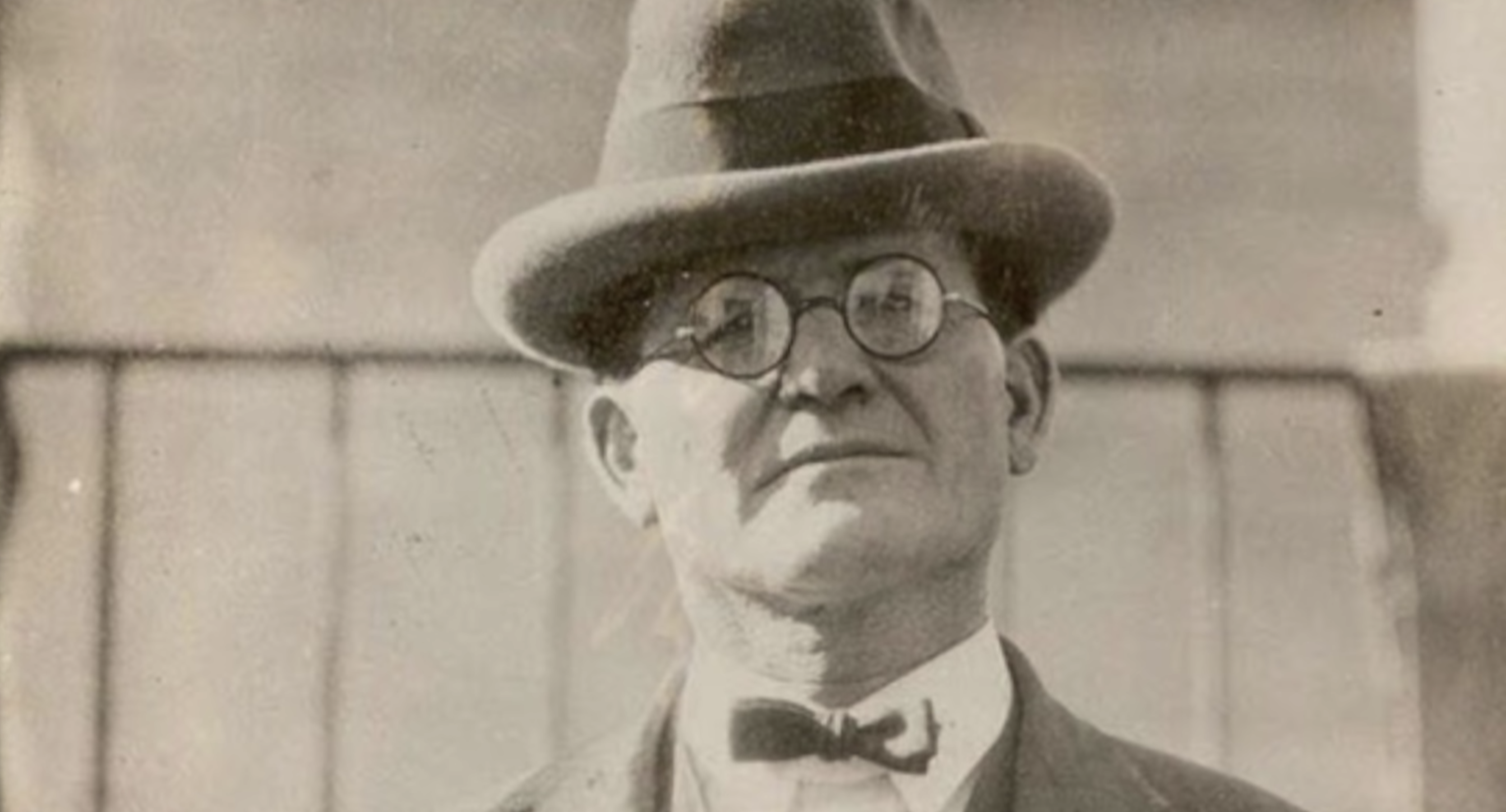
Here, by the way, is a snap of the actual Ernest Burkhart and Mollie Burkhart (played by DiCaprio and Gladstone in the film)
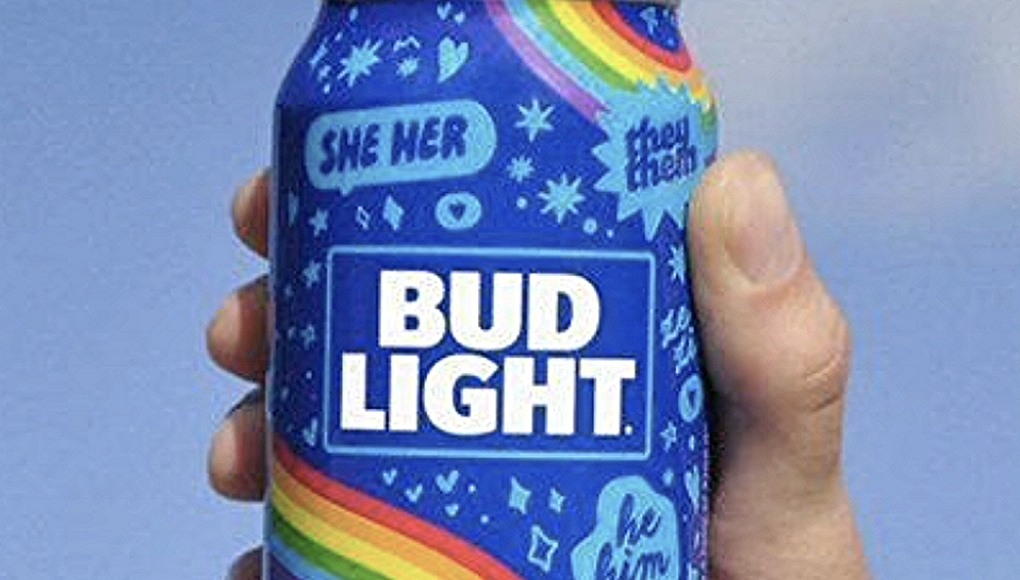
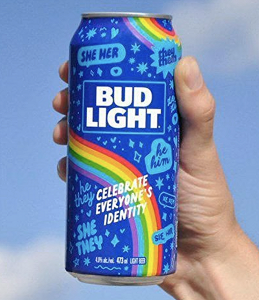
I said earlier I’ve no particular problem with Dylan Mulvaney endorsing Bud Light. But the decoration on this Bud Light can gobsmacked me. I thought inclusion was the new idea — not just beer bruhs chugging Bud Light during football games but all sizes, shapes and persuasions. But the decoration plainly says “gays and trans people only.” Sober for 11 years, I haven’t been up to speed on beer cans for quite some time.** Sorry.
…will engulf me on Thursday evening (4.13), and all I can say is that “the clarity of mind experienced by a man standing on the gallows is wonderful.”
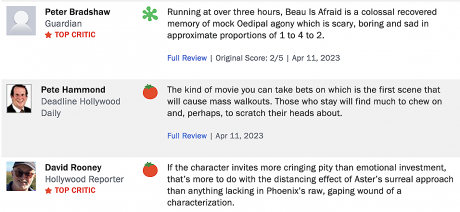
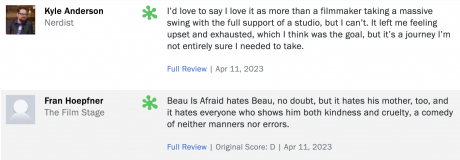
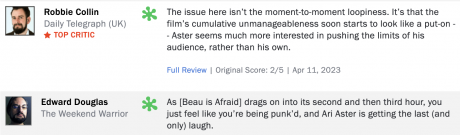
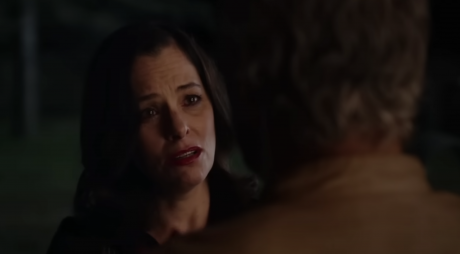
Although I hate certain aspects of my life and indeed myself, I do respect my willingness to sit through an IMAX presentation of Beau Is Afraid. Willingness as in hardcore manliness.
“A new concept arrived in the 1930s, the motel — a portmanteau word made out of motor + hotel. They sprang up all over, and in the early years they were usually family owned.
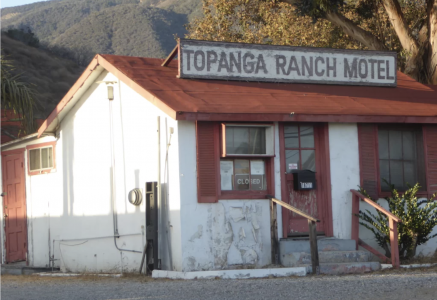
“A classic example of an early bungalow-style operation was the Topanga Ranch Motel. Built in the mid ’30s and once owned by William Randolph Hearst, it was one of the first Topanga-Malibu hostelries to cater exclusively to the motorcar crowd.
“We know a screenwriter who would stay at the Topanga Ranch Motel for weeks in winter. [It was] a gently decaying relic, but cheap and quiet and there were no distractions — just a TV that only received three stations on a good day. But by then, the era of the motel was over.”
Sasha and I were chatting yesterday in a general sense, this and that and whatever. The subject eventually drifted into “what’s out there that sounds good…something that might heat up the blood?” We discussed some of the big attractions at the ‘23 Cannes Film Festival (the slate will be announced on Thursday, 4.13), and for whatever reason I forgot to mention that I’ll be submitting to both Renfield and Ari Aster‘s Beau Is Afraid that same day. I also didn’t mention HE’s most eagerly awaited pre-Cannes film, which is Matt Johnson and Matthew Miller‘s BlackBerry (IFC Films, 5.12). Anyway…