“Some Like It Hot” Meets Presentism — Woke, Diverse, Nonbinary, etc.

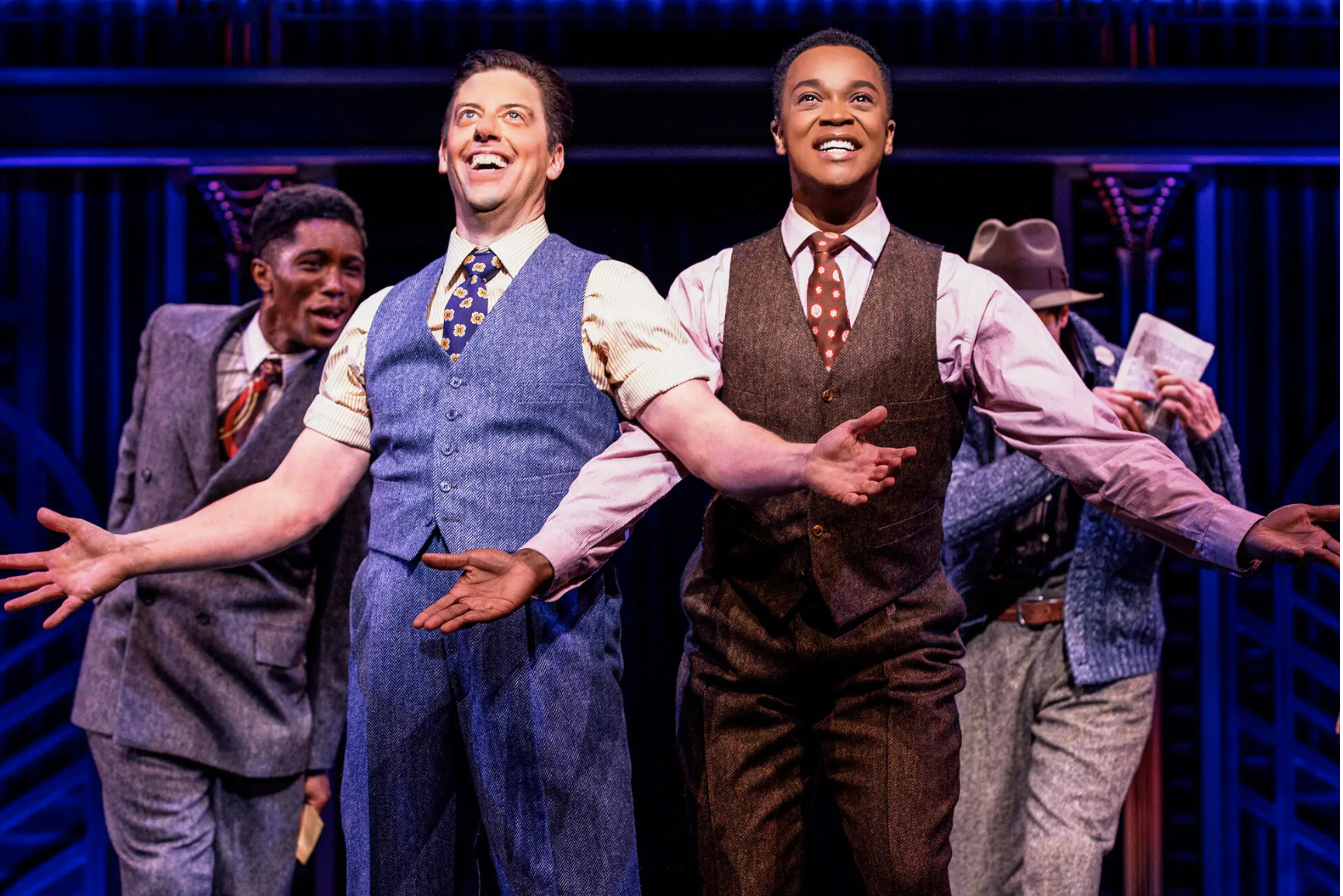
I’ve been told that Broadway’s diversified, woked-up stage musical of Some Like It Hot isn’t doing so well commercially. No stars to speak of is one reason. Overly woke-icized may be another.

The show ignores the basic scheme of the Billy Wilder’s 1959 classic, making more than half the characters black with the Jerry/Daphne character (played by Jack Lemmon in the Wilder film) embracing transgenderism and yaddah yaddah. And the show buries the film’s final line — “nobody’s perfect.” Of course it does!

Directed by Casey Nicholaw and featuring Christian Borle (Joe/Josephine), J. Harrison Ghee (Jerry/Daphne), Adrianna Hicks as Sugar (called Sugar “Kane” Kowalczyk when she was played by Marilyn Monroe) and Kevin Del Aguila as an Latino Osgood, Some Like It Hot opened just under three weeks ago — 12.11.22.

HE reader Des McGrath: “The Jack Lemmon character has been rewritten to discover that he is a trans woman over the course of the story.

“The immortal final line? Gone. Instead of Osgood Fielding responding ‘Nobody’s perfect’, he tells Daphne ‘You’re perfect just the way you are’ (or something like that).

“And the Marilyn Monroe character is no longer a dumb blonde but a strong black woman, who sings about how as a child growing up in a small town in Georgia she liked to go to the movies, but ‘could only use the balcony. Like the movies, life could be that black and white.’

“So now she wants to break the color barrier in Hollywood.”

HE to McGrath: “Like the film, the show is set in 1929. Sugar wants to break Hollywood’s color barrier in nineteen-twenty-fucking-nine? The new Some Like It Hot, in short, is another exercise in presentism — transposing the woke sensibilities of today to the jazz age.”
I Was Strangely Submissive

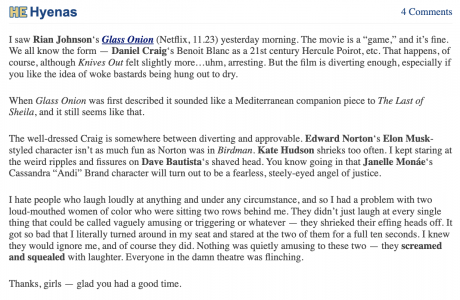
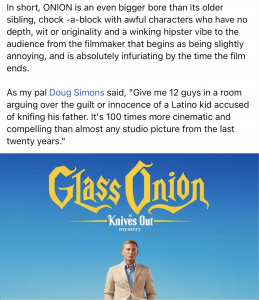
…when I saw Glass Onion at the Paris theatre sometime around 11.12 or thereabouts. I wasn’t expecting much except, hopefully, a Last of Sheila remake, and when that didn’t happen I kind of just gave up and sat there and went “okay, whatever.” I felt mildly underwhelmed, but not all that pissed off.

I wasn’t irritated by the film as much as by a couple of women sitting two rows behind me. They were laughing…make that shrieking at everything, and loudly. After a while I couldn’t stand it. I turned around and glared at them for a full ten seconds. If I had the power of telepathic messaging I would have conveyed the following to these low-class boobs: “For God’s sake, this movie isn’t too bad if your expectations are sufficiently low, but it’s not that good and you guys are killing the modest enjoyment factor…can you please turn it down?”

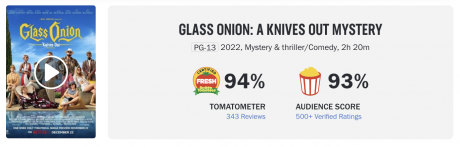
Since Glass Onion started streaming on Netflix six days ago (12.23) there’s been a groundswell of negative social-media opinion from non-professional critics. Perhaps this is a fringe thing as the Rotten Tomatoes ticket buyers have given it an overwhelmingly positive response, and of course the mainstream whore critics loved it.

Awesome New Jersey Turnpike Music

Plus this 1977 song sounds much better without the singing and the lyrics. The point is made by the guitars — nothing more needed.

On Wednesday afternoon (yesterday) I experienced a form of transcendence while listening to this instrumental track. I was moving north on the New Jersey Turnpike, and I suddenly felt more energized and attuned than usual…super-charged even. I felt like I was driving like Steve McQueen in Le Mans. Everything was perfect.

If An Ad Agency Was Stupid Enough…

…to create this kind of spot today and if the underwear manufacturer and participating TV stations were stupid enough to run it, they’d all be sent packing…cancelled, shamed, run out of the business and condemned to work in fast food for the rest of their lives.

The advertiser was Underdaks, an Australian men’s underwear brand. Shot in 1994, it was temporarily banned from Australian TV after a later-dismissed complaint to the Advertising Standards Council made because of the tagline “He’s probably gay”. Alternate tagline: “Nice luggage”.

Read more

To Be Soul-Kissed by Demi Moore…

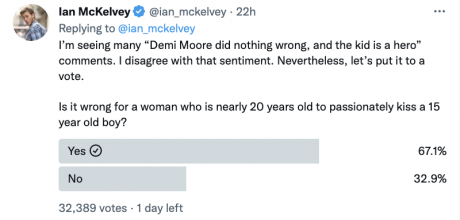
If the kid (actor Philip Tanzini) had been, say, 12 or 13 or even 14, I might not feel altogether comfortable watching Demi Moore (19 at the time) give him a hot-mama kiss. But 15 is cool. Plus he was a showbiz kid. Plus he looked like a nerd — that doesn’t mean he wasn’t ready to slam ham at the drop of a hat.

Plus it was 1981 — the dawn of the tits ‘n’ zits era of movies (Losin’ It, All The Right Moves, Risky Business). Everybody knew the score, and the era of woke prudery was several decades off. Tanzini is now 56 years old and probably melting down over the memory.

I was 15 once, and my hormonal surges were like bodily volcanoes…Krakatoa, East of Java. I would’ve dropped to my knees, gotten out a hymn book and praised God if a hotsy-totsy 19 year-old actress had kissed me like that.

I was taking sneaky Saturday trips into Manhattan when I was 15, remember, and occasionally getting goosed by 40ish, creepy-looking gay guys on 42nd Street, and I more or less shrugged that shit off.

One day when I was 15 my mother told me to watch out for older women who might try to take advantage of me, and my only thought was “please…please, God…arrange for an older foxy woman to try to bring thoroughly immoral, anti-Christian sexual rapture into my life!”

Needless to add, Hollywood Elsewhere stands with the 32.9% of Twitter responders who have no problem with this.

Red River D

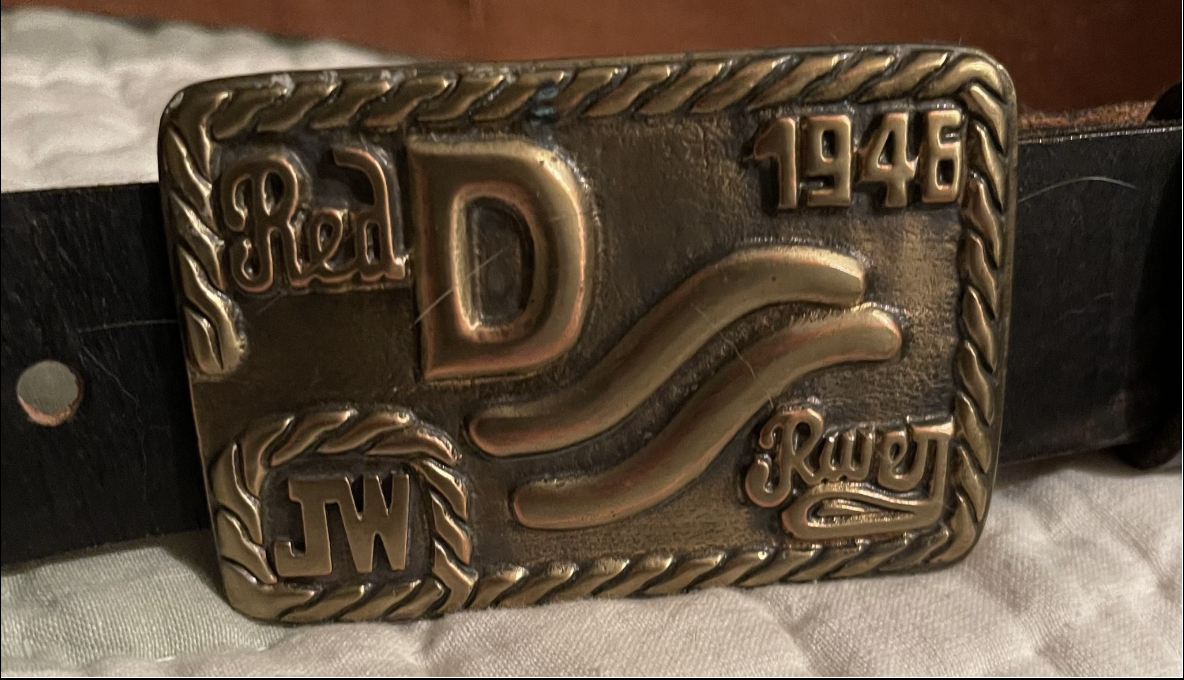
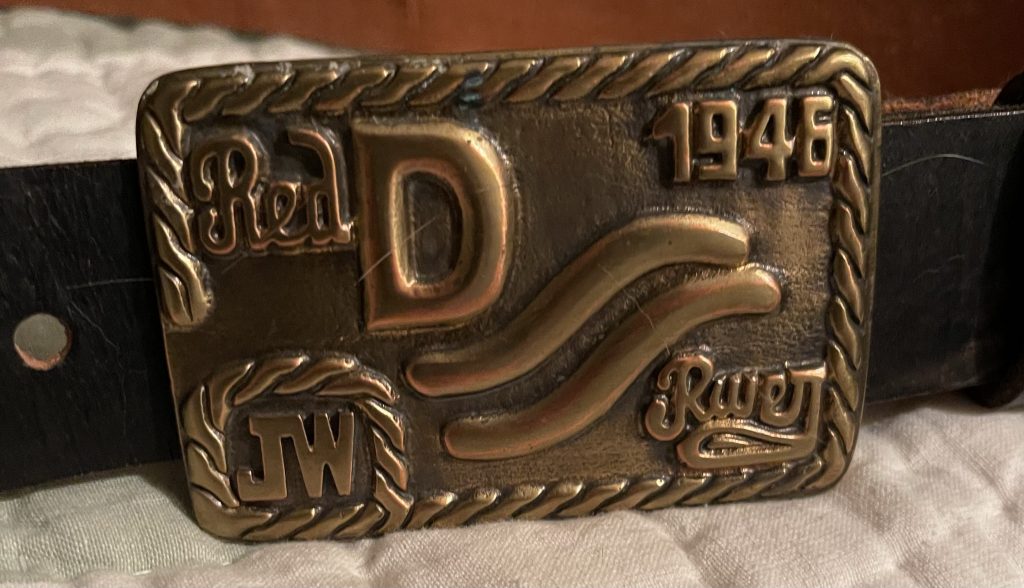
There’s something hugely joyful about reuniting with my mail-order John Wayne Red River brass belt buckle. The fact that I’m happy to once again have it in my possession means, of course, that I’m just as much of a racist swine as Wayne was during his lifespan, and has nothing to do with my loving the 1948 Howard Hawks western (which, as the buckle points out, was actually shot in ‘46).

No Faith At All

If there’s one thing that today’s director-writers don’t seem to want to do and generally avoid doing for the most part, it’s letting the audience put two and two together. (The seventh screenwriting rule according to Billy Wilder or more precisely Ernst Lubitsch). Most filmmakers don’t like the idea of Joe and Jane figuring stuff out — they’d rather just spell it out in so many words.

Is It Me For A Moment?

I’m driving back to Connecticut this afternoon, having spent almost a full week at Jett and Cait’s home in West Orange, hanging with the dogs and trying to keep warm. A balmy 45 degrees now…unseasonably mild temps for the next few days.

I have a few posts in mind (more on A Man Called Otto, a riff on the origins of Weimar era anti-Semitism, Billy Wilder’s screenwriting wisdom) but not until I’m back in Wilton, I guess.

Meanwhile I’m suffering from a slightly acidic stomach and popping Pepto Bismol chewables every hour or so. I don’t like this — my health has been perfect my whole life.

https://vimeo.com/784653902

Honest Conversation

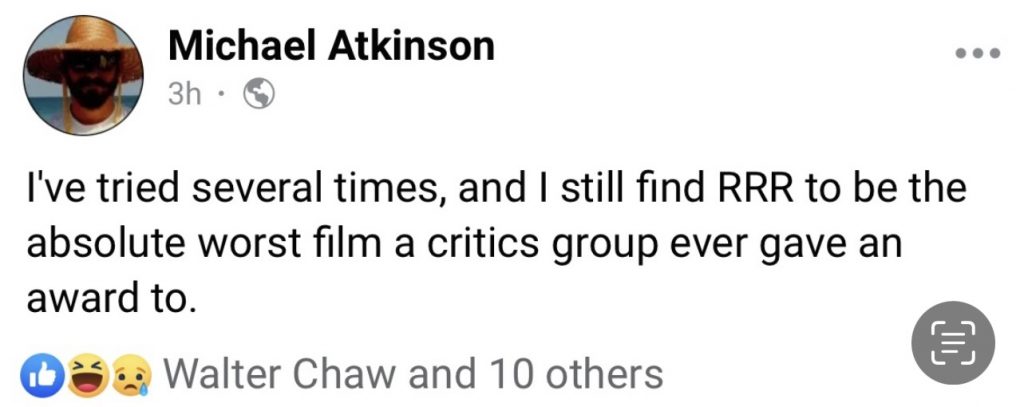
Friendo to HE: “I lasted through 80 minutes of Everything Everywhere All At Once.”

HE to friendo: “Funny.”

Friendo to HE: “That was all I could handle. Couldn’t take any more.”

HE to friendo: “It took me about three hours to get through it. I needed to take breaks.”

Friendo to HE: “My 80 minutes included breaks as well.”

HE to friendo: “Step outside, breathe some air, eat an apple.”

Friendo to HE: “How any sane person thinks this thing can win [the] Best Picture Oscar…no way that can happen.”

Another LAT Gender-Free Retort

Penned by a LAFCA member, here’s a response to the 12.27 L.A Times editorial about the advisability of going gender-neutral with Oscar acting noms:

Since 1929, the Academy Award of Merit (aka Oscar) has been awarded to artists by artists. Less than a decade after the 19th amendment granted women the right to vote, the Academy of Motion Picture Arts and Sciences created the categories of Best Actor and Best Actress, not as artifacts of a patriarchal, oppressive past but harbingers of a more progressive future in which the inseparability of sex and performance was acknowledged — and celebrated at parity.

This model has held for nearly a century because it is understood that actors bring more than simply talent to their craft — they bring the intractible experience of life as either male or female.

It is no surprise that recent calls to abolish these categories, including gender-neutral moves by the Spirit Awards, the Gotham Awards and the Los Angeles Film Critics Association, originate outside the profession and community of actors most impacted by them. These are efforts to change longstanding practice not at the behest of performers or for the betterment of the art, but to serve a broader, relatively recent agenda that presumes to achieve “equality” through the erasure of any recognized distinctions between the sexes. We reject these efforts as regressive and misogynist and call on the Academy and other organizations to do likewise.

It is especially disconcerting that this pressure campaign comes during a year with no fewer than three major awards contenders — The Woman King, Women Talking and She Said — singularly centered on the unique experiences of women. That all three films were also written and directed by women is a laudable step in the right direction — but could they have been just as easily written and directed by men? Absolutely. Could their predominantly female casts have been replaced by men? Categorically not. This is the distinction that advocates of genderless categories ignore.

Cate Blanchett and Michelle Yeoh are already heavy awards season Best Actress favorites for their respective performances in Tàr and Everything Everywhere All at Once. But their achievements are more than great acting — the characters depicted are wives and mothers, women struggling to meet unequal expectations in a male-dominated world. These are parts defined by their explorations of womanhood, elevated by great actresses with the irreplaceable experience of being women.

The same may be said on the other side of the equation — Colin Farrell and Bill Nighy‘s respective performances in The Banshees of Inisherin and Living are likewise rooted in their irreplaceable experiences as men. Living, adapted from Akira Kurosawa’s 1952 film Ikiru, is a noteworthy case in point. Though separated by seventy years and two continents, Bill Nighy and Takashi Shimura face precisely the same realities — experiences which transcend culture while being bound by sex.

Actors and actresses all understand that their career paths diverge based on sex and that this constitutes an opportunity, not a handicap. We should not expect or want Frances McDormand to play Macbeth any more than we should want Denzel Washington to play Lady Macbeth as the resulting performances would ring false, lacking the emotional resonance with which cinema connects the lived experiences of performers and audiences.

Read more