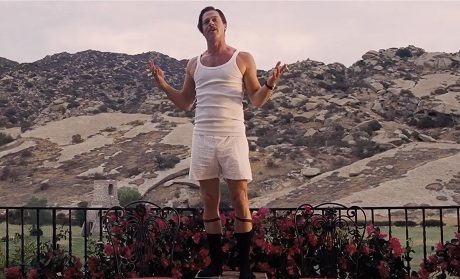
Maher Does A Side-Step

Two nights ago Bill Maher devoted his “New Rules” segment to a rant about presentism. Terrific, I told myself — one of HE’s pet peeves will get an airing on Real Time! Then I watched it and went “oh.”

I naturally figured Maher would mention the movie manifestations of this trend, or an insistence among producers, directors and casting directors over the last four or five years that POCs were just as socially prominent in the past as they are today (hence Bridgerton, the Yale girlfriend switch-out in George Clooney‘s The Tender Bar, Jodie Turner Smith playing Anne Boleyn, African and Asian actors filling costarring roles in Mary, Queen of Scots, Olivia Wilde‘s Don’t Worry Darling**, wealthy travellers of color in Kenneth Branagh‘s Murder on the Orient Express and Death on the Nile). Not to mention the virtue-signalling reflected in the absence of Dahomey slave-trading in The Woman King,

But Maher decided against mentioning this because…I don’t know…because it might sound to some like he was against diverse casting of any kind when it comes to any historical sagas or settings? Which, certain factual histories aside, might get him into trouble. So he side-stepped it.

What he focused on instead was a James H. Sweet article called “IS HISTORY HISTORY? / Identity Politics and Teleologies of the Present,” which was posted a month ago on historians.org.

** Seemingly presentism, I should say. As it turns out it actually isn’t.

“Some People Are Shits”

Imagine if the beloved Martin Scorsese had announced that Killers of the Flower Moon will be his last film and that he’ll henceforth he’d be devoting himself to novel-writing. Or if, God forbid, James Cameron or Kathryn Bigelow or Alexander Payne or Guillermo del Toro were to announce the same.

Variety and The Hollywood Reporter, trust me, would almost certainly collect a few admiring quotes from colleagues while lamenting the eclipse of a great and prodigious talent. Their stories would also list some of his or her more luminous career highlights.

So what did the trades publish in response to Woody Allen’s announcement that he’ll be retiring from filmmaking after he completes work on his 50th film, a Paris-based dramedy that’s allegedly in the vein of Match Point? They mainly recited police-blotter stuff — dry, flat summaries of how Allen’s career has been diminished in the eyes of wokesters and the mainstream press over the past few years due to Dylan Farrow‘s account of what allegedly happened on 8.4.92 with no logical counter-views, and how Amazon cut him loose, his autobiography was dropped by Hachette and he’s had to rely on European financing, etc.

In so doing Variety and The Hollywood Reporter have effectively said the following: (a) “Well, it’s not surprising that Allen is finally throwing in the towel,” (b) “We can’t honestly say that we’re distraught over this news” and (c) “Maybe it’s not such a bad idea that Allen goes away and stays away, considering his current reputation.”

On 7.28.22 Indiewire‘s Christian Zilko and Ryan Lattanzio reported that Allen had told Alec Baldwin that he was thinking of retiring, and they posted the same kind of chilly summary.

HE to Variety‘s Anna Marie de la Fuente, The Hollywood Reporter‘s Ryan Gajewski, the Indiewire team and their editors (along with all the others who’ve posted similar remarks): “No offense, guys, but you’re showing disrespect in a way that strikes most of us as odious and repellent. You honestly make me want to throw up.

“Allen is incontestably a great filmmaker — a man of considerable genius and relentless innovative creativity, a guy whose output has enhanced the quality and worldliness of American cinema over the last 55 years, and whose sterling reputation as a filmmaker will be remembered and cherished long after the authors and editors of these repulsive trade articles will have died and been forgotten.

“This is a man, remember, who made 15 great or near-great films over a 45-year period (starting in the mid ’70s and ending in the early 20teens) — Annie Hall, Interiors, Manhattan, Stardust Memories, Zelig, Broadway Danny Rose, The Purple Rose of Cairo, Hannah and Her Sisters, Crimes and Misdemeanors, Husbands and Wives, Bullets Over Broadway, Mighty Aphrodite, Match Point, Vicky Cristina Barcelona, Midnight in Paris (15).

Not to mention 18 others that most of us regard as sturdy and respectable — What’s Up, Tiger Lily?, Take the Money and Run, Bananas, Everything You Always Wanted to Know About Sex, Sleeper, Love and Death, A Midsummer Night’s Sex Comedy, Radio Days, Another Woman, Alice, Everyone Says I Love You, Deconstructing Harry, Celebrity, Sweet and Lowdown, Small Time Crooks, Melinda and Melinda, Irrational Man, Blue Jasmine.

Only one other world-class director has cranked out as many first-rate films over a period that lasted over half a century — Alfred Hitchcock.

How dare you dismiss this man with your implied derision and disdain? Do you understand that in the greater scheme of things Allen is a man of considerable wit and vision and artistic consequence and that you and yours, comparatively speaking, are insects?

Bowie Dreamscape (Again)

From a 9.17 Air Mail piece, written by Jonathan Dean, about Moonage Daydream director Brett Morgen:

I wrote this last summer, but it was precisely Morgen’s “clear set or rules” that gradually put me off Moonage Daydream when I caught a Cannes midnight showing on 5.23.22. Now that Neon’s Moonage Daydream is finally playing here and there, I’m wondering what the HE consensus might be.

Here’s how I put it:

Here’s a wise comment from Justin Michael Ptak, posted on 5.234.22:

“I realized a way to reinvigorate the band/artist biopic. The filmmaker cannot go through their entire, randomly ordered, rags-to-riches-to-rags to rehab to rejuvenation to what-come-may tale, but instead focus on one specific, seminal moment in that artist’s/bands creative/destructive life and just allow the audience to soak that in and bring them along for a ride in that specific time and place.

“One can think of any number of tales told about this artist or that band that would make a very cool, condensed retelling if kept to those constraints.

George Gershwin and his Rhapsody in Blue moment, Jimi Hendrix realizing he can really play guitar in his own stratospheric way, Brian Wilson creating Good Vibrations, Bob Dylan‘s transition from folk to electric, the Beatles making Revolver, Ronnie Van Zant insanity surrounding Sweet Home Alabama, Pat Benatar‘s Battlefield of Love, Spike Jonze shooting the Beastie Boys Sabotage video, any 48 hours with Kim Gordon of Sonic Youth, Dinosaur Jr.’s J Mascis connecting with Lou Barlow, a week in Athens, Georgia with Jeff Mangum and Neutral Milk Hotel, etc.

“Tie these creative sagas into the on goings and vibe of the period and times a la Quentin’s Once Upon A Time in Hollywood, and you have yourself a pretty chill picture.”

Woody Announces Retirement From Movies

Woody Allen has stated that his currently-lensing, Paris-based film will be his last. He told La Vanguardia, a storied Spanish publication, that we will not make any more films “in principle“, but that he plans to write his first novel.

Quote: “My idea, in principle, is not to make more movies and focus on writing these stories and, well, now I’m thinking more of a novel.” He added that he does not plan to publish more memoirs.

Smart-asses and Woody haters will say that his retirement decision was made for him years ago, and that the U.S. film industry retired or “cancelled” Allen over the Dylan thing back in the mid to late teens. That’s bullshit, of course. If he wanted to Allen could continue to make features for as long as he’s physically able.

I think having made 49 films, at least one-third of which are excellent and other third are regarded as very good to diverting to mildly approvable…that’s an extremely honorable track record, all things considered.

I’ve missed a couple but…

Allen’s Greatest (sequential order): Annie Hall, Interiors, Manhattan, Stardust Memories, Zelig, Broadway Danny Rose, The Purple Rose of Cairo, Hannah and Her Sisters, Crimes and Misdemeanors, Husbands and Wives, Bullets Over Broadway, Mighty Aphrodite, Match Point, Vicky Cristina Barcelona, Midnight in Paris (15).

Solid Goods: What’s Up, Tiger Lily?, Take the Money and Run, Bananas, Everything You Always Wanted to Know About Sex, Sleeper, Love and Death, A Midsummer Night’s Sex Comedy, Radio Days, Another Woman, Alice, Everyone Says I Love You, Deconstructing Harry, Celebrity, Sweet and Lowdown, Small Time Crooks, Melinda and Melinda, Irrational Man, Blue Jasmine. (18)

Pretty Good, Moderately Appealing, Mezzo-Mezzo: Shadows and Fog, Cassandra’s Dream, Whatever Works, Hollywood Ending, You Will Meet a Tall Dark Stranger, Anything Else, To Rome with Love, Magic in the Moonligh, Café Society, Wonder Wheel. (10)

Not So Hot: Curse of the Jade Scorpion, Scoop, Rifkin’s Festival. (3)

So Much For Doomsayers

Gina Prince Bythewater‘s The Woman King hasn’t tanked — it’s actually performing fairly decently. Analysts are projecting $18 million by Sunday night. For a 19th Century African war film starring a distinguished actress who’s barely a movie star, the box-office response isn’t half bad.

The Passion of the Marilyn

HE to Blonde spoiler whiners: This post discusses the August 1962 death of Marilyn Monroe, which is what Andrew Dominik‘s Blonde (Netflix streaming, 9.28.22) ends with.

HE to friendo #1: “Yesterday I slogged my way through Andrew Dominik‘s Blonde, which I regard as artful torture porn. And then I happened upon a Matt Lynch tweet that analogized Blonde and a landmark 1988 film, and the instant I read it I said ‘yes!'”

“I’m thinking not just of the incessant dismissals and degradations and spiritual uncertainties, but the anguished and agonized relationship between the main protagonist and the elusive ‘father.’

“Just as Willem Dafoe sips a goblet of sacramental wine before submitting to his final fate, Norma Jean swallows alcohol and barbiturates before her final episode of passion at her Fifth Helena Drive abode (the delivery man, the fuzzy tiger, the shattering note). And like Dafoe’s Jesus, a spectral Marilyn smiles and separates from death, and greets the immortality that she still enjoys today a la Andrew Dominik.”

Friendo #1 to HE: “That’s a brilliant interpretation. Celebrity is in its own way like religion. It still is. The fandoms online are like churches. Which says more about us than it does Marilyn. Lynch is saying we treat her like a kind of deity. Very smart. The myth is the truth.”

Friendo #2 to HE: “Well, there’s no doubt that she was a supreme martyr of 20th-century feminine glory and trauma. But the Jesus comparison feels a little abstract to me. What I think you’re possibly leaving out is that Blonde, dark as it is, is not torture porn. It’s a movie that’s trying to capture who Marilyn Monroe really was.”

HE to Friendo #2: “I really do think it’s primarily torture porn of an artful nature. Yes, it does capture who Monroe really was, but at what a price! Yes, it’s about the MYTH, or precisely THE TRAGIC but TRANSCENDENT MYTH. Marilyn suffered for our sins, but she’s lived eternally ever since and, in an underlined and undeniable sense, more splendidly and blessedly over the last 60 years than she did in her own biological life span, which lasted only a mere 36 years.


“The last thing Marilyn does, after dying, is become a happy ghost…she separates from her body as she smiles delightedly at the camera. As if to say, ‘The torment is finally over, and now the eternally blessed myth takes over, and I will revel in the glory of that myth for ever and ever.’” Or, if you will, “It is accomplished.”

Friendo #2 to HE: “That’s what I liked about Blonde. It’s probably the best account of what was truly occurring inside Monroe’s mind. Other depictions have failed in trying to convey the inner torture she was feeling.”

HE to Friendo #2: “Oh, it was torture, all right!”

Friendo #2 to HE: “I think it’s torture psychodrama. That’s what’s fascinating about it. She’s one of the most important artists of the 20th century, and I found the spectacle of what was happening inside her quite gripping. The cornerstone of her trauma, remember, isn’t all the men who exploited or didn’t understand her. It was her insanely abusive upbringing. It’s boring to say but that, in a nutshell, is why she was so fucked up.”

HE to Friendo #2: “Agreed. The mother and the father were demonic.”

Friendo #2 to HE: “Not just because the Hollywood system was patriarchal and exploitative and oppressive. But because the Hollywood system crumpled this already broken person.”

HE to Friendo #2: “After meeting and hanging with Montgomery Clift, Monroe told a friend ‘I’ve just met someone who might be as fucked up as I am, and maybe more so.'”

Friendo #2 to HE: “I don’t see how all of that, portrayed truthfully and with a fair degree of artfulness (although there are a number of things in the film I didn’t care for), adds up to ‘torture porn.'”

HE to Friendo #2: “Artful torture porn.”

Friendo #2 to HE: “And the bottom line is — this is the grand paradox the movie captures — Marilyn’s search for ‘daddy’ became the cornerstone of her art.”

HE to Friendo #2: “Good point. Especially the squinting, Arthur Miller-like daddy figure she speaks of in Some Like It Hot. Not to mention Clark Gable (The Misfits), Louis Calhern (The Asphalt Jungle), George Sanders (All About Eve), Laurence Olivier (The Prince and the Showgirl), and even, in a stretch, Charles Coburn and Cary Grant in Monkey Business.”

Read more

Man of Many Ethnicities

Henry Silva‘s most memorable role was “Chunjin”, a Korean guide and turncoat, in John Frankenheimer‘s The Manchurian Candidate (’62). Silva’s biggest scene was a martial-arts duke-out with Frank Sinatra in the Manhattan apartment of Laurence Harvey‘s “Raymond Shaw”, for whom Chunjin was working for as a servant, cook and driver. (Angela Lansbury, playing Harvey’s malevolent mother, calls him “Chu Chin Chow.”)

Silva, however, was of Sicilian and Spanish descent, so he would have had a tough time playing a Korean under today’s woke theocracy.

During his ’50s and ’60s heyday, Silva also played a Mexican peasant farmer who confronted Marlon Brando in Viva Zapata (’52), a Manhattan heroin dealer in A Hatful of Rain (’57), a generic bad guy in The Bravados (’58), a forest-dwelling Venezuelan in Green Mansions (’59), a Vegas sharpie in Ocean’s 11 (’60), a Native American in Sergeants 3 (’63), a Sicilian assassin in Johnny Cool (’63), a Japanese detective in The Return of Mr. Moto (’65), and an Apache in Five Savage Men (’70).

Silva died two days ago (9.14) at the Motion Picture & Television Fund home in Los Angeles. He was 95. Respect & condolences. Woke fanaticism never touched him, and he lived a bountiful life for that.

Read more

If There’s One “SNL” Irritant

…it’s “why oh why hasn’t Lorne Michaels hired a non-binary cast member?” The absence of such a weekly presence may have really hurt the show, and now we can all relax…we can all say “this glaring flaw has finally been addressed.”

Does this mean, in this particular instance, that Molly Kearney (aka Molly Meatbrick) was born…er, male-ish but has since transitioned?

Simple Solution

Bill Maher to Aaron Rodgers, starting at 1:12 mark: “The Republicans are actually more dangerous, and they’re certainly more…I can’t say the word anymore but it begins with ‘r’…we’re not allowed to say it anymore, which is why I hate woke because we need that word desperately because the country is…but the woke side is so much more obnoxious…the level of hate that they engender in me, with the kind of shit that they do…is like…”

Rodgers to Maher: “Why would they not move to the middle? They would get everyone on their side!”

Maher to Rodgers: “I say that every week. If they just would shed this skin…this woke skin of pregnant men and [equity over meritocracy] and ‘let’s make crime legal’…math is racist…whatever nonsense they’re into…all that shit, and it would be so easy to just leave it behind, and they would win every election.”

Repeating: Houston Biopic Is This Year’s “Respect”

Initially posted on 4.27.22: Kasi LemmonsI Wanna Dance With Somebody (Sony, 12.21.22), a cradle-to-grave biopic of the late Whitney Houston, was screened last night in Las Vegas, and the word (I spoke to two viewers) is definitely on the approving side.

It’s longish (150 minutes, give or take) and technically incomplete, as is normal for any film that’s more than eight months from opening. And it covers almost all of the biographical basics for Whitney fans — definitely a fan-service presentation.

For what it’s worth one guy’s reaction is through the roof about Naomi Ackie‘s Whitney performance. I know nothing about Ackie except that (a) she’s British and (b) played the smallish role of “Jannah” in 2019’s Star Wars: The Rise of Skywalker.

What kind of movie is I Wanna Dance With Somebody? Honest response: “It’s a TIFF People’s Award winner…it’s not a Venice or Telluride type of film…it’s been made for your hoi polloi faithful. And yet it’s intelligent and well-written as far as biopics go…screenplay by Anthony McCarten, shot by Zero Dark Thirty‘s Barry Aykroyd. Nothing wrong with that. It takes all sorts of films to make a world.

It’s basically a six-character drama — Ackie as Houston, Ashton Sanders as Bobby Brown, Stanley Tucci as Clive Davis, Nafessa Williams as Robyn Crawford (Whitney’s girlfriend), Clarke Peters as Whitney’s father and Tamara Tunie as her mom.

Houston’s Bodyguard costar Kevin Costner isn’t a character in the film.

Read more

If You See A Film That Really Works

…and is more or less ready to be shown commercially, what would your reaction be if you were a distributor in a position to purchase distribution rights?

I can tell you what my reaction would be. My reaction would be “this is such a good film that we need to not release it for another 15 or 16 months, just to be on the safe side….we need to put it on ice and let things just cool off and simmer down. Let’s not go into this situation half-cocked.”

I’m kidding. That wouldn’t have been my reaction. That was Focus Features’ reaction when they bought Alexander Payne‘s The Holdovers.

A guy (or guys) who saw The Holdovers last Sunday (i.e., five days ago) in Toronto shared reactions with TheWrap‘s Brian Welk

Reaction #1: “Outside a screening of Alexander Payne’s The Holdovers at the Scotiabank Theatre in Toronto on Sunday, one attendee left feeling that he had seen the best movie playing at the festival, even though it wasn’t an official selection of TIFF, and almost no one knew the screening was happening.”

Reaction #2: “[An] individual close to the project described it as touching, funny and very emotional, blending comedy and drama in the way that Sideways or Payne’s other films have managed with ease. Not only does The Holdovers reunite Payne with his Sideways star Paul Giamatti, the film fits snugly into Payne’s larger repertoire, moving away from the high-concept social satire Downsizing and instead evoking Payne’s humanism and the frustrations about ‘life being bewildering.'”

Influenced By Visit to AMC Danbury

There are very few things in life that are more depressing (to me personally, I mean) than being in the company of a relentlessly joyous and alpha-minded person who is completely and totally in love with life or movies or what-have-you…who is so happy and buoyant that he/she can’t stop glowing and smiling and tingling. No offense but I would much rather spend time with sardonic, gravel-voiced, half-cranky types like Paul Morrissey or Paul Schrader.

Posted on 11.14.12: “It was sometime in the early ’80s when I began using ‘happiness pills’ as a term of disdain and derision. It came from a phoner I did with screenwriter Ed Naha, who later went on to co-write Honey, I Shrunk The Kids (’89). Ed was nice and obviously bright, but a little too euphoric and positive-minded. Alpha, alpha, gimme-a-break alpha. Like he was scared of even glancing at the sardonic or cynical or battle-weary side.

“It got to the point in our conversation that I started to mutter to myself, ‘Is there anything in the world that you’re not fucking delighted by or blissed out about, you relentlessly Pollyannic fuck?’

“I complained about him later with a friend, saying that he must have been swallowing great handfuls of happiness pills. Ever since then I’ve used this term whenever I meet someone who overdoes the cheerful. Because it feels like a kind of cover-up. It feels strenuous. Like Sally Hawkins‘ Poppy character in Mike Leigh‘s Happy Go Lucky (’08).

“And yet oddly, I haven’t been feeling this way since I stopped drinking. But I still can’t abide the kind of happiness that seems to come from a place of fear and/or avoidance.”