9:40pm: I tweeted a reply to Zoe Rose Bryant as follows: “Hey, Zoë, I’m a straight white dude, okay, but Jordan Ruimy’s parents are North African so he doesn’t quite qualify. Oscar death to EEAAO!”
Bryant, whose award-season sentiments are basically or mostly “everything is wonderful…every film, every performance…love it all!”…Bryant has bravelyblockedme so my tweet doesn’t exist on Twitter. So here it is.
What Zoe meant, in part, is that despite his ethnic heritage, Jordan sounds like a “white dude.” He has that “white dude” attitude. Meaning that he doesn’t seem to understand movies as fully as she does.
Posted 2 and 1/2 years ago, way back in July 2020….time flies when you’re absolutely loving your life. Back then there were assholes commenters (like the late “Seasonal Affleck Disorder“) who kept writing “what will it take to get Jeff to stop posting about this crap…everything’s fine…just write about loving movies!”
Gene Siskel: “You have to summon the courage to say what you honestly feel [about a film]. And that’s not easy. There’s a whole new world called political correctness going on, and that is death to a critic, to participate in that. Wanting be liked is another…forget even the world of political correctness. Wanting to be liked, wanting to go along with the group [is] death to a critic. [Forget all that and] take your best shot.”
Roger Ebert: “When you said the word ‘political correctness’ it made me think of college students working for the student papers or writing papers that are going to be read out loud in class…political correctness is the fascism of the ’90s. This feeling that you have to keep your ideas and your way of looking at things within very narrow boundaries or you’ll offend someone. Certainly one of the purposes of journalism is to challenge that kind of thinking. And one of the purposes of criticism is to break boundaries. But what politically correct students are training themselves to do today is to lie…to lie.”
HE to Siskel and Ebert in heaven: Those politically correct college students of the late ’90s are now in positions of power and running the show. You wouldn’t believe what’s happening today at the N.Y. Times, for example. And that p.c. culture has become extremely censorious and punitive. They’re meting out punishment to transgressors and contrarians, and the ultimate p.c. punishment is called “cancelling’ — they’ll murder you on a digital platform called Twitter and get you fired if you persist in saying the wrong thing…so in the film realm if you depart from the officially sanctified view of this or that topic according to, say, Guy Lodge or Jessica Kiang, you’ll get beaten up by the mob. You could even be forced to drive for Uber or work in fast food if you’re not careful.
And you know what else? Many of the smartest big-time critics are just going along with this. Because they’re mice…because they’re afraid of standing up. It’s not that different from the Commie witch hunts of early to mid ’50s. [Thanks to Jordan Ruimy for passing along clip.]
Ebert text from heaven, just received: “Let’s say, for example, that you’re not as much of a fan of the great Ennio Morricone as others. That might brand you as being less perceptive than you should be, but you are absolutely entitled to say that without dodging punches.”
The spooky closing montage is the crowning crescendo of William Cameron Menzies‘ Invaders From Mars (’53). Without this sequence the film would amount to much less, certainly in terms of present-day esteem. The combination of that eerie choral music (composed by Mort Glickman, orchestrated by Raoul Kraushar) along with those trippy reverse-motion shots still get under your skin.
A huge round of applause to editor Arthur Roberts, and an extra round for Glickman — the choral music delivers the spook and the soul.
The new Ignite Bluray arrived just a couple of days ago, and on one of these video essays Glickman is given credit for the music by Invaders restoration master Scott MacQueen. Joe Dante and John Landis also deliver excellent commentary in the same essay.
Apologies for the crappy video capture — I should have shot it last night.
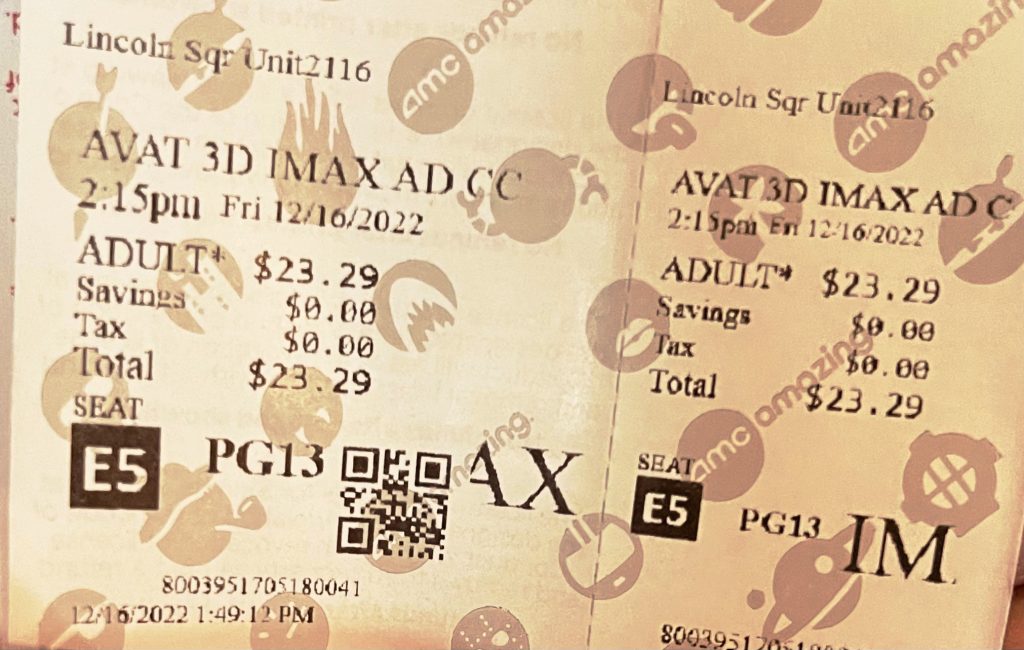
I was sitting in seat E5 during yesterday afternoon’s Avatar 2 screening. The “show” started at 2:15 pm, but as we all know that meant the film itself wouldn’t start until at least 20 minutes of trailers had unspooled. As it happened the film didn’t begin until 2:40 pm. During the 25 minutes of trailers two seats to my left were empty, but I figured the purchasers would show up at the last minute. They didn’t, and after a while I started to say to myself “hey, this is pretty good…maybe I can move over and stretch my legs.”
At 3:07 pm the seat purchasers finally showed up. 27 minutes after the film had begun. The fact that both were overweight had nothing to do with anything, of course. Avatar 2 seats are expensive, and they had to have reserved them a good 10 days in advance. How undisciplined and chaotic does your life have to be to cause this much delay? This wasn’t just another movie –it was an opening-day showing of one of the biggest films of the year. Did they forget? One of them couldn’t get out of the bathroom? I gradually pushed these thoughts out of my head, but it took a while.
Avatar 2 runs 192 minutes — add on 25 minutes of trailer promos and you’re talking 217 minutes. That’s obviously part of the exhaustion factor — it’s grueling to be bombarded with loud, floor-vibrating, super-sized images for three hours and 37 minutes. Lawrence of Arabia runs ten minutes longer (227 minutes) but that film doesn’t rough you up like Avatar 2 — it’s visually vast and eye-filling, but huge portions are dialogue-driven.
Pre-Elon Musk Twitter may not have done the right journalistic thing by suppressing the sad, pathetic sagaof Hunter Biden during the ‘20 ejection, but I’m glad they did it regardless. Because the Hunter Biden scandal is nothing, as I explained early last September:
Before yesterday’s 2:15 pm Lincoln Square screening of Avatar2 they showed the trailer for James Gunn’s GuardiansoftheGalaxy, Vol. 3 (Disney, 5.5.23). My spirit sank — anotherMarvelattitudegoofballfan–servicecomedyinspace. The patience of Chris Pratt’s Peter Quill once again tried by Dave Bautista’s Drax the Destroyer…really bad for the soul, man. Pit of depression.
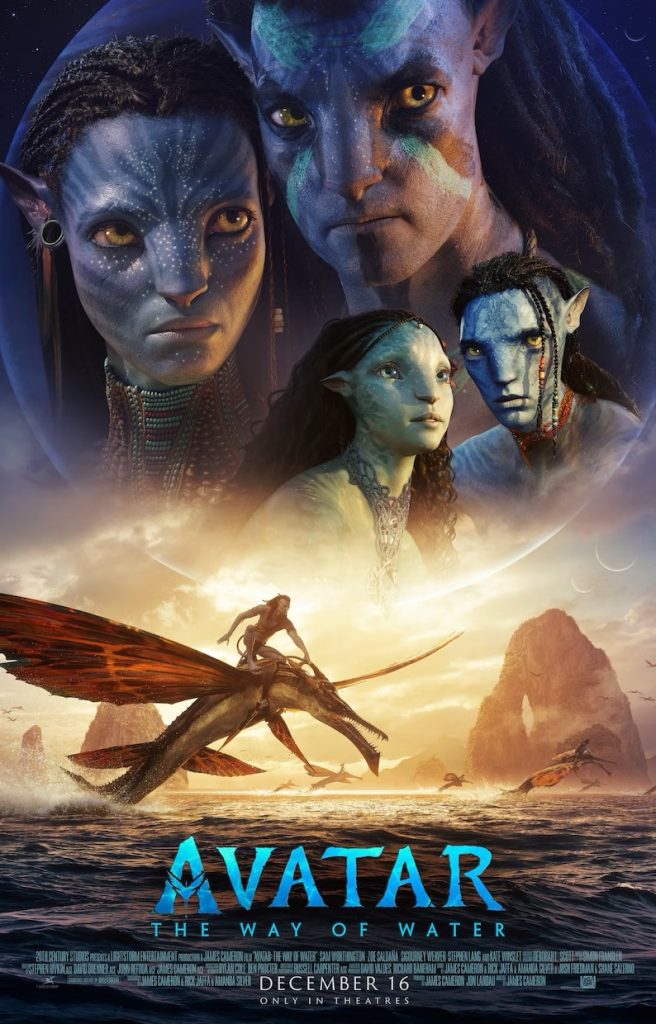
My God, Avatar2: TheWayofWater rerally romps and stomps like nothing I’ve seen in a long while, and the astonishing CG realism (which I couldn’t settle into at first — it took me 10 minutes to find my way into it) is quite the thing, and there’s no beating that last 50- or 60-minute aquatic pitched-battle, breaching-whale, pulse-rifle-burst, arrow-piercing “woo-woo!” destructathon.
A family that fiercely fights together loves all the more…ThePoseidon Adventure meets a return-to-Titanic sinkathon + TheAbyss drowning trauma + weeping death scene + the wildest, craziest, most vigorously sustained battle lollapalooza ever…worth the price and then some…pays off like a motherfucker.
James Cameron is a drop-dead brilliant action director…let no one ever challenge that statement.
And I’m now determined to practice my Navi cat howl-Māori battle cry.
But so much of Avatar2 is padded all to hell & is too fucking long, man…it could’ve easily, EASILY been 45 minutes shorter. The narrative pretty much stops in the middle section and becomes a bloated, ultra-costly real-estate video + a tricks-of-under-the-sea survival instructional + Club Med acqua-blue travelogue for glorious Pandora Shores.
The tech is marvelous and bracinglyreal & every last dollar seems to be on the screen. But there’s something oddly oppressive and even un-entertaining at times about being vigorously assaulted & smothered by so much CG dough…truckloads & truckloads of cash spent by the ultimate wizardly maestro of wildly expensive holy shit superfuck blockbusters. The film is a titanic grand-slam CG toy factory spendathon…whew!
I like the “family is a fortress” theme but my God, I was exhausted when it ended. I’m not altogether sure I want to see it a second time. Variety’s Owen Gleiberman was right when he called it thin. Pic seems to take as much as it gives.
Only in New York City can you negotiate the price of a large Good & Plenty. “$3.50,” the newsstand guy said. “They charged me $3.00 last week!…right here!”, I indignantly replied. Newsstand guy: “S’allright.” HE: “What?” Newsstandguy: “Three is good.”
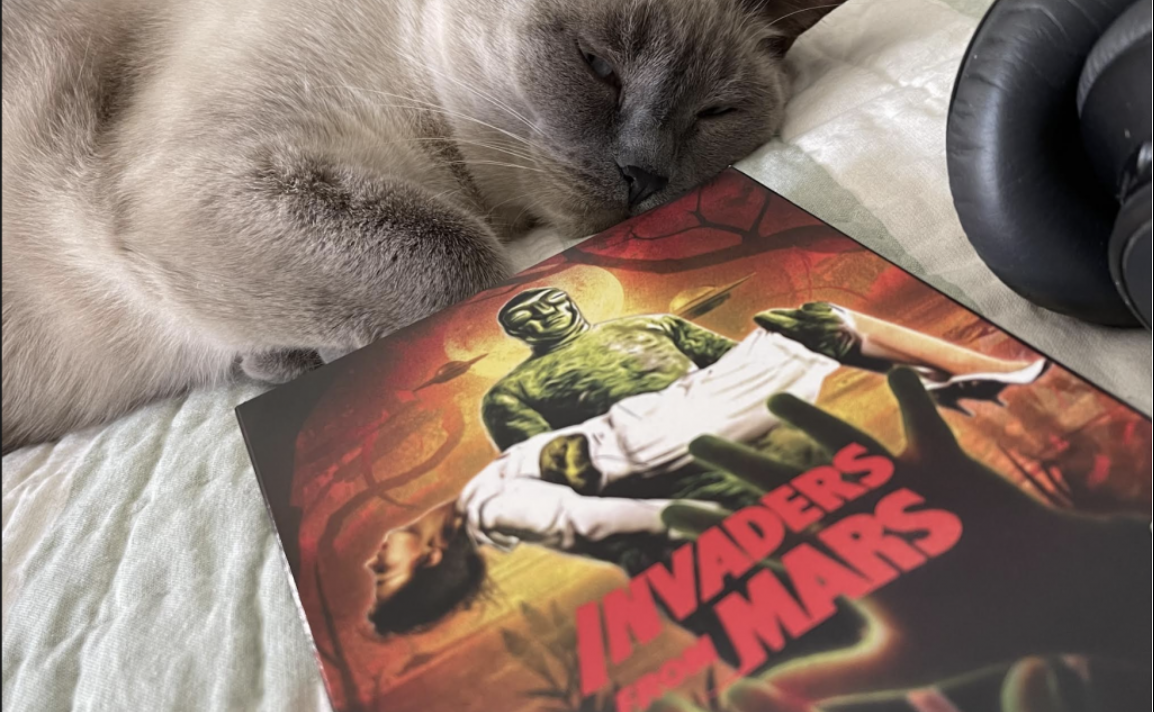
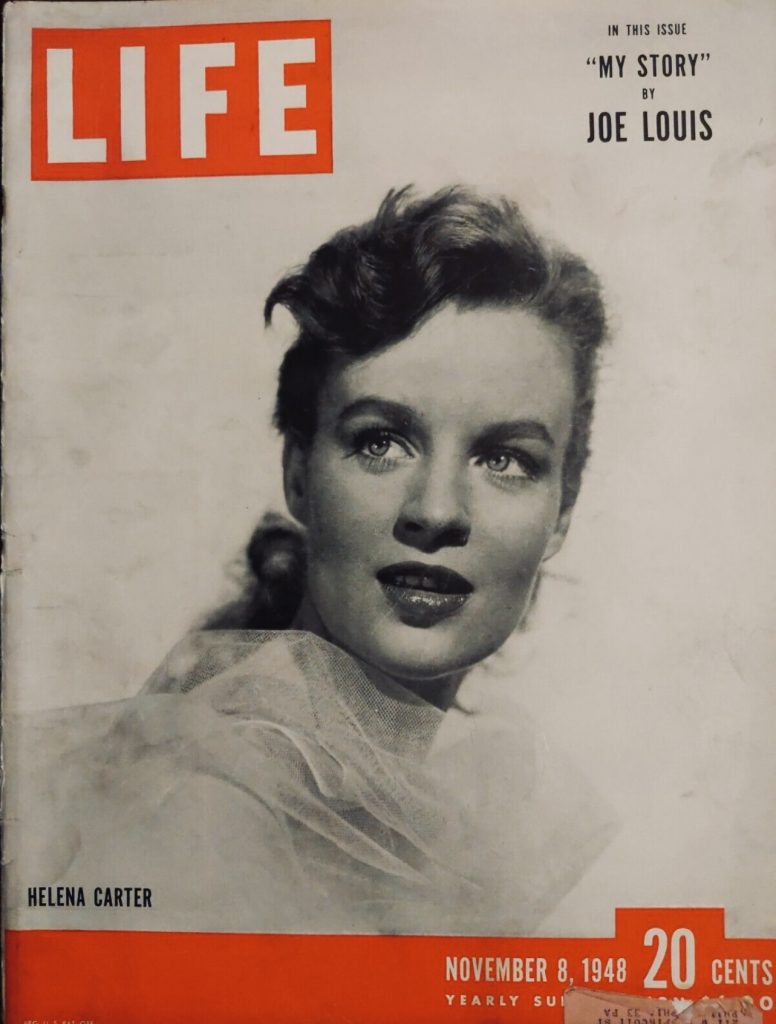
All my life I’ve been nursing erotic fantasies about the late Helena Carter, who played “Dr. Blake with the torn blouse” in InvadersFromMars (‘53). The IgniteBluray of this classic paranoid alien invasion film arrived yesterday, and it prompted a Google search about Carter, whose Invaders performance was not only her most famous but her last.
It was only after discovering Carter’s 1948 Life magazine cover photo that I realized why she didn’t catch on in a bigger way. Tenwords: Beautiful eyes and mouth but her nose was too big -— i.e., on the bulbous side. If she’d gotten a nose job things might have turned out differently…seriously.
I’m not speaking as a 2022 woke (or more precisely woke-terrified) person but a time traveller from 1953, when emerging actresses were almost entirely judged and promoted according to their looks.
And I’m saying this, mind, as someone who’s gone under the knife myself so don’t tell me.
Nice location scouting on someone’s part. Unless they somehow erased the apes and tapirs from the original 2001 footage and replaced them with dolls and little girls. Either way, excellent work on Greta Gerwig‘s part.