#MeToo-Stamped “Spotlight”…Definitely

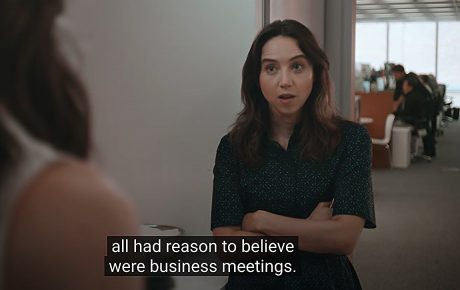
A friend was a tad skeptical about the trailer for Maria Schrader‘s She Said (Universal, 11.18), which popped this morning. Actually two friends were, but this film is going to sail through.

“No, no…this is good,” I replied. “I can feel it. It has discipline, tension…first-rate acting from Carey Mulligan, Zoe Kazan and, as Weinstein employee Zelda Perkins, Samantha Morton. A well-honed screenplay by Rebecca Lenkiewicz. Nicholas Britell‘s music is a little overbearing** but this is Spotlight again.”

This is a Best Picture contender — no question, no doubt. If Spotlight can get there, this can too.

The victims weren’t children being molested by priests and some who were invited to Harvey’s first-class hotel rooms had to be at least wary of what might happen, but this is one of those social justice, social portraiture flicks that can’t miss, at least as far as a Best Picture nomination is concerned.

“Apparently Harvey isn’t played by anyone. Well, he is, but not as a speaking character with a puss. There’s a clip of a big fat guy we see from the rear, but we don’t see his face. We hear Harvey’s voice on a speakerphone during a conference call, but his voice isn’t deep or punchy enough.”

A guy who’s allegedly caught a research screening:

“Better than a TV movie. Not sure about Best Picture, but Samantha Morton and Carey Mulligan are the MVPs. Very intelligently made and well-directed. They smartly show the effect of the abuse. Victims go back to the hotel rooms, reenact what happened in the bed and shower, but with their clothes on. It’s very Spotlight, maybe too much so. It also has a fantastic ending. We never get to see Weinstein’s face, only see his back and hear his voice.”

Pic is produced by Plan B’s Brad Pitt, Dede Gardner and Jeremy Kleiner.

Lenkiewicz’s screenplay is based on Jodi Kantor and Megan Twohey’s “She Said.”

Read more

Drowning in Carver Weltschmerz

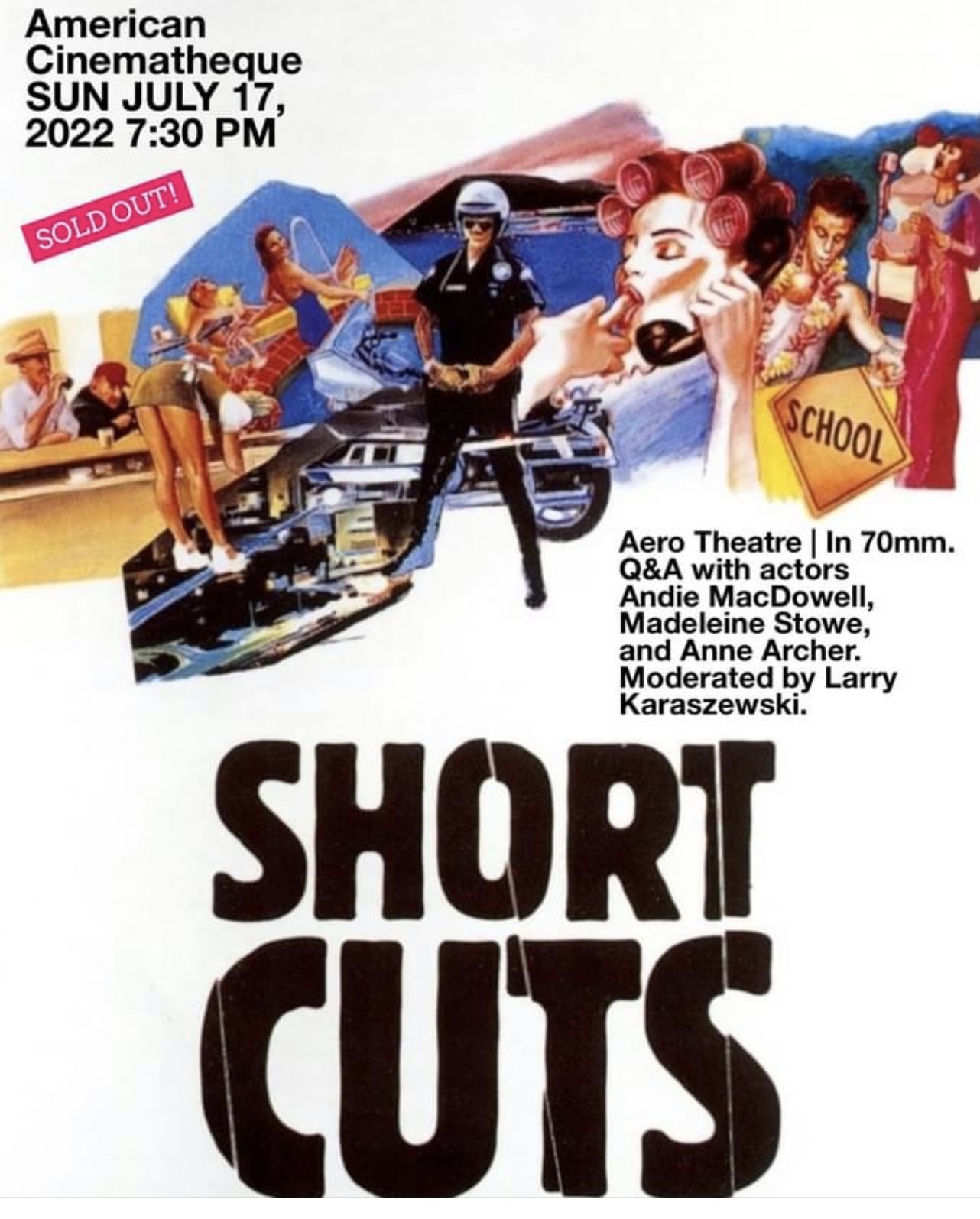
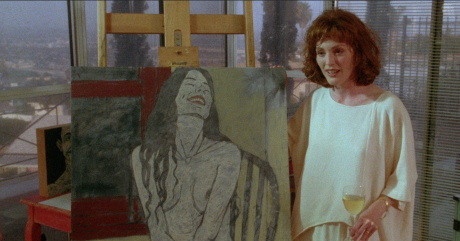
Sincere apologies to Larry Karaszewski, but I don’t have many fond memories of Robert Altman‘s Short Cuts (’93). I saw it 29 years ago, once, and all I remember is the faintly dreary vibes and the cast behaving in the usual eccentric, Altman-esque ways and the visual drabness and the Julianne Moore-Matthew Modine argument scene with the pubic hair and that soul-baring scene with Jack Lemmon “acting” in his usual actor-ish fashion.

I “respect” Short Cuts, of course, but there’s a reason why I haven’t re-watched it in all this time. The reason is the miserable downishness of Raymond Carver‘s short stories. If I was suddenly stuck in a Carver story or wearing the shoes of a Carver character, I would become a heroin addict.

Respectful disagreement with the late Michael Wilmington: “Short Cuts is a Los Angeles jazz rhapsody that represents Robert Altman at an all-time personal peak—and it came at just the right time in his career. For anyone who believed that what American movies needed most, after the often-moribund cinematic eighties, was more of the old Altman independent spirit and maverick brilliance — and more of a sense of what the country really is, rather than what it should be — the director’s sudden cinematic reemergence with 1992’s The Player and 1993’s Short Cuts was an occasion for bravos.”

80 Years on Planet Earth

Without even thinking it through it’s my earnest belief that Harrison Ford‘s best performance ever is Jack Ryan in Clear and Present Danger (’94), followed by his Philadelphia detective in Witness (’85 — his only Best Actor nomination), Han Solo in The Empire Strikes Back (’80), Ally Fox in The Mosquito Coast (’86), Deckard in Blade Runner (’82), the widower in Random Hearts, the hosthot executive in Working Girl and the TV anchor in Morning Glory.

[Posted two years ago] “Frantic is an example of the kind of film that we used to make in the olden days, and for me [there were certain] directors who were really important in the formation of a career. I didn’t actually do it all myself. I got to work with Alan Pakula, Sydney Pollack, Mike Nichols, Phillip Noyce, Roman Polanski, Peter Weir, Ridley Scott, Wolfgang Petersen].

“Those kinds of films are as important on a human level as, uh, those more successful films” — the Star Wars and Indiana Jones franchises. “Which I keep revisiting in interview situations, because they are the most successful films.” [Unspoken: “Most successful” because your basic whiteside and T-shirt-wearing knuckle draggers obsess over these films and seem to need them like babies need their blankies.]

“But [making big franchise movies for the unwashed salivating hordes] is not what makes a life. That’s not what makes a career. That’s not what brings pleasure to the pursuit of something effable.” — Harrison Ford, starting around the 8:26 mark.

Why, then, did Ford turn down the Michael Douglas role in Traffic? And why did he make something so flagrantly non-organic and digitally antiseptic as Call of the Wild? Legend has it that a lot of what Ford agreed to do over the last 20 years was first and foremost about producers meeting his quote. The bottom line (and please correct me if I’m wrong) seems to be that “the kind of films that we used to make in the olden days” are to some extent still being made, but their producers can’t afford Ford.

Read more

Great Parenting

Remember that scene in Manchester by the Sea when Casey Affleck is arguing with Lucas Hedges and finally says “I’m gonna knock your fucking block off” and director-writer Kenneth Lonergan, playing a passerby, sarcastically says “great parenting” to Affleck and the yelling ratches up another couple of notches?

Let’s imagine another scene in which a pair of Philadelphia brothers, aged 10 and 14, voluntarily surrender to the cops over having killed a 73-year-old guy (James Lambert) who was beaten to death on 6.24.22.

Imagine that you’re aware of the whole story behind this tragedy, and you come upon the parents of these kids outside the police precinct. What would be the appropriate dialogue? Would you say “great parenting” or would you say “the poor guy was beaten to death around 3 am, for Chrissake…what kind of parents let their kids run wild at 3 am?? And what kind of parents raise kids who would even want to beat a guy to death??”

A 10 year-old kid who helps beat an old guy to death is going to turn out wrong…that’s obvious. But imagine how it feels if you’re the father or the mother of these little shits.

Friendo: “This story is a complete disaster and one the media will barely cover, for obvious reasons.”

HE: “What do you mean ‘a complete disaster’? It was a matter of neighborhood culture and whatnot, but mainly derelict parenting…poisonous, appalling, derelict parenting.”

“All You’re Seeing Is The Beliefs of the Writers”

“[Many of today’s] screenwriters have gone to college for four or five years, and where they’ve been told incessantly [that] the world is inherently racist and sexist…everyone is awful, everyone hates each other and it’s just this big heirarchy of everyone getting oppressed by everyone else, and so that’s going to be reflected in what they write and what they try to rationalize in their stories, and that’s why [we’re getting what we’re getting].”

In the view of Will Jordan‘s “Critical Drinker” (or, if you will, just plain Jordan) a good portion of the woke poisoning of iconic characters has happened under the influence of the Disney death star.

“They took over the Stars Wars brand, they took over Marvel…and in the case of Star Wars you would see characters like Han Solo, Luke Skywalker…these classic heroes from 20, 30 years ago” — actually 40 to 45 years ago — “that were awesome, and suddenly they’re gettin’ brought back and [they’ve become] deadbeat dads or grumpy old men livin’ on an island, and they want to die and have lost all hope…it’s a terrible thing to do to these characters…it’s one thing to kill them off, and another to destroy their legacy and the very essence of who they were.”

Moths to Flames

Sara Dosa‘s Fire of Love (Neon/National Geographic, 7.6) tells the story of devoted (one could say obsessive) volcanologists Katia and Maurice Krafft, who died in a volcanic explosion atop Japan’s Mount Unzen on 6.3.91 — 31 years ago.

The married couple — French natives, deep soulmates — had been studying, cataloguing, filming and photo-snapping volcanic eruptions since the early ’70s, and were among the most fearless and exacting in their field.

Dosa’s 93-minute doc is mostly composed of volcano footage (color, 16mm) that the Kraffts shot over the years, and which apparently was only made accessible to Dosa and her producers somewhat recently. The film also contains a fair amount of footage of the Kraffts themselves.

The dynamic visuals (miles-high clouds of gray ash, thunderous rumbling, pools of intense red-gold lava bubbling over and streaming down mountainsides) are exciting or at least fascinating until they become familiar, at which point you’re left with “okay, here are some more lava flows” and “wow, more shots of nuclear blast ash clouds.”

The problem, for me, is Dosa’s decision to weave it all together with Miranda July‘s whispering, barely enunciated narration. I was on the verge of abandoning the doc because of this aspect. July sounds like a parent quietly reading a Babar the Elephant story to a small child at bedtime.

The idea, presumably, is to pass along a certain romantic sensibility as well as (I gathered) soft-spoken Katia’s view of volcano worship, marriage, the twists and turns of nature…the whole magilla. But if ever a narration track rubbed me the wrong way, it was this one.
.
The honest truth is that I found Fire of Love a tad boring at first. If the Kraffts hadn’t been killed there would be no film, just as Werner Herzog‘s Grizzly Man wouldn’t have been a film if Timothy Treadwell hadn’t been eaten by a bear.

Herzog’s Into The Inferno (’16) covers roughly the same ground as Fire of Love, and I for one found it a bit more intriguing than Dosa’s decentenough film.

Why were the Kraffts so into volcanoes? “Both Katia and I got into volcanology because we were disappointed in humanity,” Maurice said. “Since a volcano is greater than man, we felt this is what we need. Something beyond human understanding.”

But were they really seeking a mystical communion with the primal forces of nature? Or were the Kraffts simply volcano junkies in the same way that some photojournalists obsessively cover war zones, and Joanne and Bill Harding (Helen Hunt, Bill Paxton) were tornado junkies in Twister?

The Kraffts were doing valuable work, but they were primarily, it seems to me, moths lured by flame. Was their story a replay of the ancient myth of Icarus? You could certainly start with that interpretation.

The Kraffts were killed not by lava but a pyroclastic cloud — a fast-moving current of boiling hot gas and volcanic matter that flows along the ground away from a volcano at average speeds of 100 kph but sometimes as fast as 700 kph. They and American volcanologist Harry Glicken were standing on a ridge near the volcano and suddenly the cloud surged up and over and killed them “instantly.”

I found it odd that Dosa’s doc doesn’t mention that 43 people were killed that day by the same tragic event — the Kraffts, Glicken and 40 journalists. Wouldn’t the deaths of so many people in the same area warrant an explanation of what happened? Dosa barely gets into the specifics.

Narration quote: “Katia and Maurice know that these [volcanic] rocks will long outlive them. They are not religious. [They know] we all have one short life, and then we return to the ground.”

Okay, except I knew that large rocks would outlive me when I was nine years old and going on nature hikes with my Cub Scout pack. I remember asking this very question of an adult — “how long have these rocks been here?” Thousands of years, I was told.

Read more

If I Was In My 20s

…I wouldn’t necessarily want to become pregnant, but I’d certainly want to keep my options open. Either way this is why the Democrats are going to die in November.

Whatever, Man…

None of my business, nothing to say except that Bradley-Huma is no longer “quiet”. If I was an attractive straight woman of a certain social station, I would be somewhat hesitant about anything amorous with Cooper. He scares me a little. Just a little.

Polanski Could Yet Stroll Down Chandler’s Mean Streets

Hardcore haters of Roman Polanski gonna hate no matter what, but it suddenly appears as if the decades-old rape case against the 88 year-old director might be dropped before long.

THR‘s Winston Cho reported earlier today that the L.A. County District Attorney’s Office “is no longer opposing a request to unseal a former prosecutor’s testimony that Polanski claims will reveal misconduct from [the late Judge Lawrence J. Rittenband], thus warranting dismissal of the decades-old case against him.”

This means that transcripts of closed-door testimony from the original prosecutor handling the case, Roger Gunson, who retired in 2002, will soon be unsealed. This could lead to Polanski being allowed to return to the United States if it’s found that Rittenbrand improperly reneged on the plea deal Polanski’s attorneys allegedly struck with prosecutors over 90 days of psychiatric evaluation.

Excerpt from “The Roman Arena” (’09), written by Phil Nugent:

Marina Zenovich‘s Roman Polanski: Wanted and Desired has an irresistible story to tell: much of the second half is narrated by the lawyers involved, including the prosecutor David Wells, and their accounts match.

“The villain is the late Judge Lawrence J. Rittenband, a publicity addict who was mainly concerned with how the show…excuse me, I mean the trial, was playing out in the media.

“The title Wanted and Desired comes from a witness to the circus who notes the striking difference between the European reporters who saw Polanski as an important cultural figure and the American TV crews and journalists, who saw him as a malignant dwarf who had come for our women — and Zenovich makes the point that this view was so strong even at the start of Polanski’s Hollywood career that, in the wake of his wife’s murder, the media often treated the director as if he might be complicit in the killings, or at least as if he had somehow brought it on himself by making sicko movies like Rosemary’s Baby.

“According to the lawyers, Rittenband actually called them into his chambers and told them what parts he wanted them to play in scenes that he wanted to act out in the courtroom for the media.

“Ultimately, he agreed, as his little secret with Polanski and the lawyers, to force Polanski to spend a maximum of ninety days in a maximum security prison receiving ‘psychiatric evaluation.’

“Again, according to the lawyers, it was understood that this would be Polanski’s sentence, and that after it was over, he’d be given probation. If true, this would mean that Polanski, for all practical purposes, had already served his sentence when he went on the lam, and both the prosecution team and the psychiatric experts were good with it. But after the shrinks decided that Polanski had had enough and he was turned loose after 42 days, the media decided that he wasn’t showing sufficient public remorse, and Rittenband, upset by the bad press, informed the lawyers that he’d changed his mind and was going to throw the book at the little bastard.

“Gunson recalls that, after that mind-blower, Polanski’s lawyer asked him how he could explain this to his client, and Gunson, to his regret, he says, replied that if Polanski were his own client, he might just tell him to hop the next plane out of Rittenband’s magic kingdom.

“In the wake of Wanted and Desired, Polanski’s lawyers made a motion to have the case against him dropped. They were quickly followed by an effort by the woman Polanski raped [Samantha Geimer] to drop the charges, saying that the lingering ‘attention’ the case still generated “is not pleasant to experience and is not worth maintaining over some irrelevant legal nicety, the continuation of the case.

“The let’s-drop-this-thing movement ultimately foundered because Polanski refused to return to the U.S. He didn’t trust the District Attorney’s office, and in light of recent events, he may have had the right idea.

“It’s hard for even a conspiracy-phobe like myself not to conclude that what made this case an A-list priority after all this time is that Roman Polanski’s real crime is that he ran away, thrived, and in the process made the law look ridiculous.

“And then, having done all that, he even had the audacity to feel them out about getting his name cleared so that he could visit their fine city again and, after they tried to save face by imposing some restrictions of their own, like asking him to actually show up in a courtroom, walked away again, saying, no — my life’s good, it’s not really that important to me.”

Chappelle Deserves It

Dave Chappelle’s The Closer, his controversial stand-up special that triggered backlash from offended trans people, has landed two nominations for the 2022 Emmys. The Netflix presentation was nominated for best pre-recorded variety special, and another for the director, Stan Lathan. Yes, despite all the rage. (Or because of it.)

Chappelle’s special is competing against Tony Bennett and Lady Gaga’s One Last Time, Adele’s One Night Only, Norm Macdonald’s Nothing Special (posthumous), and Warner Bros. and HBO Max’s Harry Potter reunion.

I love the reactions of ET Canada‘s Carlos Bustamante and Morgan Hoffman to Chappelle’s “What’s In A Name.” They clearly don’t approve and can’t stress enough that Chappelle has caused emotional hurt among some in the trans community. They’re almost like an act, these two — a parody of Millennial sensitives.

Read more

Alone Again, Naturally

The Hollywood Reporter has excerpted a passage from Ken Auletta‘s “Hollywood Ending: Harvey Weinstein and the Culture of Silence.” Here’s an excerpt of that excerpt:

“While Miramax employees respected Harvey’s talents, few liked him. ‘I never had a single personal conversation with Harvey…I don’t think he knew if I was married or had a family,’ said a former senior executive who worked closely with him. Most found him cold and remote. He had few industry friends outside Miramax. Despite their scorching verbal battles and sometimes rivalry, Bob remained Harvey’s best friend. And to those in the office, his only friend.

“But even that friendship didn’t last, as Bob voted to terminate Harvey from the Weinstein Company in October 2017, and no longer speaks to his brother.

“Today, Harvey has been transferred from a maximum security prison outside Buffalo, New York, to await trial later this year in Los Angeles. He resides in a medical ward of the Twin Towers correctional facility (450 Bauchet Street, Los Angeles), relying on a wheelchair to move about. He is plagued by spinal stenosis, diabetes, high blood pressure, a steep cholesterol count, a weak heart fortified by a stent, and glaucoma that requires injections to stave off blindness.

“No longer does Harvey have four assistants hovering to execute his orders, or a car with four televisions to screen films as he was whisked to another meeting or premiere. In prison, his telephone calls must go through his lawyers. He has no internet access, and few visitors. Like his brother, his three adult daughters from his first marriage refuse to speak to him. His second wife, Georgina Chapman, divorced him and now dates and walks the red carpet with actor Adrien Brody.

“Harvey Weinstein is very much alone. And although he won’t accept responsibility, he can’t blame anyone but himself.”

Johnson’s Successor?

Mary Elizabeth Truss, 46, is a British politician who’s been a Conservative Party member since ’96, when she was 20. She’s served in cabinet positions under Prime Ministers David Cameron, Theresa May and Boris Johnson. She began serving as Foreign Secretary last year, and Minister for Women and Equalities in ’19.

Two days ago (7.10.22) Truss announced her intention to run in the Conservative Party leadership election, and thereby, if elected, succeed Boris Johnson as British Prime Minister. Her stated influences are Margret Thatcher, Ronald Reagan and the former chancellor of the Exchequer Nigel Lawson.