Gigli-Cleopatra Connection

Variety‘s Owen Gleiberman has posted an essay about the iconic pairing of Ben Affleck and Jennifer Lopez, formerly known as Bennifer or, if you will, “B-Lo”, and their recent Las Vegas marriage and especially Gigli, their 2003 box-office bomb that was directed by Martin Brest.

But what got my attention was the following passage: “And, of course, just as Liz and Dick had a famous bad movie to launch them, so did J. Lo and Ben. Elizabeth Taylor and Richard Burton had begun their torrid love affair on the set of Cleopatra in 1961, and by the time the movie came out, in 1963, it seemed to be all about the two of them.

“The same can be said for Gigli, the infamous debacle of a 2003 romantic comedy. Lopez and Affleck first got involved during the shooting of it, in 2002, and by the time the film came out, in August 2003, what was happening on screen seemed a mere footnote to the real-life dramatic series of their romance.

Cleopatra was an iconic movie, a four-hour spectacle of ancient glitz bloated with expense and designed to lure audiences back from their pesky new loyalty to the small screen. Nothing about Gigli, when it came out, looked especially iconic; it wasn’t showy or expensive, and it was given such a rude collective backhand by the critics that it died a quick death.”

HE response: I don’t think it’s quite fair to dismiss Cleopatra as a “bad movie.” It’s a slog to sit through, of course, but it’s so handsomely and expensively produced and Leon Shamroy‘s cinematography is luscious eye candy, and Rex Harrison’s Julius Caesar is crisp and rousing, I feel, especially during the opening 15 or 20 minutes, and Roddy McDowell’s Ceasar Augustus is easily the best adult performance he ever gave and Martin Landau’s Ruffio is very good also, and even Burton and Taylor have their moments. And you can’t fault those first 15 or 20 minutes, and the opening credit sequence is wonderful. So you can’t just dismiss it as a “bad movie,” although it obviously has pacing and story-tension problems.
Read more

“Nope” Encounter

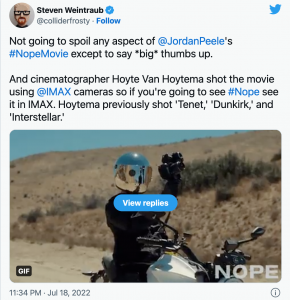
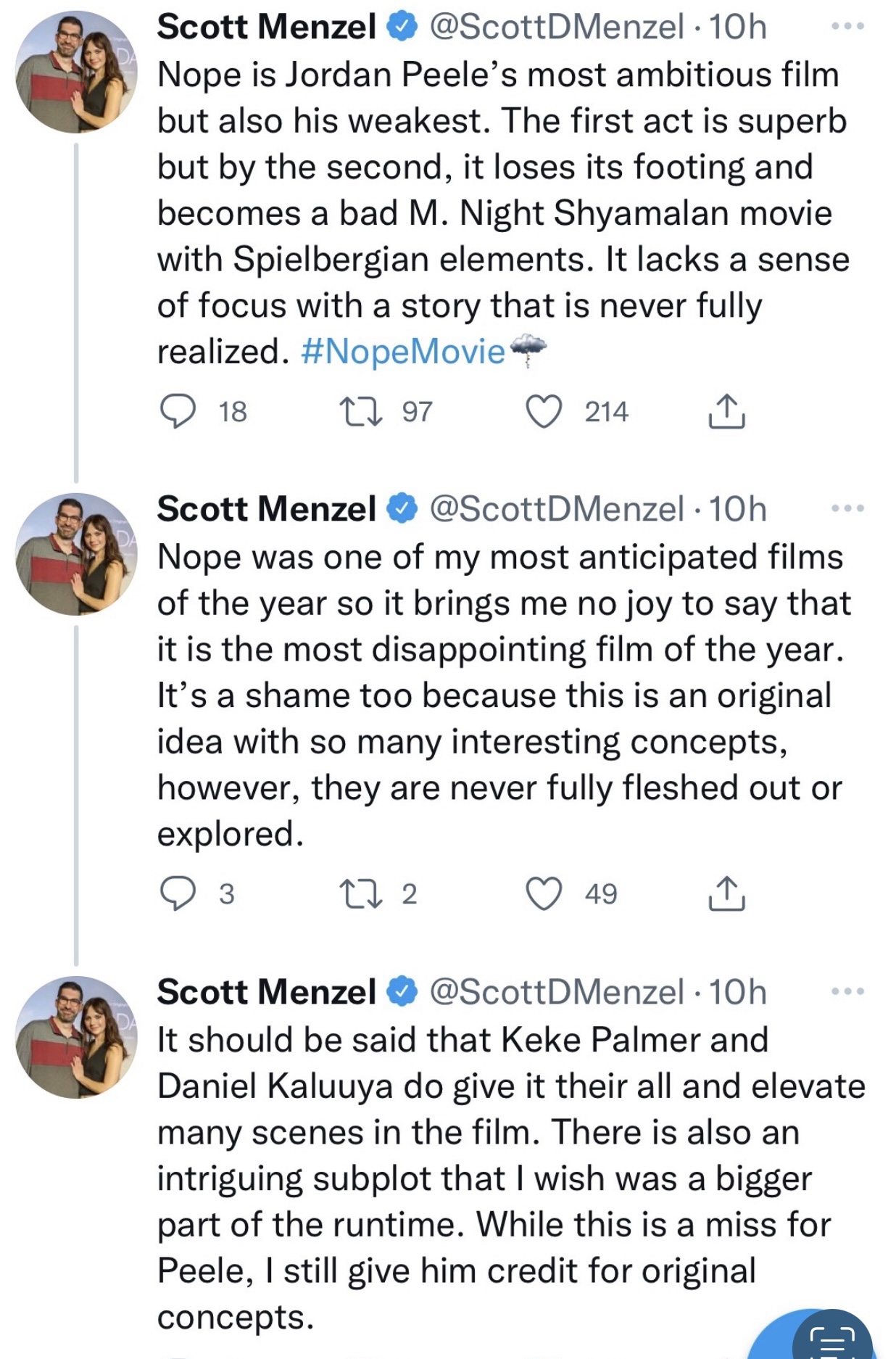
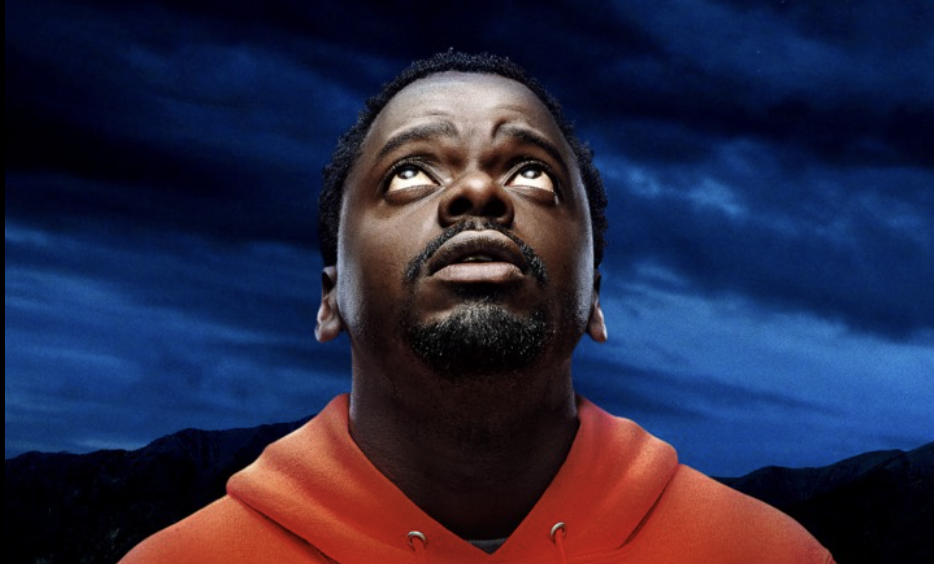
Jordan Peele‘s Nope opens on Friday, 7.22, which really means Thursday night. I’ll catch it at 7 pm this evening.

Premise: “After random objects falling from the sky result in the death of their father, ranch-owning siblings OJ and Emerald Haywood (Daniel Kaluuya, Keke Palmer) attempt to capture video evidence of an unidentified flying object with the help of tech salesman Angel Torres (Brandon Perea) and documentarian Antlers Holst (Michael Wincott).”

If your first name is Antlers, what do your friends call you — Ant? Anty?

“Live and Die” Lives Again

Anthony and Joe Russo, directors of The Gray Man (Netflix, 7.22), have said that William Friedkin‘s To Live and Die in L.A., (’85) was an influence in the making of their new film, which struck me as wholly uninvolving and spiritually dead in a Grand Theft Auto sort of way.

Late yesterday afternoon a friend and I caught a screening of Friedkin’s film at Netflix’s flagship theatre in Manhattan, the Paris on 58th. It was my third or fourth viewing but my first in a theatre since ’85, and I was fairly blown away by the clarity of the screenplay, which was co-authored by Friedkin and Gerald Petievich.

Not only can you actually hear and understand the dialogue but — bonus! — you can follow the story on a plot point-by-plot point basis. The vast majority of today’s action thrillers are deliberately written in order to keep the viewer “behind” the narrative — you’re never completely on top of what’s going on, the nagging questions are never answered until the end and sometimes even a climactic windup isn’t enough due to sloppy confusion or loose ends.

To Live and Die in L.A. employs the same narrative discipline that Friedkin used in The French Connection, The Exorcist and Sorcerer. Shot in late ’84 or early ’85, but every inch a “’70s film.” At least by my understanding of that term.

And everyone is so young. William Petersen, pushing 70 as we speak, was 31 or 32 during filming, but he looks a good five years younger than he did as FBI agent Will Graham in Manhunter (’86). Willem Dafoe was 29 during filming, but he looks like a teenager. I didn’t like John Pankow‘s candy-ass treasury agent when I first saw this, but I still don’t like him today…he’s playing a wimpering little girl. Costar Dean Stockwell was in his late 40s. As Petersen’s blonde, hard-luck girlfriend, Darlanna Fluegel was intense and believable. Her career was in good shape throughout the ’80s and early ’90s, but she was diagnosed with early onset Alzheimer’s in ’09 and died in 2017 at age 64.

A Mouse, A Pussy or a Wet Noodle?

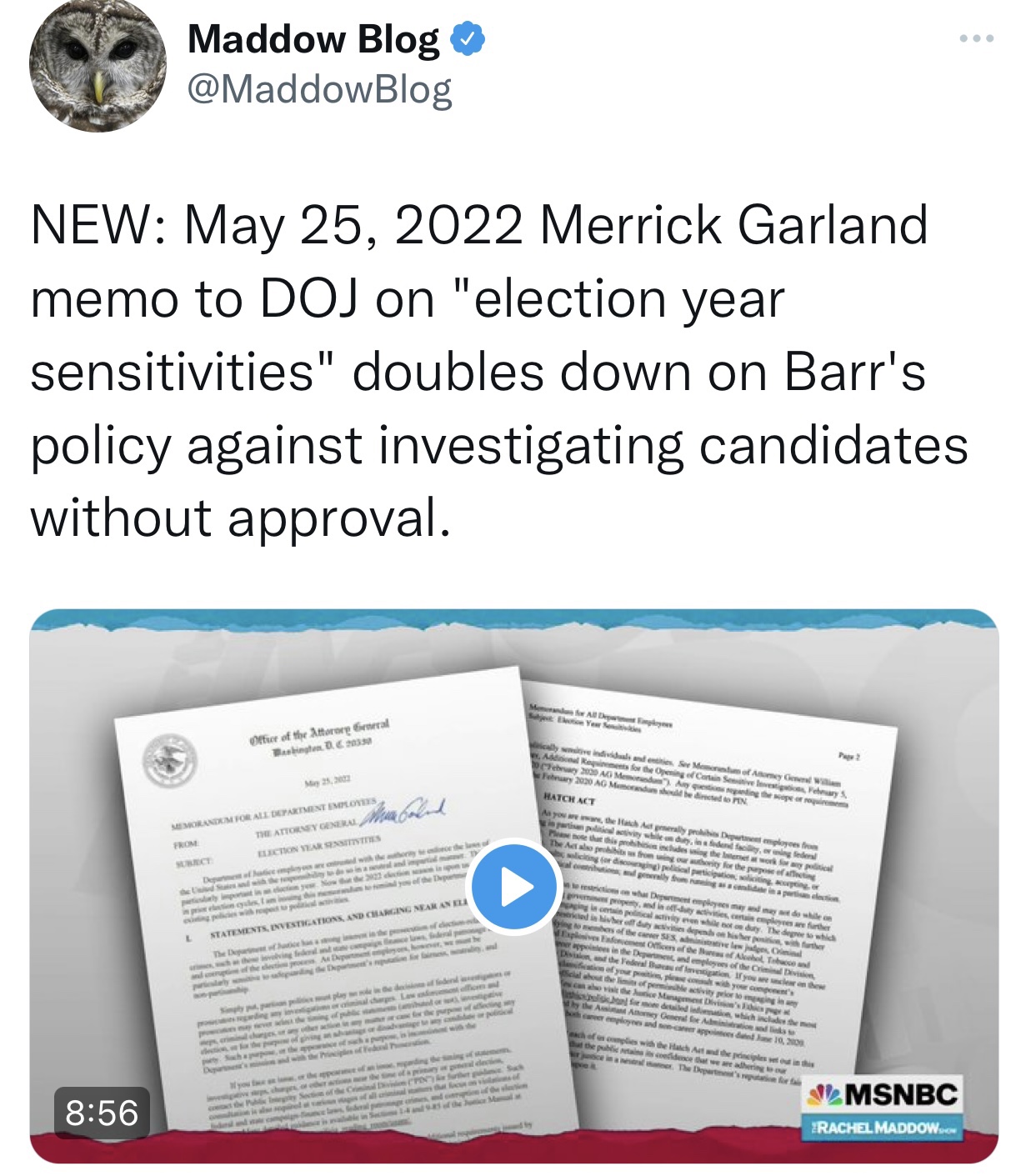
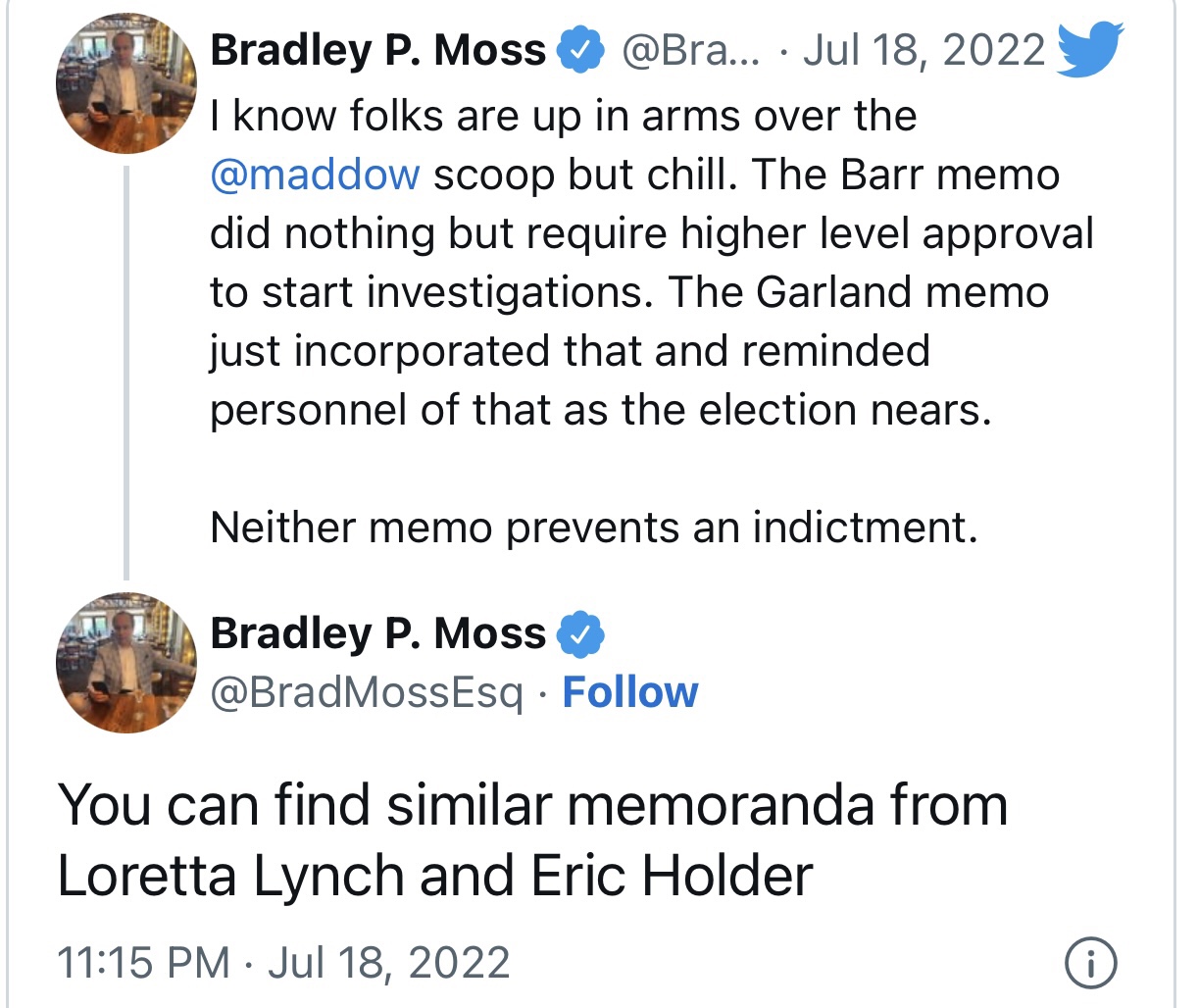
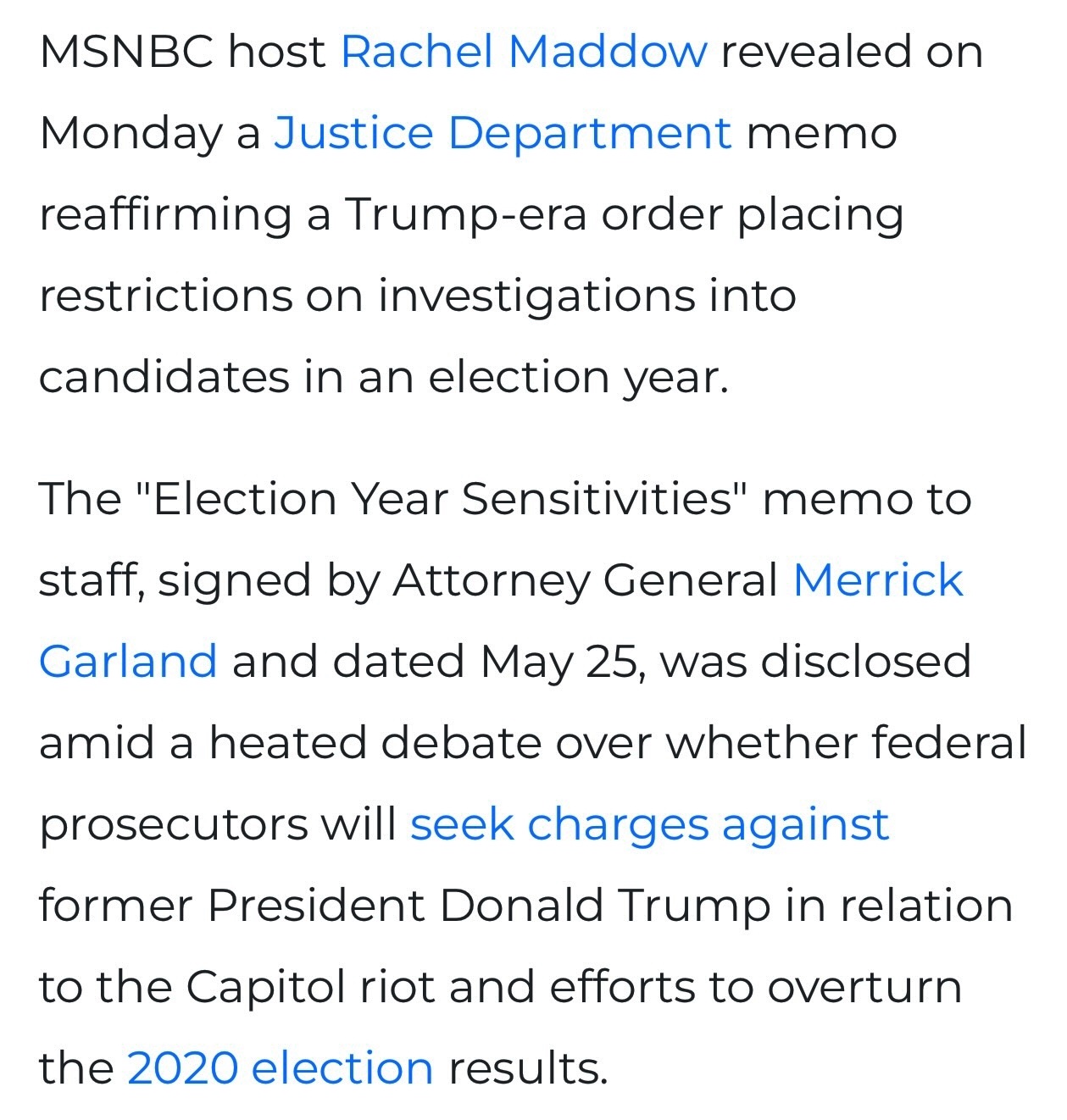
This is it, a document that contains smoking-gun proof that Attorney General Merrick Garland is committed first and foremost to political caution and squeamishness when it comes to the absolute necessity of prosecuting the only U.S. President in history to ignite mob rebellion against this country’s Constitutional system of transfer of Presidential power and scheme to overturn a legit election through manipulation and skullduggery. Donald Trump is an animal and a sociopath, and if the U.S. Justice Dept. doesn’t stand up and prosecute his loathsome ass then we are no longer a law-abiding Democracy and the concept of equal justice under law is meaningless — it’s that simple.

Something About Harry Styles

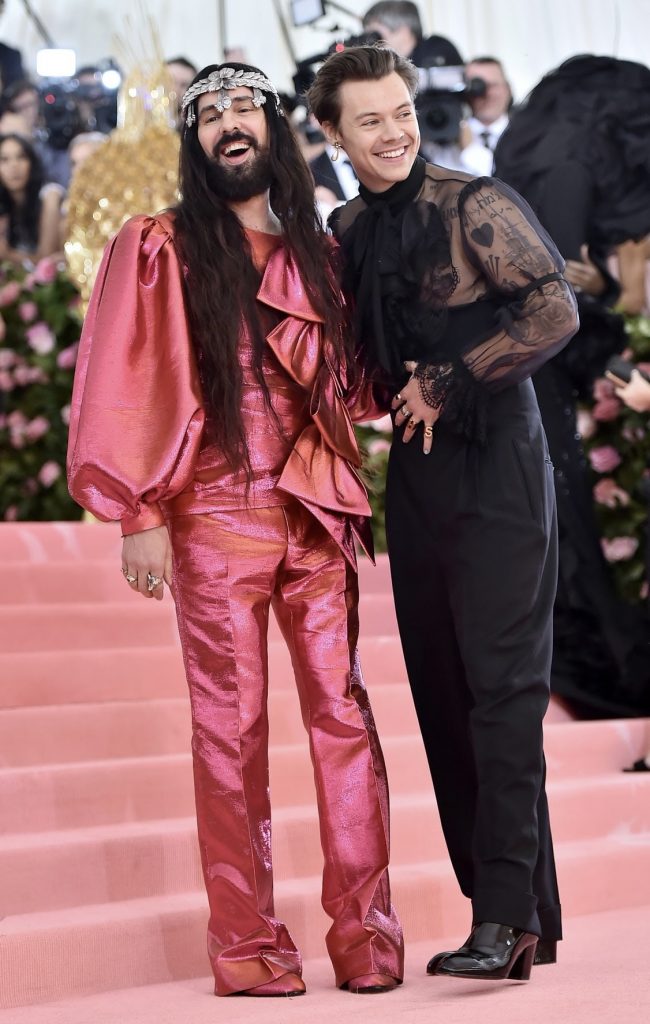
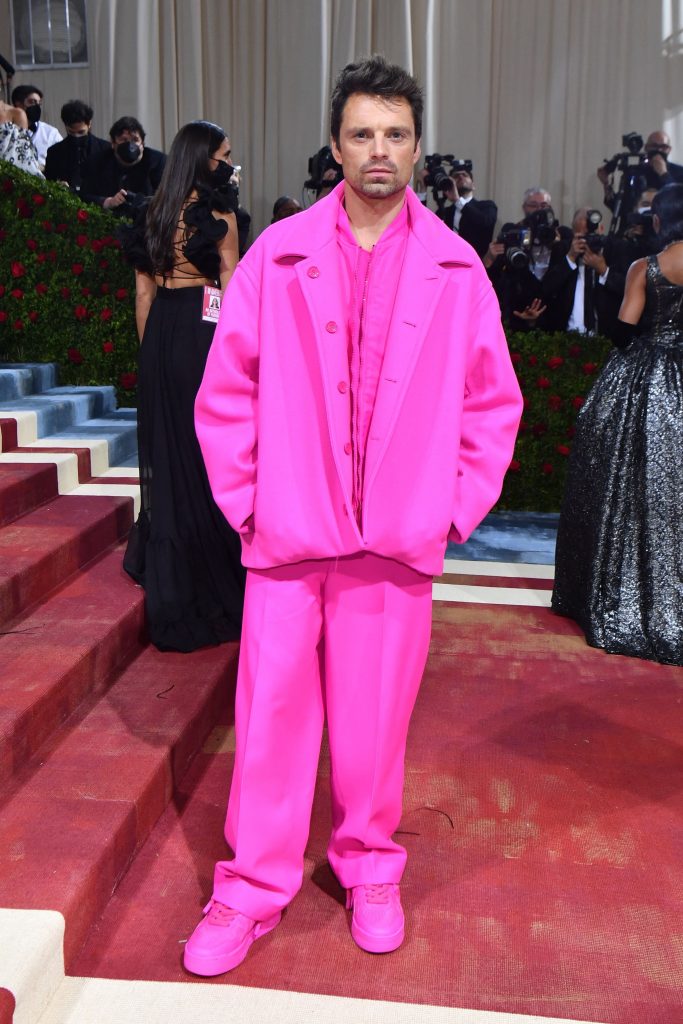
…and the whole jerkwater girly-glam, gender-fluid fashion thing that he’s been statement-izing for a year or two…I guess I was interpreting this as a detour or phase of some kind…an exhibition thing that he wanted to embrace and which would run its course and then on to the next thing…but Styles and others seem to be settling into this anti-straight, anti-traditional-dude, embrace-the-pink-and-the-frilly fashion attitude, and I for one am feeling a bit irked and even (do I dare say this?) angry. I’m sick of his wearing pearl necklaces and transparent black-net sleeves and I don’t care if I sound harumphy. Harry Styles can honestly go fuck himself, and this, to me, has nothing to do with sexuality or gender issues. It has to do with simply being sick of this shit…okay?

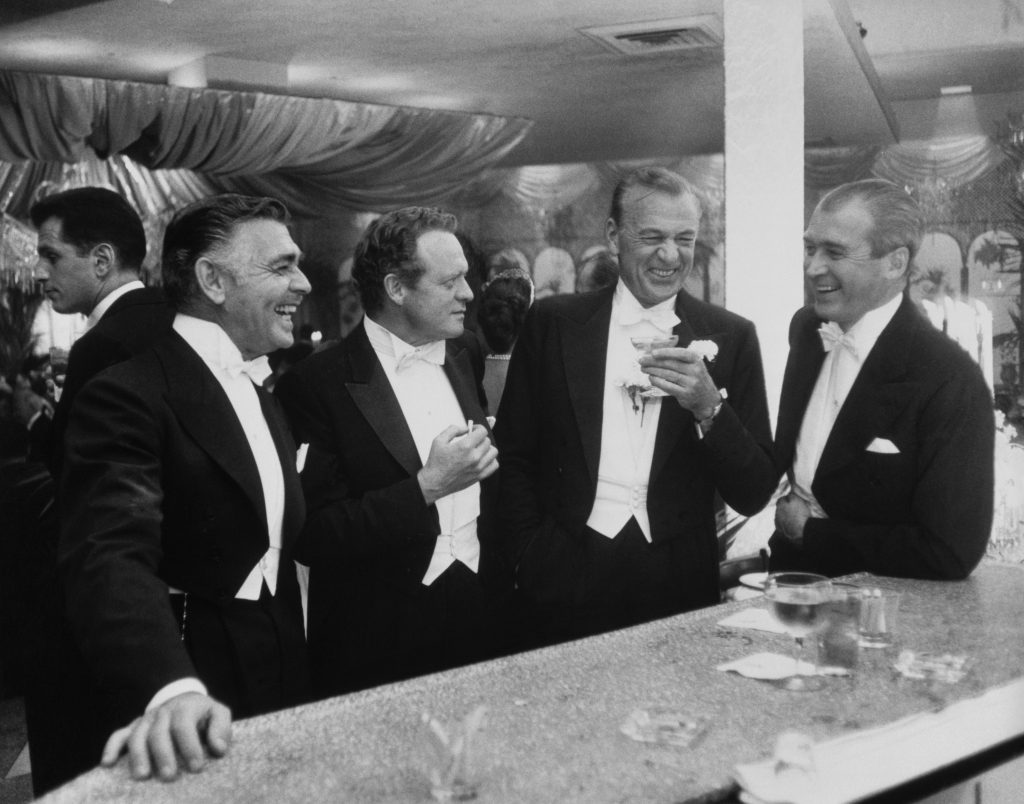
Pics stolen from Vincent Boucher’s “Hollywood Men Are Having A Vibe Shift,” a 7.9 Ankler article.

Long-Known Facts Reiterated

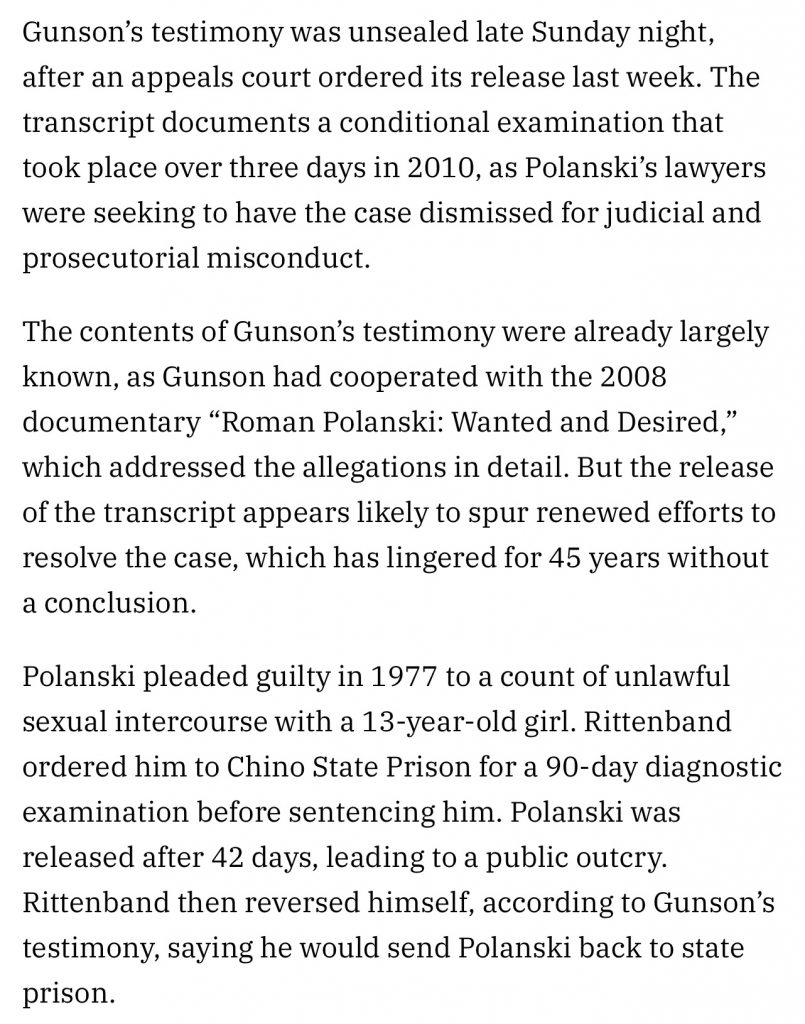
Variety’s Gene Maddaus has posted a 7.18.22 article that summarizes recently unsealed 2010 transcripts about the decades-simmering Roman Polanski case, and more particularly the critical views of retired prosecutor Roger Gunson.

The gist is that 12 years ago Gunson believed that Judge Lawrence Rittenbrand (now deceased) was a bad apple who had rashly reneged on a plea deal with Polanski’s attorneys.

Is there anything new in these transcripts? Not if you’ve seen Marina Zenovich’s Roman Polanski: Wanted and Desired (‘08) and her follow up doc, Roman Polanski: Odd Man Out (‘12). The whole Gunson critique and the Rittenbrand history is contained, explained and examined every which way.

Maddaus excerpt:

The long and the short is that the facts about Rittenbrand’s mishandling of this case have been available for well over a decade and damn near 15 years. It was mainly a matter of watching the first Zenovich doc; the second was dessert.

Corpses In The Cellar

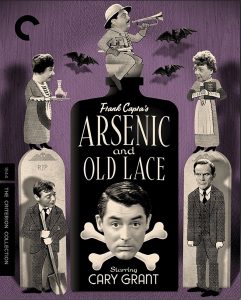
Frank Capra‘s Arsenic and Old Lace (’44), a broad macabre farce set in a Brooklyn rooming house, began as a hit Broadway play that opened in January 1941. (Here’s Brooks Atkinson’s N.Y. Times review.) Capra’s film shot sometime in late ’41 or early ’42, and was originally slated to open on 9.30.42. But the contract with the play’s producers stated that the film would not be released until the Broadway run ended. The play ran for for three and a half years (or until the summer of ’44), so the film wasn’t released until 9.1.44.

I first watched the Capra flick as a kid, and found it okay. I streamed a 480p version two or three years ago, and while I enjoyed Raymond Massey‘s performance (in the part created on the New York stage by Boris Karloff) and Peter Lorre‘s, I found it hyper and strenuous. It charges you up at first, but then it gradually wears you down. And how many thousands of times has the play been performed in high schools?

Criterion is releasing a “new 4K digital transfer” Bluray version on 10.11.22. It’ll look better than ever before, I’m sure, but would want to shell out $31 and change for a copy? Not I.

Funniest Action Sequence of 21st Century?

Chris Nolan wasn’t always a big-deal, big-budget, IMAX-fortified mythologist whose movies were invariably greeted as events. Once upon a time he was just a clever, regular-guy filmmaker. We’re talking about a five-year period when he made Following (’98), Memento (’00) and Insomnia (’02). That Nolan no longer exists, of course. He became CHRIS NOLAN in ’05 with Batman Begins and never looked back. But I miss the 29-year-old Memento guy…I really do.

Dry, Delicious, A Bit Chilly

Barbet Schroeder‘s Reversal of Fortune (’90) delivers one of my all-time favorite endings, which isn’t an “ending” as much ironic commentary about the mindset of a rich, very blase sociopath (Jeremy Irons‘ Claus von Bulow) and the difference between the “little people” and the Fifth Avenue elites who occasionally pop into this or that store. The scene happens between :50 and 1:25. HE comment: The checkout clerk had it coming because she was so unsubtle when she stared at the front page of the New York Post. She did it so blatantly that she forced Von Bulow to respond.

Straight Monkeypox Dope

Mainstream media reporters and editors are generally forbidden…okay, discouraged from filing the kind of straight-from-the-shoulder Monkeypox report that Donald McNeil, the highly respected chronicler of pandemics who reported for The New York Times for decades, has posted on Common Sense.

Excerpt #1: “At the moment, unless you are a gay man with multiple or anonymous sex partners, you are probably at not much risk.”

Excerpt #2: “There are two effective vaccines for this disease and one solid treatment, [so] why are we losing the fight? I blame shortages of vaccines and tests, the initial hesitancy by squeamish health agencies to openly discuss who was most at risk, and the refusal of organizers of lucrative gay sex parties to cancel them over the past few months, even as evidence mounted that they are super-spreader events.”