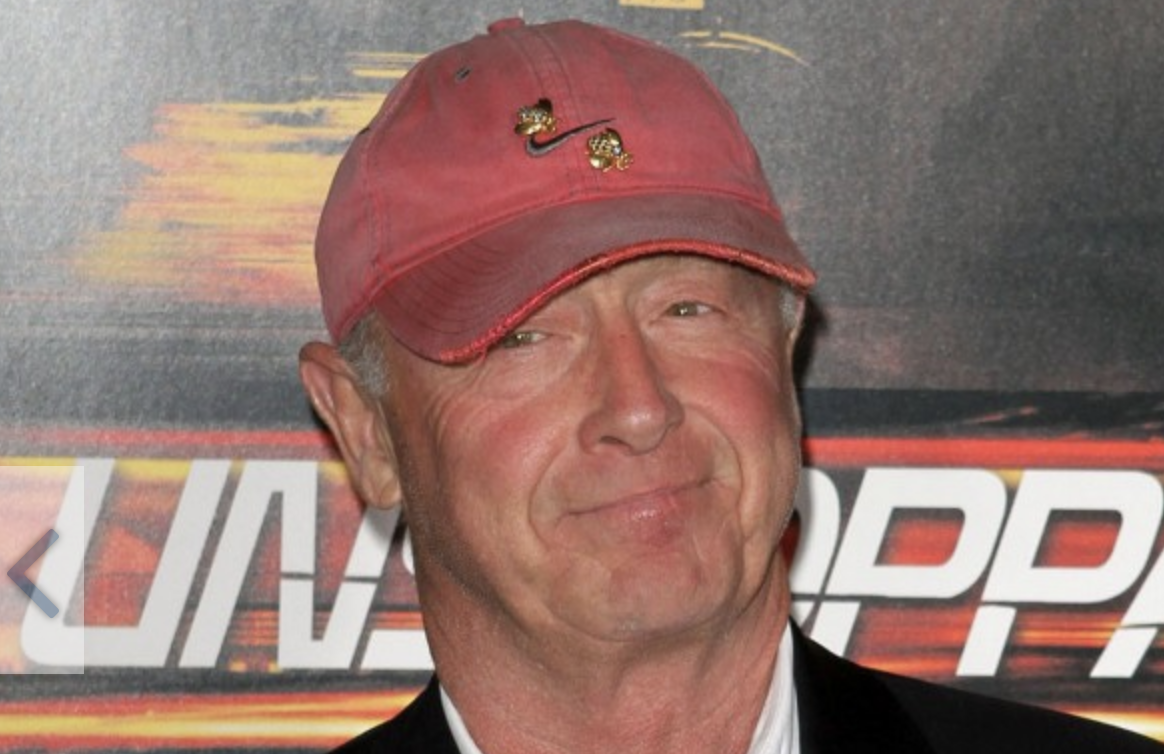
On 5.20 former Paramount and Disney production chief David Kirkpatrick posted a fascinating Facebook essay about working with fabled director Tony Scott (1944-2012) on Top Gun (’86).
“Original Top Gun helmer Tony Scott was to have directed Top Gun: Maverick. Tony had a signed contract with Paramount and was developing the screenplay. But ten years ago this August, Tony jumped off a San Pedro bridge to his death. I am not certain of the whys behind the suicide**, only that it is always a sad event when someone checks out early. It’s especially sad when it is someone as sunny, bull-headed, and easy-to-laugh as Tony. He silently battled cancer for 40 years but kept it quiet. There was no sign of it in the coroner’s report or any other underlying health issues. His brother, Ridley, called his suicide ‘inexplicable.’
“I first met Tony on the screen. He was a lad of 15 years. He starred in his older brother’s first experimental film. It was shot with a Bolex in Hartelpool England. The movie was called Boy & Bicycle — 45 minutes of Ridley Scott doing fancy camera moves while Tony rode around. It was not as powerful as Truffaut’s first film which also tackled the subject matter of bicycles, but it showed the daring and power of the film language that Ridley would later command in movies from Alien to Blade Runner to Gladiator.
“Tony had a sweet demeanor in that short movie. While he was 8 years older than I, I always treated him like a younger brother. What does that mean? I was kind but firm with him because he could be prone toward mischief and disobedience even while smiling and hugging you.
“In the flesh, I first met Tony in an interview with Ned Tanen, the head of the studio, at Ned’s house in [Santa Monica] on Channel Road. The meeting was to determine if Tony should direct Top Gun. During the high-tension meeting, Tony fell asleep. In mid-sentence. While explaining his vision in Ned’s favorite chair.
“35 Hollywood directors had turned down Top Gun. The producers, Don Simpson and Jerry Bruckheimer, were anxious to keep the project alive. But NO ONE wanted to get near it. Don and Jerry had a monster hit with Flashdance. BUT when first viewed, Flashdance was a hot mess. After the preview, the theatre was empty. The audience had walked out. It was that bad. Flashdance went through 35 arduous previews until it morphed into an audience-pleasing juggernaut success. Paramount was infamous for previewing until the movie was the best it could be.
“After the meeting with Scott, Tanen turned to me and said ‘well, what do you want to do?’
“Then came the most important prompt of my life. I learned so much through that prompt. Ned said, ‘Listen, I hate this fuckin’ project. I hate these fuckin’ looney-tune producers. Everyone in town hates the script. But I believe in you. If you want to make a fuckin’ movie with this Brit who falls asleep in the middle of a job interview, then be my fucking guest. You make the decision, right or wrong. And when this fucking movie comes out, you’re going to wear it, for better or worse. You get it? Do you understand me?’
“I took up the gauntlet. To be fair, Scott was jet-lagged. He had gotten off a plane from London and was rushed to Ned’s house for the meeting. I felt bad for my younger brother.
“That night, I booked a projection room on the Paramount lot, ordered some take-out, and watched Tony’s last movie, The Hunger, about lesbian vampires. It was beautiful to look at, and it was godawful. Commercial storytelling demands that a director put the energy of the narrative in the right place. It was a bunch of pretty images and nothing more.
“In The Hunger, Tony was so focused on closeups of high heels and red-painted mouths and endless fluttering curtains, I never had a clue where I was in the story. He never established the geography of the narrative. There were no masters. No exits and entrances of people into rooms. Where the heck were we?
“After a sleepless night, I asked to have breakfast with Tony and his manager, Bill Unger. I explained to Tony that we would hire him to direct Top Gun under two conditions: 1) adhere to the budget of $13.5 million and 2) in every scene, shoot a master up front as protection. ‘We have to know where we are, Tony. You are a brilliant shooter but we have to know where we are. If we are shooting a bar scene, we need to see the bar to establish the scene. That goes for every scene, whether it be an air hanger or a classroom. ‘I promise, mate,’ he said as he smiled and hugged me.
“I went back to Tanen and told him we had found our man. I explained why we were hiring him, what the simple strategy of obtaining master shots in each scene. I told Ned that I had gone over the financials and believed with some certainty, with Tom Cruise’s star power, we could reach at least break-even if the picture did $50 million in U.S. box office. With that box office, we should do at least 3 million units in home video.”
Tanen: ‘Listen to you,’ he laughed. ‘You’ll have my job in 3 years.’
“’I appreciate the responsibility and for your belief in me,’ I said. ‘No one has ever believed in me like that.’
“’Get outta here,’ he said but he was choked up. Three years later, I took over his job. He was tired of it. Ned helped me believe in myself. I never worked so effing hard to make Tony work as the director in all my life.