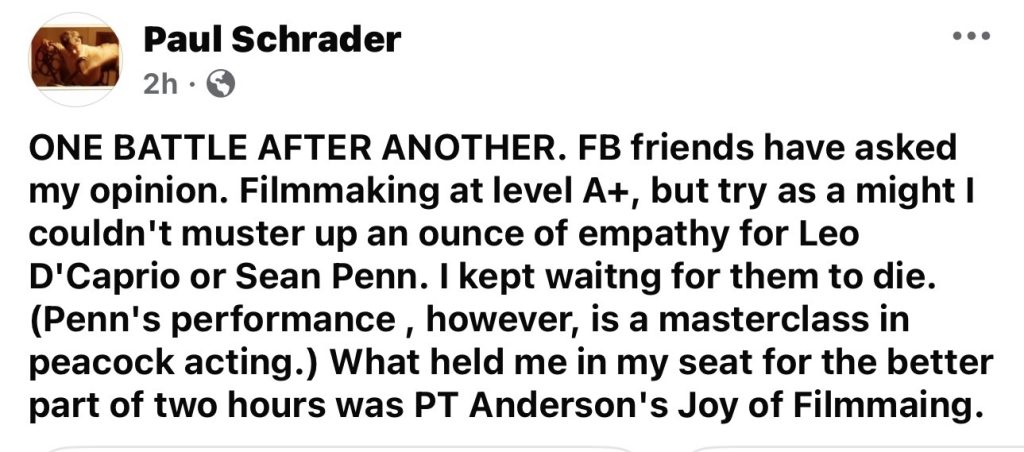
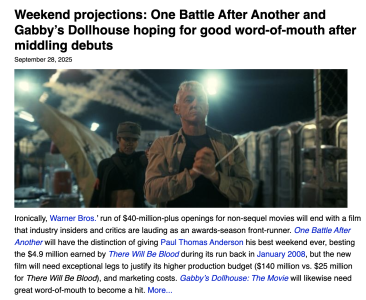
Somewhere during OneBattleAfterAnother’s second act, Leonardo DiCaprio’s Bob Ferguson is fleeing the bad guys at night as he runs and leaps over a series of urban rooftops. Then he falls from one, crashing into a drooping tree branch on his way down (a drop of roughly 15 feet) and landing flat on his chest.
There’s no way Leo’s stunt guy could’ve jumped and landed like that. Too dangerous. (A 15-foot fall recently killedafemaletrapezeartist in Germany.) I’m guessing he was speedily lowered on a wire, which was then digitally erased. But the fall happens so quickly and is sufficiently obscured by the dark that the trickery isn’t noticed. This is the kind of clever, blink-and-you’ll-miss-it stunt that I really admire.
“Peacock acting”! Name other examples of this over the decades? DanielDayLewis in GangsofNew York, etc.
This morning I happened to click on something at the bottom of a decade-old HE review, and lo and behold I was suddenly listening to an automated woman’s voice reading the review aloud, and sounding pretty cool at that.
In less than ten seconds I had decided that I had to install a TTS plug-in of some kind that would make it easy for the slowest, oldest, least adaptable HE readers out there to listen to my latest jottings while driving to work or whatever.
Every review or rant or riff that I’ve ever written will soon be available in spoken-word form. And I can chooseanyvoice…one with a Joni Mitchell-like twang, a cultured Meryl Streep or a blithely urbane Cary Grant, my own voice, one that sounds a bit like Lee Marvin (“My heart was lighter then”) or Edward R. Murrow….anything.
Posted in Venice on 8.28.25: Noah Baumbach‘s Jay Kelly (Netflix, 11.14) — a reflection-and-meditation piece about a 60ish movie star’s life (in some respects literally George Clooney’s, one gathers or infers, and doubly so during a tribute at the very end which presents a montage of Clooney’s films) — is actually prettygood, and it ends in a very affecting and bittersweet way.
It’s a summary of a rich guy and his famous life and what it’s all meant or seems to mean, and the final emotional residue in terms of friends, family, selfishness, distractions, blessings, highs and lows…really the whole magillah.
It’s generally fast and fleeting and briskly assembled, and is actually reminiscent, in some respects and as curious as this may sound, of Charles Dickens‘ “A Christmas Carol” (in particular the 1951 film version that Brian Desmond Hurst directed and which Alistair Sim brought to life), especially as the film is largely about Clooney’s Kelly absorbing a series of some uncomfortable and sometimes painful realizations about how his business associates, old friends and especially his two daughters really feel about him.
It’s not a masterwork — it doesn’t feel heavy or deep enough, and seems a bit facile at times — and it’s certainly not on the corrupted-adult level of Tony Gilroy‘s Michael Clayton, in which Clooney gave his finest performance.
But Clooney plays it openly and with vulnerability — he knows this line of country like the back of his hand — and the film itself conveys, persuades, penetrates. It sells its own movie-star, “this is the life he’s chosen” narrative.
At times Jay Kelly feels a bit old-fashioned — very “scripted”, very “acted” and a little schmaltzy here and there, and the visual flashback transitions are almost on the level of The Man Who Shot Liberty Valance (’62).
But it finally feels whole and melancholy and solemnly considered, especially at the very end. It’s expansive and exploratory and fully felt, and is very well acted by not just Clooney but by Adam Sandler (as Jay’s manager), Laura Dern (publicist), Billy Crudup (former acting buddy), Riley Keough (daughter #1), Grace Edwards (daughter #2) and Stacy Keach (roguishly “charming” dad on the downswing).
Jay Kelly is a show and a “movie” but it works according to its own delivery terms, and is certainly better than I thought it would be, and the final line absolutely kills — it even brought a tear to my eye.
It’s therefore a solid A-minus or a B-plus, and Clooney and Sandler really touch bottom, bring the goods.
Quibble #1: Everyone in Kelly’s inner circle has pretty much written him off emotionally. They regard him as flaky, immature, undependable, self-absorbed. But that’s what many big-time actors are for the most part, no? Doesn’t everyone accept this? Many and probably most famous actors are in love with themselves first, and their family and friends second. Big deal. Roll with it.
Quibble #2: Crudup plays a 50ish might-have-been actor who resents and is actually enraged at Kelly for having stolen a key part that Crudup had auditioned for and badly wanted at the time, but the annals of film acting are filled with stories about a friend who was just tagging along who wound up getting the role from an impromptu audition instead of the primary guy. Just because Crudup was extra-hungry for the role in question doesn’t mean he was entitled to it, or that he was right for it. Mature people understand that life can be unfair.
Quibble #3: Nobody would ever refer to a big film tribute event taking place in “Tuscany”…they would say Siena or Florence or Volterra or Radda in Chianti. Just like no one would talk about a similar-type event in the States happening in the “Deep South” or the “Pacific Northwest.”
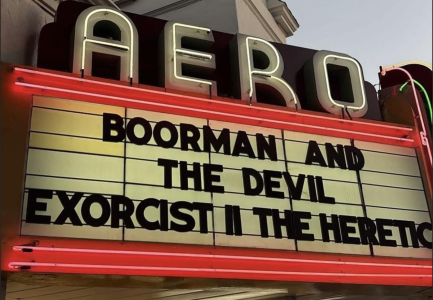
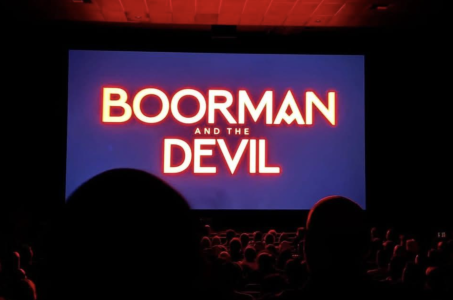
HE had a light dinner with a couple of super-smart movie guys on Saturday evening, and we wound up sending an awful lot of directors to the guillotine, I’m afraid. Michel Franco, John Boorman, William Friedkin and three or four others escaped the blade, but Guillermo del Toro, Park Chan-Wook, Ryan Coogler…many, many directors rode in the proverbial horse-drawn cart to the Place de Concorde and felt the kiss of steel.
A voice of perception: “One Battle After Another is Paul Thomas Anderson‘s love letter to his daughter…the current between Leonardo DiCaprio and Chase Infiniti is the most affecting thing about it.”
Overheard: “It’s largely about Christian nationalism today, and that force — not simply in the movie, but within the Trump regime — is on a primal level about race, and there’s really no point in denying that the hugely influential and representative Charlie Kirk was a straight-up KKK-level racist. He was quite open about it.”
Ditto: “Critics aren’t allowed to say that the political undercurrent of OBAA is primarily powered by the ardor of enflamed black females…it’s set in a 21st Century world of militant political rebellion that has no room for or interest in ’70s memories of the mostly white SLA cadres (Nancy Ling Perry, Emily Harris, Patricia Hearst, et al.) or radical outlaws like Bernadine Dohrn, Kathy Boudin, Diana Oughton or Cathy Wilkerson. Okay, Alana Haim is a junior member of the team but otherwise the French 75-ers and the Beaver nuns are all sisters of Angela Davis and Kathleen Cleaver.
“Without militant black women OBAA wouldn’t have much wood in the fire. Leo’s character is no Mark Rudd or Fred Hampton…he’s basically an insecure dork or a schlumpy sloucher, and certainly a tag-along. Sean Penn’s Lockjaw is primarily defined by his perverse animal-boner attraction to Teyana Taylor‘s Perfidia Beverly Hills.”
…but the current idea is to re-build or otherwise streamline Hollywood Elsewhere based on a WordPress theme called Voice. Except Voice has proved to be a bit fickle and tweaky. I seem to recall someone stating a while back that there’s another theme that’s closer to the classic HE appearance (particularly regarding the copy and headline fonts), and that it might be called “Hollywood” something-or-other. Just asking.
A well-educated friend mentioned the other day that within certain professional circles LSD is available as a spray…a misting spray that one can squeeze into the mouth or perhaps even the nostrils. She said it was “legal” in certain European countries, although Google disputes this.
When I contemplate the phrase “deep inside your mind and soul” I tend to think of thoughts, feelings and fleeting insights that are rooted in (a) the life experience and (b) the biological constitution of one Jeffrey Wells….all rolled up into one softball-sized wad of soft clay.
But to me the ultimate transportation enabled by LSD — satori, enlightenment, Godhead consciousness — is not about the personal but…put it any way you prefer but I’m calling it the universal, cosmic, eternal realms of forever.
It’s about transcending the psychological and sailing into the mystic. The chains fall away, and you become one with the sky and the stars.
It’s not about discovery as much as submission and acceptance. Not about “break on through to the other side” (Doors, Huxley) as much as “slip your piece under the towel, slip the key into the lock and just open the door and click…walk on through.” The general presumption is that the seeker needs to somehow “think” himself or herself way into the Godstream…nope. It’s more about just kicking back and letting it in.
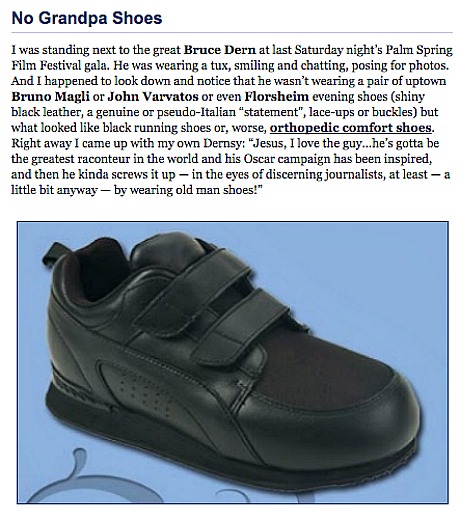
Rob Reiner was holding his own with Bill Maher and sounding reasonably sane and sensible, and then a wide shot revealed that Reiner was wearing a pair of men’s black Merrell slip-ons and suddenly I lost interest. Because I just can’t with the Merrells.
I was derided for saying this, of course, but you can’t explain this aesthetic to deplorable-shoe types. Either you get the importance of wearing elegant shoes in public or you don’t. Wear your grandpa shoes all you want when you’re at home or shuffling around the mall, but never in front of the paying public.
I’m mentioning this again because a certain famous guy was recently photographed in a pair of black senior-citizen sneakers during a post-screening q & a. People in the audience listened to him discuss this and that, I’m sure, but they also had a good 30 to 40 minutes to just sit there and contemplate those ugly-ass shoes. Those people will never forget this.
My original point was that all self-respecting actors, celebrities and X-factor types need to tough it out and wear cool Italian shoes for lah-lah events, no matter what.
I’ve walked around the streets of Rome, Milan, Venice, Sienna and Florence on warm evenings, and white-haired Italian guys never, ever wear comfort shoes. They would rather be stricken with a heart attack and collapse on the street than wear those clunky things. When you’re hanging with the swells you have to look classy and elegant, even if it hurts. Even if it shortens your life.
You can laugh but a man’s choice of footwear usually says a lot about him, particularly about how he sees himself. Once the public realizes that you’re more into comfort clunkers than looking good, it’s the beginning of the end.
All my life I’ve been describing Marlon Brando‘s Tetiaroa as a sprawling horseshoe-shaped atoll, but the the Brando resort is confined to just one of the smaller islands — Onetahi. The hotel, the bungalows, the airstrip…all of it. The bungalows rent for $3500 a night, or so I’ve read.
“As the United States gets pushed, day by day, closer and closer to autocracy, that’s a situation that ought to be setting everyone in the country on edge. Yet it’s part of the nature of autocracy to narcotize people into numbness, delusion, fear, and a kind of self-perpetuating apathy. And that’s what seems to be happening in America right now. Gavin Newsom shouldn’t be the only one saying that we’re in danger of not having real elections in 2028; tons of people (leaders, citizens, journalists) should be saying it. But too many of us are caught in a zone halfway between resistance and despair, and that’s the mood that One Battle After Another taps into.”
“Paul Thomas Anderson did himself no favors when he shot a scene in which Leonardo DiCaprio‘s character is shown watching The Battle of Algiers, possibly the greatest political film ever made.
“The contrast between Gillo Pontecorvo‘s brilliantly realistic and nuanced masterpiece and PTA’s slick but essentially meaningless satire could not be more extreme. One has something meaningful to say about revolutionary violence, colonialism and their effects. The other is basically a caper film with aspirations to say something about our present-day political crisis, but fails to do so.
“Benicio del Toro‘s ‘Sensei’ character is the only character who’s actually doing something of benefit, given his work with the undocumented. Just about everyone else is portrayed as a foul-mouthed, charged-rhetoric revolutionary or, in the case of Sean Penn, a rigidly violent and racist nut job. Well, that’s not true — Chase Infiniti‘s Willa Ferguson is untainted by insurrectionist fervor, and is fairly compelling on her otwn terms.
“I didn’t hate One Battle After Another — it’s too well made for that. But it’s been wildly over-rated.”
In his 9.28 Anemonereview, Variety‘s Owen Gleiberman reveals that Daniel Day Lewis‘s Ray, a morose, white-haired hermit and a victim of priestly molestation when young, recalls an act of gross revenge — i.e., shitting on the face of the priest who diddled him.
Gleiberman: “Ray describes an encounter with the priest in which he pretended to come on to him, then had the priest lay down, face up, on the floor. Earlier that day, Ray had imbibed a special regimen of food and Guinness that would leave his bowels in a very active state; by the time he saw the priest, they were rumbling with need. And that’s when he took down his trousers, crouched over the priest’s face, and…let loose.”
“Trust me, I’m describing this far more abstractly than Ray does, and Day-Lewis, his face rippled with a grin of malice, digs with hideous relish into the scatological description of what went down.”
In Hal Ashby‘s The Last Detail, Otis Young‘s “Mulhall”, after hearing a seemingly incredulous statement of fact, says to Clifton James, “You’re shittin’ me.”
James to Young (deadpan): “I wouldn’t shit you. You’re my favorite turd.”