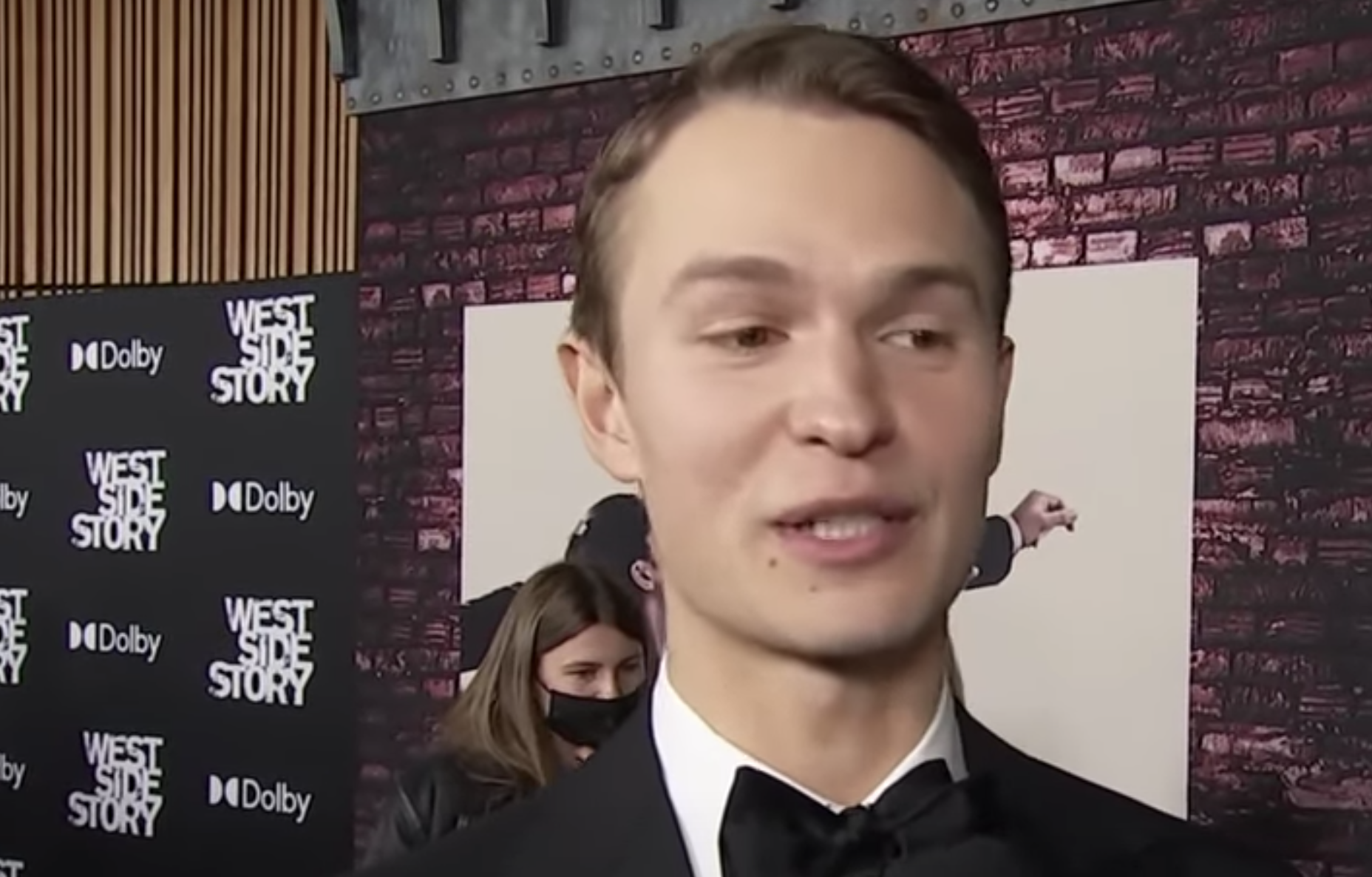
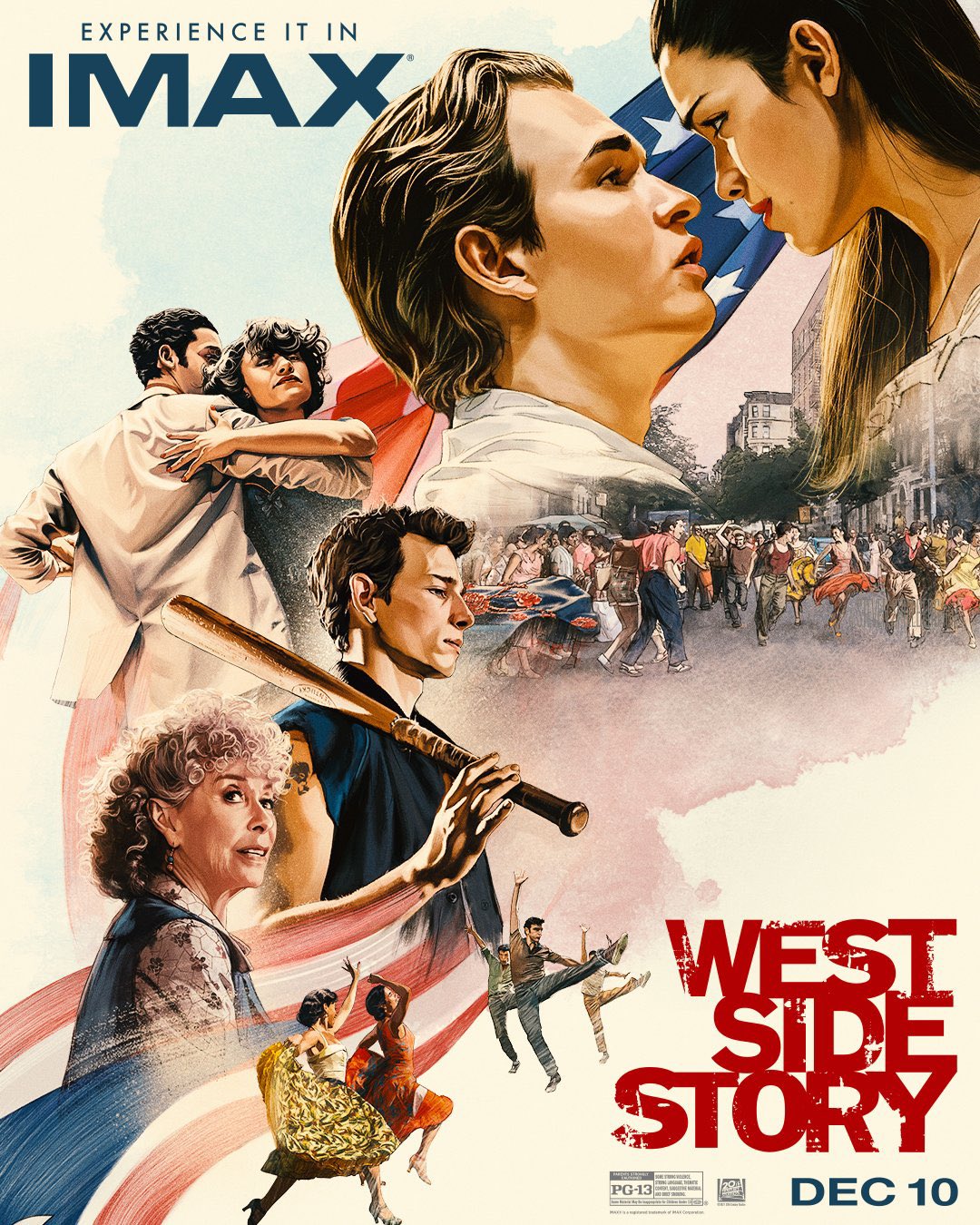
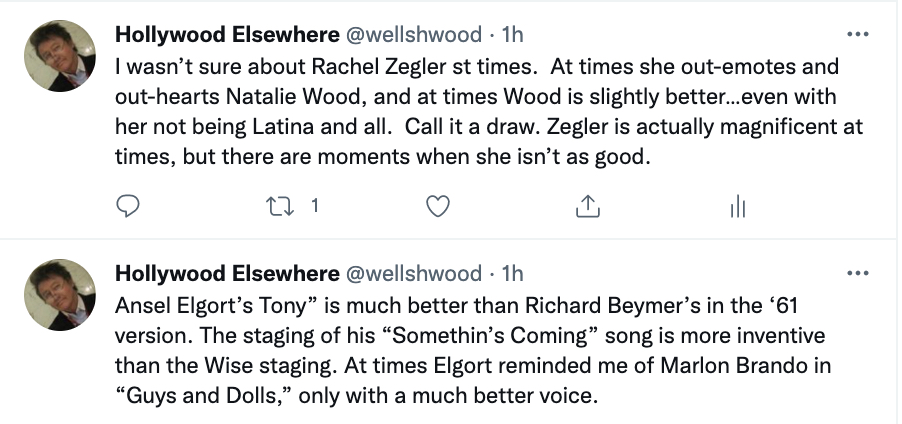
At last night’s West Side Story premiere at Lincoln Center, costar Ansel Elgort (who is quite confident and kind of Brando-ish as Tony — don’t listen to the haters) was, no offense, wearing the wrong haircut. With his traditional black tux and tall, slender frame, Elgort needed to look less like Jared Kushner and more like a slightly scruffy street shuffler of some kind….more like a daydreamer who sometimes forgets to visit the barber shop. A family-of-Trump vibe isn’t the right thing to rock in this particular climate.
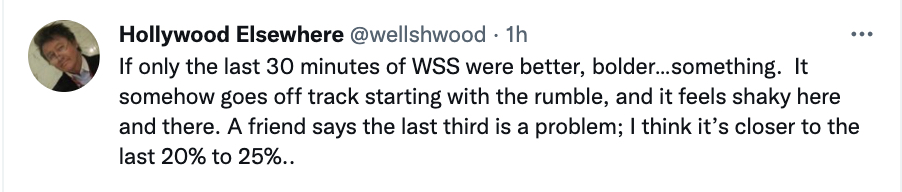
…was more of a 75% vs. 25% split reaction, but it was tweeted last night in earnest. The gladhanders who love almost everything have their place and function, but their raves about Steven Spielberg‘s just-premiered, sure-to-be-Oscar-nominated urban musical don’t mean much. At the risk of sounding puffed up, Rod Lurie is right — a single, emotional, very respectful thumbs-up from someone like myself (there are others who share my mixed view of Spielberg’s career arc) is worth 15 or 20 jump-up-and-down raves from a community of junket prostitutes. It means something in the same way that an HE pan of a boilerplate Marvel or D.C. film is meaningless.
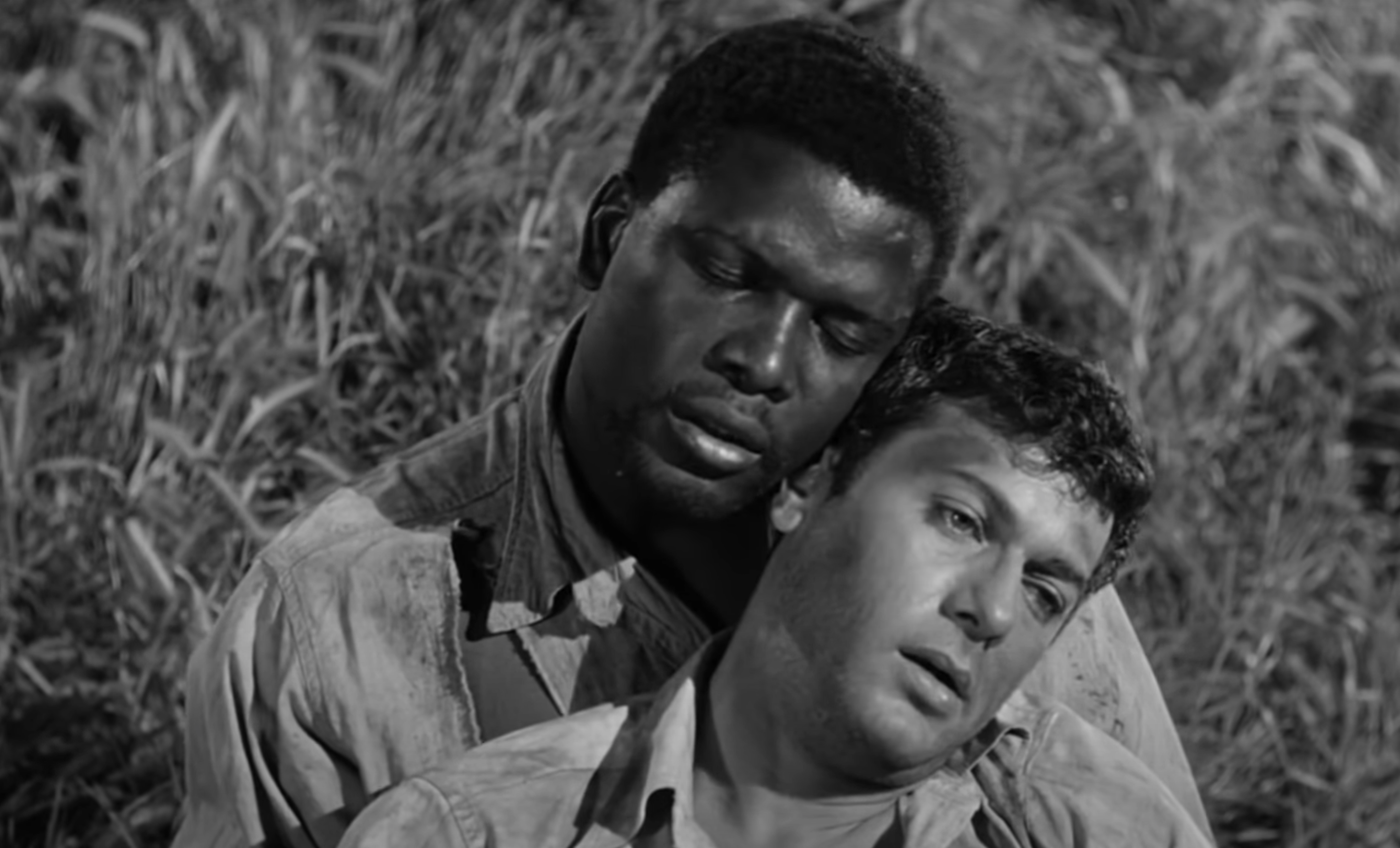
21 years ago I sat down with Tony Curtis at the Beverly Glen shopping center, just south of Mulholland Drive. I waved to him above the heads of several customers sitting outside a popular, packed delicatessen. Curtis waved me over and led me to the inside of a less-crowded Starbucks — fewer people, fewer stares.
When he ordered coffee for both of us, the woman at the counter insisted on a freebie. “Really?” he said to her. “Well, thank you so much!”
We talked about everything — politics, drug-dependency (Curtis had difficulties in this area during the ’80s), Burt Lancaster, old Hollywood, his website (tonycurtis.com, a venue for selling his paintings), women, new technologies, etc.
At midpoint I handed Curtis a list of his 120 films and asked him to check those he’s genuinely proud of. He checked a total of 18. He checked Sweet Smell of Success (naturally) but not The Vikings. Some Like It Hot (of course!) but not The Outsider. He checked Houdini. Every film he made after Spartacus in 1960 up until 1968’s The Boston Strangler, he didn’t check. He checked his role as a pair of mafiosos — Louis ‘Lepke’ Buchalter in 1975’s Lepke and Sam Giancana in the 1986 TV movie Mafia Princess.
Among his notable TV guest appearances, Curtis checked only one — the voice role of ‘Stony Curtis’ in a 1965 episode of The Flintstones.
Dwayne’s answer would have to be “well, if you’re asking me that in the same way you asked Tony Curtis the same question, my answer would have to be zip. Because I’m not genuinely proud of any of my films. I’m glad a lot of them were popular and made money, and I’m certainly glad that I’ve become a hugely successful brand and all. But I’m not a Tony Curtis-level actor, and I never will be.”
Imagine my sitting down with Chris Pratt under similar circumstances. Imagine my handing him a list of the 14 or 15 films he’s starred or played a strong co-lead in over the last, say, 10 years, and asking him to check those he’s genuinely “proud of”.
Pratt’s answer would have to be “well, if you’re asking me that in the same spirit that you asked Tony Curtis and Dwayne Johnson, my answer would have to be that among the films I’ve starred in, I am genuinely proud of nothing. I’m ‘proud’ a lot of my films made money, and I’m certainly glad that I’ve become a hugely successful, bulky-bod, conservative-minded actor with big money and big homes.
“I’m genuinely proud of three films that I played a supporting role in between 2011 and 2013 — Bennett Miller‘s Moneyball, Kathy Bigelow‘s Zero Dark Thirty and Spike Jonze‘s Her — but that’s another subject. The bottom line is that as a movie star I make commercial fast-food movies and that’s all. If I’m the star, you know it’s going to be a throw-away, more or less. You know it, I know it. I’m really sorry I did Passengers, which everyone hated, but the money was good so I took it and ran like a thief.
I’ve just asked a few of these pitchforkers to please post factual evidence that proves Elgort, co-lead of West Side Story, is in fact a predator, a sexual assaulter and/or a pedophile. Because my understanding (and please forgive if there’s something substantial that I’ve missed) is that Elgort isn’t guilty of a damn thing except for having possibly behaved brusquely (i.e., insensitively, heartlessly) with this or that lass.
Consideration #1: The “Gabby” episode — the one that happened in 2014 and blew up on Twitter for three or four days in late June 2020 — is nothing, or at least nothing indictable.
Consideration #2: I don’t think flirtatious texts between a 20something Elgort and this or that teenaged girl are proof of anything.
Ansel and “Gabby’s” relationship happened in New York State in late 2014, when she was old enough (17) to consent. Elgort turned 20 on 3.14.14. He and Gabby were sexual and then Elgort hurt her feelings by ignoring her messages in some kind of passive-aggressive way. That’s all it was. It was nothing. Relationships will occasionally leave bruises. I know what it feels like to be casually dumped or abruptly ignored by a lover, but it happens. Tough shit, life in the big city, etc.
Portions of Steven Spielberg‘s West Side Story (20th Century, 12.9) had me in tears. Dude tears, of course — the eyes well up but you don’t go all the way and start sniffling with Kleenex. I’ve been listening to that original 1957 Broadway stage show album all my life, and earlier tonight it all came back and started flooding through me. I tried to tweet my reactions as best I could on the Metro North train back to Wilton. The final 25 or so minutes don’t work as well as they should, but I forgave the film anyway.
I can’t just roam around town on a whim. Because every waking minute I’m on the hunt for power outlets. Because I don’t feel secure unless my iPhone 12, both external batteries and the Macbook Air are fully charged. And finding outlets is a very difficult thing, or so it seemed today along Broadway on the Upper West Side (90s, 80s, 70s). Starbucks cafes used to be my default power-outlet lifeline ten years ago, but it’s literally been years since I’ve visited one in which the outlets weren’t totally covered over. (I get it — they don’t want wifi bums sitting there all day long.) A half hour ago I poked my head into a Starbucks at B’way and 75th…eureka! Six or seven outlets! Happy, blissful…the world isn’t as cold and indifferent as it seemed.
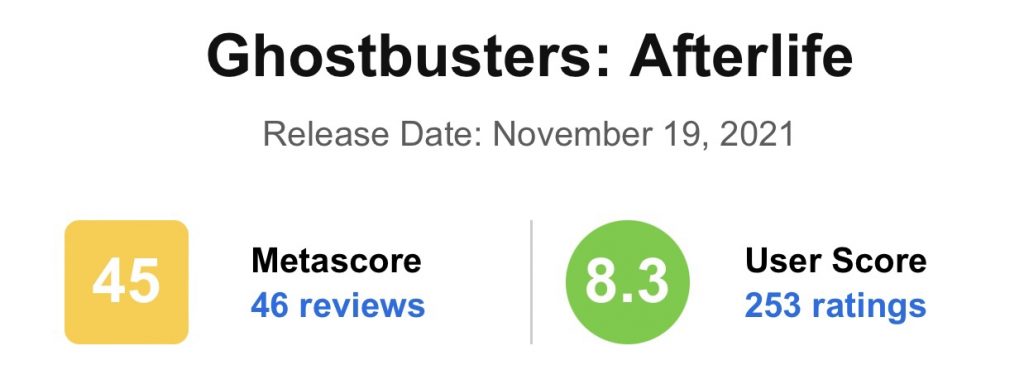
Most critics despise Ghostbusters: Afterlife; Joe and Jane Popcorn are apparently okay with it, or at least not hating it that much. Having loathed Ivan Reitman original Ghostbusters (‘84) as well as Paul Feig’s feminized 2016 reboot, I decided early on I wouldn’t be seeing Jason Reitman’s years-later, Paul Rudd-starring rehash. So I’m asking — why is this alleged piece of shit an apparent hit?
“Revulsion and Contempt,” posted on 7.25.01: “Annette is a misanthropic rock opera about rabid egotism, demonic personality disorder, black soul syndrome, rage, alcoholism, murder, self-loathing, self-destruction.
“Only the most perverse, anti-populist critics will even flirt with being kind to, much less praising, Annette when it opens stateside. Once you get past the strikingly surreal visual style and the fact that it was, like, made at all, there is only the self-loathing rage of Adam Driver’s Henry McHenry character, a stand-up comedian, and [director] Leos Carax’s seething disdain for easily led-along audiences.
“Annette is ‘brave’ and wildly out there, but this is arguably the most morally repellent musical ever made in motion picture history. Driver’s Henry, an envelope-pushing comedian who performs one-man shows that aren’t in the least bit amusing, is astounding — one of the most flagrantlyrevoltingprotagonists I’ve ever spent time with in my moviegoing life.”
A forthcoming limited series about the making of Bernardo Bertolucci‘s Last Tango in Paris is in the works from CBS Studios and Greg Silverman’s Stampede Ventures. Variety‘s Naman Ramachandranreports that the series, written by Jeremy Miller and Daniel Cohn, will span the 18 months before, during and after the production of Tango, and will be told through the lens of those at the center of the events — stars Maria Schneider, Marlon Brando and Bertolucci.”
Ramachandran gets it dead wrong, however, by stating that Bertolucci “admitted” that the film’s infamous anal rape scene film “was not consensual” as far as Schneider was concerned. I repeat — DEAD WRONG. Bertolucci never said that the scene itself (which was scripted) was non-consensual — the only surprise or non-consensual aspect was the use of butter as a lubricant.
In a 12.3.16 Variety piece by Seth Kelley, Bertolucci said that “I had been, in a way, horrible to Maria because I didn’t tell her what was going on” — i.e., by not telling her about the butter. And yet, the late director added, he didn’t regret shooting the scene. “I didn’t want Maria to act her humiliation, her rage. I wanted Maria to feel, not to act, the rage and humiliation. Then she hated me for her whole life.”
“I would like, for the last time, to clear up a ridiculous misunderstanding that continues to generate press reports about Last Tango in Paris around the world,” Bertolucci stated. “[Three] years ago at the Cinematheque Francaise someone asked me for details on the famous butter scene. I specified, but perhaps I was not clear, that I decided with Marlon Brando not to inform Maria that we would [use] butter. We wanted her spontaneous reaction to that improper use [of the butter]. That is where the misunderstanding lies.
“Somebody thought, and thinks, that Maria had not been informed about the violence on her. That is false!”
Bertolucci explained that “Maria knew everything because she had read the script, where it was all described. The only novelty was the idea of the butter.”
The sexual penetration of Schneider by Brando was simulated, of course.
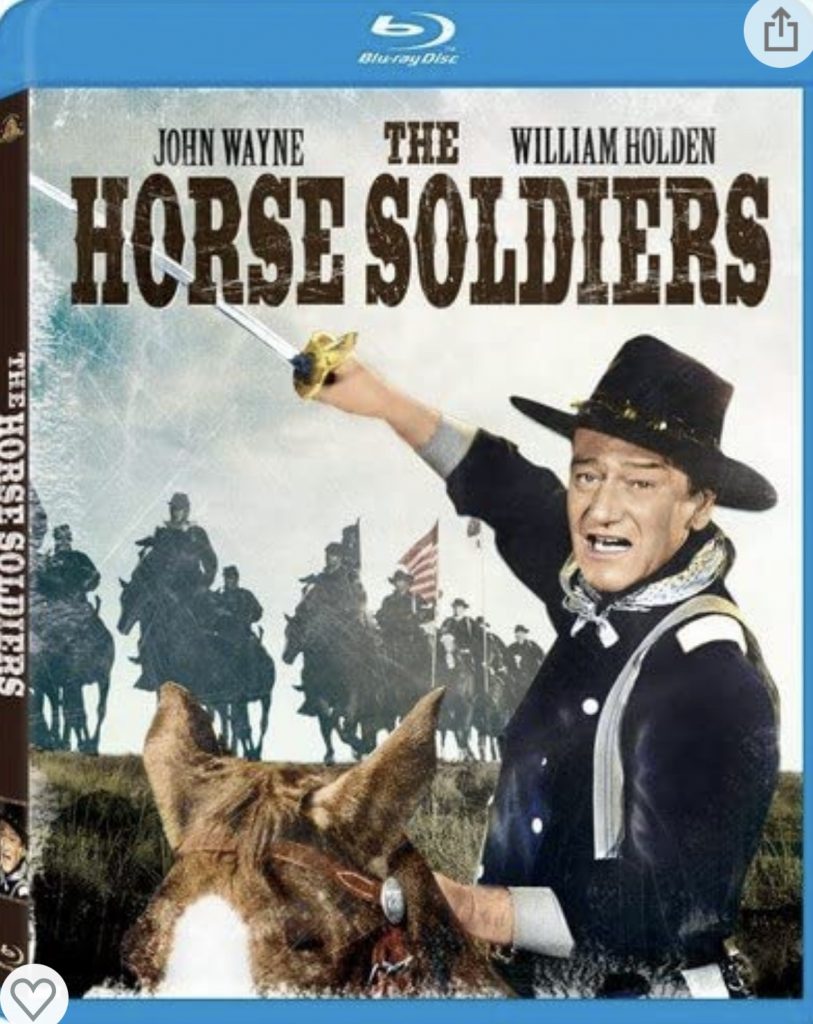
Hollywood Elsewhere is perfectly satisfied with a 2011 MGM Bluray of John Ford’s TheHorseSoldiers — good color, exceptional detail, 1.66:1 aspect ratio — so I’m not sharing any particular excitement over Kino Lorber’sforthcoming4Kversion, which will emerge early next year.
Ford scholar Joseph McBride, who recently recorded a commentary track for the KL disc, has posted the following on Facebook:
“This Civil War film is an example of what a great director can and can’t do with a weak script. The film has sublime imagery by Ford and cinematographer WilliamH. Clothier and many moving vignettes but is burdened with plot contrivances and other story and production problems. “
[HEinterjection: The film is not burdened with a “weak script” — it’s fine. Punctuated by several memorable sequences (futile Confederate attack on Newton Station, Union soldiers retreating when attacked by boys from a local military school) and fortified with fine performances top to bottom.]
“Ford was devastated at the end of location shooting and lost much of his already tenuous interest in the film when a beloved member of his Stock Company, stuntman Fred Kennedy, died doing what should have been a routine horse fall.
“I interviewed people involved in the filming, including a witness to that event, while researching my biography SEARCHING FOR JOHN FORD and did additional research for this commentary on one of the director’s somber late works, an especially grim look at that war. It’s always a privilege to be asked by Kino Lorber to comment on films by my favorite director.”
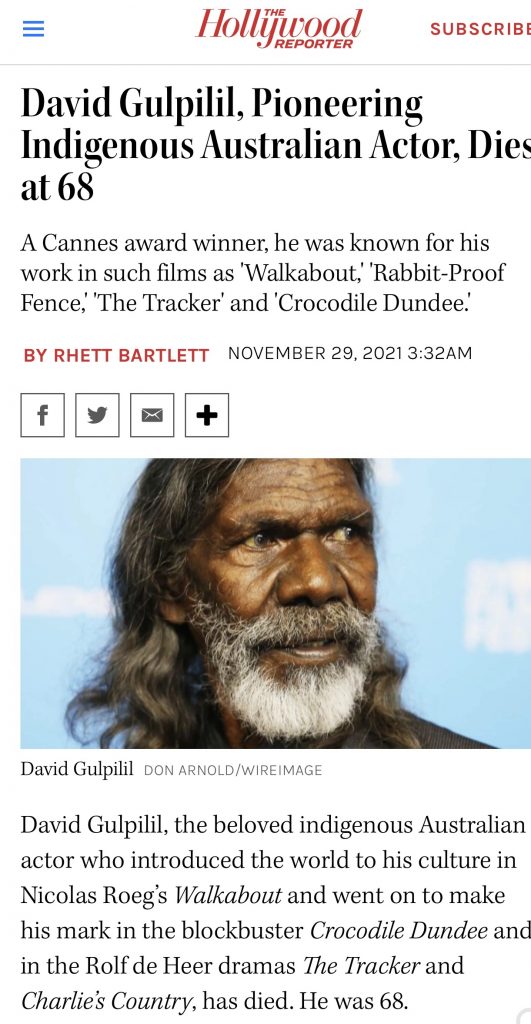
Hollywood Elsewhere joins the mourners of legendary Australian (Aboriginal) actor and dancer David Guilpil, who has passed from lung cancer at age 68.
A symbol of indigenous pride and a man of great meditative silence, Guilpil’s best-known or most striking performances were captured in Nicolas Roeg’s Walkabout, Peter Weir’s The Last Wave, CrocodileDundee (original + sequel), Philip Noyce’s RabbitProof Fence and TenCanoes (‘06).
Noyce: “For tens of millions the world over, David was the living embodiment of Australia’s 100,000 year First Nation culture. He taught us all so much.”
Posted on 7.9.08: HE commenter Burmashave: “Anybody ever think about James Dean playing Jesus if he’d lived, and how fucking crazy that would have been?”
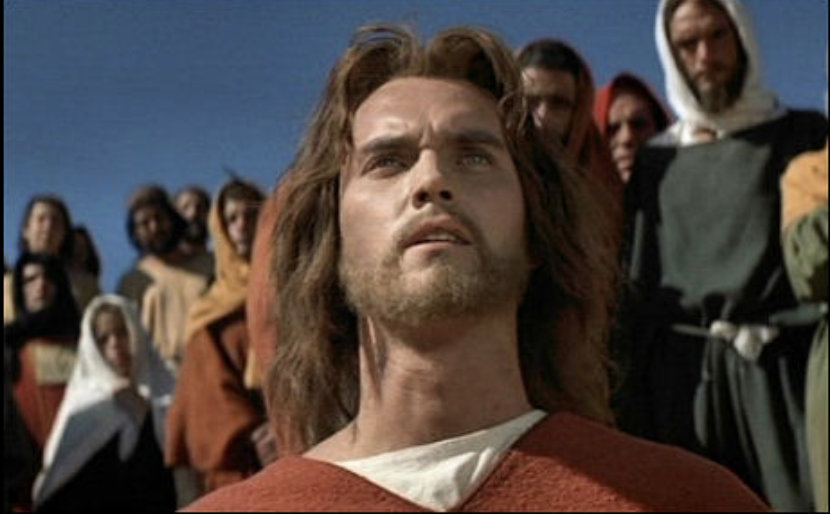
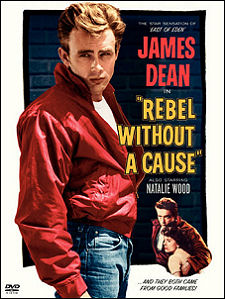
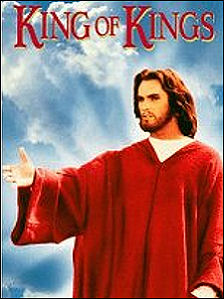
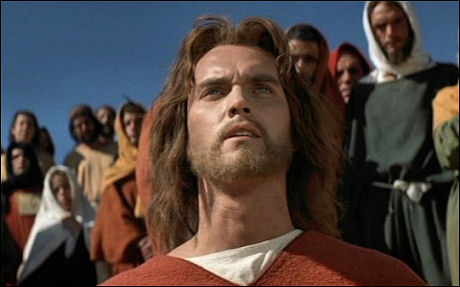
There’s a distinct similarity factor between Rebel Without a Cause‘s James Dean and King of Kings‘ Jeffrey Hunter. Both films were directed by Nicholas Ray, of course, so in a sartorial fashion Ray did sorta kinda cast Dean in his Bible movie. He did this by having Hunter wear a facsimile of the iconic red jacket and white T-shirt get-up that Dean wore in Rebel.
Variety critic Todd McCarthy reminded me this morning, in fact, that “Ray dressed Hunter in a robe of exactly the same shade of red as Dean’s Rebel jacket.”
The idea of Christ wearing a red robe had already been established in The Robe and Demetrius and the Gladiators, but think for a moment about the ludicrousness of a dirt-poor Jesus of Nazareth wearing a red cloak with a perfect white T-shirt garment underneath. It’s as if they had Gap and Banana Republic shops in old Jerusalem, and Jesus and his disciples occasionally shopped there.
What if J.C. had hired a fashion consultant? “As you know, Nazarene, plain red works fine on every occasion, but — stop me if I’m overstepping — you need to present an extra stylistic distinction, something that says ‘this guy is special’ and not just some, whatever, shepherd or olive farmer or whatever, if you follow my drift. That’s why a white undergarment is such a good idea. And it comes with white briefs in case, perish the thought, you’re ever crucified, because the Roman guards will let you keep the briefs on. Or at least, they have with my other customers.”
“Everything you say about King of Kings is right,” McCarthy wrote about my 7.8 posting, “but to me the most compelling aspect of the film it how political it is. The first whole section of the picture details the political situation in Judea at the time with almost documentary-like attention, and the script’s great and provocative gesture is to present Jesus and Harry Guardino‘s Barabbas as parallel revolutionaries — Jesus of a religious stripe and Barabbas as a political outlaw, which makes the ending ironic.
“In defining the major Jesus films of the ’60s-70s period, it’s fair to say that Stevens’ The Greatest Story Ever Told is the Protestant version, Zeffirelli’s Jesus of Nazareth is the Catholic version, Pasolini’s The Gospel According to St. Matthew is the Marxist version and King of Kings is the Zionist version.
“Of course Hunter is physically far too fair (and note the shaved armpits at the crucifixion), but he still manages to achieve a poignant purity as things move along. The score is one of Rozsa’s very greatest and crucial to covering over various narrative lurches and shortcomings. And, by the way, there are no known 70mm prints, so you can’t blame the Cinematheque for not delivering one.””