
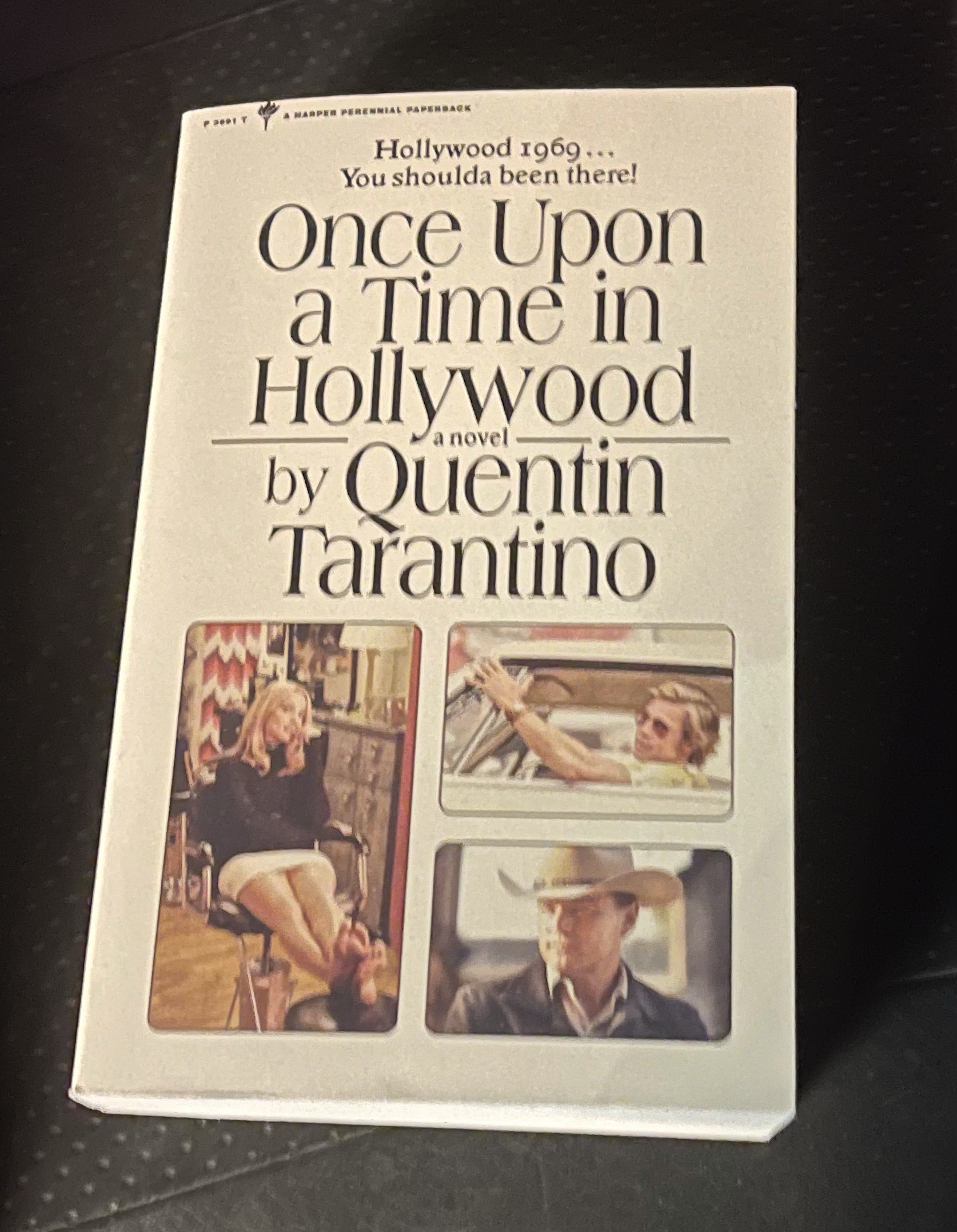
Copies at Amoeba (I’m told, didn’t get there). Book Soup was closed; sold out at Barnes & Noble at The Grove. The NewBev was my last resort…success!
From Dwight Garner’s 6.28 N.Y. Times review:

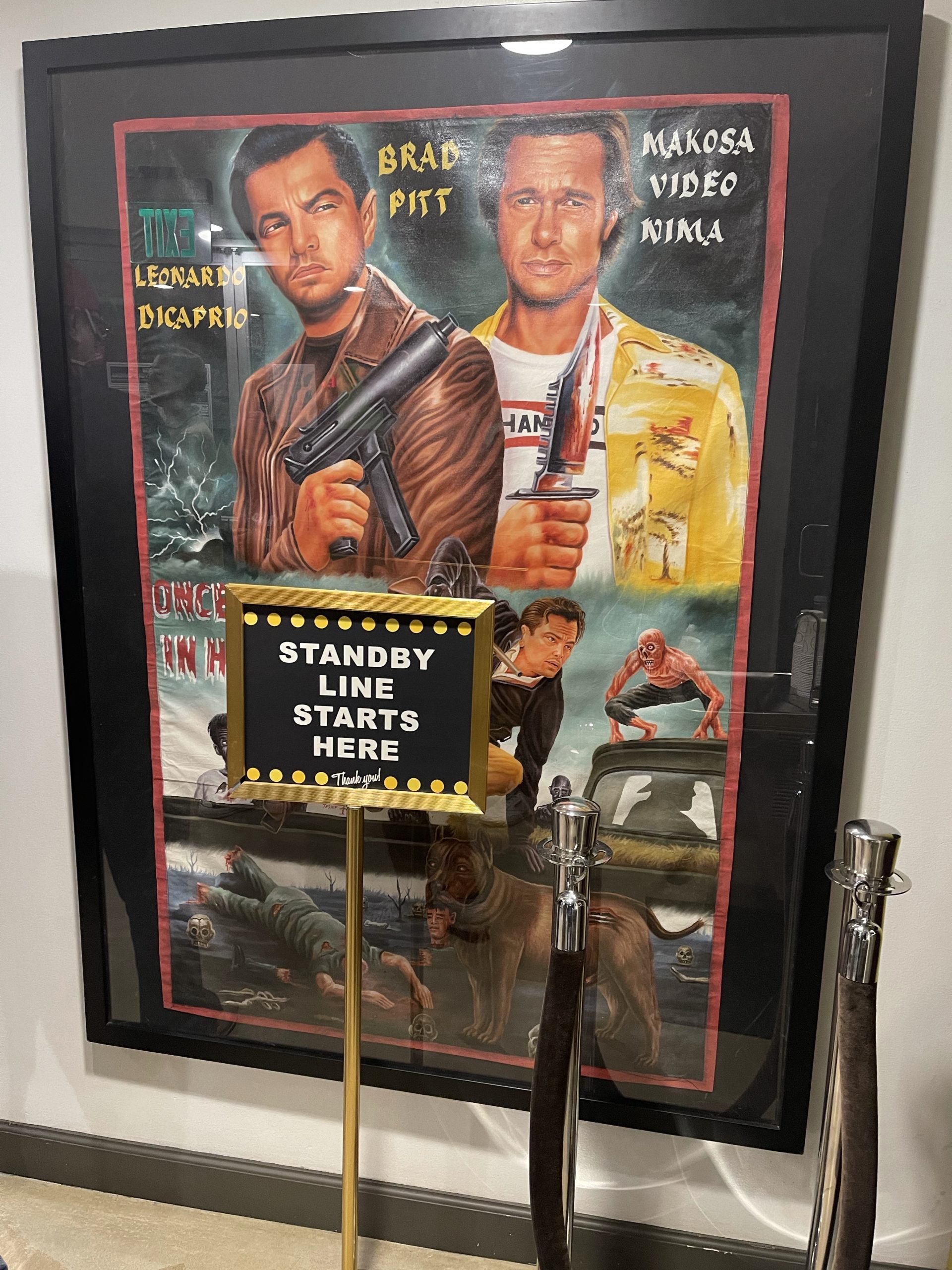

Copies at Amoeba (I’m told, didn’t get there). Book Soup was closed; sold out at Barnes & Noble at The Grove. The NewBev was my last resort…success!
From Dwight Garner’s 6.28 N.Y. Times review:
Seven or eight days ago I mentioned that World of Reel‘s Jordan Ruimy was polling critics on the five best films of 2021. My top five, submitted to Ruimy later that day, were Thomas Anders Jensen’s Riders of Justice, Jasmila Zbanić‘s Quo Vadis, Aida?, Simon Stone‘s The Dig, Phillip Noyce‘s Above Suspicion, and Jon Chu and Lin-Manuel Miranda‘s In The Heights.
I waffled later that night and deleted In The Heights in favor of Michel Franco‘s New Order.
I had a testy conversation with God that night. It was actually more of a threat than a debate. “All I can say is that Ruimy’s critics had better not vote In The Heights into the top slot,” I warned. “That wouldn’t be fair or right. It would be, in fact, hugely depressing, as it would be seen as a sympathetic bro hug from critics who’d approved of Chu and Miranda’s film only to see it dramatically underperform at the box-office and also disappoint as an HBO Max streamer.”
Yesterday Ruimy published the results of his poll, based on the preferences of more than 100 critics, and Quo Vadis, Aida? emerged as the top vote-getter. “Thank God,” I blurted out, although In The Heights polled a close second.
Ruimy: “Jasmila Žbanić’s Quo Vadis, Aida? has been named the best movie of the first six months of 2021. Although it had its world premiere at the Venice Film Festival last September, the film was only released Stateside on March 5th of this year. Tackling the harrowing journey of a Bosnian UN translator torn between family and work as the Serbian army takes over her town, the film earned rave reviews and even managed to garner a Best International Feature Film Oscar nomination.
“The newly installed Oscar eligibility rules made it possible for many critics to include films such as The Father (#7) and Judas and the Black Messiah (#8) into their lists. However, one future Oscar contender that is very much a 2022 movie finished as the runner-up to this poll — John Chu’s In the Heights.”
Sha’Carri Richardson, 21, is a legendary track and field sprinter who competes in the 100 meters and 200 meters. She was all set to race in the Tokyo Olympics but now has been banned from this (or at least suspended) because she recently admitted to getting ripped once or twice, and this led to the U.S. Anti-Doping Agency suspending her — obviously a silly and petty ruling on their part, given the overall.
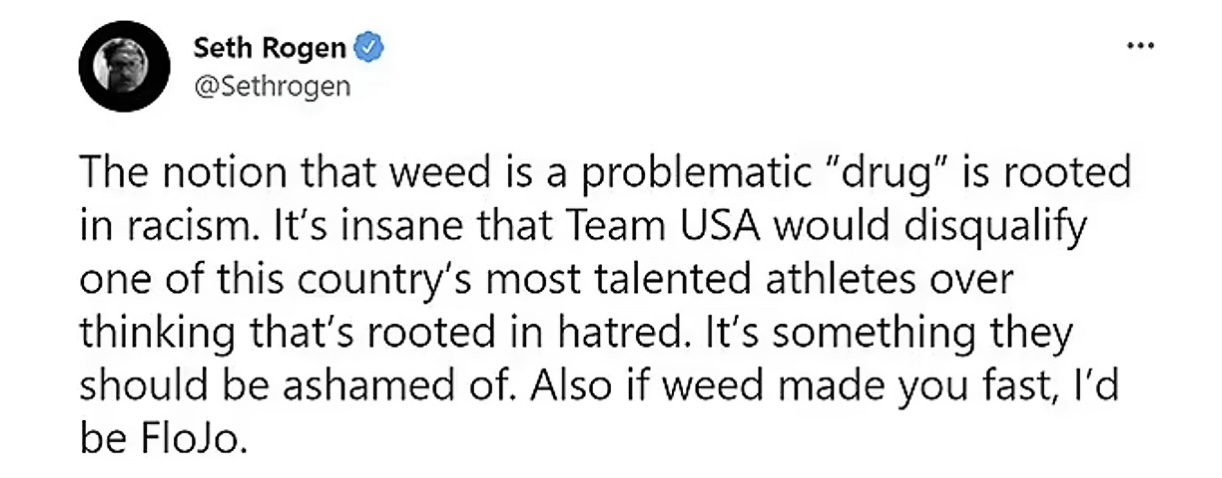
Even stranger, however, was a reaction bv Seth Rogen, to wit: “The notion that weed is a problematic ‘drug’ is rooted in racism,” he declared. “It’s insane that Team USA would disqualify one of this country’s most talented athletes over thinking that’s rooted in hatred. It’s something they should be ashamed of.”
White House press spokesperson Jen Psaki: “We will certainly leave [the U.S. Anti-Doping Agency] the space and room to make their decisions about anti-doping policies that need to be implemented. I will also note that Sha’Carri Richardson is an inspiring young woman[who’s] gone through a lot personally’ and “happens to be one of the fastest women in the world…that’s an important part of the story as well.”
Married journo pally to HE: “We were listening to sounds in the car when up popped a tune from Tom Waits’ score for One From the Heart. I’ve always loved this bluesy/jazzy collaboration with Crystal Gayle, and have long felt that it, along with Curtis Mayfield‘s ‘Superfly,’ may be the finest song composed exclusively for a film….ever, I mean.
“Maybe your readers could have some fun with this? What’s the best song score composed exclusively for a film? Broadway shows and previously recorded works don’t count.”
HE to Married Journo Pally: Excellent topic and thanks for suggesting it, although I’m frankly mystified that you would find Waits and Gayle’s One From The Heart song and especially their performance of it…I’m dumbfounded that you find it captivating.
I’m primarily talking about Waits, a seriously respected and certainly a distinctive song stylist, but he’s always infuriated me — to me he’s always has always sounded like a slurry, drunken, degenerate bullfrog lying in the gutter. And you can never understand a word he’s singing — Waits would rather die than fall into line on that score.
Again — I’m not putting Waits down. Well, I am but at the same time I’m acknowledging that he’s revered by people who know the music realm better than I. If I was smart I’d keep my yap shut about him, but I can’t help it. He always sounds the same and does the same thing every damn time with every lyric and song — same mood, same feeling, same “whoaaagghhh!!…rejoice and soak in the hoarse and gravelly boozer sounds I’m putting out here….like Charles Bukowski I’m a man of the bottle or at least I sound like one, and I tell the truth every damn time.”
I’ve never been that much of a fan of Mayfield’s “Superfly” either — a decent early ’70s AM-radio track but calm down.
My two favorite songs written directly for the screen were created in the early ’80s, and less than three years apart.
#1 is “We Don’t Need Another Hero,” the Tina Turner song from Mad Max: Beyond Thunderdome (’85) — lyrics by Terry Britten and Graham Lyle.
#2 is “Up Where We Belong” from Taylor Hackford‘s An Officer and a Gentleman (’82) — composed by Jack Nitzsche and Buffy Sainte-Marie, lyrics by Will Jennings.
And no, I don’t care if the music snobs put me down for having shallow or banal taste in movie tunes. I recognize and respect the artistry of Tom Waits but I’ve never really liked anything he’s ever performed. Sue me but “Up Where We Belong” and “We Don’t Need Another Hero” are pleasing, arresting — they have a catchy, hook-y quality, and are well produced, and they seem to enhance the value of the films from whence they sprang.
Neither Mad Max Beyond Thunderdome or An Officer and a Gentleman are grade-A films, but…I suppose what I’m actually saying is that the songs are better than the films. They reach in and turn the tumbler.
Say it loud, repeat often: Fuck the snobs.
Oh, and speaking of banal: Bill Conti‘s main-title melody for Broadcast News [after the jump] is about as drippy and whore-ish and old-farty as it gets, but it’s well-produced and it works. I’m sorry but it does.
Does anyone remember Dave Karnes? Or more precisely Michael Shannon‘s portrayal of Karnes in Oliver Stone‘s World Trade Center (’06)?
Karnes was the ex-Marine who ducked out of his office job in Wilton, Connecticut, and drove into Manhattan on the afternoon of 9/11/01 and made it through police barriers and onto the WTC site by dinner hour, and who later found Port Authority cops John McLoughlin (Nicolas Cage) and Will Jimeno (Michael Pena) buried under the mashed-up rubble, and brought the rescue teams to their aid.
World Trade Center was an odd Stone film because it had nothing to “say” except (1) “McLoughlin and Jimeo sure went through hell that day”, but (2) “thank God for Karnes and his dogged persistence.” No politics, no Hollywood leftie attitude — just a straight drama about a lot of good people pulling together to save a couple of guys from the jaws of death. A movie about caring, family, duty, perseverance.
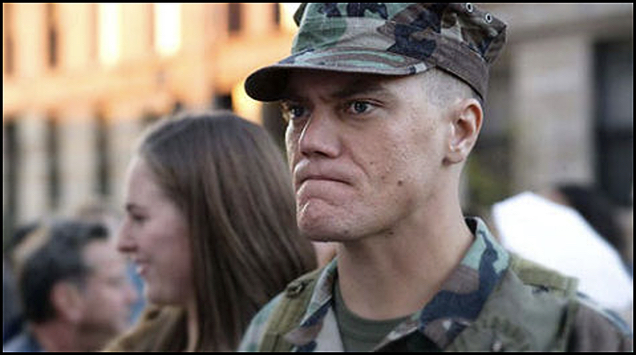
If Karnes hadn’t put on his Marine uniform and gotten himself a Marine haircut at a Stamford barbershop and driven down to Manhattan and all, it’s quite possible McLoughlin and Jimeno might not have survived. (Who knows?) Shannon portrays him as a bit of a nut, but a good kind of nut in a situation like 9/11 — a guy who laser-beams right into what needs to be done, and then does it.
Curiously, Stone decided to omit a character detail that I’ve always found really interesting. Karnes drove into Manhattan in a recently purchased Porsche 911 convertible, and at times, according to a 9.02 Slate story by Rebeca Liss, at speeds of 120 mph.
That’s a fascinating trait for a 9/11 savior — tear-assing down the Connecticut Turnpike and the Henry Hudson Parkway in a muscle car with the top down, and stopping at a McDonald’s along the way.
Why didn’t Stone show this? My theory is that he wanted Karnes to appear selfless and monk-like — a slightly loony military saint. And I think he knew this impression wouldn’t fly with audiences if he had Karnes driving a Porsche 911 because a lot of people think that guys who drive Porsches are dickheads.
But I had read about Karnes and his Porsche two or three years ago and was waiting for that shot. I felt that Stone sold Karnes short by trying to simplify him into a ex-Marine who resembled the real-deal Karnes in some ways but not entirely.
Early this morning I requested streaming access to Oliver Stone‘s JFK Revisited: Through The Looking Glass, which will screen during the about-to-begin 2021 Cannes Film Festival. I just want to be able to see it and write about it concurrent with the Cannes-attending journos…that’s all.
“I’ve been all in on the JFK assassination particulars for decades,” I explained. “But I’m skeptical about the occipital head wound thing. I’m reluctant to accept that so many people could’ve worked so hard to alter the head wound, and none of them had a tearful deathbed confession moment…not a one? But I’m open to the testimony of those Parkland doctors who insisted that they saw a gaping occipital head wound on the stretcher in Emergency Trauma Room #1.”
“But it’s not just the Parkland doctors who saw the gaping hole in the rear of Kennedy’s skull,” I was told by a Stone colleague. “It’s also in the declassified files of the HSCA; there are also just as many witnesses [who saw the same] during the Bethesda autopsy.
“That is what the film focuses on — the declassified files made possible by the Assassination Records Review Board. Which the mainstream media ignored.
HE reply: “I’ve watched many, many interview videos with those Parkland doctors, particularly around the time of the 50th anniversary (i.e., 2013), and not a single interviewer or moderator followed up with an obvious follow-up question, to wit:
“’Nobody’s challenging the accuracy of your first-hand observations,’ they should have been asked, ‘but how do you explain the bizarre lack of ANY visual evidence in the Zapruder and Nix films…why is visual evidence that shows a rear-of-the-head blow-out…why is this supposed evidence completely missing in the Zapruder and Nix films? How do you explain this?”
“One could also mention the fact that LIFE’s Richard Stolley — the man who arranged for LIFE’s purchase of the Z film and who saw the raw Zapruder footage in Dallas right after it came out the lab — it’s surely significant that Stolley never once mentioned any discrepancy between the raw Z film and the various color versions that eventually became ubiquitous after the full Z film was aired by Geraldo Rivera in the late ‘70s.
“Think of all the people who were involved in the alleged alteration of the Z film…those at that alleged CIA secret Kodak lab in Rochester, not to mention Bethesda doctors who took pictures of Kennedy’s head wound during the autopsy, and how they all somehow managed to ignore or cover up the gaping occipital head wound WHILE AT THE SAME TIME creating fake images of the top of the head and right temple wounds…
“Remember also how the blood and cranial brain matter somehow caught the sun’s reflected glare in Dealey Plaza in the Z film and how difficult it would have been to fake this…
“Remember also that Jackie Kennedy’s white-gloved right hand touched the rear of JFK’s head right after the fatal shot and yet her glove wasn’t soaked in blood…
And then imagine the number of people involved in this alleged conspiracy to hide and deceive, and ask why none of them — NOT ONE ALLEGED CONSPIRATOR — blurted out any kind of deathbed confession. People are generally terrible at keeping a secret, especially over a period of several decades. And yet every last photographic conspirator kept their yaps shut for decades on end. EVERY LAST ONE stuck to Moscow Rules to their last dying breath.”
All screen villains are perverse or flamboyant in one way or another, but it’s fairly rare to run into one with with a truly twisted or offbeat attitude. In an off-handed, no-big-deal, between-the-lines sort of way, I mean. Muddy-souled, less-than-admirable fellows who are both neurotic and a bit moronic. Not “comedic” figures, but dour, compromised souls whose bizarre manner, obsessions and quirks makes them a bit laughable or at least amusing to some extent.
For whatever reason screenwriters, directors and producers don’t seem to like this kind of ne’er-do-well. They seem to prefer hardcore fiends or clumsy criminals in comedies, guys who are so clumsy and unsure of themselves that you can’t regard them as dangerous or threatening. And nothing much in-between.
“Stacy the hitman“, portrayed by Nicky Katt in Steven Soderbergh‘s The Limey, is one such figure. He’s fairly sullen and hostile and always ready to clip someone if the money is right, but there’s something about his smart-ass manner that suggests a less-than-fully-malicious fellow. Something vaguely nihilistic. A guy who doesn’t seem to care all that much about anything.
Peter Ustinov‘s “Lentulus Batiatus“, the gladiator-school owner in Stanley Kubrick‘s Spartacus, is too dry and witty to fit the profile of a proper villain. He is, after all, someone who buys and sells human beings and sends a certain percentage of them to their deaths — obviously an ugly way to make a living. It’s just that Ustinov can’t help being self-effacing and philosophical, and therefore charming.
My favorite in-between villain is Richard Masur‘s Danskin, a grubby, bearded criminal in Karl Reisz’s Who’ll Stop The Rain (’78). A malcontent with an angry streak, Danskin has a contentious relationship with Ray Sharkey’s even more hapless “Smitty”. They both work for Anthony Zerbe‘s Antheil, a crooked narcotics detective who’s looking to abscond with two kilograms of heroin thhat’s been smuggled into the U.S. by Michael Moriarty‘s “John Converse”.
Danskin and Smitty are bottom-of-the-barrel types — foul, compulsive, insensitive — but they occasionally get into back-and-forth bickerings that are fairly hilarious.
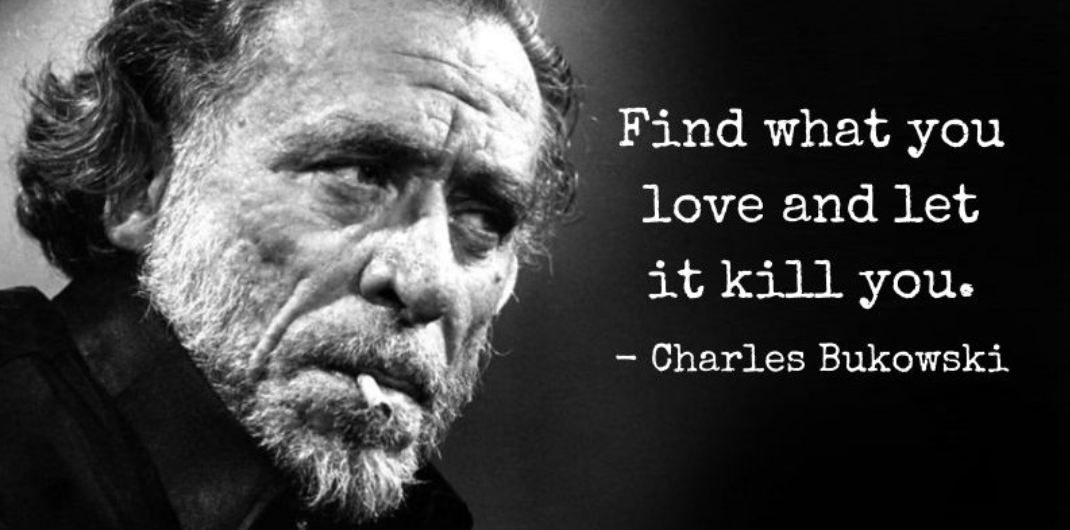
HE Plus, 6.29.19: There’s a great Charles Bukowski line from one of his short story volumes, a line about how good it feels and how beautiful the world seems when you get out of jail. I can confirm that. Not only does the world look and feel like the friendliest and gentlest place you could possibly experience, but it smells wonderful — food stands, car exhaust, sea air, asphalt, window cleaner, green lawns, garbage dumpsters. Compared to the well-scrubbed but nonetheless stinky aroma of the L.A. County Jail, I mean.
I did three or four days in L.A. County in the ’70s for unpaid parking tickets. Remember that Cary Grant line in North by Northwest about the cops chasing him for “seven parking tickets”? Well, I went to jail for not paying the fines on 27 of the damn things. That’s right — 27. I had a half-arrogant, half-cavalier attitude back then, to put it mildly. I didn’t agree with the idea of forking over hundreds in parking fines. The money they wanted was excessive, I felt, especially after the penalties increased after I didn’t pay in the first place.
One night after 9 pm I was driving west on Wilshire Boulevard, not too far from Bundy. I was pulled over for running a red light. They ran my plates and I was promptly cuffed and taken down to the West Los Angeles police station on Butler Avenue. The desk cops discovered my multiple offenses after doing a search, of course. They printed out copies of each arrest warrant for each “failure to pay fine.” I remember some laughter as the printer kept printing and printing and printing.
I was taken down to L.A. County later that night. It was just like what Dustin Hoffman went through in Straight Time. A shower, orange fatigues, bedding. I was put into a cell with three other guys. Being in close proximity to bald naked winos who smelled horrible…memories!
Over the next three or four days I was driven around to the various municipalities where I’d failed to put quarters into the meter — Santa Monica, Van Nuys, Malibu, Central Los Angeles. In each courtroom I was brought before a judge, listened to my offenses, pled “guilty, your honor” and was given a sentence of “time served.” I was released at the end of the fourth day.
It was an awful thing to go through, but I managed to eliminate a total debt of at least $2K (it might have closer to $2500) so when I got out I didn’t owe a thing to anyone. So in a sense I earned or was “paid” at least $500 a day.
I know enough about mingling with other lawbreakers to recognize the truth of a line that Hoffman’s Max Denbo said in Straight Time: “Outside it’s what you have in your pockets — inside it’s who you are.”
I remember spending several hours in a common-area holding cell with nine or ten guys. One flamboyantly gay guy was jabbering with everyone and discussing his life and values and colorful adventures. He talked a lot about how much he loved hitting his favorite bars in “Glitterwood” (i.e., West Hollywood). At one point he came over to me and flirted a bit…sorry.
There’s nothing like getting out of jail to make you feel like Jesus’ son. It reminds you what a wonderful and blessed place the world outside is, and what a sublime thing it can be to walk around free and do whatever you want within the usual boundaries, and how serene it can be to be smiled at by strangers in stores and restaurants. People you wouldn’t give a second thought to suddenly seem like good samaritans because of some act of casual kindness.
Jail doesn’t just teach you about yourself but about your immediate circle. “If you want to know who your friends are,” Bukowski once wrote, “get yourself a jail sentence.” Or do some time in a hospital bed.

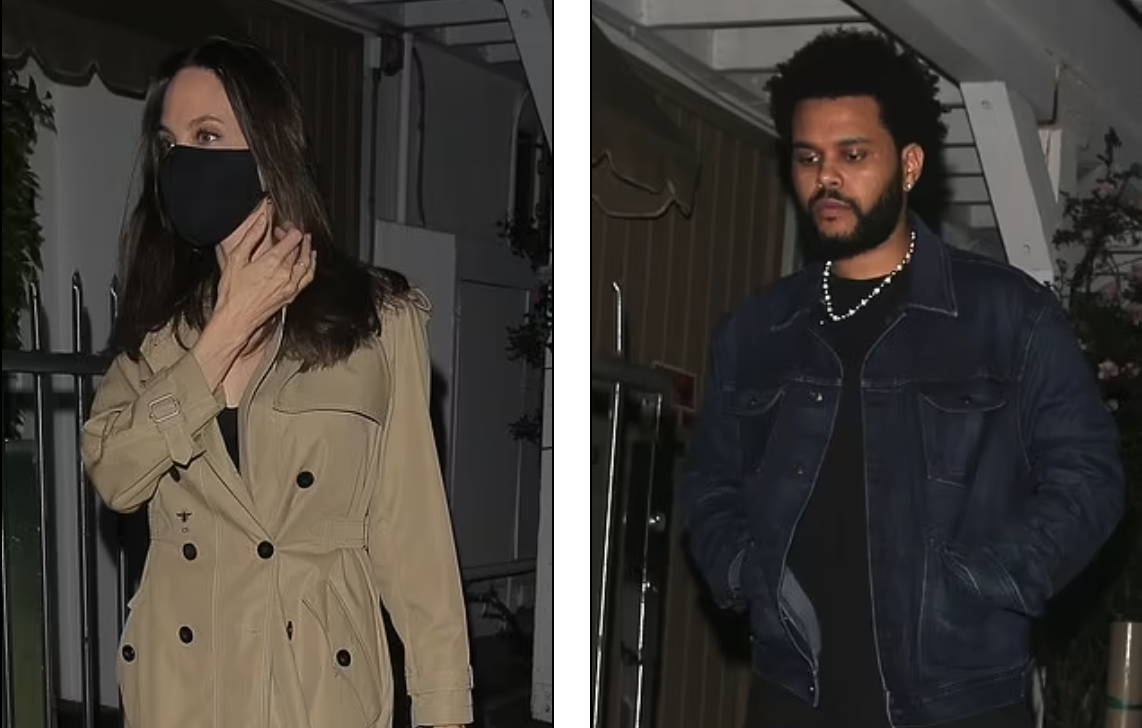
I’ve eaten at Giorgio Baldi twice…no, three times. The first time was 10 or 11 years ago with Hurt Locker screenwriter Mark Boal (Zero Dark Thirty was years off at the time). Clint Eastwood and Sean Penn were sharing an indoor table. Three or four years later I ate there on my own dime, and then returned again in ’16 or thereabouts. It’s pricey but excellent. The Dover Sole is heavenly — moist and light, bursting with flavor, sprinkled with lime.
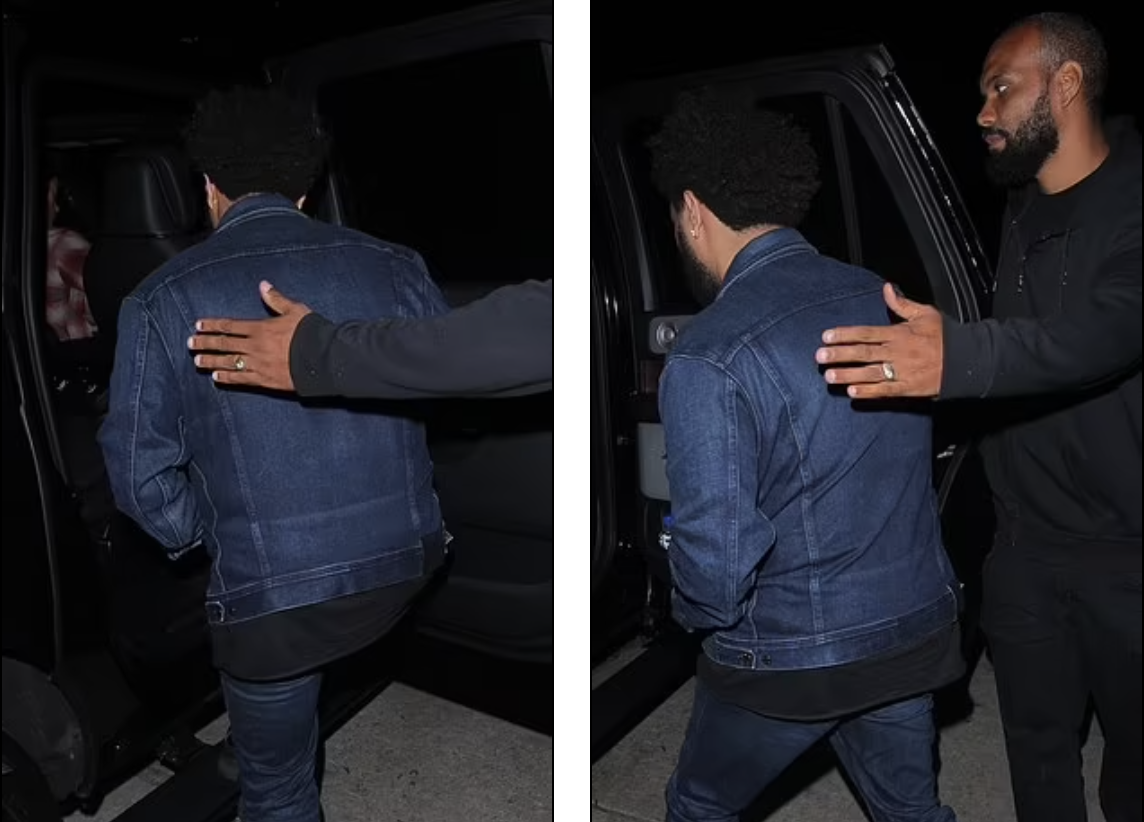
But I’ll tell you one thing. If I was rich or famous enough to have a security guy with me, and if he were to gently place his hand on my back as I stepped into the waiting SUV, I would probably stop and turn around and ask, “Why are you putting your hand on my back?”
Security: Sir?
HE: Why did you place your hand on my back as I was stepping into the car?
Security: We’re just here for you, sir. No issues.
HE: What are you trying to do, guide me into the car?
Security: Just an instinct, sir. We’re right behind you.
HE: I know you’re right behind me, but don’t touch me.
Security: Sorry.
HE: It’s okay. Just don’t do it.
Security: Okay. Understood.
HE: I’ve been stepping into SUVs all my life.
Security: Of course.
HE: I’m sure you’re a good man.
Security: I try to be.
HE: And you are.
Security: Yes sir.
HE: Okay, good.
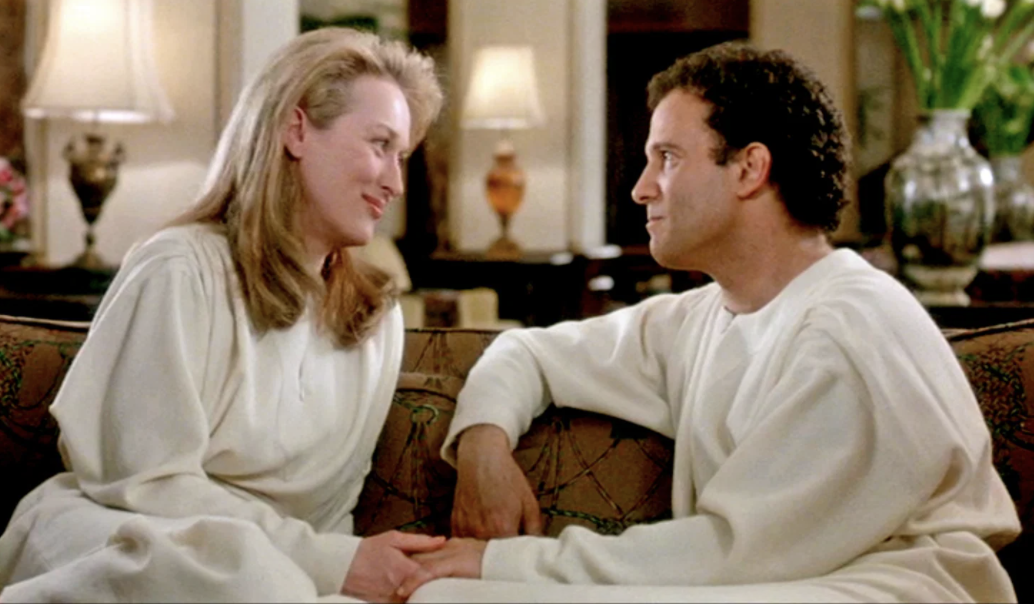
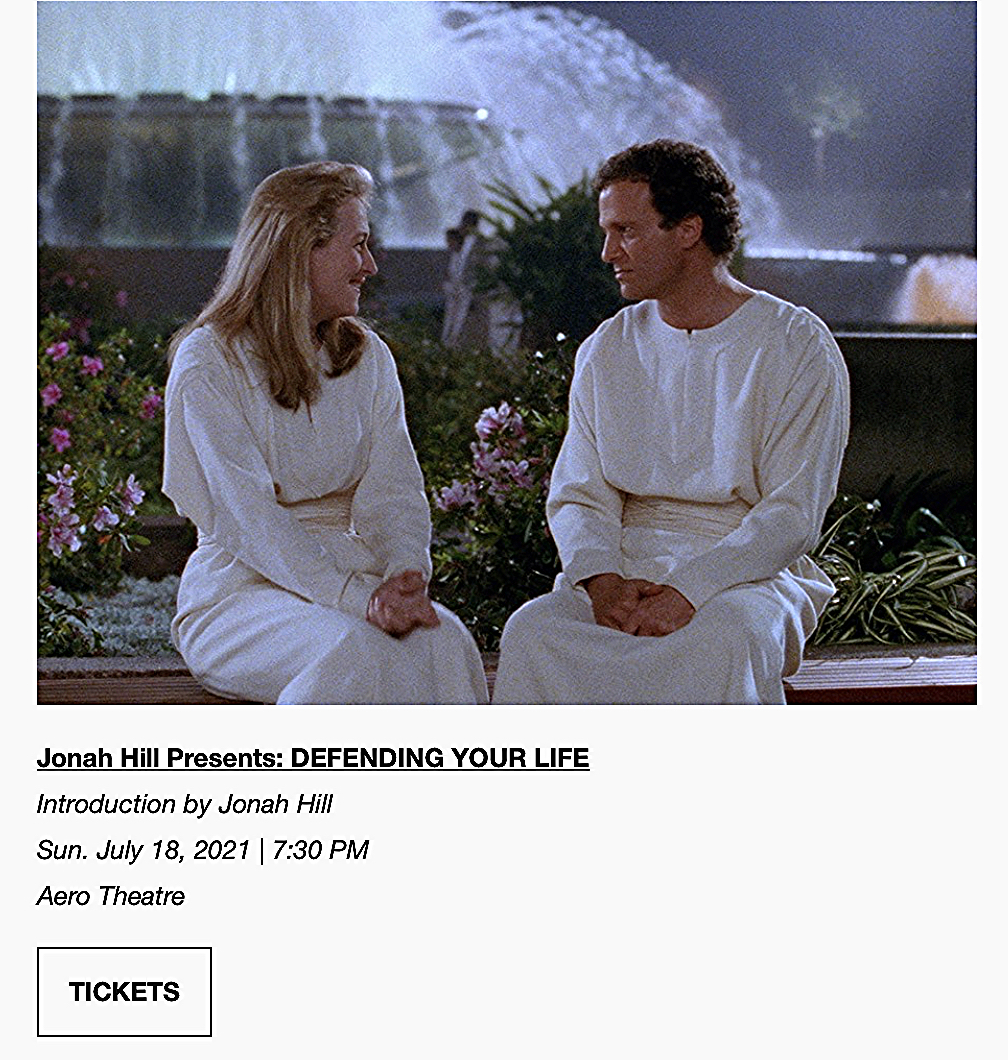
Exactly what, I’m asking myself, will the great Jonah Hill have to say about the great Albert Brooks and his 1991 classic, Defending Your Life? Other than the usual hosannahs and platitudes, I mean — “This film means so much to me personally,” “Brooks is a genius” (which he is), “It’s so rare for a film to be funny and make you think and touch your heart at the same time,” etc. All of which are valid sentiments.
Defending Your Life basically asks viewers “how much of your life has been driven by fear and anxiety and cowardice, and how much of your life has been about truth and bravery and taking stabs at creativity and applying kindness rather than judgment…? We all conform as best we can because we want safety and security in our lives, but conforming too much will suffocate your soul…so where have you been putting most of your emphasis and energy?”
The one thing I didn’t like about Defending Your Life was its portrayal of Meryl Streep‘s “Julia” character –it seemed dishonest, or at the very least incomplete.
Brooks’ recently deceased “Daniel Miller” falls in love with Julia during his stay in Judgment City, which is a kind of purgatory for souls to be judged on their past lives, as they wait to see if their next phase of mortal incarnation will be a re-run or a step up the spiritual ladder. Daniel, we gradually learn, lived too much of his life in fear of this or that, and Julia, it seems, never had a fearful day in her life. She’s so perfect and gracious she’s almost suffocating. Nobody is that good.

11 years ago I riffed about films that have dealt with death in a “good” way: “The best death-meditation films impart a sense of tranquility or acceptance about what’s to come, which is what most of us go to films about death to receive, and what the best of these always seem to convey in some way.
“They usually do this by selling the idea of structure and continuity. They persuade that despite the universe being run on cold chance and mathematical indifference, each life has a particular task or fulfillment that needs to happen, and that by satisfying this requirement some connection to a grand scheme is revealed.
“You can call this a delusional wish-fulfillment scenario (and I won’t argue about that), but certain films have sold this idea in a way that simultaneously gives you the chills but also settles you down and makes you feel okay.
“Here’s a list of some top achievers in this realm. I’m not going to explain why they’re successful in conveying the above except to underline that it’s not just me talking here — these movies definitely impart a sense of benevolent order and a belief that the end of a life on the planet earth is but a passage into something else. I’ve listed them in order of preference, or by the standard of emotional persuasion.
“1. Martin Scorsese‘s The Last Temptation of Christ. 2. Stephen Frears‘ The Hit. 3. Brian Desmond Hurst‘s A Christmas Carol. 4. Warren Beatty and Buck Henry‘s Heaven Can Wait. 5. Henry King‘s Carousel (based on Ferenc Molnar‘s Lilliom). 6. Tim Burton‘s Beetlejuice. 6. Michael Powell‘s A Matter Of Life And Death, a.k.a. Stairway To Heaven. 7. Albert Brooks‘ Defending Your Life.
I’d been putting off watching The Tomorrow War. Naturally. Obviously. As God is my witness, my caretaker and my co-pilot, I don’t want to watch a Chris Pratt film ever again…any subject, anywhere, by anyone. To me Pratt is nothing short of a demonic figure…as much of a cinematic repellent as Dwayne Johnson, and that’s saying something. Pratt doesn’t take anything seriously…everything’s an effing joke, everything’s “ironic”…I really hate his ass.
Nonetheless I tried watching this damn thing twice last night, and both times it defeated me within minutes. Deflated me, I mean. You’d have to be a serious gamer to watch this thing in the first place…right? Probably a necessity. Speaking as a 60/40 fan of Doug Liman and Tom Cruise‘s Live Die Repeat (aka Edge of Tomorrow), I was hoping that The Tomorrow War might deliver in a similar way….nope!
I just can’t stand those ridiculous reptile monsters with their open howling mouths…hordes and hordes…like those mountains of zombie insects in World War Z…I’m so sick of seeing monsters of any kind…I really hated those Quiet Place, Part II beasts….plus we’re surrounded by real-life monsters on Twitter on a 24/7 basis…sick of it, sick of it, throwing up. And yet 80% of your Rotten Tomato readers are down with this film….80%!!
When I first posted this recollection of a mid ’70s affair I was attacked (what else?) for having been a profligate libertine. I replied as follows: We’re living through a fairly conservative era right now. A whole lotta scolding going on. But in the mid ’70s there was a distinction between what was regarded as casual infidelity and the serious, hurtful, real-deal kind. It may sound cavalier in today’s realm, but middle-class sexual mores were different in those days. A randy current.
“My indiscretion was admitted to, duly regretted, apologized for. A subsequent casual infidelity happened on her end the following year, and I was in no position to do anything but accept and roll with it. (And it certainly doesn’t matter to me currently.) By ‘70s standards casual infidelity wasn’t necessarily a knife in the heart or a catastrophic deal-breaker. People were scampy. A different time.”
Originally posted on 7.12.19 on HE Plus: “I became an amateur stage actor between ’75 and ’76, when I was living in Westport, Connecticut. My big move to Manhattan was about a year and a half off. The usual nocturnal distractions prevailed, of course — carousing, partying, movies. But I also wrote program notes for the Westport Country Playhouse Cinema. And I acted in front of paying audiences.
“First I played the timid ‘Dr. Spivey’ in a Stamford Community Playhouse production of One Flew Over the Cuckoo’s Nest (which I mentioned to Ken Kesey when I interviewed him in Park City in ’98 or thereabouts), and then a macho backwoods type named ‘Marvin Hudgens’ in a Westport Playhouse production of Dark of the Moon.
“Sandra, a pretty married woman of 34, was also cast in Dark of the Moon. She and hubby Burt, a balding oil-company attorney, lived in a nice clapboard colonial not too far from the playhouse. She was one of those ‘passionate with a capital p’ types — a lover of theatre, intense eyes, great cheekbones. Plus she was a part-time dominatrix with all the necessary gear (black bustiere, fishnet stockings, a leather cat-o-nine-tails whip, tall spike-heeled boots). Every so often she would visit Manhattan and get into scenes with submissives.
“Sandra was playing a sexy witch in Dark of the Moon, and it wasn’t much of a reach. Fierce energy, quite the firecracker.
“Anyway we ‘hit it off,’ as the saying goes. I was in a fairly serious relationship at the time, but getting away with a hot side romance (i.e., not getting caught) seemed doable. Sandra was far too attractive to ignore, and the likelihood of our affair being discovered seemed low, her being married and all. She certainly didn’t want Burt to find out.
“Plus it was the mid ’70s, which was arguably the randiest, most bacchanalian era in U.S. history, certainly in the well-off Connecticut suburbs. Random couplings were fairly routine back then. I wasn’t George Roundy in Shampoo, but I was tasting that kind of activity, at least from time to time.
“The hot-and-heavy happened in Sandra’s car, in her home in the afternoons, once in my parents home in Wilton, once in the Westport woods. We never once got a motel room or spent a clandestine weekend in Manhattan. It was always along the lines of ‘let’s meet tomorrow at 4 pm near the train station.’
“The affair went on for roughly three months, maybe four. It was hottest during the run of the play, then it moved into a less intense Phase Two. After a while Sandra started to feel more and more ill-at-ease about our being seen together. She never wanted to catch any films in the Westport or Norwalk area — too easy to be spotted.
“Then came the shocker. After one of our get-togethers at her home, Sandra told me she’d been telling Burt everything about our affair. All the details, chapter and verse. Her reports were a turn-on for Burt, she said, and it put a charge into their sex life.
“On one level I was fascinated, but on another I felt…betrayed? I understood and respected the fact that her marriage was priority #1 in her life, but I thought our little affair was between us. I was partly amused, partly perplexed and a little bit thrown. My interest kind of diminished after that. The affair was running out of steam anyway.
“Sandra and Burt left Westport and moved to Dallas two or three years later. Late ’70s, early ’80s. I remember somehow finding her Dallas number in ’82 or ’83 and calling and chatting a bit. Good to hear her voice. She was moderately happy or at least content, she said.
“A couple of hours ago I did a Google search and discovered that poor Sandra passed from cancer three years ago. Shock and sadness. She was a great lady.”