“That Aside, What Did You Think of the Play, Mrs. Lincoln?”

Yesterday morning I read a 5.7.24 Richard Brody appreciation of the late N.Y. Times film critic Andrew Sennwald, who served as the paper of record’s senior film authority between 9.18.34 and 1.12.36.

Hired by the Times as a reporter at age 23, Sennwald soon became a top-tier, unusually perceptive examiner of the art and hoopla of film, Brody writes. Sennwald was an ardent admirer of director Josef von Sternberg, for one thing.

I’ve since read a few of Sennwald’s reviews. He wrote confidently and well, and certainly knew the realm.

It’s a shame that this highly respected guy died at age 28 and suddenly at that, and possibly by his own hand despite reportedly being in excellent health, not to mention in the professional prime of his life.

Weird as it sounds, Sennwald died of gas-stove poisoning, apparently or at least possibly a suicide.

On top of which the gas, which Sennwald, being dead, was unable turn off, exploded and wrecked his penthouse apartment at 670 West End Avenue, and not just the penthouse but the top three floors of the 17-story building. Investigators found Sennwald in his pajamas, on the floor of his kitchen.

Was this an accident? Why in heaven would a young man who’d quickly vaulted to a highly eminent position in his chosen field (it doesn’t get much better than being a top critic at the Times), a guy who lived in a fairly swanky abode and presumably had everything to live for…why would he off himself on a Saturday around midnight, and in his pajamas yet?

If I intended to do myself in, I would do so in my finest apparel — silk shirt, knotted tie, spit-shined shoes.

Sennwald’s last review focused on Rene Clair‘s The Ghost Goes West. Sennwald was succeeded at the Times by Frank Nugent.

Sennwald’s marriage to journalist Yvonne Beaudry, whom he met while going for his journalism degree at Columbia University, had apparently gone south. Sennwald’s Wiki page describes her as an ex-wife, although they were reportedly on cordial terms. Beaudry was out on the town when he died.

Sennwald may have been suffering from a serious eye ailment called Uveitis, but there’s not much info on this. He was also an insomniac.

While reporting that Sennwald’s death was seemingly a “suicide”, Brody otherwise focuses entirely on his film criticism. I respect his decision to ignore the curious circumstances that attended Sennwald’s passing, but that’s still one hell of an ignore.

It’s not like Sennwald swallowed some pills and slipped away quietly while slumping on a bench in Central Park. His death triggered a violent spectacle and a major neighborhood trauma — collapsed walls, fellow residents evacuated, a busted water main…bluh-DOOM!!

Brody could have just as easily have written about the Skull Island life of King Kong (wrestling an occasional T-Rex, killing Teradactyls, roaring a lot) and then blown off what happened on his final day of life in midtown Manhattan.

Not to mention the fact (I’ve made this point but indulge me) that a top N.Y. Times critic would never kill himself inside his West End Ave. penthouse at a fairly young age…does this make any sense to anyone at all?

A film critic hypothetically pulls the plug when (a) he/she can’t find decent employment, (b) is past his/her prime (65 or older) and (c) is barely making ends meet in a grubby flat in the East Village.

Reported by The Brooklyn Eagle on 1.13.36:

Brody:

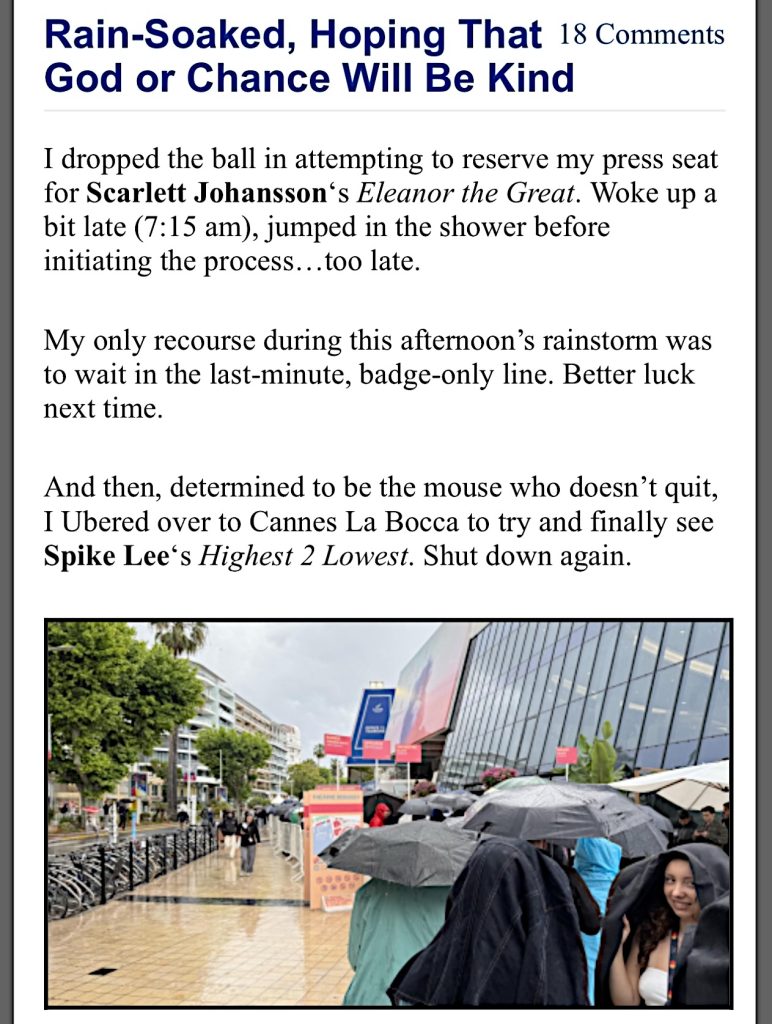
Choose or Lose: Cannes Day #1 (5.14)

Amelie Bonnin ‘s Partir Un Jour (lowered expectations) at 9 am, the Chris McQuarrie thing at 12:30 pm, Mascha Schilinski’s Sound of Falling at 3:30 pm, ixnay on the Robert DeNiro thing, MI: Final Reckoning at 6:45 pm, Sergei Loznitsa’s Two Prosecutors at 10:15 pm. Four films. Come hell or high water, I must commit at 1 am eastern, tonight.

91 Years and Counting

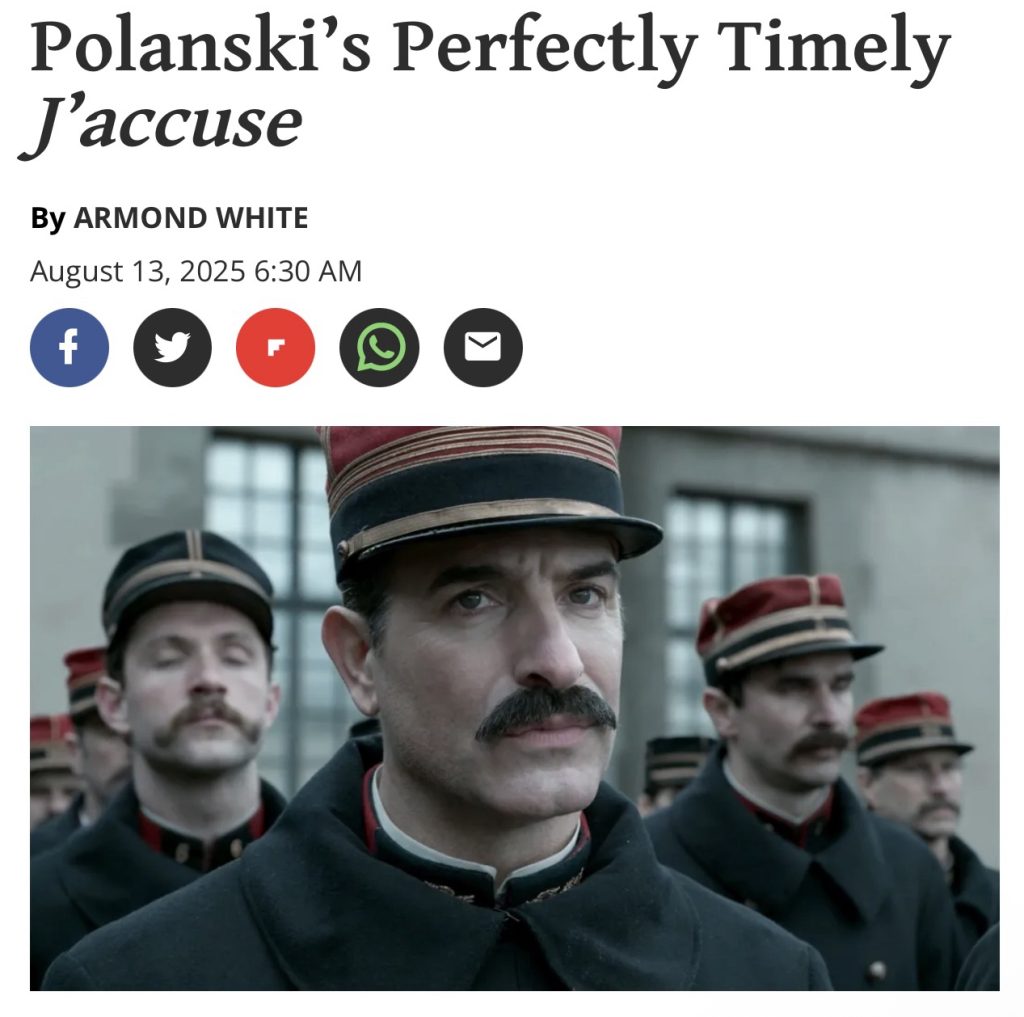
In a comment thread following an 11.29.24 piece about an English-subtitled Russian Bluray of Roman Polanski‘s An Officer and a Spy (“#MeToo Suppressionists Are Powerless In This Regard“), the redoubtable Clemmy wrote, “If you financially support a child rapist, you do not care about your granddaughter’s future.”

HE response to Clemmy: “While most many intelligent people support the cinematic art of the obviously gifted and indisputably great Roman Polanski, HE does not and never has supported the notion that anyone proven guilty of sexual abuse or assault should skate. Crimes of the loins have penalties. Nobody’s disputing this.

“Then again are you telling me that Polanski hasn’t been made to suffer and submit to the proverbial lash for the last 47 [now 48] years?

“Are you telling me that Polanski’s kids, Morgane and Elvis, live in a state of perpetual fear about what their allegedly monstrous dad might do to them?

“We’re talking about two twains here, two separate boxes.

“History is flooded with accounts of great artists who didn’t behave well at certain points in their lives, or who behaved abusively or with cruelty toward this or that person. Isolated incidents, I mean.

“Enlightened art scholars have long argued and understood that at the end of the day you can’t throw the baby out with the bathwater.

“#MeToo ideologues will never understand or accept this.”

Read more

“You Make Me Feel Valuable”

“I feel this way because I’m a money whore, and you’ve got a lot of money so…perfection, right?” — Dakota Johnson‘s Lucy to Pedro Pascal‘s Harry Castillo in Celine Song‘s The Materialists (A24, 6.15). Okay, this isn’t an actual quote but it might as well be.

I hate this movie, sight unseen.

One of the most withering moments of my life happened in July ’13. I was texting with a lady I’d fallen in love with (i.e., an affair that ran from early May through late October) and in the middle of a discussion about something fairly basic she texted (and I mean right out of the fucking blue), “I’m expensive.”

Whoa.

It would have been one thing if I was a compulsive cheap-ass who was always looking to squeeze a nickel until the buffalo shits, but I was probably more of a give-give-giver with her than I’d been with any other girlfriend in my life. I was very generous and comme ci comme ca about everything. Everything was cool and steady. And yet she dropped that line on me. I’ll never forget that moment for the rest of my life.

The last time I’d heard that line was when Marilyn Maxwell said it to Kirk Douglas in Champion (’49). We all know what she meant, of course. Obviously not just “I’m high maintenance” but “I might be too high maintenance for you, given your apparent income and frugal tendencies. I’m not saying I’m a money whore but…well, you tell me.”

Posted on 10.28.13:

I obviously dip into non-film topics in this space from time to time, but I draw the line at relationship stuff. I’ll allude every so often to something going really well but leave it at that. Boundaries are respected, no telling tales, stays in the box. But I’m also figuring there’s nothing terribly gauche about acknowledging that it’s exhausting to go through a two-hour texting meltdown when things have taken a turn for the worse.

I wonder if anyone hashes this stuff out eyeball-to-eyeball any more. Thank God that iMessage allows you to text from a computer keyboard — I don’t think I could thumb my way through one of these ordeals. Texting your innermost disappointments and lamentations while keeping up your end of the “debate” (which can never be won or lost, of course) is quite debilitating. When you wake up the next morning you feel empty and a bit numb. Is “gutted” too strong a word?

Read more

Chicago Pope

The Chicago-born Robert Francis Prevost, now known worldwide as Pope Leo XIV, seems like a mild-mannered devotional…sensible, practical, political-minded…a facilitator type…perhaps a Ralph Fiennes-y type of guy. What do I actually know? He doesn’t strike me as a fire-and-brimstone type. He has a face that says “okay, I get it, we be cool.” Willing to forgive.

Read more

“At Close Range” Will Always Be James Foley’s Greatest

Confession: I’ve never seen James Foley‘s After Dark, My Sweet (’90), which Roger Ebert insisted was “one of the purest and most uncompromising” film noirs ever, capturing above all “the lonely, exhausted lives of its characters.”

I’ve decided to finally watch this respected but all-but-forgotten film, even though I suspect I’ll probably hate it. (I’ve come to fear adaptations of Jim Thompson novels — brutality and heartlessness are his calling cards.) Why am I catching After Dark, My Sweet regardless? I feel I owe it to the memory of Foley, who died from brain cancer earlier this week. He was only 71.

There’s no question that Foley’s At Close Range, written by Nicholas Kazan, will always be regarded as his masterpiece. It taught me to think of rural Pennsylvania as a place where blue-collar bad guys thrive and ugly things happen at night. Patrick Leonard‘s haunting score + Madonna‘s iconic recording of “Live to Tell”…perfect. Chris Walken‘s demonically twitchy performance as the sociopathic Big Brad is surely his all-time finest. Walken to Sean Penn in that third-act kitchen scene: “You think you have the guts?…to kill?…me?”

Foley’s direction of David Mamet‘s Glengarry Glen Ross (’92) is also top shelf, although nothing will ever touch the original 1984 Broadway play version (which I caught on opening night with all the big-gun critics) with Joe Mantegna, Robert Prosky and the others. I’ve alwaye loved the slogan on the Glengarry film poster: “A film for everyone who works for a living.”

Puts “Sinners” To Shame

Yesterday “Los Bostonian”, while callously dismissing the AI-authored “Celluloid Renegades” script, complained there’s too little in the way of elemental film passion on this site…”rarely any discussion of editing, lighting, screenwriting, shot composition.”

Okay, here’s a riff on lighting, or more particularly a comparison between (a) Pawel Edelman‘s beyond-brilliant cinematography, fortified by his soft and subdued but wonderfully calibrated lighting, on Roman Polanski‘s An Officer and a Spy (’19), which I re-watched a couple of nights ago, and (b) the occasionally muddy, oppressively under-illuminated, at times barely discernible lensing of Sinners by Autumn Durald Arkapaw.

Each and every frame of the Polanski is a bath…an eyeball massage…a capturing of Belle Epoque Paris that never stops hitting the sweet spot…never over- or under-lighted, every shot as perfect as it could possibly be for a period film of this sort. Easily in the class of John Alcott‘s Barry Lyndon, if not in a class of its own.

Too many people have written that Arkapaw’s lighting of the second half of Sinners (i.e., the nocturnal vampire stuff) is so depressingly under-lighted that at times it’s borderline unwatchable. When images are this soupy, something is very wrong.

Edelman’s lighting expertise is so far above and beyond what Arkapaw is apparently capable of or interested in…it’s almost unfair to mention them in the same sentence.

Edelman’s credits include Taylor Hackford‘s Ray, Steven Zallian‘s All the King’s Men, Andrzej Wajda‘s Walesa: Man of Hope, and Polanski’s The Ghost Writer (masterfully lighted). Arkapaw shot Black Panther: Wakanda Forever (no great shakes) and The Last Showgirl (never saw it).

Fair enough?

Return of Mumbly, Gurgly, Slurry-Voiced Joe

Everyone knows that Joe Biden‘s arrogant decision to run for re-election two and a half years ago (i.e., right after the ’22 midterm elections) pretty much ushered in Trump 2.0. He fucked us, and in my book that makes him a really bad guy.

Asked on The View about his mental decline over the second half of his term, Joe muttered and wheezed and gurgled a denial of sorts.

And then wife Jill jumped in to shore him up during the interview’s second half. All through ’23 and ’24 Joe and his Democratic gaslighting squad did what they could to spin and dodge and obfuscate. Joe actually said today that had he stayed in the ’24 race, he would have beaten Trump. This is ridiculous!

What about the books that have been written about his cognitive decline? “They are wrong,” Joe mumbled.

Jill: “The people who wrote those books were not in the White House with us. If you look at things today, give me Joe Biden any time.”

“Door Tests” Stopped in Early ’90s

Most of Chaz Palmintieri‘s A Bronx Tale (’93) is set in 1968. Back then the “door test” was a legitimate and reliable way to figure out if a prospective girlfriend was selfish or not. Remote door locks, which became common in US-made vehicles starting around ’90 or thereabouts, gradually put the door test out of commission.

I was driving a 1990 Nissan 240Z when I saw A Bronx Tale, and I distinctly recall it had no remote door lock. With some relish I subjected a couple of women I was seeing to the door test. They both passed with flying colors, or so I recall.

“They Are All Equal….Uhm, Dead Now”

A new 4K restoration of Stanley Kubrick‘s Barry Lyndon will screen at the grand and immaculate Debussy theatre on Friday, 5.23 — my final night at the 2025 Cannes Film Festival.

There’s no way this Criterion-supervised version (due to “street” via 4K Bluray on 7.8.25) will deliver any kind of noticable bump over the current Criterion manifestation. It’ll look magnificent of course, but the viewing experience, boiled down, will be the same one I saw projected at the Ziegfeld in late December of ’75.

I’ve seen Lyndon at least 10 or 12 times since, and I know every line and frame by heart. And Marisa Berenson‘s empty, blank-faced performance has sapped my spirit on each and every occasion. She was such a drag to hang with.

However, the 5.23 Cannes screening will probably be my last opportunity to see the handsome, downbeat, darkly humorous Barry in a truly first-rate venue — really big screen, perfectly projected light levels, state-of-the-art sound. So I’ll probably have a seat.

Speaking of Flatline Elements“, posted on 5.14.23:

Stanley Kubrick was famous for encouraging lively, eccentric and even over-the-top performances. Steven Spielberg’s 1999 recollection abut a 1980 dinner with Kubrick at Childwickbury Manor, during which Kubrick explained that Jack Nicholson‘s over-the-top performance in The Shining was a kind of tribute to the acting style of James Cagney, is a case in point.

It is therefore strange if not bizarre that during the making of Barry Lyndon, Kubrick directed Marisa Berenson to give such an opaque non-performance. In each and every scene, her Lady Lyndon conveys utter vacuity…absolutely nothing behind the eyes.

Did Kubrick realize too late in the process that he’d made a mistake, that Berenson was profoundly ungifted and had next to nothing inside, and that the best course would be to emphasize (rather than try to obscure) this fact?

Berenson is the primary cause, in fact, of Barry Lyndon‘s “dead zone” problem.

Read more