For six long years I’ve been waiting for the demise of Taika Waititi, or, you know, for his streak to run out of gas. At least that.
And now, to go by the Critical Drinker, it finally has. I’ve been secretly hoping for the Waititi torch to go out since sitting and suffering through JoJo Rabbit, which I called “a stylistic wank-off and about a quarter-inch deep” in September 2019.
Only now can it be told: In my 9.25.19 JoJo Rabbit review I reported that “there was a seasoned industry guy sitting behind me who couldn’t stop laughing, and heartily at that. At one point I half turned in my seat as if to say ‘what the fuck?’, but I didn’t turn all the way around.” That industry guy was no one else but Jeff Sneider.
Eureka! Late last night I watched the first three episodes of Rebecca Miller’s Mr. Scorsese, and I felt so roused and super-engaged I didn’t even notice that episode #3 (which ends with the rightwing hate that greeted TheLastTemptationofChrist in ‘88) ended just after 2 am.
We’re all fully familiar with the frenzied, 60-year, up-and-down-but-mostly-up saga of the career of Martin Scorsese, of course, but there’s something primal and alive and almost cleansing in the fissures and textures of Miller’s five-hour doc.
Why did it hold me so? Because it didn’t just feel like Scorsese’s story but my own. At every juncture I was “there” in real time, communing with each and every film — emotionally, instinctually, aesthetically — and I mean going all the way back to Boxcar Bertha, which wasn’t much (after seeing it John Cassavetes gave Scorsese a fatherly hug and said “you’ve just spent a year of your life making a piece of shit”) but at least had one good sex scene.
In a phrase Mr. Scorsese is reallygreatstuff. First-rate, up close and searingly personal. It reminds you that Scorsese led a very anxious and shadowed and haunted life for at least his first half-century on the planet. No bowl of cherries, no walk in the park.
I’m thinking now of anon–camera PaulSchrader quote about how Travis Bickle, the proverbial Underground Man, was speaking to “no one” in the early ‘70s…the isolation was all but total back then. Now almost the same kind of guy is online, and he is legion…the solo Underground Man thing has become an online community…the “Internet Man”.
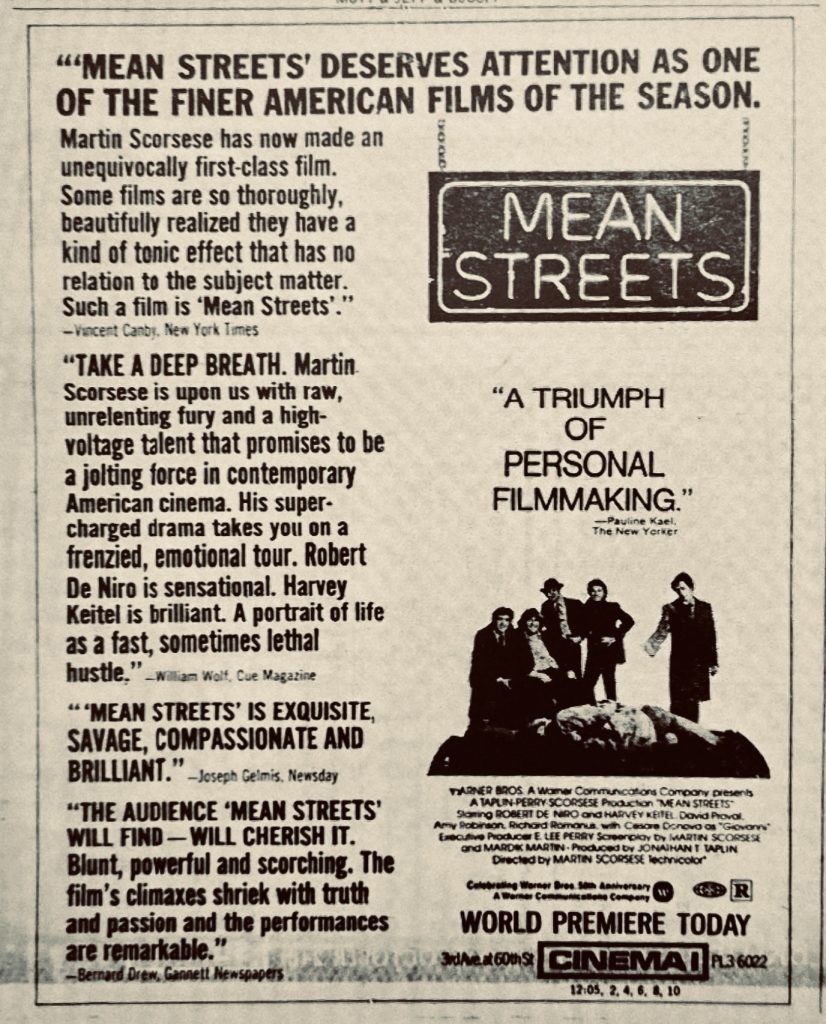
Please re-read Pauline Kael’s 2.9.76 NewYorkerreview of TaxiDriver.
Friendo: “The persistent sneers of dismissal that now frequently greet Pauline’s name are one more sign that 2025 film culture has lost its marbles.”
Consider a brief fencing match between HE commenter JHR (J.R. Ewing with an inserted middle initial) and The Living, Breathing Embodiment of Hollywood Elsewhere in this morning’s “Accepting But Mystified” thread, the subject being a friendly, gracious, middle-aged Connecticut woman having never even HEARD of Anora:
HE: “Anora-wise, there are many concentric circles of passion and interest and engagement. The innermost circle is being an Anora devotee who’s seen it two or three times and can even quote dialogue from it. The outermost ring is, at the very least, having heard of its existence and/or its multi-Oscar triumph. To have not even HEARD of 2024’s Best Picture winner is to have no pulse — you are a flatliner.
“John Huston once famously said that all you need is a healthy sense of curiosity in order to live a well-educated life.”
JHR: “None of my friends (seniors, late 60s, retired college+ educated professionals with $) had ever heard of Anora when I pitched it to them, nor do they have any knowledge of the Oscars results.
“I had lunch with seven of them yesterday, I asked if anyone had been watching the MLB playoffs, and none of them had. They pay little attention to sports except for our big time college football team just down the road where most of us attended college.”
HE: “Seven of your senior chums got together for lunch? Seven? Isn’t that a bit crowded? A group of four is more like it, no? Seven is too conversationally competitive.
“Then again why not go bigger? Why not 10 or 12 having lunch at the same coffin-sized table? Hell, make it twenty! Twenty friends sharing a big luxurious lunch together. Think of all the shouting and guffawing…think of all the shrieking, raucous laughter and the tee-hee giggling!”
JHR: “What do my friends do with their leisure time? They read books, they have hobbies like golf, and they travel a lot — Europe, etc. Lifestyles most people would envy. I do all the above, too, but I am the only movie fan in my crowd, and I think that [Anora ignorance] is more common than you may understand, particularly when it comes to Oscar films.
“I can count on three fingers the number of my friends who are current on movies like me, out of a broader circle of about 40 lifelong friends.”
HE: “’40 friends’? That’s too many. Five’ll get you ten 30 or 35 of those 40 are fair-weather types.”
HE: “To live a life without a semi-active or semi-vibrant sense of curiosity is not living. Have your friends ever heard of Socrates? He was a Greek philosopher…oh, wait, have they ever heard of ancient Greece?
“In any event Socrates once wrote that ‘an unexamined life is not worth living.’ Maybe that’s too historical. Let’s try this…have your friends ever heard the expression ‘the lights are on but nobody’s home?’ Have they ever listened to the 1965 Zombies song ‘She’s Not There‘?”
Kathryn Bigelow and Noah Oppenheim‘s A House of Dynamite (Netflix), which opened theatrically last Friday (10.10) on select screens, will begin streaming on on Friday, 10.24, or ten days hence.
Has anyone taken the plunge? How about sharing some reactions? I reviewed it out of the Venice Film Festival on 9.3, or nearly six weeks ago
Remember the good old JFK days when it took a little while to attack the Soviet Union with nuclear weapons? If a rogue order to bomb the Russkis had been given by an unstable SAC base commander in the early ’60s, say, nuclear bombs would then be delivered by Air Force guys flying big-ass B-52s, and with “one geographical factor in common — they are all two hours from their targets inside Russia.”
President Merkin Muffley has two hours to try and stop this bonkers attack and thereby prevent the Doomsday Machine from going off? Man, that’s a really luxurious time frame to work with, certainly compared to the lousy 25 minutes that top-level strategists and officials (White House, government, military) have in Kathryn Bigelow‘s A House of Dynamite (Netflix, 10.10).
A bum 25 minutes to, like, do something about a North Korean or Chinese or possibly even a Russian nuclear missile heading toward the great city of Chicago? C’mon! Some people need 25 minutes just to take a dump and then wash their hands, brush their teeth and spray the bathroom with Febreze.
First of all, isn’t 25 minutes a bit too short, as in not enough dramatic breathing room? Wouldn’t it be schematically preferable if the missile’s travel time took 40 minutes instead? More time to think, consider options, fire back at Pyongyang, freak out, call loved ones, generate an immediate warning to Chicago-area smartphones, etc.
A 6.22.18 Business Insider report estimated that a nuke travelling from Pyongyang to Chicago might take 39 minutes and 30 seconds. Has that Armageddon clock really been cut by 50% over the last seven years?
The fact that Dynamite lasts 112 minutes may suggest to some that the essential suspense kicks in for only 25 or so, once, or roughly one-fifth of the running time….wrong.
Bigelow and screenwriter Noah Oppenheim‘s strategy is to wade into three versions of the same 20-minute countdown — different locales, different key characters, all wearing the usual clenched, super-grim expressions.
Now that I’m re-running the film in my head, I’m not precisely recalling how those three 25-minute sections add up to 112. I’d really like to watch it again with a stopwatch.
If Bigelow went with three 40-minute sequences, more situational stuff could happen. Little things, big things, eccentric whatevers. 20 minutes is just too crammed, man. Especially for the people of Chicago.
Unless I missed something (and it’s quite possible that I did), none of the Dynamite decision-makers give serious thought to the idea of instant-messaging the entire Chicago populace (not to mention the people of Illinois, Wisconsin and Indiana) and saying something like “hey, guys…not much time for anything, but you need to immediately find some local school with old-fashioned classrooms so you can can all put your heads under the desks…seriously, you have 25 minutes to confess your sins or fuck your boyfriend or girlfriend one last time or go to church and pray to the one and only God or order your favorite spicy hot dog or Subway salami andwich or tell your kids that you adore them or, you know, pop an Oxy or inject yourself with Vietnamese heroin.”
One of the basic Dynamite messages, by the way, is that this country’s “iron dome” defense system doesn’t work all that well, especially when the task is “htting a bullet with a bullet.”
Fair question #1: “Yeah, okay, it’s a tough nut to crack but if you can’t lick this technological challenge, then what good are you, Jimmy Dick?”
Fair question #2: If you were Oppenheim and creating A House of Dynamite on your Macbook Pro, would your instinct be to show Chicago being melted to death and/or blown into little shards with a super-gigantic mushroom cloud reaching so many miles high that even Cary Grant‘s Roger Thornill could see it from that Prairie Stop Highway 41 cornfield, which was….what, in southern Illinois or western Indiana?
Or would you figure “naaah, it’s more effective to hold back and prompt the audience to imagine the carnage instead?”
Cheers and congrats to all the Dynamite players, first and foremost Rebecca Ferguson (generally the coolest and most composed), followed by Idris Elba (irked and perplexed U.S. President), Gabriel Basso (second most disciplined), Jared Harris (unstable James Forrestal-like Defense Secretary), Tracy Letts (the General Buck Turgidson of this scenario, only older and without the laughs and no pistol-hot girlfriend), Anthony Ramos (hardcore team leader who vomits when push comes to shove), Moses Ingram, Jonah Hauer-King, Greta Lee (North Korean expert) and the great Jason Clarke
A House of Dynamite is not my idea of a game-changer in any kind of stylistic visual sense. It’s basically just a highly effective throttle-ride, very nicely shot by regular Bigelow dp Barry Ackroyd, and razor-cut like a motherfucker by Kirk Baxter.
What’s the default term? “A super-tense, nail-bitten thriller that Joe and Jane Popcorn will have a high old time with”…something like that But it won’t deliver the same charge on a 65-inch HD screen. It was great seeing it on the huge screen at the Sala Darsena. Everyone should be so lucky or priveleged.
You can tell from the get-go that Sam Raimi and Damian Shannon‘s script for Send Help, a #MeToo feminist revenge drama, is on the pulpy and simplistic side.
To go by the trailer for this Raimi-directed film, sexist yuppie dickhead Bradley Preston (Dylan O’Brien) has been sketched with one basic color, making him into an acidic boor and a snothead. Obviously he’s going to suffer at the hands of co-worker Linda Little (Rachel McAdams), who quickly gains the upper hand after they make it to shore after their private plane crashes into the Pacific.
This morning a friend noted the obvious similarity to Lina Wertmuller‘s Swept Away, but Hollywood’s wokezoid mentality would never permit any sort of surprising or transformative relationship to develop between the two. (Imagine McAdams turning over on her stomach and purring “sodomize me” to O’Brien…right.)
This is clearly…okay, seemingly a boilerplate film for unsophisticated women — a “make the male asshole suffer for his sins” flick.
The friend then wondered if Send Help might be “Misery on a South Seas island” with McAdams as Kathy Bates and O’Brien as James Caan.
In my view, Raimi’s first fully mature and dramatically effective film was A Simple Plan (’98), a moralistic midwestern noir. He followed this up with For The Love of the Game (’99), a not-as-good sports drama that was nonetheless reasonably decent, and then came The Gift (’00).
But with the dawn of the 21st Century Raimi never even tried to operate in the naturalistic realm again. To be frank about it, Raimi pretty much committed creative suicide by selling his soul to the Marvel empire…Spider-Man (’02), Spider-Man 2 (’04), Spider-Man 3 (’07), Drag Me to Hell (09), the vaguely shitty Oz the Great and Powerful and, most recently, Doctor Strange in the Multiverse of Madness (’22).
…is buying into a fairly silly or pretentious idea.
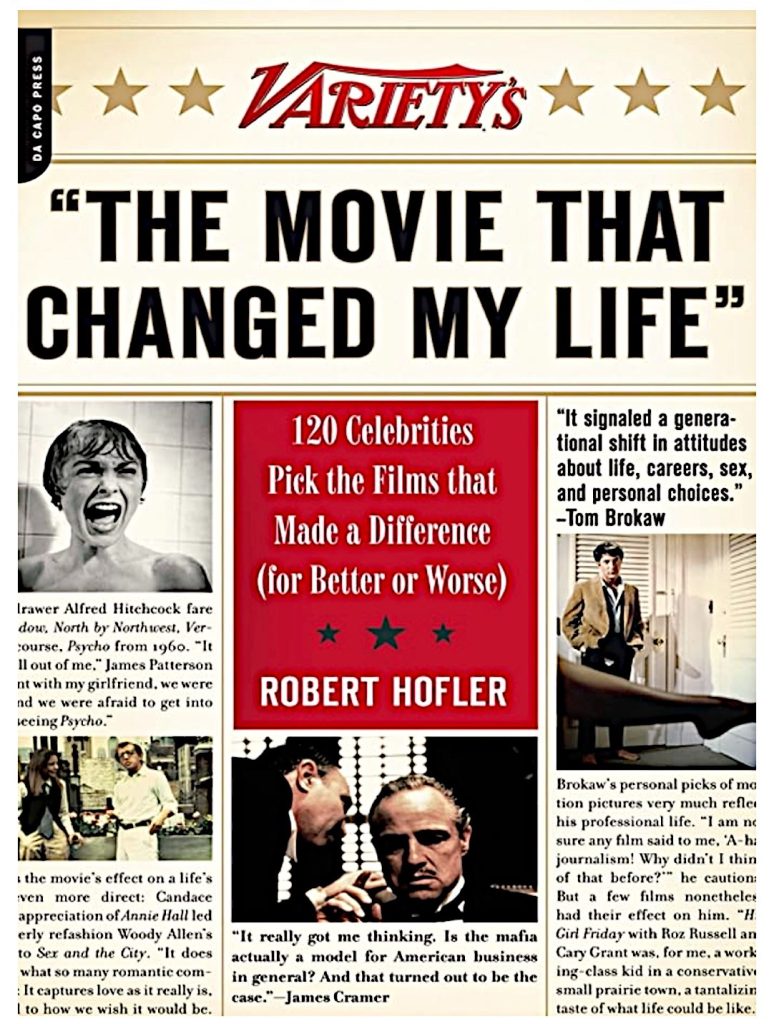
What exciting movies do to young, impressionable types is often a combination of three things. One, they turn on a light bulb. Two, they light a fuse and, if the impressionable youth is lucky, ignite a spiritual chain reaction. And three, they inject you with one of those “aha!” or “eureka!” realizations (i.e., “wow, really good films can reach deep inside and amount to much, much more than just entertainment”).
Okay, I’ll share a “changed my life” reaction to a film. The explosive, cannon–likesound of the six-shooters in Shane, which I saw on a sub-run, years-later basis at some kiddie matinee when I was nine or ten. I had never heard that kind of primalroar from any machine or device or living thing before. It shook my soul in a way that never quite left my system or even faded.
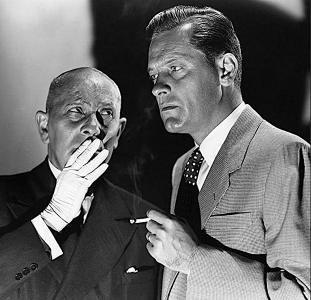
In BillyWilderSunsetBoulevard (‘50), the regal, curiously old-world, organ-playing, stiff-necked Max von Mayerling (Eric Von Stroheim) is not just Norma Desmond’s chauffeur. He is also her ex-husband and a once-powerful Hollywood director.
In the 1920s and early ‘30s Stroheim himself was a major, auteur-level Hollywood director (GreedTheMerryWidow, Queen Kelly), which is why the snickering, smart-assed Wilder cast him as Max — a “wink wink” meta thing.
Like Von Mayerling, Von Stroheim’s imperious manner, exacting standards and creative arrogance had led to his being elbowed out of the elite circles of Hollywood power before he was 50.
I was never a filmmaker, of course, but I was undeniably an influential and consequential industry reporter and freelance commentator, print-wise, in the ‘90s, and then I became a major columnist, opinion-monger and “Oscarwhisperer” when Hollywood Elsewhere took flight in ‘04 until…oh, roughly ‘21 or thereabouts, which is when I was Twitter-torpedoed by the Stalinist wokezoids, and by the femmebot-trans contingent in particular.
I hadn’t “done” a damn thing — it was all about my not-woke-enough or anti-woke views and opinions.
The 2025 version of HE is just as perceptively snap-dragon and on-target and lusciously well-written as it was in my Clinton-Bush-Obama-early Trump heyday.
But supplemental-income-wise I have become, in a sense, aMax Von Mayerlingvariation, chauffeuring Fairfield County swells to the four NYC-area airports while radiating a certain worldly, “oh, I’ve been around and done a few little things in my time” mentality or attitude, although always with a wink and a smile.
On top of which after his fall from grace Max Von Mayerling wasn’t a well-read, Bhagavad Gita-fortified columnist who annually attended the major film festivals (Cannes, Telluride, Venice) by way of crowd-funding and the kindness of certain friends.
In a certain light I’ve sorta come full circle. The first really cool job I ever had was driving for Checker Cab in Boston (’70s), and all the while I was a secret genius.
Von Stroheim never accepted the humiliation of becoming his ex-wife’s chauffeur, but he certainly suffered an industry-mindset comedown in the ‘30s, ‘40s and ‘50s. He was only 72 when he died in 1957.
HE is not really trying to effectuate a One Battle After Another takedown campaign.
Yesterday’s VistaVision carping aside, I’m simply saying that Paul Thomas Anderson‘s insurrectionist POC girlboss epic hasn’t a prayer of winning the Best Picture Oscar because winning in this category will, in the minds of Average Joe and Jane ticket buyers, permanently underline a notion that Hollywood is hopelessly aligned with the wokeazoid left.
OBAA could win in other categories (although not in the Best Actress race — Chase Infiniti has zero chance in this regard) and more power to it in this regard. PTA’s film is a very well-made, full-throttle, zing-zang achievement, and it certainly deserves respect as far as that goes.
HE is, of course, definitely trying to persuade as many people as possible that the second half of Sinners is low-rent, Samuel Z. Arkoff-level, drooling vampire bullshit, and is therefore undeserving of any Oscar wins. HE recognizes that many industry members are nonetheless persuaded that identity campaigns are a valid way to go, and so Ryan Coogler will probably end up being nominated for direction or screenplay but that’s all…nominations but no wins.
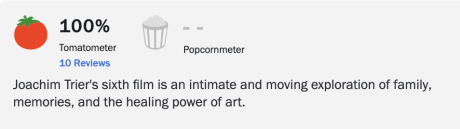
Value screened last weekend to an adoring crowd at the Hamptons Film Festival, and is currently press-screening in Manhattan prior to the early November debut, which is only 24 days off.
It’s a guaranteed Best Picture Oscar nominee; ditto Renate Reinsve and Skellan Skarsgard for Best Actress and Best Supporting Actor, respectively. We all understand that Hamnet is the Oscar frontrunner as we speak, but don’t sell Value short.
Posted on 5.21.25: I saw Joachim Trier’s SentimentalValue last night at 10:30 pm, exiting around 12:40 am. I was afraid it might not live up to expectations, but no worries — I began to feel not only stirred and satisfied but deeply moved and delighted by the half-hour mark, and then it just got better and better.
For my money this is surely the Palme d’Or winner. I wanted to see it again this morning at 8:30 am. Yes, it’s that good, that affecting, that headstrong and explorational. A 15-minute-long standing ovation at the Grand Lumiere, and all the snippy, snooty Cannes critics are jumping onboard.
But what matters, finally, is what HE thinks and feel deep down, and that, basically, is “yes, yes…this is what excellent, emotionally riveting family dramas do…especially with brilliant actors like Renata Reinsve (truly amazing…she really kills) and Stellan Skarsgård, Inga Ibsdotter Lilleaas and Elle Fanning topping the ensemble cast.”
But I was really too whipped to tap anything out when I returned to the pad at 1:15 am. I managed a grand total of 4.5 hours of sleep, and am now at a Salles Bunuel screening of Eugene Jarecki‘s The Six Billion Dollar Man…beginning in a few.
Sentimental Value (why do I keep calling it Sentimental Gesture in my head?) is a complex, expertly jiggered, beautifully acted Ingmar Bergman-esque family drama that feels at times like Woody Allen‘s Hannah and Her Sisters but with less comic snap…it’s more of a fundamentally anxious, sad, sometimes very dark but humanist dramedy (a flicking comic edge, a Netflix putdown or two).
It’s a film that’s completely receptive and open to all the unsettled cross-current stuff that defines any shattered, high-achieving family, and this one in particular.
Emotional uncertainty and relationship upheavals are in plentiful supply.
Set in Oslo, it’s basically about an estranged relationship between Skarsgard’s Gustav Berg, a blunt-spoken, film-director father who hates watching plays, and his two adult daughters — Reinsve’s Nora Berg, a prominent stage and TV actress who’s a bundle of nerves, anxiety and looming depression, and Lilleaas’s Agnes, Nora’s younger sister who’s not in “the business.”
Gustav’s career has been slumping but now he’s returning to filmmaking with a purportedly excellent script that’s partly based on his mother’s life (although he denies this), and he wants Nora to star in it. She refuses over communication and trust issues, and so Gustav hires Fanning’s Rachel Kemp, a big-time American actress, to play Nora’s role.
I could sense right away that Kemp would eventually drop out and that Nora would overcome her anger and step into the role at the last minute. And I knew the film would explore every angle and crevasse before this happens.
‘ Value really digs down and goes to town within a super-attuned family dynamic…steadfast love, familial warmth, sudden tears, extra-marital intrigue, stage fright, film industry satire, thoughts of suicide…nothing in the way of soothing or settled-down comfort until the very end, and even then…but it’s wonderful.
…when whalebods were seen as sexy, healthy, and life-affirming in the most wonderful way imaginable? Ozempic and other crash-diet drugs put an end to that, thank God, and now it’s even okay for a semblance of the male gaze to make a slight comeback. Because a vibe shift (lo and behold) has happened, and the once-bullying woke Stalinists have fled into the forest.
Triggered by a recent CNN article about the return of the male gaze, “After Party”‘s Emily Jashinsky and Spencer Klavan, Associate editor for Claremont Review of Books and Author of “Light of the Mind, Light of the World”, on a recent CNN article on the “male gaze” and how mainstream outlets frame timeless human desires as outdated or problematic, contrasting the body-positivity era of 2020 with today’s renewed focus on fitness.
The large-format, high-resolution VistaVision process only lasted from ’54 to ’61, but it certainly made films look extra-sharp and luscious during that brief heyday — The Ten Commandments, Richard III, Strategic Air Command, To Catch a Thief, The Searchers, The Man Who Knew Too Much, Loving You, Gunfight At The O.K. Coral, North by Northwest, One-Eyed Jacks, etc.
VistaVision generally made color features look like eye-popping, high-calorie desserts, and the black-and-white ones — The Desperate Hours, Fear Strikes Out, The Joker is Wild, Desire Under The Elms, The Tin Star — looked extra smooth and needle-sharp with wonderful deep blacks. Present-tense Bluray and 4K renderings of these films are always extra-pronounced…good enough to eat.
So why don’t the new VistaVision films — Paul Thomas AndersonOne Battle After Another and Brady Corbet‘s The Brutalist — look as good as the oldies? To me the newbies look okay but that’s all. The 35mm process via the Beaumont VistaVision camera or “Beaucam”, which Anderson and Corbet used, is roughly the same calibre as the VV cameras used in the ’50s, but neither OBAA or The Brutalist deliver that special VistaVision schwing. There isn’t a single moment in Anderson’s gritty-ass film that delivers any kind of super-pleasurable eye bath.
I’m presuming that Anderson wasn’t interested in giving his films a ’50s visual sheen and may have been looking to deliver that hand-held, you-are-there verite quality that Gillo Pontecorvo used for The Battle of Algiers, and that’s fine. But why shoot the fucking thing in VistaVision then? Because OBAA just looks like a normal, no-big-deal 35mm movie. It certainly doesn’t make your eyes go boiiiinng!