What exactly is wrong with the 58 year-old María Corina Machado, who ran in absentia (i.e., by proxy) against Nicholas Maduro in a 2024 president election and won by a landslide….what is wrong with her assuming the presidency in Maduro’s absence?
She’s obviously a smart, canny, enterprising, pugnacious, rough-and-tumble politician, and the country gave her a decisive win last year. Plus she won the Nobel Peace Prize last October.
So what’s the problem? I’ll tell you what the problem is. Trump is the problem. Machado “is a very nice lady but she doesn’t have the respect,” he’s reportedly said. Translation: She’s too decent, too humanist, too progressive, and not corrupt enough in terms of oil revenues.
Wiki excerpt: “The Norwegian Nobel Committee praised Machado as ‘one of the most extraordinary examples of civilian courage in Latin America in recent times’.
“At the time of the prize’s announcement, Machado was in hiding inside Venezuela, fearing repression from the government of Nicolás Maduro. She secretly escaped the country to reach Oslo with the help of international allies, but vowed to return to Venezuela to continue opposing the Maduro regime.”
I think Walsh was a bit off in his timeline. We still had a vibrant monoculture in 2011. An HE article I came across today proves this. Here’s how it went:
Here are HE’s rankings and classifications for over 200 films released in 2011. My top 14 met the usual pick-of-the-litter characteristics — quality, audacity, originality, personal satisfaction, stylistic excitement, something strong and central.
If you include the “decent, not half bad” category the bottom line is that 2011 delivered 60-plus films that ranged from excellent to very good to respectably passable.
How many 2025 fims were excellent to very good to respectably passable? 15 or 20? Less? Here’s my top ten.
HE’s 14 Best of 2011 (in this order): Moneyball, A Separation, The Descendants, Miss Bala, Margaret, Drive, Contagion, Win Win, Tyrannosaur, The Tree of Life, Mission: Impossible — Ghost Protocol, Warrior, Haywire, In The Land of Blood and Honey. (14)
Special “I Don’t Know Where They Precisely Belong But I Like ‘Em More Than Some Of The Others” Distinction (i.e., Close With Unlit Cigar): Attack The Block, Beginners, Rise Of The Planet Of The Apes, X-Men First Class, The Girl with the Dragon Tattoo, Captain America, Hugo, 50/50, Young Adult, The Artist, Hanna, The Guard, Bridesmaids, Buck, Page One: Inside The NY Times, Rampart. (15)
Good & Generally Approved With Issues (in this order): Take Shelter, A Better Life, Tinker Tailor Soldier Spy, The Ides of March, Midnight in Paris, A Dangerous Method, Albert Nobbs, J. Edgar, Martha Marcy May Marlene, Applause, Melancholia, The Lincoln Lawyer, Another Happy Day, Source Code, Point Blank, Cedar Rapids, The Iron Lady, Happy Happy, Super, The Housemaid, Carnage, Another Earth, Le Havre. (23)
The Wrong Stuff: War Horse, Tintin, The Lie. (3)
Decent, Not Half Bad: Coriolanus, Harry Potter and the Deathly Hallows, Part 2, Insidious, The Last Lions, Myth of the American Sleepover, Tabloid, Super 8, The Trip, Making The Boys (doc about Mart Crowley and The Boys in the Band), Jane Eyre, Paranormal Activity 3, Restless, Submarine, Take This Waltz, Thor, Meet Monica Valour, Rango. (18)
Approved But Lesser Almodovar: The Skin I Live In. (1)
Lesser Dardennes: The Kid With A Bike. (1)
Lesser Kiarostami: Certified Copy (1)
Respectable Intentions, Didn’t Get There: Meek’s Cutoff, London Boulevard, Texas Killing Fields, Extremely Loud & Incredibly Close, Straw Dogs, The Way Back, Like Crazy, The Rum Diary, Sleeping Beauty, The Adjustment Bureau, The Company Men, White Irish Drinkers, The Devil’s Double, The Dilemma, We Bought A Zoo, Wuthering Heights, Anonymous. (19)
Meh, Underbaked, Less is Less, Insufficient: Rubber, Ceremony, Hall Pass, Bullhead, Fright Night, The Help, Magic Trip, Our Idiot Brother. (8)
Regretful Shortfallers: 30 Minutes Or Less, The Beaver, Higher Ground, Knuckle, Larry Crowne, Limitless. (6)
No Comment: Black Power Mixtape, Elite Squad 2: The Enemy Within, Jeff Who Lives At Home, The Last Circus, The Oranges, Paul Williams Still Alive, Project Nim, Red State, Pina, Pariah, The Deep Blue Sea, This Must Be The Place, The Turin Horse. (13)
Haven’t Seen ‘Em & Don’t Care That Much: Apollo 18, The Lady, Arthur Christmas, Soul Surfer, Henry’s Crime, Blank City, Cold Weather, Blackthorn, Bonsai, A Boy And His Samurai, Burke & Hare, Cars 2, The Catechism Cataclysm, Conan The Barbarian, The Double, Gnomeo & Juliet, Happy Feet 2, The Human Centipede II, I Am Number Four, Jack and Jill, Just Go With It, Kung-Fu Panda 2, The Muppets, Mars Needs Moms, My Sucky Teen Romance, No Strings Attached, Paul Williams Still Alive, Phillip The Fossil, Priest, The Sitter, The Smurfs, Snow Flower & The Secret Fan, Sound Of My Voice, The Thing, The Woman, The Three Musketeers, Alvin And The Chipmunks: Chipwrecked. (38)
Acute Dislike, Blah, Nothing, Stinko: The Big Year, Arthur, Bad Teacher, Battle: Los Angeles, Butter, The Caller, Cat Run, The Change-Up, Cowboy & Aliens, Colombiana, Crazy, Stupid, Love, Dream House, Fast Five, Final Destination 5, Five Days of War, Footloose, Friends With Benefits, The Green Hornet, Green Lantern, Hall Pass, The Hangover Part II, Hobo With A Shotgun, Horrible Bosses, Kaboom, Machine Gun Preacher, New Year’s Eve, One Day, Paul, Pirates Of The Caribbean: On Stranger Tides, Red Riding Hood, Sucker Punch, Transformers: Dark Of The Moon, The Twilight Saga: Breaking Dawn — Part 1, Tower Heist, Twixt, Water For Elephants, We Need To Talk About Kevin, Your Highness, The Zookeeper, Your Highness, Miral. (41)
Movie-focused columnists obviously need to engage with films as often and fully as possible, and preferably without an attitude. (Hah!) Actually it doesn’t matter if I go in with a fuck-me attitude — if a film is good, it’s good. Even if an unseen film is generating toxic street buzz or worse, you still have to submit to the damn thing…tough it out, take the pain. (I certainly did this while watching The Housemaid.)
Except, that is, when it comes to pricey, cynical, corporate-funded, big-studio sequels, which I almost always despise. (Exceptions happen once in a blue moon…The Godfather, Part II, Ocean’s Twelve, etc.) So yes, I’m feeling a tad conflicted and a tiny bit guilty about my decision to avoid Avatar: Fire and Ash (totally sick of Cameron’s franchise), Wicked: For Good, Predator: Badlands, Jack Black and Paul Rudd‘s Anaconda and the fifth season of Stranger Things.
But I’m mostly (90%) at peace with with my decision. Especially in the case of Fire and Ash. I also feel this way about Park Chan Wook‘s No Other Choice.
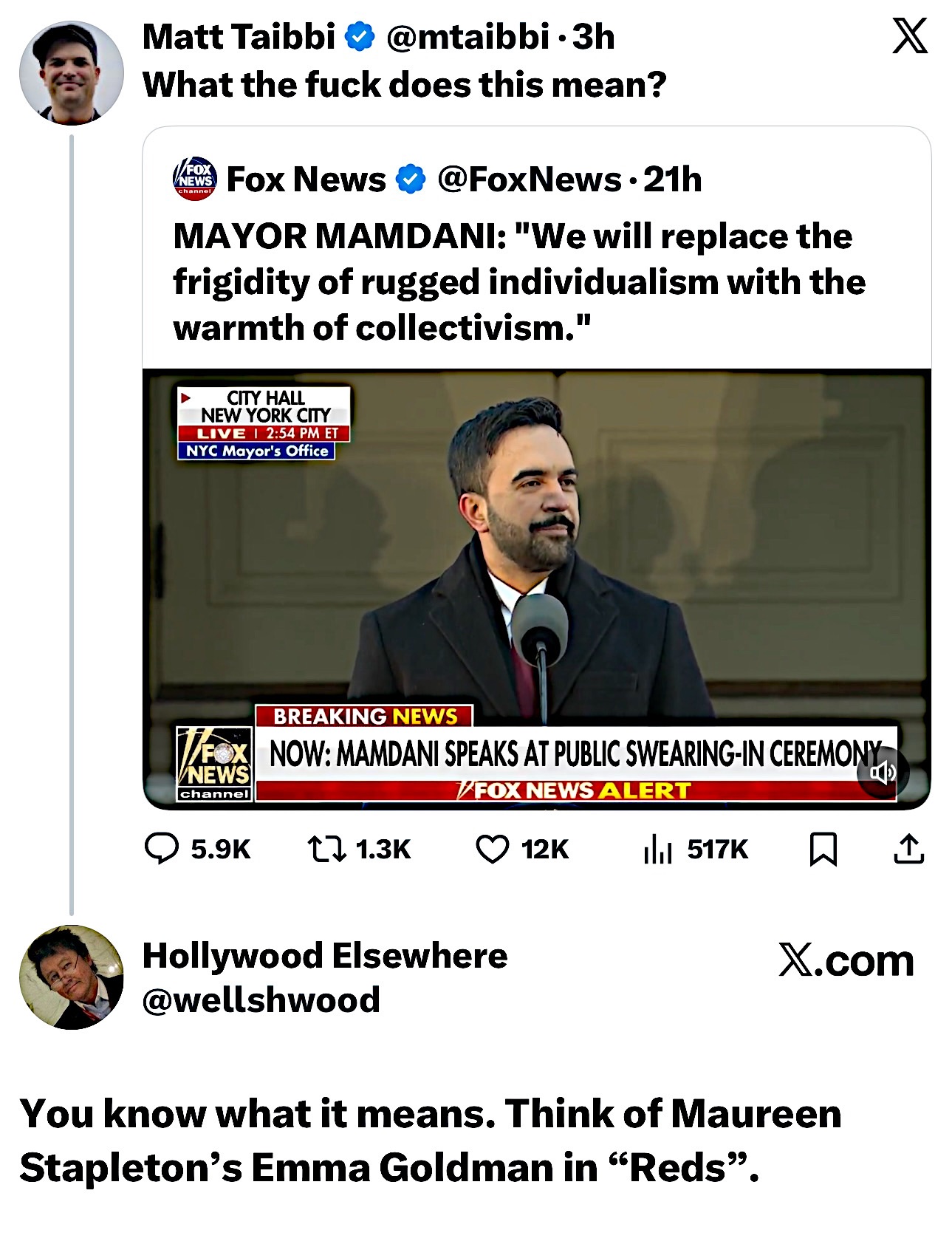
Letitia James: So let us begin and repeat after me… Zhoran Mamdani: (Places hand on the Quran) Letitia James: “I…” Zhoran Mamdani: “I…” Letitia James: “Zohran Kwame Mamdani” Zhoran Mamdani: “Zhoran Kwame Mandani.” Letitia James: “Do solemnly swear.” Zhoran Mamdani: “Do solemnly swear.”
And so on and so forth. Congrats to the new mayor of the five boroughs. But why did James begin by asking Mamdani to say the word “I”? Isn’t that kind of lame? If I’d administered the oath, I would have begun with…
Hollywood Elsewhere: “I, Zoran Kwame Mamdani, do solemnly swear…” Zhoran Mamdani: “I, Zoran Kwame Mamdani, do solemnly swear…” and so on.
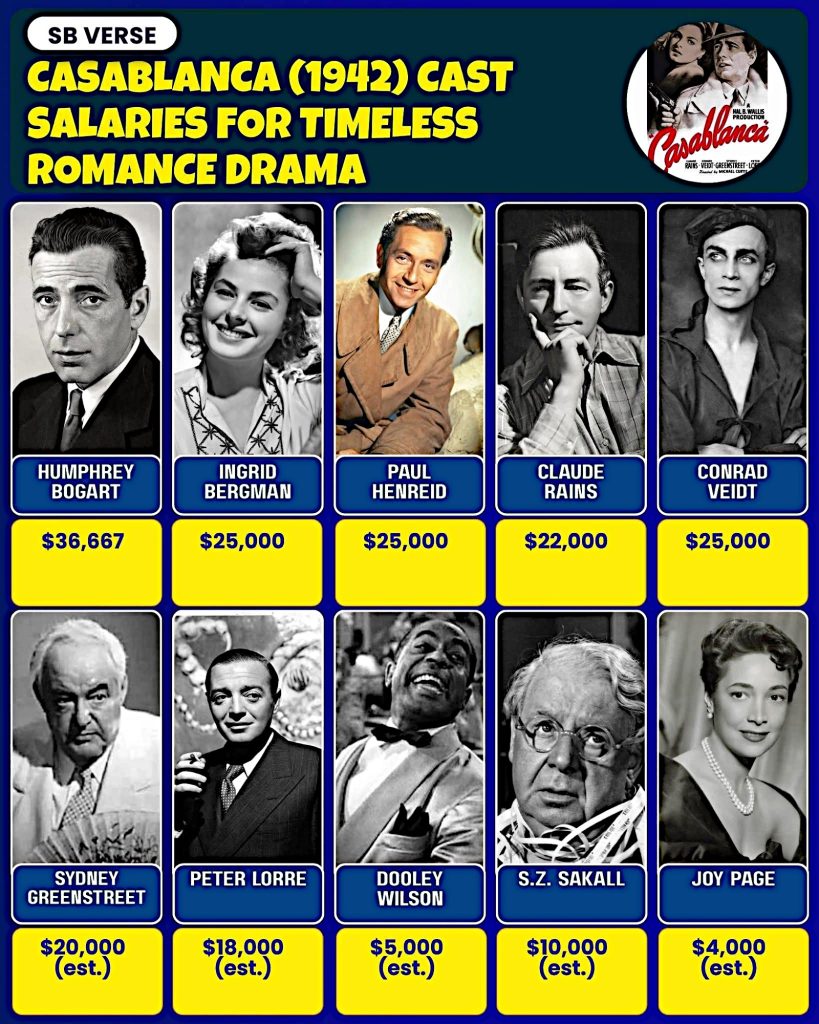
Dooley Wilson’s piano-playing “Sam” delivers most of the heart and soul in Casablanca. Humphrey Bogart, Ingrid Bergman and Paul Henreid aside, Wilson is one of the cast members you really and truly remember. He’s easily as vivid and prominent as thereasonablywell–paid Claude Rains and Conrad Veidt ($22K and $25K respectively) and yet Wilson snagged only a lousy $5K. Producer HalWallis almost certainly exploited Wilson’s situation to the hilt.
I can handle coldtemps in the low 40s and 30s, but forget the 20s and don’t even mention the teens. And no wind, for God’s sake! Half the time I dream about living in Key West or, better yet, Cuba or Belize or Turks and Caicos. I hate windy cold. Stuff of nightmares.
From Owen Gleiberman‘s obliging, carefully phrased review of Paul Feig‘s The Housemaid (Lionsgate, 12.19):
“The Housemaid [is] a movie of diabolical developments, and that’s what’s captivating about it. That, and Elizabeth Perkins’ droll performance as a mother-in-law from WASP hell, and the fact that in following the ins and outs that made the novel such a hit, the film creates an ideology of male-female relationships that’s at once timely, glibly mythological, and born to be milked by a Hollywood thriller.
“There’s a note of pop sadism at work in the material; The Housemaid features scenes of people terrorizing each other in violently gaudy ways. Yet the scenes don’t feel exploitative, because they express the characters’ drives, and the audience is hanging on the outcome. In the thick of awards season, when those of us in the media are busy nattering on about prestige films, this is the kind of stylishly tricky high-trash movie that can steal some of the limelight.
Indications are that Paul Feig‘s The Housemaid (Lionsgate, 12.19), based on Freida McFadden‘s three-year-old novel, a feminist potboiler that has since grown into a multi-book franchise, is going to be a bit of a groaner…perhaps even a forehead-slapper.
All feminist airport fiction is based upon a single premise, which is that the principal male character is a toxic piece of shit who has made his own bed and deserves all the bad karma that’s sure to come his way.
It certainly seems unlikely that Feig’s film will deliver the intrigue and complexity of Im Sang-soo‘s The Housemaid (’10), which I recall as being half-decent.
Both versions have vaguely similar plots with the husband banging (or at least looking to bang) the housemaid, and the wife freaking out and the usual blowback kicking in.
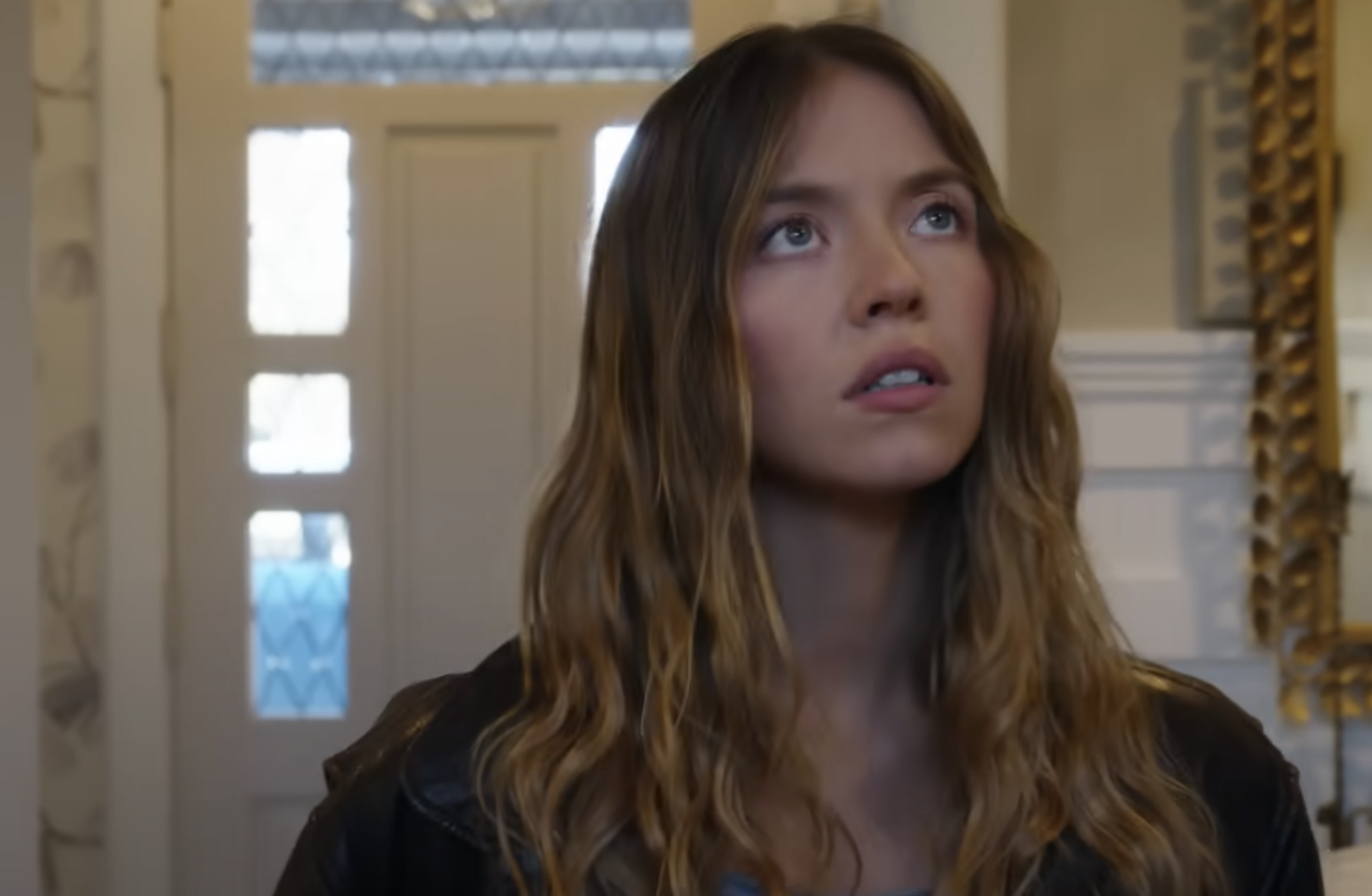
The Housemaid costars Sydney Sweeney as the titular character; Amanda Seyfried and Brandon Sklenar (the bearded, nice-guy suitor in It Ends With Us) are her wealthy employers.
No TV weather woman would freeze up like this, and the news show floor techs wouldn’t just stand there like frozen zombies. Seized by some kind of invisible force and not knowing why or how or anything, Emily Blunt would do her best to pretend that everything’s okay. She would improvise a little blah-blah, air some bullshit, etc.
Where are the UFOs, and where’s Carlo Rimbaldi when we really need him?
Sources have told People that Nick Reiner was allegedly acting erratically with guests at Conan O’Brien‘s Christmas party last Saturday night. Source: “Nick was freaking everyone out, acting crazy, kept asking people if they were famous.”
Us Weekly was told that the 32 year-old drug-susceptible asshole behaved “creepily” at O’Brien’s soiree, while a third insider told TMZ that Nick looked out of place at the party, wearing a hoodie when the dress code was formal.
And yet the prevailing view among comment-thread predators in yesterday’s “Odious Aftermath” discussion was that if an obviously disturbed youth is fated to kill his or her parents, it’s better for the parents to just say “okay, we accept this…bring it on”.
I was in a not-great, probably-going-nowhere place for a certain period in my early to mid 20s, but writing and journalism gradually lifted me out of that hole. Maybe a three-year period, give or take. Okay, call it four years. Hell, make it five.
I just barely crawled out of that attitude, that downward swirl kind of life, but while I was “under the weather” I could feel the weight of my vague gloom getting a bit worse each succeeding year.
Yes, I was drinking and drugging back then (pot, speed, Coors beer and Jack Daniels-and-ginger-ale were my constant companions, my beloved hermanos) but not — or so I’ve long told myself — to the point of any kind of insane self-destructive addiction. Thank God I had a certain inner decency or resolution of some kind within…some kind of fortunate spiritual inheritance, probably from my mother’s side of the family. Call it luck or God’s grace.
But to have lived in this kind of sinkhole for 17 years like Nick Reiner apparently has?….for more than half of a 32-year span of life? Forget it. You’re sunk. I’ve seen and felt that downhead vibe in others who never found their way out of the pit…some who just couldn’t turn things around and make something good or half-promising happen.
After 17 or so years of anguish Nick Reiner has finally found his catharsis. He’s murdered the people who brought him into this world and loved and nurtured him as best they could but ironically (or in Nick’s all-screwed-up head at least) never stopped making him feel depressed and enraged. He’s clearly a self-hater of epic proportions…a demonic figure.
Earlier today I slipped on a small patch of ice, my calves and ankles went flying and I came crashing down…whummp…whooof! But I bounced right back. No aching rib cage, no sprained wrists, no bruised elbows, no aching knees or snapped bones…nothing. My resilience amazes me, I’m branded on my feet, etc.
What saved me? I didn’t fall on hard frozen ground or asphalt or gravel or rocks, but upon a soft mound of snow.
I wasn’t so lucky in mid-February 2019 when I slipped and fell on an icy slope in the Sierras. Nothing was broken but my ribs ached like a sonuvabitch for a good two or three weeks.
I experienced a bulletproof moment last night. Fairly amazing. I fell on some ice and came crashing down on my right elbow, and nothing happened. I got right up and kept walking. My glasses were destroyed but no aches or scrapes, no bruises, no morning-after stiffness, no Advils…nothing. I could have theoretically busted my arm. A great feeling.
It was vaguely akin to that Pulp Fiction moment when John Travolta and Samuel L. Jackson are shot several times by a kid who bursts out of the bathroom and yet none of them are hit — all the bullet holes are in the wall behind them. This led Jackson to want to quit being a hitman and just “walk the earth” like Caine in Kung Fu, “meet all kinds of people, get into adventures.”
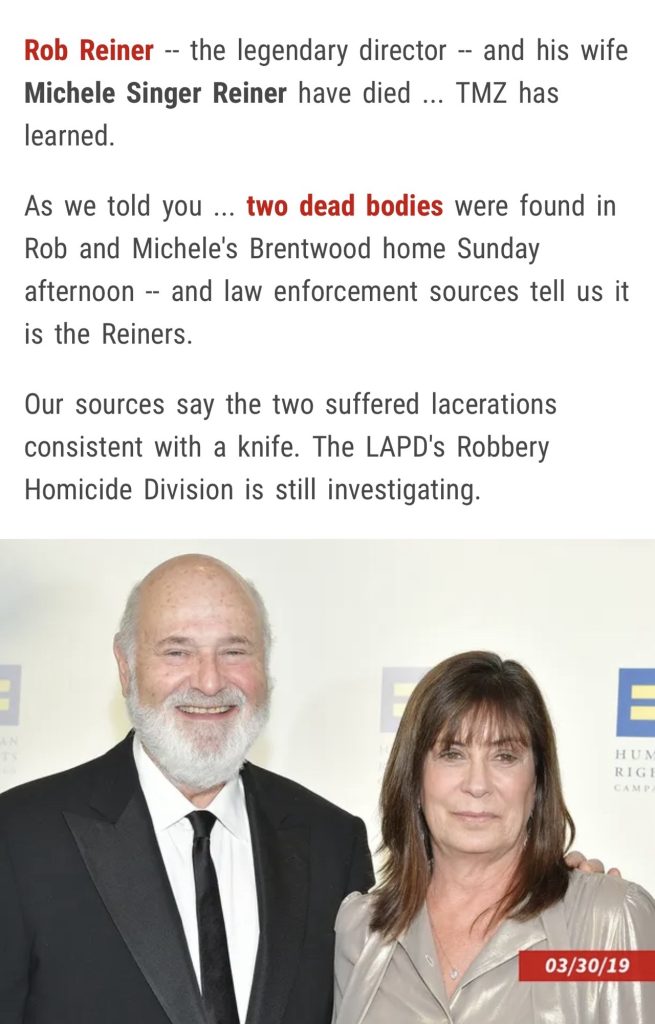
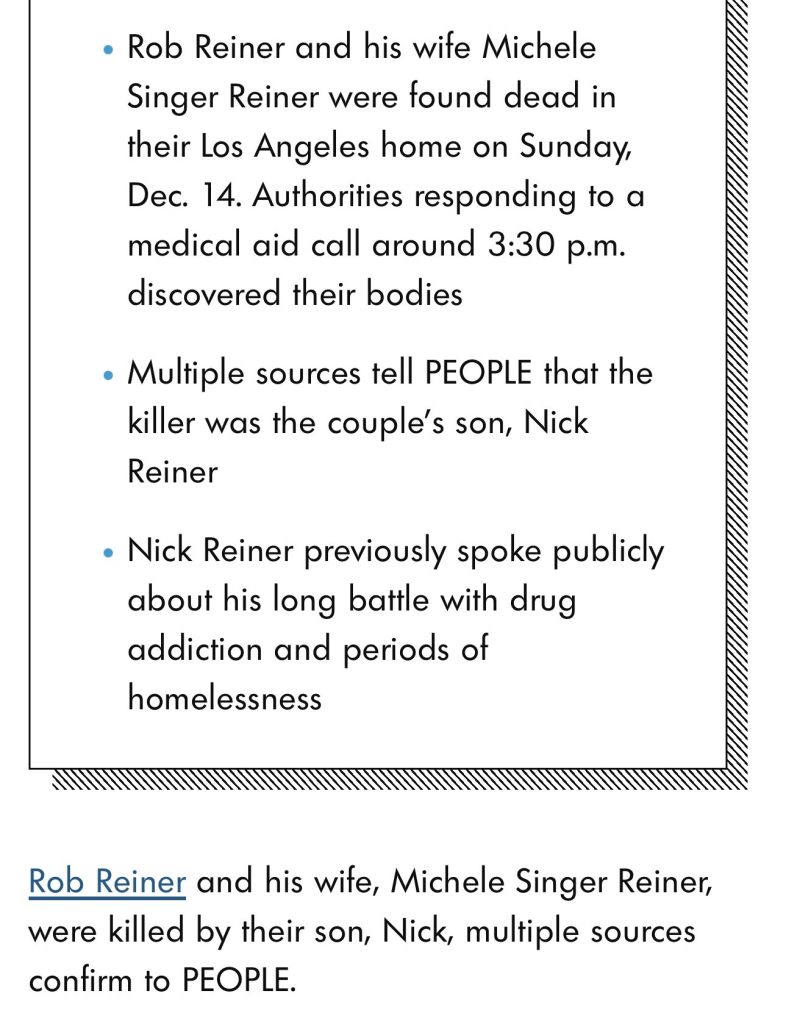
Rob Reiner…good God. Murdered. Late Sunday afternoon the famed director, 78, and his wife, Michele Singer Reiner, 68, were found stabbed to death in their flush Brentwood home on South Chadbourne Ave. (south of Sunset).
Reiner’s 32 year-old son Nick, who co-wrote BeingCharlie, a decade-old, well-intentioned family melodrama, directed by the elder Reiner and based on Nick’s own teenaged struggle with drugs and homelessness, has been identified as the assailant. BeingCharlie premiered at TIFF in September ‘15. Nobody saw it, a criticalbust. streaming on Fandango.
YouTubelink…this is getting more and more surreal.
10:45amMonday: Talk about psychotic and deranged behavior…PresidentTrump has posted that “anger” triggered by the elder Reiner’s intense, years-long criticism of Trump’s policies and impulsive style of governing was somehow a factor in his killing.
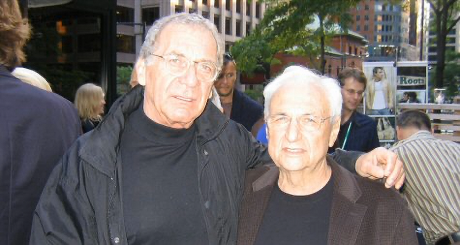
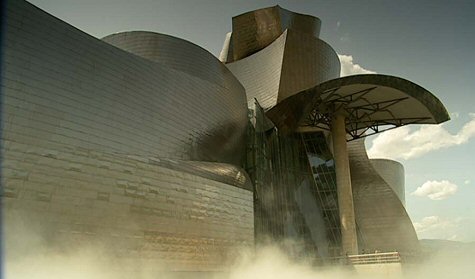
Legendary architect Frank Gehry died exactly a week ago at age 96. His spirit ascended from inside his home in Santa Monica. I don’t know why I didn’t jump on this right away as I’ve always loved Gehry’s creations and was deeply moved and honored to meet him in Toronto 19 years ago — a handshake at an outdoor cocktail party for Sydney Pollack‘s Sketches of Frank Gehry, on 9.10.06.
HE-posted 19 years ago: Sydney Pollack‘s Sketches of Frank Gehry (Sony Pictures Classics, 5.12.06), which I caught yesterday at a public screening at Toronto’s Elgin theatre, is a stirring, hugely likable portrait of the most daring and innovative architect of our time.
Corny as this sounds, Sketches left me with a more vivid feeling of celebration and with more reasons to feel enthused and excited about life than anything I’ve seen so far at this festival.
I knew a few things about Gehry before seeing this film, but not a whole lot. Now I feel like I know a few things. The man is the Pablo Picasso of architects. He’s a risk-taker who lives big and tosses the creative dice all the time and really goes for it. And I now know about his significant creations (the most famous being Disney Hall in downtown Los Angeles and a seaside museum in Bilbao, Spain), how he creates, who he mostly is, where he’s been.
Sketches is more than just a meet-and-understand-Frank-Gehry movie — it’s a contact high.
Here’s a discussion I did with Pollack about Sketches….apologies for the sound quality. Poor Sydney passed less than two years later (5.26.08).
It’s a film that lets you into the head of a genius in a very relaxed and plain-spoken way, and it lets you share in the sense of being a person of Gehry’s magnitude — a guy who has created a kingdom out of a supreme confidence in his dreams, but at the same time someone honest enough to admit he doesn’t precisely know what he’s doing much of the time.
This is partly due to Gehry having been very open and unguarded with Pollack as the doc was being shot, and partly due to Pollack having sculpted this film in a way that feels more personal and congenial and relaxed than your typical portrait-of-a-noteworthy-person movie.
And yet Pollack doesn’t relent in passing along all the information we need to know about Gehry. It’s all done with total thoroughness and clarity of purpose.
I met and spoke with Gehry and Pollack at a nice cocktail party on Wellington Street late yesterday afternoon, courtesy of publicist Amanda Lundberg. What a pleasure to hang with these guys. I left the party feeling wise and steady and optimistic about everything.
Sketches of Frank Gehry will air on the PBS “American Masters” series in late ’06, but Pollack first wants it to play theatrically. This should happen. I can see this film being an essential “see” with people of a certain stripe, and yet a ten year-old kid could watch it and understand almost everything.
I can only repeat that the film is much more than just a sturdy documentary — it’s a profound turn-on. I’ve looked at Gehry’s buildings and designs — those weirdly bent and sloping pieces of steel and sheet metal and glass and what-have-you — but I never really “saw” them until yesterday.
There’s a wonderful edit right at the beginning of the film, which I won’t spoil by describing in too much detail. Suffice that it takes Gehry’s doodly drawings and brings them into full-metal aliveness in a single stroke.
There’s another delicious moment when Julian Schnabel is asked about Gehry’s press critics, and he refers to them as “flies on the neck of a lion…they’re the sort of people who complain that Robert Duvall’s character in Apocalypse Now is over the top.”