
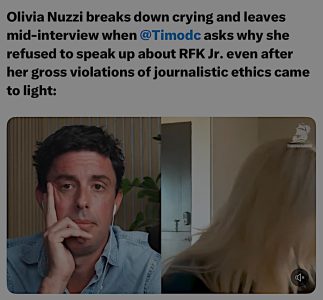
Just watch this short clip and tell me you don’t recoil in disgust. Olivia Nuzzi is a diabolical person. The sooner she is out of the public discourse, the better. pic.twitter.com/UsvraidmQZ
— John Jackson (@hissgoescobra) December 3, 2025
.@Timodc: "He's being nominated to HHS Secretary…You had information that you could have shared…and you didn't share anything about him. Why? Did you still love him?"@Olivianuzzi: "I don't know how to responsibly handle this on camera."
Tim: " You admit in the book that… pic.twitter.com/FE2Yv2DKDM
— The Bulwark (@BulwarkOnline) December 3, 2025
Friendo: “I don’t know what Joe Popcorn will make of Marty Supreme (A24, 12.25) but I can tell you this: the critics can’t be trusted. Generally I mean but especially regarding this Josh Safdie puppy.
“I tried to watch it last night, but I bailed after the bathtub fell through the roof and seriously harmed the old man and his dog. Two friends who were watching it with me bailed after this scene. It’s not bad, it’s just…I don’t know…frenetic, monotonous, obnoxious…kinda like Uncut Gems.”
By the way: It can at least be said that Albert Brooks‘ performance as a retiring governor (aka “Governor Bill”) in James L. Brooks‘ Ella McCay is…uhm, not too bad. A guy who’s seen it says “yeah, he’s not embarrassing. But most of the film is cringe.” The 20th Century release opens on 12.12.
Posted on 9.10.19: “Uncut Gems is a full-barrelled, deep dive into the realm of a manic, crazy-fuck gambler (Adam Sandler), and yes, it ‘feels like being locked inside the pinwheeling brain of a lunatic for more than two hours,’ as Peter Debruge wrote.
“And guess what? It’ll make your head explode and drive you fucking nuts. By the time it’s over you’ll be drooling and jabbering and gasping for air.
“And yet Uncut Gems has a 100% rating on Rotten Tomatoes. In other words not one person so far feels as I do. And I’m telling you the truth, mon freres. Which is why you can’t trust “critics”, per se. Because they’re all living in their own little fickle cubbyholes while Hollywood Elsewhere is standing tall and firm with its feet planted on the sidewalk and looking dead smack at cosmic reality each and every minute of every day…no let-up.
Everyone but everyone loves Marty Supreme, but a lot of the praisers are go-along whores. It should be of some concern to the Supreme team that Time‘s Stephanie Zacharek is not a fan.
“Critics have a duty to be clear with readers,” Marshall Fine has written in a 4.12 essay. “Not to warn them, per se, because that implies something about relative merit. But to be clear or honest [when the case applies]: This is a movie in which nothing much happens. Or this is a movie in which what does happen doesn’t make a lot of sense. Or is deliberately off-putting or upsetting.”
I am one of the few critic-columnists who actually says stuff like this from time to time. But I disagree with Fine siding with the virtues of audience-friendly films, particularly when he uses Brian Helgeland‘s 42 as a sterling example.
“You know what an audience-friendly film is,” Fine writes. “It tells a story that engages you about characters you can like and root for. {And] yet movies that seek to tell a story that uplifts or inspires often get short shrift from critics. 42 is being slagged by some critics for being manipulative, [but it] happens to be a well-made and extremely involving story about an important moment in history.”
Wells response: 42 is okay if you like your movies to be tidy and primary-colored and unfettered to a fault, but it’s a very simplistic film in which every narrative or emotional point is served with the chops and stylings that I associate with 1950s Disney films. The actors conspicuously “act” every line, every emotional moment. It’s one slice of cake after another. Sugar, icing, familiar, sanctified.
One exception: that scene in which Jackie Robinson is taunted by a Philadelphia Phillies manager with racial epithets. I’m not likely to forget this scene ever. It’s extremely ugly.
Back to Fine: “The fact that 42 works on the viewer emotionally, however, is often seen as a negative by critics who aren’t comfortable with movies that deal with feelings, rather than ideas or theories.” There’s an audience, Fine allows, for nervy, brainy and complex films like To the Wonder, Upstream Color, Room 237, Holy Motors and The Master. But “all of those are not audience-friendly,” he states. “Most of them were barely watchable.
But if you read the reviews, you would find little that’s descriptive of what the movie actually looks or feels like while you’re watching it. Which, for a lot of people, was a negative experience in the case of those particular titles. “How many people saw them because of positive reviews that were misleading? How many might have thought twice if the review mentioned that, oh, well, this film is all but incomprehensible, even if you’ve read a director’s statement on what it means? Or, well, this movie has very little dialogue and takes a 20-minute break for a flashback to the beginning of time? Or this movie is about an inarticulate movie star caught in moments by himself during a movie junket?”
Wells response: I also think that critics should just say what it’s like to watch certain films. If a film is great or legendary or well worth seeing they need to say that, of course, but they also have to admit how it plays in Average-Joe terms and how it feels to actually sit through it. I’m not saying “nobody does this except me,” but who does do this? New Yorker critic David Denby strives to convey this, I think. Andy Klein does this. I’m sure there are others. But I know that it’s a clear violation of the monk-dweeb code to speak candidly about how this or that monk-worshipped, Film Society of Lincoln Center-approved film actually plays for non-dweebs or your no-account brother-in-law or the guy who works at the neighborhood pizza parlor.
Guys like Dennis Lim will never cop to this. It also needs to be said that “audience-friendly” is a somewhat flattering term. The more accurate term is audience-pandering. Pandering to the banal default emotions that the less hip, more simple-minded and certainly less adventurous portions of the paying public like to take a bath in. Because these emotions are comforting, reassuring, and above all familiar. That is what 42 does, in spades.
The sublimely gifted Tom Stoppard, the Czech-born, British-seasoned author of Rosencrantz and Guildenstern Are Dead (’66), Jumpers (’72), Travesties (’74), Night and Day (’78), The Real Thing (’82), Hapgood (’88), Arcadia (’93), The Invention of Love (’97), The Coast of Utopia (saw it at the Vivian Beaumont in ’07), Rock ‘n’ Roll (’06) and Leopoldstadt (’20)….one of the greatest fellows I’ve ever “known”, so to speak, has passed at age 88.
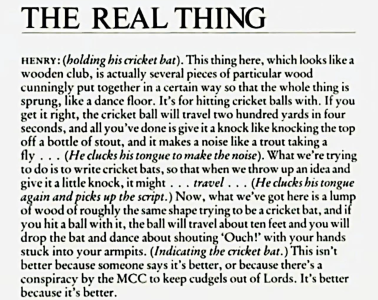
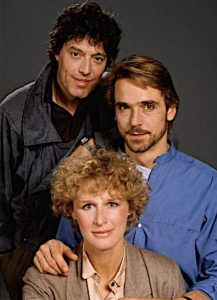
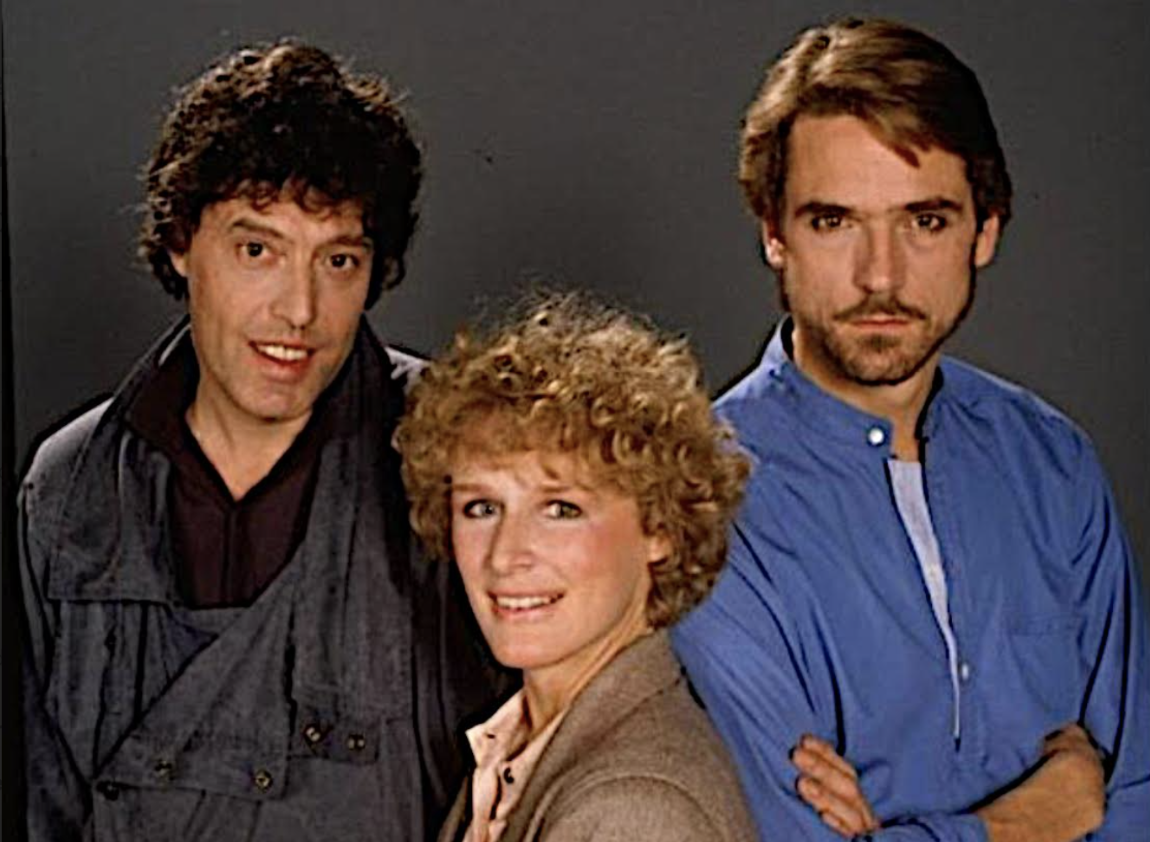
Posted on 10.16.22: The Reagan-era play that lifted me up and melted me down like none before or since was Tom Stoppard‘s The Real Thing (’84).
“Sappy as this sounds, it made me swoon. Okay, not ‘swoon’ but it struck some kind of deep, profound chord. Partly because I saw it at a time when I believed that the right relationship with the right woman could really make a difference. That was then and this is now, but I was in the tank for this stuff in ’84. The play used the Monkees’ “I’m A Believer” as mood music, and I pretty much was one at the time.
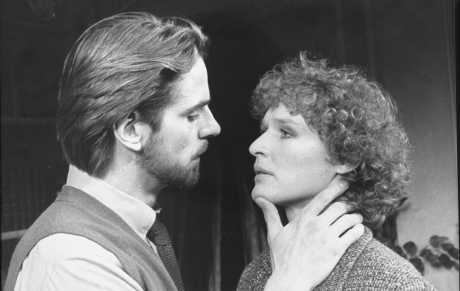
“I’m speaking of the original B’way production, of course, directed by Mike Nichols and costarring Jeremy Irons and Glenn Close. My admiration for Irons’ performance as Henry, a witty London playwright who resembled Stoppard in various ways, was boundless. Close, whom I was just getting to know back then, was truly magnificent as Annie.”
N.Y. Times critic Frank Rich called it “not only Mr. Stoppard’s most moving play, but also the most bracing play that anyone has written about love and marriage in years.”
“Love has to do with knowing and being known. I remember how it stopped seeming odd that in biblical Greek, knowing was used for making love. Whosit knew so-and-so. Carnal knowledge. It’s what lovers trust each other with. Knowledge of each other, not of the flesh but through the flesh, knowledge of self, the real him, the real her, in extremis, the mask slipped from the face.
“Every other version of oneself is on offer to the public. We share our vivacity, grief, sulks, anger, joy…we hand it out to anybody who happens to be standing around, to friends and family with a momentary sense of indecency perhaps, to strangers without hesitation. Our lovers share us with the passing trade. But in pairs we insist that we give ourselves to each other. What selves? What’s left? What else is there that hasn’t been dealt out like a pack of cards?
“[The answer is] carnal knowledge. Personal, final, uncompromised. Knowing, being known. I revere that. Having that is being rich, [so] you can be generous about what’s shared — she walks, she talks, she laughs, she lends a sympathetic ear, she kicks off her shoes and dances on the tables, she’s everybody’s and it don’t mean a thing, let them eat cake.
“Knowledge is something else, the undealt card, and while it’s held it makes you free-and-easy and nice to know, and when it’s gone EVERYTHING IS PAIN. Every single thing. Every object that meets the eye, a pencil, a tangerine, a travel poster. As if the physical world has been wired up to pass a current back to the part of your brain where imagination glows like a filament in a lobe no bigger than a torch bulb. Pain.”
— from Tom Stoppard‘s The Real Thing, directed by Mike Nichols and costarring Jeremy Irons and Glenn Close. It opened at the former Plymouth Theatre (now the Gerald Schoenfeld Theatre) on 1.5.84.
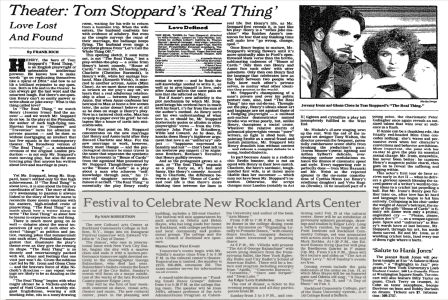
Frank Rich’s N.Y. Times review, 1.6.84.
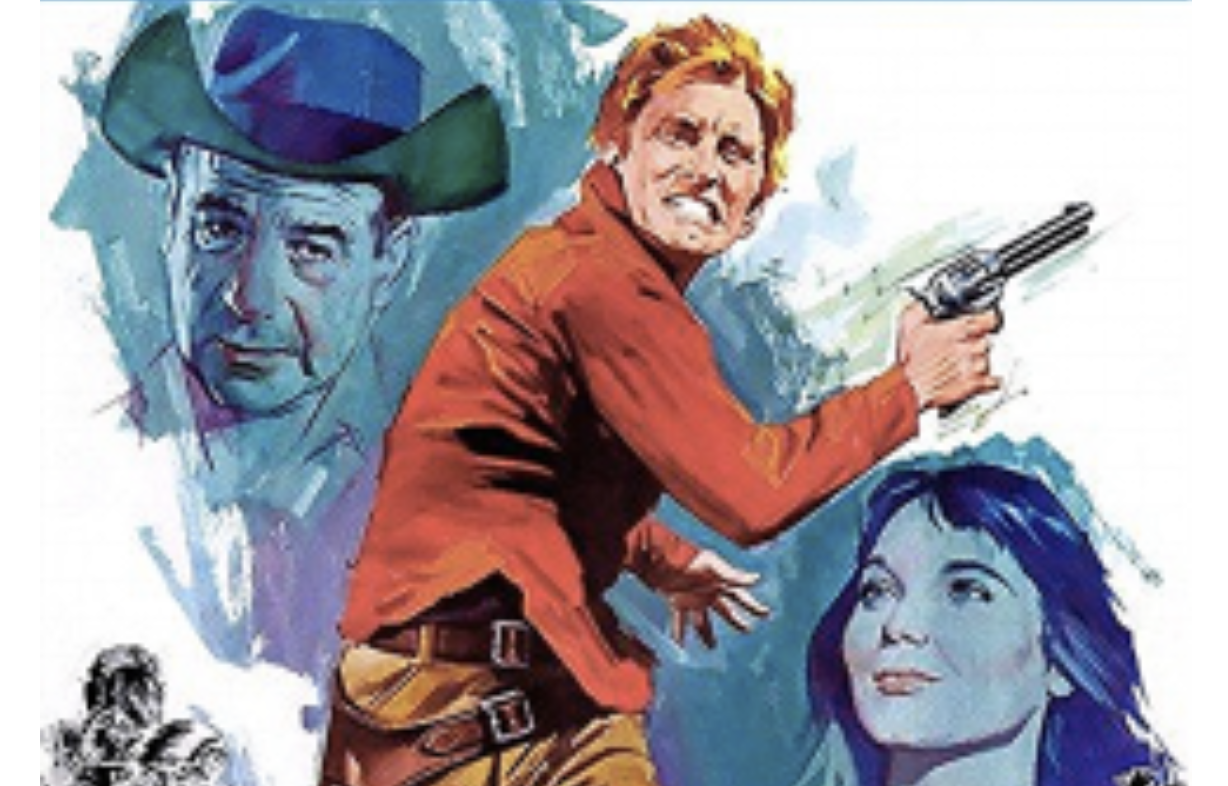
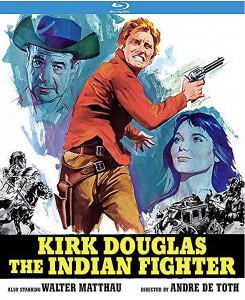
The Indian Fighter (United Artists, 12.21.55) was a passable-but-no-great-shakes western, starring Kirk Douglas and directed by Andre de Toth. It served the usual brawny action stuff in eye-filling CinemaScope, but the main hook was the sexual rapport between the 39-year-old Douglas and the 20 year-old Elsa Martinelli, a native of Tuscany and a fashion model, playing a willing Sioux squaw.
Douglas was a legendary hound, of course, and given the fact that (a) he hired Martinelli after seeing her photo on a European magazine cover, and (b) his company, Bryna Productions, produced The Indian Fighter, you can guess what happened off-screen.
12.22.55 N.Y. Times review excerpt: “Douglas’s Johnny Hawks, a free soul, thinks nothing of detouring a wagon train he is leading towards Oregon in order to keep a nocturnal tryst with the chief’s comely daughter; and only one reel before he nearly had succumbed to the blandishments of an equally beauteous widow.
“It must be noted of course, that the script by Ben Hecht and Frank Davis has a fair sense of humor, and that the forests and mountains of Oregon, where this fiction was filmed, are sweeping and picturesque in color and CinemaScope.
“In the brunette Elsa Martinelli, who plays the Indian lass with a minimum of words and a maximum of feline grace, Mr. Douglas has come up with a pretty photogenic newcomer.
“Eduard Franz as Chief Red Cloud, Walter Matthau and Lon Chaney as the bad men of this escapade, Diana Douglas as the marriage-minded widow and cavalry officer Walter Abel do not contribute spectacular performances.
“But Mr. Douglas’ characterization is properly muscular. As a hard though not faultless gent, he sits a horse well, looks great in buckskins and sometimes gives the impression that he could take over a pioneer’s chores. Mr. Douglas has not blazed a cinema trail with The Indian Fighter, but he has come up with a sturdy entertainment that should please the action fans.”
But what would Ken Burns say?
I’ll be catching my second viewing of Hamnet fairly soon, but based upon my first viewing I don’t recall many specifics about the demanding, burdensome life of William Shakespeare. Until the film’s final third, I mean, which is when your under-educated Joe and Jane Popcorn viewers begin to understand that he’s doing well as a combination playwright, director and actor.
Maggie O’Farrell and Chloe Zhao‘s script mainly focuses on how things were in Stratford-upon-Avon for Shakespeare’s eight-years-older wife, Agnes Shakespeare (aka Anne Hathaway), and particularly the arduous responsibilities and domestic family strife that Agnes/Anne had to cope with.
But not much is offered about Will, who, for half or two-thirds of the film, is off galavanting in London doing God-knows-what but was actually working on the writing and performing of his plays. This is what an under-educated viewer might gather or infer.
The film offers damn few specifics about Mr. Shakespeare, particularly (a) his living situations in London, (b) his work habits (i.e., did he write most of his plays in Stratford-upon-Avon or in London?…apparently the former but the film is vague), (c) his all-around success as a playwright beginning in the early 1590s (he wrote and produced most of his plays between 1589 and 1613), and (d) Shakespeare becoming wealthy enough to purchase, at age 33, a sizable, bordering-on-grandiose family home in Stratford, known as New Place, which he bought for about 120 pounds in 1597.
Shakespeare purchased New Place roughly a year after the death of his 11-year-old son, Hamnet Shakespeare, who had succumbed to the plague.
If Hamnet acknowledges the purchase of New Place, I missed it due to muttered speech or murky dialogue, or a combination of the two.
London and Stratford-upon-Avon are roughly 100 miles apart. In the 1590s, travel between these cities would take about 2 to 3 days by horse, or 4 to 5 days on foot. For some reason horse-drawn carriages were much slower, taking around 10 days.
A general lack of sanitation caused the bubonic plague and Black Death, which “swept through Asia, Europe, and Africa in the 14th century and killed an estimated 50 million people, including about 25% to 60% of the European population,” the Wikipage says.
London had no working sewer system. Waste was often dumped in streets or rivers, contributing to a general foulness and stench.
Shakespeare’s most notable London residences were in the St. Helen’s parish (near the modern-day Lloyd’s Building) and later on Silver Street, near St. Paul’s Cathedral. He also lived briefly in Southwark near the Globe Theatre. Will purchased his first London home in the Blackfriars area in 1613. He moved back to Stratford-upon-Avon that same year. He died three years later at age 52.
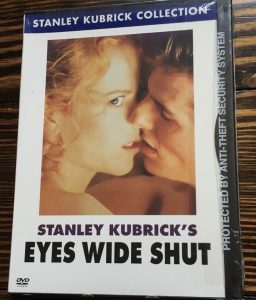
IndieWire‘s Ryan Lattanzio has interviewed Larry Smith, the Eyes Wide Shut dp who more or less orchestrated the outrageous teal distortion of Stanley Kubrick‘s final film.
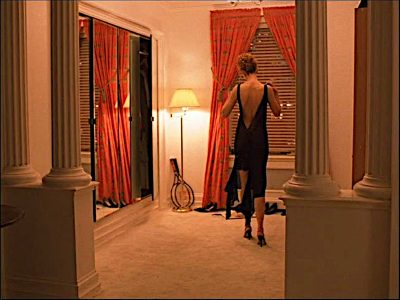
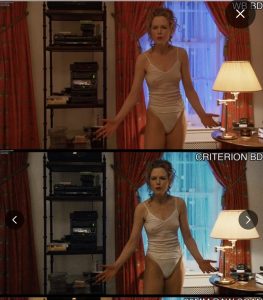
Color-grading-wise, the just-released Criterion 4K Bluray version is, I strongly feel, an abomination.
Lattanzio: “Cinephiles who got an early look at the new 4K transfer took issue on social media with the ‘teal’ color-grading on many of the bedroom and nighttime scenes. Is what we are seeing on the Criterion edition what people saw in theaters on a 35mm film print?”
Smith: “I’m assuming a lot of these people either have the original DVD or they’ve seen it somewhere…normally, people who comment on these are people who know the film really well, so you have to take on board that they do know a little bit about what they’re talking about.”
HE to Smith: “Yeah, I know ‘a little bit’ about what I’m talking about. I saw Eyes Wide Shut once and then a second time when viewings began in the summer of ’99, or so I recall, on the Warner Bros. lot. I’ve also caught it on DVD, Bluray and streaming.
“You and Criterion’s Lee Kline have murdered the original nocturnal-blue, amber-accented window lighting, and you’ve distorted many other blue-and-golden-amber tints in an entire array of stand-out moments.”
Smith: “Or it could be that they’ve seen really bad prints of it in the past, or when they last saw it.”
HE to Smith: “Bullshit — I saw a fresh, scratch-less 35mm print on the WB lot, and while I didn’t care for the grainstorming the colors struck me as more or less perfect. EWS wasn’t supposed to look distorted or, for that matter, un-natural. It was intended to look like a pretty but unreal world of hauntings, suspicions, spooks, pervos, paranoia and tingly undercurrents.”
Smith: “Stanley died before he could color-grade this movie, so the somebody else [who stepped into the breach] probably wasn’t qualified, then you’re going to get the final answer print and the DVD to be not as good as they could or should be.”
HE to Smith: “Bullshit — you’re a vandalizer, a distortionist. Your name will live in infamy.”
Smith: “If people are wedded to [a certain] look of the film over [the last 26 or so years], then that’s what they’re used to, then of course, when they see this version, it’s gonna jump for some people. [But] it should jump in a more enjoyable way. It doesn’t change the plot; it’s just visually, I hope anyway, more interesting to see. Less grain, the highlights are not too bright. We pulled back maybe a couple things here and there that [Stanley] would’ve done anyway for sure.”
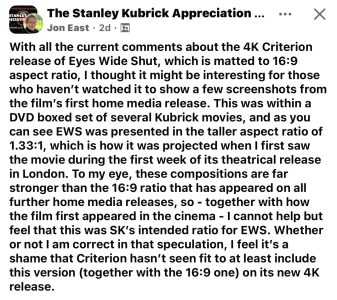
Smith tells Latttanzio that with the exception of the large-format Spartacus and 2001: A Space Odyssey, Kubrick “only shot in one format, [which was] 1.85…that was his preferred aspect ratio.”
Complete bullshit, Larry!
Kubrick understood the unfortunate necessity of having to allow for 1.85 projection, but he was a boxy aspect ratio guy all the way. I love the boxy versions of all his major films, and am very much looking forward, by the way, to Criterion’s forthcoming 4K Lolita Bluray, which will presumably be presented in 1.37, as this is how Criterion presented Kubrick’s 1962 film on a CAV laser disc back in the early ’90s.
Larry Smith has no honor in this realm. He’s certainly not truthful. To go by his various statements and distortions and sidesteppings, he sounds to me like a bullshitter, plain and simple.
Give Lattanzio credit for at least raising the teal issue.
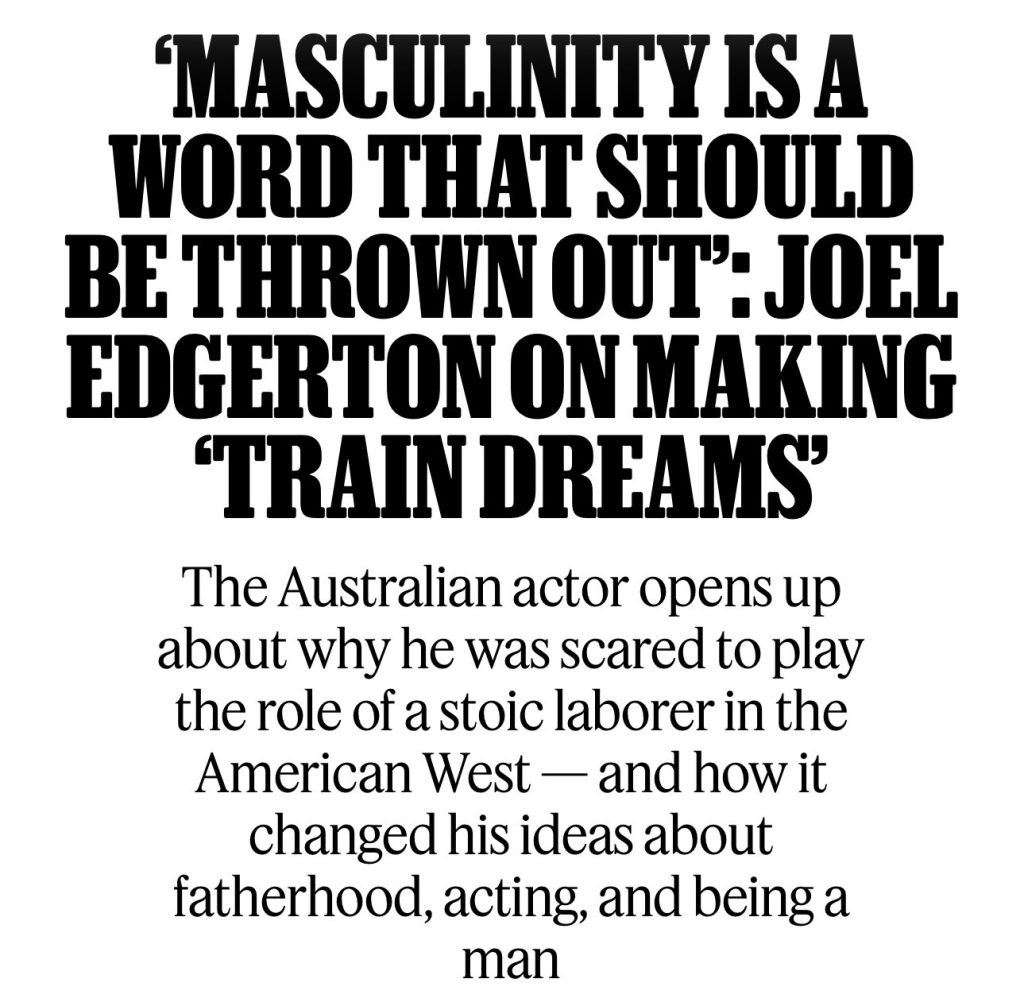
Okay, that’s it — Joel Edgerton has just slit his own throat, Oscar-nomination-wise. He’s finished, and he did it all to himself.
Edgerton simply doesn’t get it. The absence and/or the diluting of strong, confident masculinity is what’s wrong with Hollywood films. This is why Joe and Jane Popcorn despise Hollywood types. Edgerton is lost…he thinks it’s 2020 or ’21 or ’22. Things are different now. The winds have shifted.
Edgerton’s disparaging of masculinity wasn’t that different from what the wimpy, squishy, oh-so-sensitive Paul Mescal said during last May’s Cannes Film Festival. “[Notions of masculinity] are ever shifting,” Mescal mewed. “I think maybe in cinema we’re moving away from the traditional, alpha, leading male characters.” HE to Mescal: “You contemptible little candy-ass…nothing would give me more pleasure than to sharply slap the side of your fecking head, Lee Ermey-syle.”
Apparently the late, great Paul Newman once passed along a rock-steady cinematic truth — one that rivals Howard Hawks’ declaration that all award-worthy films have “at least three great scenes and no bad ones.”
Newman’s Law states that all first-rate, award-worthy or at least commercially successful films start and end with a certain gravitational punch or pizazz. They grab the audience during their opening 15 minutes, and then really bring it home during the final 15. If the opening and the closing deliver the right stuff, the film is a keeper.
Like The Wild Bunch, say. Or Dr. Strangelove or Out of the Past or From Here to Eternity or The French Connection or The Exorcist or The Best Years of Our Lives or Paths of Glory or Viva Zapata or…
Think of The Hustler’s opening sequence (Newman and Myron McCormack using subterfuge to take several tavern patrons) and the 15-minute finale (Newman beats Jackie Gleason, has it out with George C. Scott over the death of Piper Laurie).
Or Butch Cassidy and the Sundance Kid (beginning with Robert Redford being accused of cheating at poker, “hey, kid…how good are ya?”, and closing with that doomed, small-town shoot-out with Mexican militia).
Or The Verdict (alcoholic Newman enduring the humiliation of ambulance-chasing vs. semi-sober Newman’s big jury sermon + the jury finding for the plaintiff and against St. Catherine’s).
How does Newman’s Law apply to One Battle After Another? As much as I hate admitting this, Paul Thomas Anderson’s agitprop film does the double bang — a great opening 15 or 20 with the French 75 pulling off an immigration-camp raid, and a great car-chase finale out in the barren rolling hills.
How does Newman’s Law apply to Hamnet? It doesn’t because the effectiveness of Chloe Zhao’s drama is all about the final 15 — the opening 15 don’t really do the drill.
Sentimental Value delivers Newman satisfaction because it more or less begins with Renate Reinsve’s stage-fright breakout, and ends with a sound-stage filming scene that ties it all together.
Name one classic film (critically approved or popular with the mob) that doesn’t deliver the Newman.