Warring Themes & Sensibilities

Three days ago Paul Schrader, having just caught a theatrical showing of Apocalypse Now: Final Cut, said it’s basically a film at war with itself by trying to be two things at once.

“It’s like vibrating under the spell of juiced-up, pro-war amphetamines while, in the distance, hearing a dour somewhat confused country preacher declaiming war’s evils,” Schrader wrote on Facebook.

A filmmaker friend interpreted this to mean (although Schrader didn’t seem to actually be saying this) that there can be no such thing as an actual “antiwar film” because if your battle footage is depicted with any realism or honesty, it’s impossible not to convey the exhilaration of surviving an armed conflict (alluded to by that famous Winston Churchill quote about “nothing in life [being] so exhilarating as to be shot at without result”), and that this tends to neutralize any intended antiwar import.

Put more simply, if your war film seems to echo or confirm Churchill’s recollection, which is probably all but impossible, you can’t really make an “antiwar film.”

HE to filmmaker friend: “I don’t agree. The exhilaration of combat aspect has been understood since the first accounts of the military campaigns of Alexander The Great (Diodorus Siculus, Quintus Curtius Rufus), and certainly since Plutarch wrote about the adventures of Julis Caesar.

“But these and other accounts through the centuries (including Stanley Kubrick‘s Paths of Glory) have never negated the fact that the nature of war is to slaughter and destroy — to deliver horror and pain and misery en masse…to inflict cruelty without mercy, at least as far as the enemy is concerned. How can any honest depiction of this not be antiwar-ish?”

Schrader also said something that’s very clear and true about Apocalypse Now, which is that “the schizophrenic nature of the film goes back to the script itself. John Milius‘s original script was all bravado and gung ho crazy. Francis has the opposite sensibility. The Ride of the Valkyries, the surfers, the bunnies — that’s Milius. The Michael Herr narration, the plantation exposition, the meditations on evil — that’s Coppola.”
“Mistah Koch, He Dead”

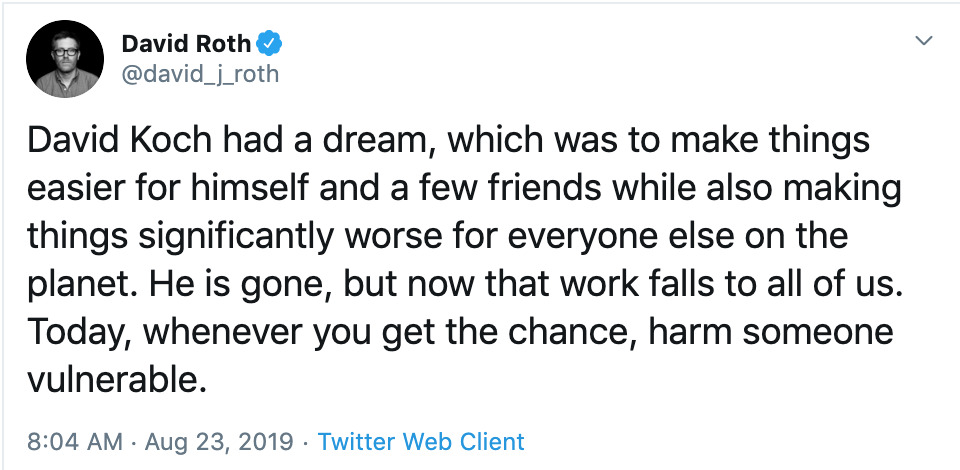
CBC Reporter: “What are the Koch brothers trying to achieve?” Jane Mayer, author of “Dark Money: The Hidden History of the Billionaires Behind the Rise of the Radical Right“: “They are very, very strident libertarians who want to shrink the government, reduce taxes, particularly their own taxes…they’re the biggest producers of toxic waste in America, and they’re also among the bigger polluters in terms of air pollution, water pollution and climate pollution.”

In short, along with his brother Charles, David Koch was the primary sponsor of climate-change doubt in the United States.

Read more

No Way To See A Movie

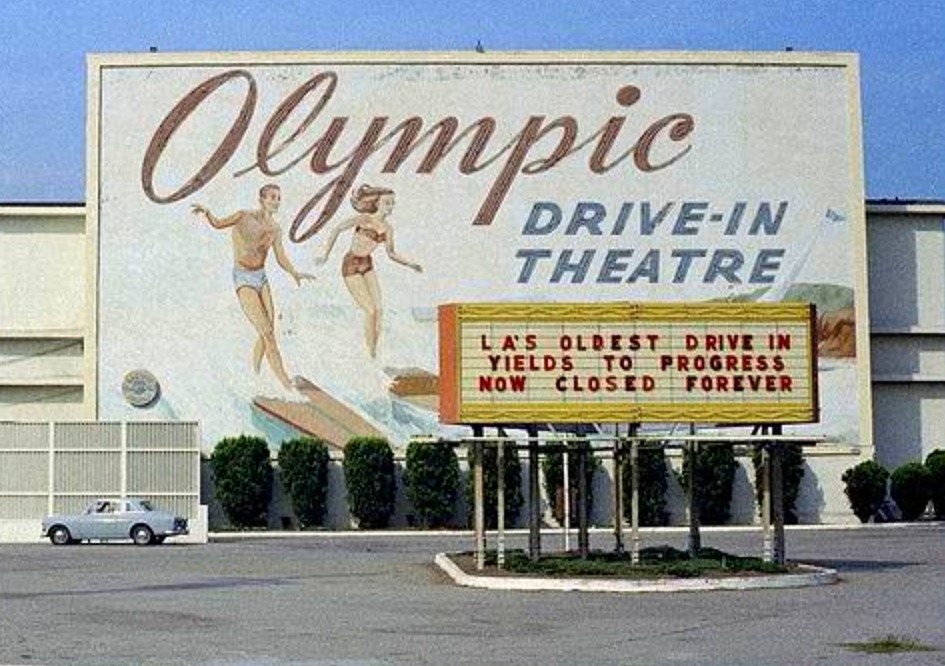
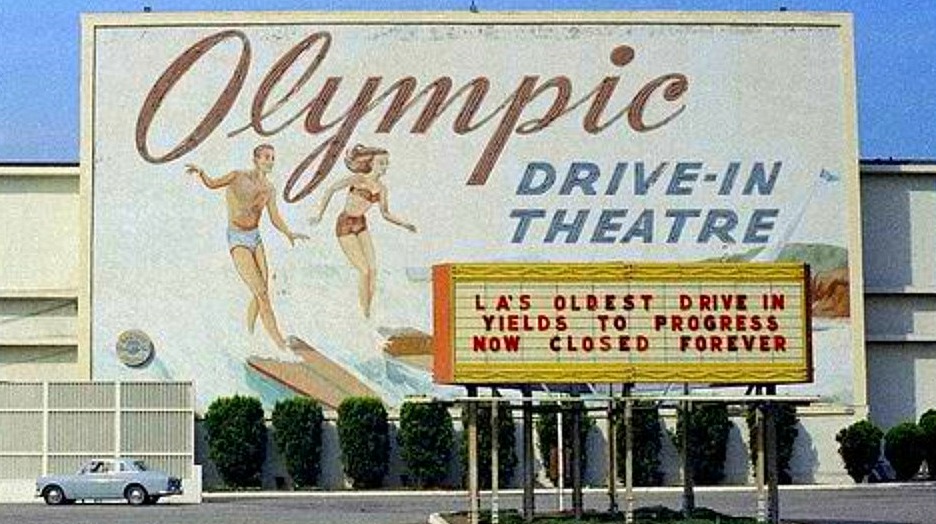
As recently as 1973 there was a drive-in theatre at the corner of Olympic and Bundy. Really. It was called (wait for it) the Olympic Drive-In. The street-facing side of the screen featured a mural of a 20something couple riding a wave. It opened on 4.4.45 and closed on 10.14.73.

The last time I even contemplated the memory of drive-in theatres was when I was watching that abandoned drive-in shoot-out scene in Michael Mann‘s Heat, which was 24 years ago.

The last time I saw a film at a drive-in was sometime in the early to mid ’80s. I think it was a Bob Zemeckis film (Used Cars or Romancing The Stone). Somewhere in the northern Burbank area, or in North Hollywood. My first drive-in experience was with my parents, somewhere in the vicinity of Long Beach Island on the Jersey Shore.

I’m kind of surprised to learn that 330 domestic drive-in theatres were in business as of two years ago. But only in podunk backwaters that nobody’s heard of, much less visited. Carthage, Missouri. Middle River, Maryland. Newville, Pennsylvania. Honor, Michigan. Russellville, Alabama. Sterling, Illinois. Driggs, Idaho. Lakeland, Florida.

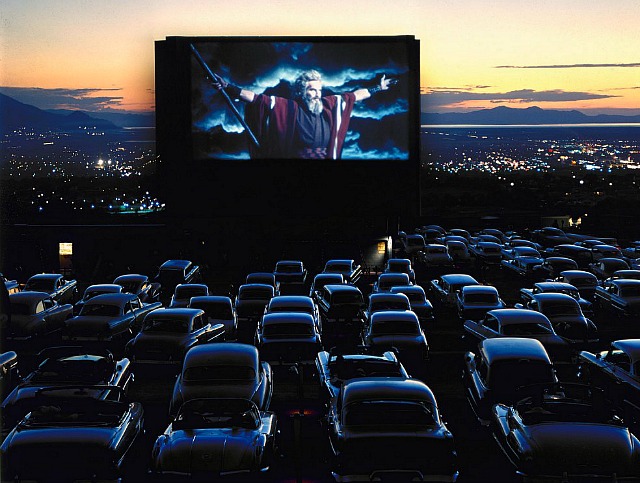
Earlier today: I respect the affectionate feelings that some have shared about the drive-in experience, and I love the Americana aspect of drive-ins (those iconic images of ‘50s and ‘60s films playing to an army of classic Chevys, Impalas, Ford Fairlanes and T-Birds), and let’s not forget the most common aspect, which was the sexual stuff (mostly second-base and third-base action).

But if you cared even a little bit about Movie Catholic viewing standards (as in decent sound and tolerable light levels, and no headlights hitting the screen every five minutes) ) you avoided drive-ins like the plague. You went to drive-ins for the car sex, and you brought your own beer.

Wise guy to HE: “‘And let’s not forget the most common aspect, which was the sexual stuff (mostly second-base and third-base action).’ I guess this explains the affection for Elton John ballads. You really are from Connecticut, aren’t you?”

HE to Wise Guy: “What are you saying, that people actually got laid at the drive-in? Some did, I guess. But they sure kept it a secret.”

Read more

Honest “Report” Thoughts

Scott Z. BurnsThe Report (Amazon, 11.5 theatrical, 11.29 streaming) is a diligent but sanctimonious film about the brave, herculean and arduous effort by Senate staffer Daniel Jones (Adam Driver) to research and write a 6000-page report about the CIA’s Detention and Interrogation Program and the use of torture (“enhanced interrogation techniques”) between October 2001 and December 2007.

It’s a passable, moderately stirring film — the story of a steadfast, determined guy who did a good and valuable thing. Which is nominally inspiring. Burns’ implied message seems to be that “if you hate torture and what the Bush-Cheney team approved for a six-year period in the name of our country, you’ll feel proud and satisfied and perhaps even cleansed by The Report. Because it’s about reclaiming our moral character and authority.”

But as a film it’s not all that interesting. Or at least, it isn’t by my sights. It feels virtuous but plodding. This, at least, was my reaction while watching it last January at the 2019 Sundance Film Festival.

No one with a shred of morality or decency could or should feel anything but profound regret about the use of torture, okayed by the Bush-Cheney team, to try and extract information from suspected Al-Qaeda and Osama bin Laden sympathizers. Torture is foul and ugly, and it almost certainly drained this country of whatever moral authority it had to start with.

As most of us know, the detention and interrogation program was authorized by President George Bush six days after the terrorist attacks of 9/11, and came to an end in December 2007. The use of torture was subsequently prohibited by an Executive Order issued by President Obama when he took office in January 2009.

But nobody knew the details until Jones’ Senate Intelligence Committee report on CIA torture, which was researched and authored over a period of three and a half years (March ’09 to December ’12), and was compiled against considerable pushback by many in the D.C. intelligence fraternity.

The report was approved on 12.13.12, but it wasn’t released to the press until 12.9.14.

Total candor: I would nonetheless be less than fully honest if I didn’t confess to being half-inclined to dislike The Report, sight unseen.

Because it seems to represent (in my mind at least) the views of the humanistic, torture-condemning industry cabal that ruthlessly torpedoed the award-season campaign of Kathryn Bigelow and Mark Boal‘s Zero Dark Thirty in late 2012 — arguably the ugliest takedown campaign of the last decade.

(The second ugliest was last year’s attempt by industry wokesters to kill Green Book. But Academy members, to their eternal credit, told these Stalinist bullies and p.c. virtue–signallers to go fuck themselves…that they like or love what Green Book is about and how it made them feel, and to hell with the Twitter scolds.)

The rap against Zero Dark Thirty was that it endorsed torture by depicting EITs in two or three scenes, and by suggesting or implying that in one instance it may have provided information that led to the finding and killing of Osama bin Laden. An expensive sports-car bribe also played a part, the film said.

The fair-minded pro-ZDT crowd (to which I belonged) felt that depicting torture didn’t amount to an endorsement of it. But the takedown crowd covered their ears.

Read more

Drooping Mandate

From “Joe Biden’s Poll Numbers Mask an Enthusiasm Challenge,” an 8.22 N.Y. Times story by Katie Glueck:

“A Monmouth University poll from this month showed Mr. Biden leading with the support of 28 percent of likely Iowa caucusgoers — virtually unchanged from the same poll’s results from April.

“But Patrick Murray, the director of Monmouth’s Polling Institute, who recently spent time in Iowa, said those numbers did not give the full picture of Mr. Biden’s support in the state.

“’I did not meet one Biden voter who was in any way, shape or form excited about voting for Biden,’ Mr. Murray said. ‘They feel that they have to vote for Joe Biden as the centrist candidate, to keep somebody from the left who they feel is unelectable from getting the nomination.'”

When Will “Midsommar” Director’s Cut Screen in Los Angeles?

Yesterday Film at Lincoln Center posted this video of a post-screening discussion that followed last weekend’s premiere of Ari Aster‘s 171-minute “director’s cut.” The theatrical cut ran 147 minutes. I’m sure fans would love to see the longer version. How about scheduling a screening at the American Cinematheque (Hollywood or Santa Monica branch)? Or at the Academy, for that matter? Or at the very least, how about Bluray-ing or streaming the longer version?

Another Eastwood Slider

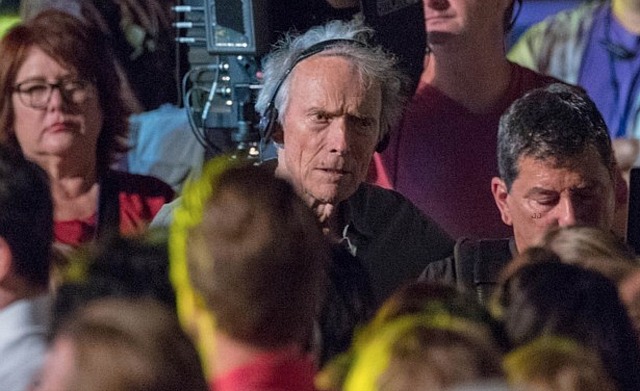
At the tail end of an 8.21 “Notes on the Season” piece about the Emmy and Oscar races, Deadline‘s Pete Hammond mentions that The Report costar Jon Hamm “mentioned” the other night that “he believes Clint Eastwood‘s Richard Jewell — so far not officially dated by Warner Bros — will be released in December.”

I’m hearing that it’s more than a case of Hamm believing this will happen, but that it’s pretty much locked and loaded. Warner Bros. will of course deny or sidestep until they announce down the road.

During filming pic was called The Ballad of Richard Jewell, which was also the title of Marie Brenner’s 1997 Vanity Fair article. The IMDB still refers to it as The Ballad of Richard Jewell but Wikipedia is calling it plain old Richard Jewell (which doesn’t sound good, by the way — the title needs “The Ballad of”).

From “They Done Him Wrong“, posted on 6.18.19: “The conservative-minded Eastwood is doing The Ballad of Richard Jewell, of course, because of the anti-news media narrative.

“In Jewel’s case the narrative (which unfolded over 88 days from late July to late October of ’96) was earned and then some. Several reporters and commentators (including the Atlanta Constitution‘s Kathy Scruggs and NBC’s Tom Brokaw) fingered Jewell as the likely Atlanta bomber without having all the facts.

“Jewell’s tragedy nonetheless feeds into Trump’s fake news mythology, and Eastwood’s film, you bet, will almost certainly strike a chord in America’s heartland or, you know, with the same ticket-buyers who flocked to Clint’s American Sniper and chortled along with Grant Torino‘s Walt Kowalski.”

Hammond: “Will this be another sneak attack on Oscar season from four-time winner Eastwood, a producer-director fond of quickly delivering his movies. Just last year he did that with The Mule, and in the past has had great success with such films as American Sniper and Million Dollar Baby in December. Warner Bros has an unusually strong slate of possible awards contenders already this year, but what’s one more when it comes from Eastwood? We shall see.”

“What Don’t I Know?”

A story of a struggling guy with all kinds of issues, set against a New York-in-the-’50s political murder mystery. Seemingly set in ’54 or ’55, to judge by the cars. Directed, adapted, produced by and starring Edward Norton, and costarring Willem Dafoe (still wearing his Lighthouse beard?), Gugu Mbatha-Raw, Bruce Willis, Alec Baldwin, Leslie Mann, Bobby Cannavale.

Wiki boilerplate: “A private investigator with Tourette syndrome (Edward Norton) works to solve the mystery of who killed his mentor (Bruce Willis) in 1950s New York.” One of the hotter Telluride titles, and the New York Film closing-night attraction. (Also slated for TIFF.)

I always thought Tourette syndrome sufferers were given to profanity and vulgarities — not in this instance. The twice-blowing-out-the-match scene is excellent.

“Wild Angels” Stinks

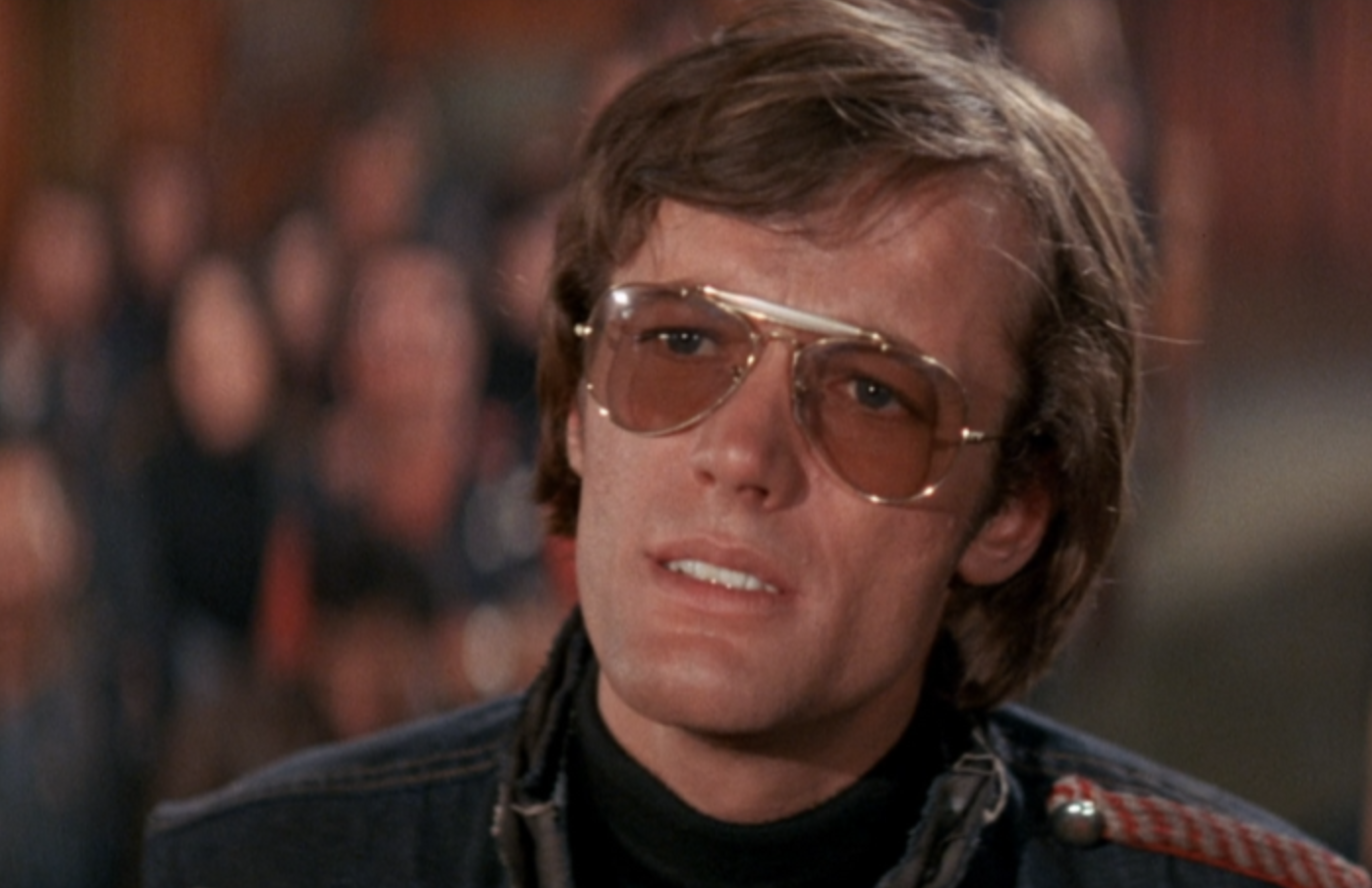
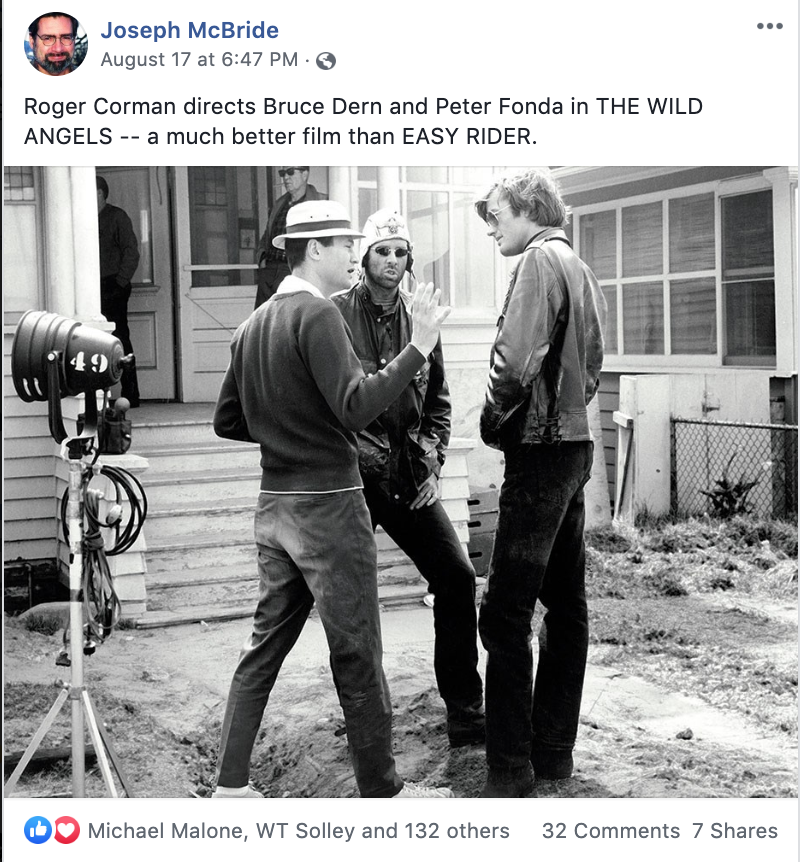
A day or two after the passing of Peter Fonda author and film scholar Joe McBride posted a Facebook comment about Roger Corman‘s The Wild Angels (’66), in which Fonda played the first significant role as a motorcycle-riding guy. McBride called it a much better film than Dennis Hopper‘s Easy Rider (’69), in which Fonda played his second significant role astride a Harley.

[Click through to full story on HE-plus]

Best Allman Brothers Story

This was told to me second-hand. It happened to a Connecticut guy whose high-school nickname was Jungle. (And was later changed to Nate.) Sometime in the early ’70s at some outdoor rock concert, the name of which escapes. But the godly Allman Brothers were on stage and performing “Ain’t Wastin’ Time No More”…sturdy sound, chugging rhythm, heavy bass and drums.

Jungle was all the way in front, maybe 15 feet from the stage, and “tripping his brains out”, as that phrase goes. And thinking, as people on halucinogens sometimes do, about the spiritual currents in his life and how he needed to stop fucking around like some doobie-smoking hippie loser and really get going.

Jungle somehow climbed up even closer to the stage. And as he listened, having scaled a fence of some kind, to the mighty thundering Allmans, he stepped out of the immediate and saw himself at a metaphorical midway point in his life, situated between this mythical super-group (symbols of power, strength and divine purpose) and the scurvy, grungy hippies below.

Jungle turned to the crowd and looked at the hippies and particularly some pathetic beardo in cutoffs and sandals (“Spare change, man?”). Again Jungle looked at the band, and then a muscular spasm went through his body as he said to himself “Jesus God, this is me…this is my choice…and I’m not gonna be a fucking hippie any more! From here on I’m with the Allmans, which is to say the realm of focus, control, vision, hard work and discipline…no more fucking around! ‘Cause I ain’t wastin’ time no more!”

Congratulations In Order

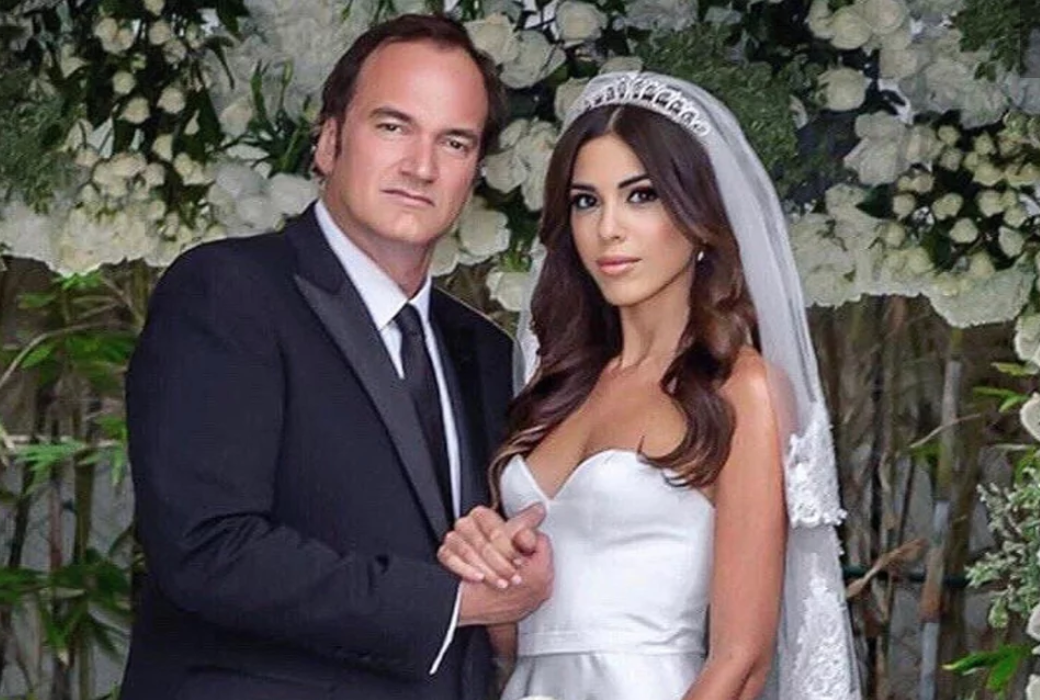
Congratulations to Quentin Tarantino and wife Daniella Pick on their announcement that a baby is on the way. Whatever the child’s gender, he/she will naturally be subjected to a relentless education about film. By the age of seven or eight he/she probably will have seen each and every Sam Fuller film ever made, and will be able to recite the release years of each, the principal cast members, the cinematographer and aspect ratio used, etc. Not to mention the films of Sergio Leone, Martin Scorsese, Howard Hawks, Richard Linklater, Brian DePalma, etc. By the time the kid is ten he/she will be blase about visiting the major film festivals. I could go on and on. His/her future is all mapped out.