American Demimonde

This morning Deadline‘s Mike Fleming reported that Barry Levinson will direct Francis And The Godfather, with Oscar Isaac starring as Francis Coppola and Jake Gyllenhaal as Robert Evans. Pic will be a how-it-all-went-down drama about the making of The Godfather. It’s based a Black List script by Andrew Farotte that was redeveloped by Levinson.

I read a draft of Farotte’s script about five years ago, and I have to say that Terry Clyne‘s I Believe in America, another script about the making of the 1972 Best Picture Oscar winner, read better. Here’s what I posted on 12.25.15. The piece was called “American Demimonde”.

I Believe in America is an authentic-sounding, tightly written, 117-page saga of the making of The Godfather. It’s told mostly from the perspective of then-Paramount chief Robert Evans and secondarily the POVs of director Francis Coppola, senior Paramount production executive Peter Bart, Al Pacino, Marlon Brando, Ali McGraw, Mario Puzo, Gulf & Western’s Charles Bluhdorn, Diane Keaton, Sidney Korshak and just about everyone else who had anything significant to do with this landmark 1972 film.
“I began reading it on my iPhone when I was in Manhattan last night, and then I got on a Brooklyn-bound C train somewhere around page 35. I had finished it by the time I hit Nostrand Ave. I flew right through it. I was hooked from the get-go.

Clyne’s script (Darrell Easton is a pen name) is quite the demimonde of neurotic, obsessive Hollywood power players, and I’m telling you it feels as realistic and trustworthy in giving voice to these characters as The Godfather felt like a Real McCoy portrayal of an Italian-American crime family. We’ve all read accounts about the making of this American classic but it’s very satisfying to find them told so smoothly and believably in such a well-honed, fat-free screenplay.

“I know Robert Evans personally (or used to know him back in the ’90s and early aughts) and Cline has totally nailed his manner, speaking style, way of thinking. Coppola sounds like Coppola, Pacino sounds like Pacino…everyone and everything sounds genuine and solid, and the story moves along in a way that feels throughly disciplined and engrossing.

“And it begins brilliantly. It begins, believe it or not, with Woody Allen, in a production meeting with Evans about the making of Play It Again, Sam, and discussing the character of American organized crime. And Allen is shot in the same slow-backwards-zoom way in which Coppola introduced Bonasera the undertaker in the opening moments of The Godfather.

“‘I’ll tell you who believes in America,’ Allen says. ‘The mob. The mafia. I mean, where else but in America could organized crime take in over forty billion dollars a year and spend so little on office supplies?’ And then the kicker: ‘And you know what the real joke about organized crime is? The mob is like a regular company. I mean a business, a firm, like American Steel.’ And a fuse is lit within Evans and we’re off to the races.
Read more

Pulled Back In

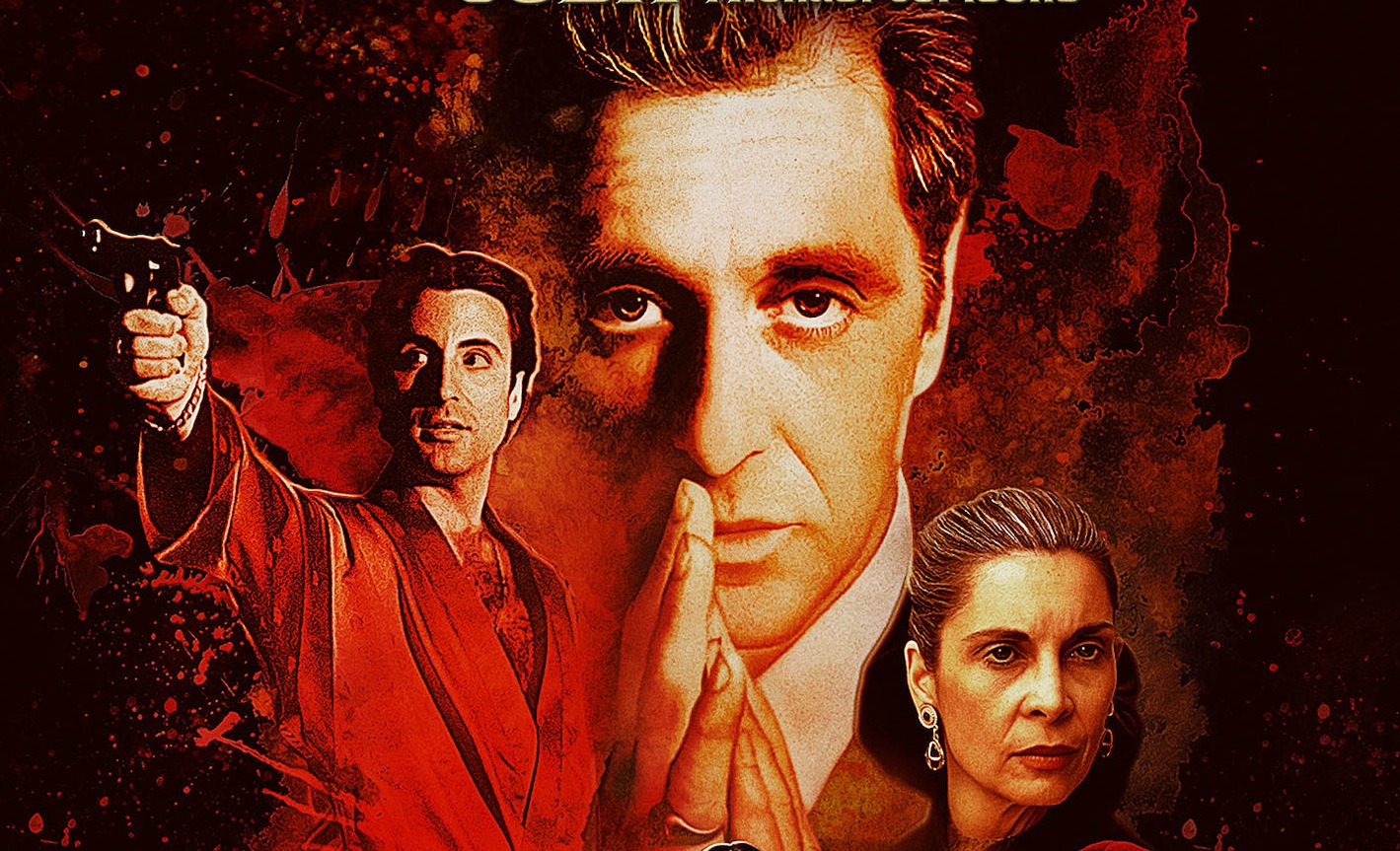
Paramount’s Bluray of Mario Puzo’s The Godfather, Coda: The Death of Michael Corleone will run 157 minutes, or five minutes shorter than the original 1990 version. The newbie pops on 12.8.20.

Francis Coppola’s statement: “For this version of the finale, I created a new beginning and ending, and rearranged some scenes, shots, and music cues. With these changes and the restored footage and sound, to me, it is a more appropriate conclusion to The Godfather and The Godfather: Part II, and I’m thankful to Jim Gianopulos and Paramount for allowing me to revisit it.”

Dying With Style

Yesterday (9.29) Widescreen‘s Anthony Francis posted on Facebook about some of his favorite death scenes. What follows are my reactions to some of these as well as a reposting of “Son of Brando Death Bubbles,” a riff about Marlon’s death scene at the end of The Young Lions (’58).

1. Marlon Brando‘s hacking cough death in Act Three of The Godfather (’72). Francis comment: “The man dies a monster — a mirror image of his true self.” HE comment: Vito Corleone does not “die as a monster” but as a kindly, animated old guy playing with his grandson. The scene in which Vito scares young Anthony by putting a piece of orange skin in his mouth is one of the most heartwarming moments in American cinema. That and the heart-to-heart scene with Al Pacino (“Wasn’t enough time, Michael”) is why Brando won the Oscar.

2. Christopher Walken shoots himself in the head in The Deer Hunter (’78). Francis comment: “One shot and with a smile, [Walken] becomes another casualty of war.” HE comment: I hated Cimino’s idiotic Russian roulette gimmick from the get-go, and have always refused to read anything into it. No lead character in a serious film has ever died for a dumber reason than Walken did in The Deer Hunter. Which I haven’t seen, by the way, since ’78 or thereabouts.”

3. John Hurt chest-burst death in Alien (’79). Francis comment: “The death that shocked audiences all over the world.” HE comment: Well, okay but people weren’t reacting to Hurt’s death as much as the realistic physical effects that made the chest-fever scene seem so vivid and traumatic. It wasn’t a death thing but a ‘holy shit, how did they do that?'”

4. Rutger Hauer‘s wings-of-a-dove death scene in Blade Runner (’82). Francis comment: “All those moments will be lost in time like tears…in the rain. Time…to die.” HE comment: “One of the saddest, gentlest and most beautiful death scenes in movie history.”

5. Josh Brolin‘s off-screen death in No Country For Old Men (’07). HE comment: “One of the strangest directorial cheats of all time…almost on a fuck-you level…you spend a whole film with a guy and then he gets blown away by some crazy Mexicans and we don’t get to witness it in real time?”

6. James Cagney‘s blown-to-kingdom-come death in Raoul Walsh‘s White Heat (’49). HE comment: “Better to go out with a big glorious bang than whimpering and anesthetized inside some padded cell.”

7. A lovesick, house-sized ape plummets 86 stories to his death in King Kong (’33). HE comment: “20 or 30 seconds before he lets go and falls there’s an expression on Kong’s face as he looks up at the planes. The look says “you fucking assholes…I’m in love and all you want to do is kill me…you’re such pricks, all of you…why didn’t you just leave me alone with Faye Wray back on the island? I would’ve taken care of her.”

8. Each and every electric-chair death in The Green Mile elicits HE contempt. As God is my witness I’ll never see that godawful film again.

9. William Holden‘s pointless and easily avoidable death in Sunset Boulevard. HE comment: Joe Gillis knows that Norma Desmond tends to react over-dramatically about everything, and he knows that she’s obsessively in love with him, and that the odds of her doing something rash if he announces he’s leaving her are high. If Gillis was smart he’d play it cool, leave her a sensible note, take the nice wardrobe and escape while she’s sleeping. And then go to the cops and say, “There’s an eccentric wealthy woman who may do something violent.”

10. Cagney’s dead-drop-flop at the end of William Wellman‘s Public Enemy (’31). HE comment: No comment required.

Read more

Exceptional Amber Bath

Seven and a half months ago a Russian guy named Alexander Britvin posted a newly colorized version of Fritz Lang‘s Metropolis. Except it’s not so much “colorized” as gently tinted with pastel watercolors, principally with shades of golden sepia amber. Nothing is crudely or garishly painted. I found the effort captivating. I’ve seen Metropolis three or four times, but I watched at least half of Britvin’s version last night and early this morning. I truly believe that if Lang could somehow return to terra firma and see this version, he would at least respect what Britvin tried to do.

HE Confession + Spiritual Cleansing

This is going to sound a bit strange, but late last night I experienced what felt like a kind of epiphany — a sense of myself and especially my hardnosed style of writing that that I’m suddenly not happy with on a certain level, and an idea that henceforth I need to dial that down. I’m not talking about abandoning my voice but chilling it down some.

After last night’s debate I was reading over some of my old stuff, and the strangest thing happened. I was suddenly stepping outside myself and reading the material like a 30something critic from England, and I was saying to myself, “This guy pushes too hard and uses too many adjectives. I could make him sound better by turning the current down and easing up on the pugilism.”

The combination of listening to Donald Trump bark and goad like a junkyard dog and then (this is going to sound really strange) watching Mervyn LeRoy‘s The FBI Story (’59), a total Eisenhower-era propaganda film that is nonetheless about basic middle-class decency and serving something greater than yourself…the combination of these influences seemed to open a door within, and all of a sudden I was saying “I have to stay as far away from caustic Trump vibes as possible, and I need to inject a little Jimmy Stewart into my soul.”

I know, I know…I’ll never be Jimmy Stewart or Tom Hanks either. I’m a sober, cat-loving Chris Walken from Connecticut by way of Next Stop, Greenwich Village, The Dogs of War, At Close Range and The King of New York. But I just knew last night that I needed more Stewart and less barking in my life.

The daily HE grind is a bear. It’s tough to push out four or five riffs or rants or reviews in exactly the right way. Sometimes a column piece won’t really read right until I’ve edited it over a 12-hour or even a 24-hour period, and then even then it sometimes feels a bit off.

I only know that I need to calm things down and not push quite so hard. I learned the value of “less is more” back in the ’70s, but I need to re-apply it. A voice is telling me this, or more precisely a whisper. Which is how inspiration always makes itself known.

To echo that great South African critic and cinematic seer Guy Lodge, “What a brand!”

Over the last 22 years Hollywood Elsewhere (including the early expressions on Mr. Showbiz, Reel.com and MoviePoopShoot) has gone through four phases.

First was the frank, occasionally tart, sometimes bludgeony attitude that began with the October ’98 launch of Mr. Showbiz, and which ended in April ’06 when I junked the twice-weekly column posting with “The Word” (short items) and shifted into a daily bloggy-blog format.

HE output increased greatly after that, and built up steam between ’06 and ’12 — a somewhat more gushy, stream-of-consciousness tone began to take over, and with that a certain…well, brashness-and-buckshot approach from time to time. Not always but now and then.

Phase Three began to take hold when I embraced sobriety on 3.20.12. The effects of a dry lifestyle are always gradual and drip-drip-drip (and sometimes one step forward and two steps back), but the wild and woolly era of ’06 to ’12 began to downshift in…I don’t know, ’13 or thereabouts. Certainly by early ’14.

Phase Four began in early ’18 when the wokester Robespierres began to seize the reins and go after transgressors, and despite the fact that my sins have never been about anything other than being overly mouthy and intemperate within the confines of the column, things became to get increasingly combative and punitive. A consensus began to take hold that I was some kind of obstinate shitheel and that I needed to dial it down and eat a little humble pie. More and more the title of this column became Hollywood Elsewhere: Under Siege.

Read more

Wrestlemania

“Biden on that stage calling the president of the United States a clown and a liar is not something Biden would have done four years ago under any circumstances. That he felt he [had] to do it is a sign to outsiders that American culture is in a cycle of decline.” — Jeremy Shapiro, research director of the European Council on Foreign Relations, to N.Y. Times reporter Steven Erlanger.

“Who won and who lost? I know I’m supposed to make something of a determination along those lines, but that’s not how this debate went down. Trump talked more and faster and louder, which was clearly his strategy: Be so damned vivid that Biden would look even paler than usual.

“In this Trump was successful. He had more fire — but dangerously, even dementedly, so. He never wore Biden down, but at moments he wore Biden out: Listening to Biden’s sentences peter out could be like hearing the air seep from a tire.

“But here’s the deal, as Biden would say: Only one man on that stage persuasively communicated that he has the interests of the American people at heart. Only one man on that stage seemed at all interested in maintaining a tether to the truth. Only one man demonstrated any respect for [Chris] Wallace or for the process. Only one man would be bearable for the next four years.

“I needn’t spell out who that man is.” — from Frank Bruni‘s “After That Fiasco, Biden Should Refuse to Debate Trump Again,” posted on 9.30.

Read more