Gotta Have It

Gotta Have It

I finally finished reading I Wake Up Screening: What To Do Once You’ve Made That Movie (Watson-Guptill) last week, and it’s one of the most easily processed, best written, most thoroughly sourced books ever written about how to get your indie movie seen (and maybe even distributed!) once it’s more or less finished.
I’m not going all kiss-ass on this book because I’m friendly with its authors, critic- journo John Anderson and Warner Independent marketing exec Laura Kim, or because I know just about every distribution exec, producer’s rep, indie publicist, film festival director, critic and entertainment journalist they’ve quoted.


Park City’s Main Street during the ’04 Sundance Film Festival

I’m saying this because it’s a sharp, cleanly written, well-organized thing, and because it contains lessons that I know are wise and based on hard experience, and because I’ve never read anything of its type quite as good. Really.
L.A. Times critic Kenneth Turan, Magnolia Pictures’ Eamonn Bowles, filmmakers Bill Condon and Kirby Dick, Picturehouse’s Bob Berney, New York Times critic Manohla Dargis, Cinetic’s John Sloss, exhibitor Gregg Leammle, N.Y. Times reporter Sharon Waxman, producer Ted Hope, Sundance honcho Geoff Gilmore, publicist Jeff Hill, Sony Classics’ Michael Barker, Telluride Film Festival director Tom Luddy, Variety‘s Tom McCarthy…these guys and maybe 50 others are quoted.
< ?php include ('/home/hollyw9/public_html/wired'); ?>
And there’s a minimum of attitude and self-referential blah-blah in this thing. Every page contains a set-up graph or two plus quotes, quotes, quotes…a set-up graph plus quotes, quotes, quotes. Solid, thoughtful…a very smooth, sans-bullshit read.
The specific advice/lessons for nascent filmmakers include (1) evaluating your film, (2) putting together the perfect team, (3) legal matters, (4) using the right launching pad, (5) sussing Sundance, (6) dealing with the media, (7) the right materials, (8) screeners, (9) the elements of buzz, (10) how not to alienate potential supporters, (11) doing things yourself, (12) finding your audience, and (13) various case studies.
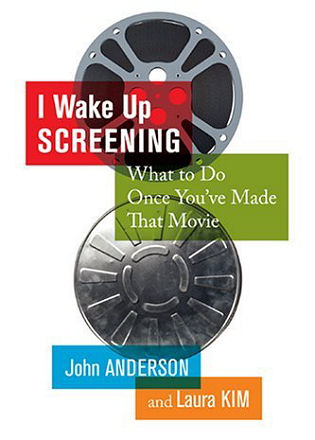
I Wake Up Screening is a how-to manual, but the inside school-of-hard-knocks aroma sets it apart. One or two pages and you’re sold. Trust levels go right up and stay up.
I seriously believe it’s in the realm of choice inside-the-industry books like The Ultimate Film Festival Guide by Chris Gore; The Whole Equation by David Thomson; Easy Riders, Raging Bulls: How the Sex-Drugs-and-Rock ‘N’ Roll Generation Saved Hollywood by Peter Biskind; The New Biographical Dictionary of Film by David Thomson; Final Cut: Art, Money, and Ego in the Making of “Heaven’s Gate” by Steven Bach; The Devil’s Candy: “The Bonfire of the Vanities” Goes to Hollywood by Julie Salamon; The American Cinema: Directors and Directions 1929-1968 by Andrew Sarris; Adventures in the Screen Trade by William Goldman; You’ll Never Eat Lunch in This Town Again by Julia Phillips; and Edward Jay Epstein’s The Big Picture
Every so often I found myself wishing Anderson and Kim had included some ruder, more Peter Biskind-type material (i.e. the kind of quotes and stories that result in certain people refusing to talk to you for four or five years).
And I was a wee bit irritated that they only spoke to (or wrote about) old-media critics and reporters. You’d never know from reading I Wake Up Screening that there are such things as online critics, journalists and buzz-spreaders who wake up and wail every damn day.


I Wake Up Screening co-author Laura Kim

“Think of yourself running in a mile-long race,” Bradford Patrick writes on the book’s Amazon.com page writes. (Sorry, but this guy’s a fairly good writer.) “You kill yourself to finish the mile, and when you can see the tape, you find out you have four more miles to go!
“That’s exactly how the authors frame the problem for a filmmaker. You got the money scraped together, you shot your film, you’ve been in post cutting the film, and then (and perhaps only then) do you become aware of the millions of details, hurdles, and pitfalls that lie between you and bliss — a theatrical release.
“The authors love film, and want nothing more than for your film to find an audience…but how? This is where the step-by-step analysis of dealing with PR, producer-reps, attorneys, media and buyers all get outed in fascinating detail.”
Anderson and I spoke about the book and the business last weekend, and here’s the recording of it. We got going and our chat lasted about 44 minutes.
Anderson is the chief film critic at Newsday, a past member of the selection committee of the New York Film Festival and a two-time past chair of the New York Film Critics Circle, a member of the National Society of Film Critics, and a member of the National Book Critics Circle.
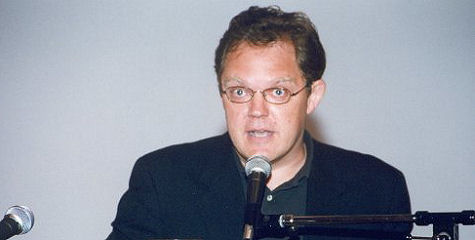

Screening co-author John Anderson, whose eyes rarely glare like they do here

Kim is exec vp of marketing and publicity for Warner Independent Films. Previously the senior vp of mPRm, she’s worked on such films as (I’m taking this right from the book) American Splendor, Dirty Pretty Things, The Pianist and Being John Malkovich.
Buy it or borrow it from a friend…but if you’re even half into the idea of being a serious filmmaker (now, soon, eventually), definitely read I Wake Up Screening.
(Since tapping this out Monday afternoon I’ve learned that “I Wake Up Screening” was also a title of a 1993 book about indie filming, written by director-writer Frank Gilroy.)

Lost Bash
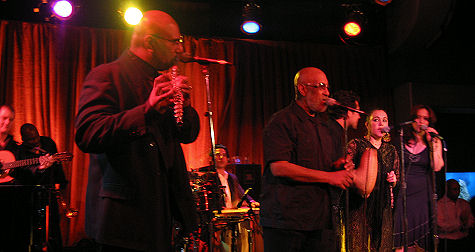

Fantastic jump-up Cuban sounds at Monday night’s after-party following the Hollywood premiere of Magnolia’s The Lost City, a tale of pre-Castro and post-Castro Cuba in the late ’50s and early ’60s, directed by and starring Andy Garcia.

Pretty lady at the party — born in Uruguay, dad was a journalist — who was with Lost City costar Steven Bauer. (I think.)
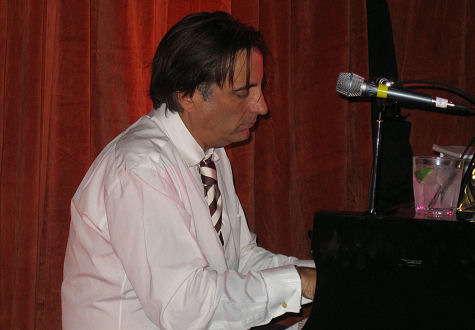
Andy Garcia during the concert portion of the Lost City after-party.

Curiously mesmerizing pool water

Disturbance

I don’t think Tom Cruise is a nutter. He has the nature of someone intensely driven, plus an emphatic personality that can seem a little manic to some. But among the hoi polloi there’s definitely an idea that he’s a wack-jobber. Or at least a view that sometime last spring or summer he got too cranked up over Scientology, lost it, jumped into a barrel and went over the falls.
If you were hiding under a rock and missed the whole Oprah couch-jump, Brooke Shields-bashing, Katie Holmes-proposal-of-marriage-on-the-Eiffel-Tower meltdown, you can go to a theatre this weekend and see it lampooned in Scary Movie 4 (The Weinstein Co.), specifically in Craig Bierko’s performance as the eccentric “Tom Ryan.”
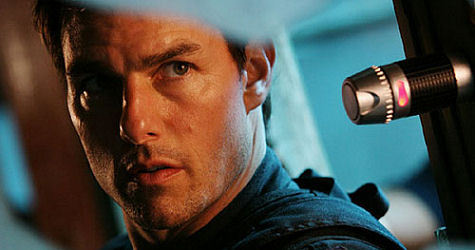

As Ethan Hunt in Mission: Impossible III (Paramount, 5.5)

And if you add this impression to some new NRG tracking numbers about Mission: Impossible III (Paramount, 5.5), you’ve got what any p.r. professional would call an issue of concern.
The NRG statistics indicate that Cruise’s box-office appeal isn’t what it used to be. The term is probably “dented” as opposed to “injured.” This allows, in any event, for a possible scenario in which M:I:3, directed and written by J.J. Abrams, may wind up with earnings that analysts will describe as “impressive,” “muscular” or “respectable” rather than “phenomenal,” “spectacular” or “record-breaking.”
There won’t be anything tragic about this. Mission: Impossible III, the first big summer film of 2006, is going to sell a shitload of tickets. I’m half into it myself, having been encouraged by what Kevin Smith said a couple of days ago (“as good if not better than the first [Mission]…Philip Seymour Hoffman plays the most believable bad guy since Anthony Hopkins in Silence“) as well as others.
And even if it’s not the greatest action movie since sliced bread, M:I:3 will still be the Big Thing to see from early to mid May until The DaVinci Code opens on 5.19.
I tried and failed to reach people who attended an exhibitor screening of M:I:3 two days ago — Wednesday, 4.12. Then I heard from a friend who said he’d spoken to two who were there. They liked it, he said, although “I didn’t get the sense that they were absolutely blown away.”
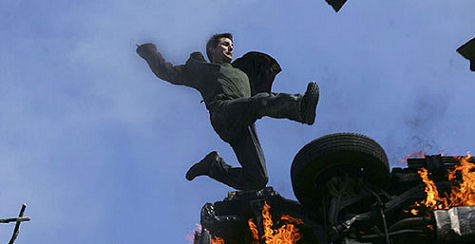
Still, if I were on Cruise’s team, I wouldn’t be feeling very good about that stupid Scary Movie 4 parody. David Zucker’s comedy earned a little over $40 million this weekend…that’s a lot of laughing kids streaming in and out…and I don’t see how those Tom Cruise wackazoid gags can do anything but mess with M:I:3‘s revenue.
There are indications all over the map that a portion of the public doesn’t believe that the 43 year-old Cruise is Tom Terrific anymore — they think he’s Tom Wacko.
I got going on this jag after hearing some National Research Group numbers that were released on Thursday, 4.13. They supposedly indicate the public’s interest in seeing Mission: Impossible: 3. I got them from a single source (I tried double- confirming with other marketing people but nobody was around due to the Good Friday holiday) but “they’re straight from the NRG report,” I was told, and “in black and white.”
Two figures got my attention: the 37% who said they’re definitely interested and the 9% who said they’re definitely not interested. My source says that at this same point before the opening of John Woo’s Mission Impossible: 2 — almost exactly six years ago — the definite interest number was in the mid 40s and that the definite non-interests were more like 2%.
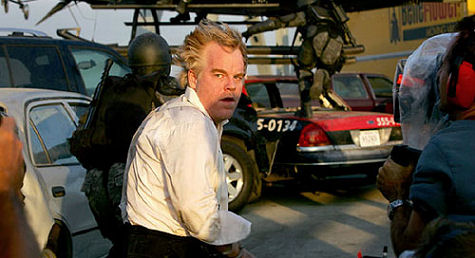

Phillip Seymour Hoffman as super-baddie Owen Davian

Paramount spokespersons said the NRG figures on M:I:3 are wrong, claiming instead that the definite interests are in “the low 40s.” (When told about this, my source said, “They’re defending the company position”).
If you go by the NRG figures, there’s clearly diminished interest in M:I:3 compared to the readings for Mission: Impossible 2, and the negatives are obviously higher also.
9% definite non-interest now vs. 2% defininite non-interest then — that’s a different climate. But a Paramount spokesperson disputed the 9% definite non-interest figure, contending that it’s actually “30% lower.”
I’m not saying NRG is the end-all and be-all (their “methodology is terrible,” an industry-watcher contended today), but if the public is feeling somewhat cooler about M:I:3 than they were about the previous two Mission films (and I say “if”), it’s probably safe to assume this isn’t due to global warming.
The Paramount spokesperson reiterated that “this movie is going to make a lot of money,” that the definite interest percentage is “where it should be” at this stage, “our first choice figures are already over 10%” and that “we haven’t even started our [advertising] campaign yet.” Fine, fine.
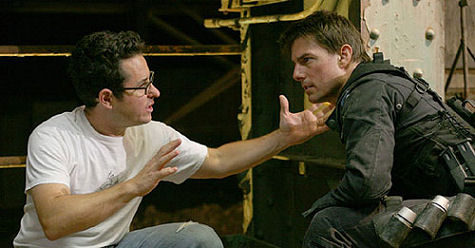

Director J.J. Abrams, Cruise on set of Mission: Impossible III

How does the HE readership feel about this? Is the want-to-see on M:I:3 just as strong as it was with the last two? How much has the wacko-Tom factor entered into things, if at all? Or is this just some NRG-industry journalist circle-jerk issue that has nothing to do with what real people are thinking?
I for one don’t give a damn about off-screen behavior. Cruise can do double somer- saults and one-armed push-ups on every talk show he goes on and it doesn’t mat- ter. I mean, not as long as the movie he’s selling kicks ass.

So Big
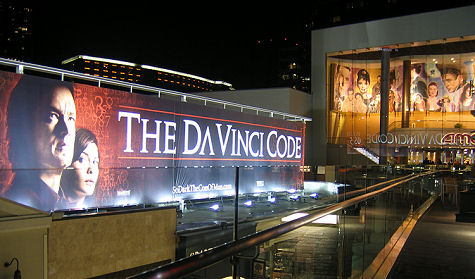

A big new AMC plex (stadium seating in all the houses) plus a big fat second-story food court opened a few weeks ago in Century City, and I finally dropped by Saturday night for a looksee. Something inside me flinches just a bit when I see an outdoor monster banner ad like this one for The DaVinci Code. It’s funny but I can feel myself inching towards feelings of vague dislike for this thing, sight unseen. No reason for this…but in the words of HAL 9000 as David Bowman was removing his memory cells, “I can feel it.”

Sensible Responses

“I’m much more excited about the third Mission than I was about the first two. Why? Because it looks like a better movie.
“And the Cruise kookiness doesn’t dissuade me in the slightest. If I didn’t boycott Val Kilmer for allegedly flicking a burning cigarette at the face of an Island of Dr. Moreau crew member (loved him since in The Salton Sea, Spartan and Kiss Kiss Bang Bang), I sure as hell am not going to lose it for Cruise because he’s passionate about something — even insanely passionate.
“The guy’s a movie star and sometime actor. If he’s an Operating Thetan 7 or whatever it is offscreen, I’m with him as long he keeps up the quality output like his work in Collateral, War of the Worlds, Magnolia and Eyes Wide Shut.” — Colin Moriarty , Canton, Ohio.
“I’m with you on how Cruise’s behavior influences my interest in seeing his movies: it doesn’t. Maybe if would if he had less of a quality track record (like Will Smith or Mel Gibson), but Cruise consistently picks interesting projects and talented directors: Kubrick, Spielberg, P.T. Anderson, Brian DePalma, Michael Mann, Cameron Crowe, etc. Devotion to Scientology can’t override that.
“Add in Mission: Impossible III having the best cast assembled in the series so far, my appreciation of J.J. Abrams’ work on TV, and both trailers so far kicking ass and getting my blood going. Put that together, and M:I:3 is actually the big May movie I’m most confident will be decent or better (because I realize my hopes for X3 may be in vain). A bit of creepy behavior from Cruise can’t change that.
“However, I fear that I may be in the minority on this. I don’t read People or Us or In Touch Weekly , but lots of people do. I know some of my co-workers have expressed a feeling of ickiness regarding Cruise in general and his new sequel in particular, and I have a feeling that the argument that Cruise has shown admirable interest in making good movies in the past won’t fly with everyone.
“In short, this is another case of the general public approaching things from a point-of-view not exactly guided by a love of movies, but rather an interest in celebrity culture and gossip. M:I:3 can probably still bank on at least $180 mil or so, but the gossip-rag backlash that was too late to really harm War of the Worlds may be in effect.” — Jesse Hassenger
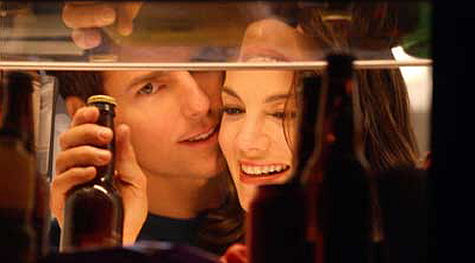

Cruise, Michelle Monagahan in Mission: Impossible III

“Who knows how big the wacko-Tom factor will play, but the solid majority of my Lost-addicted friends (college aged, guy-guys) are sold on M:I:3 based solely on writer/director J.J. Abrams. They remember the 2-hour Lost series premiere that Abrams directed, and tune in along with 20 million other viewers each week.
“And as far as I’m concerned — wacko, schmacko. Cruise usually gets the job done with intensity and control. Chef Boyardee may very well have been a nut (this is pure speculation), but dude knew how to can some delicious pasta.” — Kevin Costello
“I was contacted last night by the AC Nielsen people about upcoming films, and I responded with a ‘definitely’ about my desire to see M:I:3. I was then asked about my feelings about M:I:3 costars Tom Cruise, Ving Rhames and Keri Russell, and I said I’m in the camp of believing Cruise’s appeal isn’t what it used to be.
“I found it strange that the surveyor never inquired about the only M:I:3 participants who are solely responsible for my desire to see ot — actor Philip Seymour Hoffman and director J.J. Abrams. I would be skipping this third installment if not for the opportunity to see J.J. flex on the big screen and watch P.S.H. go bad-guy.

“I might be alone in my feelings, but I feel the best way to keep people interested in a fourth installment of this franchise would be a Dr. Lecter-like victory for Hoffman’s character over Cruise’s Agent Hunt.” — Lucas Ross, Oklahoma City, OK.
“The MI films present a conundrum. They’re just ‘movies’ vs. actual aesthetic experiences. Both of these kinds of film can use the power of film, but the desired payoff is different. The aesthetic films we expect to challenge us, nourish us, and, one hopes, maybe even make us better (I know that’s asking a lot). A movie…well, it’s a pleasant way to have a shared experience with some friends that doesn’t involve exchanging bodily fluids.
“For those of us who like a little aesthetics/intelligence with our ass-kicking, M:I:3 seesm like a disappointment in advance. For all the money spent making them, for all the flash and technology, the MI films are more than disposable — they’re forgettable.
“That said, M:I:3 does have my interest for one reason: Phillip Seymour Hoffman. You know he’ll bring it when he shows up, and that alone could put me a theatre seat.” — Roy “Griff” Griffis
“I like Tom Cruise. He’s no Paul Giamatti, but he constantly delivers in an above-average, movie-star-charisma kinda way. He’s got a certain amount of acting talent, but it’s that weird star-wattage thing that defines a Tom Cruise performance.
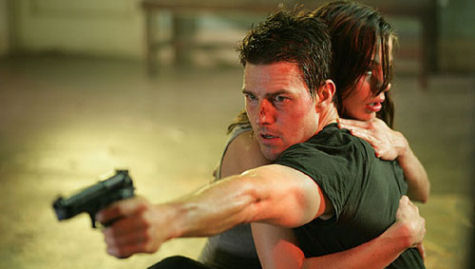
“Is he crazy? And does that affect the box office? Uhm, he may be a bit nutty, yeah…but quite frankly, that’s how I like my Hollywood stars. Let’s face it, Angelina Jolie was a lot more interesting when she was wearing a vial of Billy Bob Thornton’s blood around her neck.” — David S.
“The best thing Paramount can do to get me to see Mission: Impossible 3 is break my air conditioning on opening weekend.
“Otherwise, what’s unappealing to me about Cruise at this stage is not that he’s a cult member living in his own hermetic cocoon but that his control-freakishness has erased any human interest he once had back in Risky Business or even Jerry Maguire days. He’s as sleekly machine-tooled and inhuman as the T2000.
“Even when he tries to play a character part (Collateral, let’s say) he’s so erased of imperfection that he’s unrecognizable as one. His War of the Worlds character had human imperfections like a Calvin Klein model has stubble.
“Maybe the day will come when, as with Gary Cooper or Randolph Scott, age puts some character into his boyish face and he starts depicting human frailty, not superhuman relentlessness, on screen.” — Mike Gebert

Grabs


Car wash on Pico Blvd. near Beverly Glen– Thursday, 4.13, 5:20 pm.
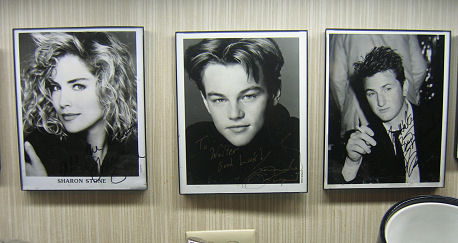
Photos hanging just above counter and near the jelly beans in the big glass jars in foyer of Sunset Screening Room — Thursday, 4.13, 9:20 pm. Photos were given in tribute to Walter, the guy who’s owned and run the room for years. Pic was taken during a late-inning recess I took from Chen Kaige’s The Promise, a flamboyant Chinese-costume adventure film — arch, bullshit-stuffed, pageantry-for-its-own-sake — that I watched for a half-hour or so but mainly slept through. I hated, hated, hated the parts that I saw.
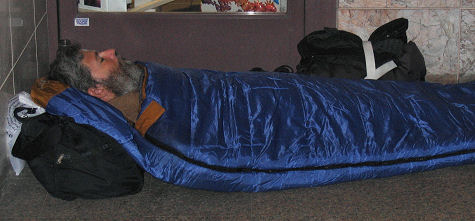
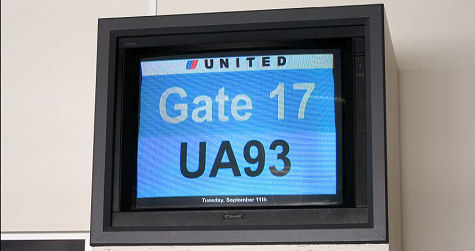
I’ve never seen a guy sleeping in front of a building with such a nice-looking sleeping bag in my life. He had a nice bag with him instead of the usual plastic garbage bag or shopping cart, and his beard was semi-trimmed and not that long. This seems to indicate he’s a semi-responsible guy who’s run into hard times and is sincerely homeless, as opposed to most of the homeless people I’ve seen, who seem to fit the general definition of “bums.” Taken on Monday, 4.10, just after the first screening of United 93
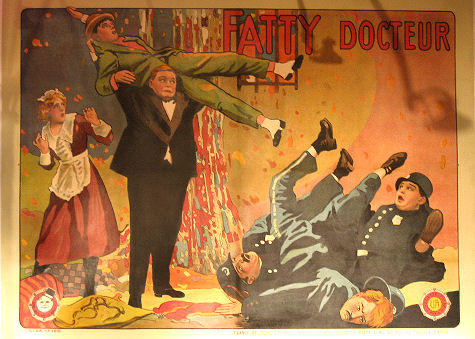
Hanging in window of a Beverly Hills store…I forget where. The French-made poster is for a 1917 Fatty Arbuckle film called Oh, Doctor!

"I think United 93 takes

“I think United 93 takes away the detachment of media reports, as well as the passage of time, and puts you directly into these situations. By doing so, the Hollywood-influenced concept of heroism that invariably exists in our mind is replaced by something more visceral and potent. Paul Greengrass is giving us a modern version of You Are There. David Poland ‘s being a contrarian and not rising up to the concept of being challenged by what is right there on the screen. He wants dramatization and fiction.” — L.A.-based director-screenwriter who saw United 93 before the press screenings started.

Hollywood Elsewhere's main page is

Hollywood Elsewhere’s main page is going to be changed, I decided today. In a week or two it’ll become just a series of paragraph blocks — the beginnings of WIRED items mostly, along with the beginnings of regular features. Bang-bang, rat-a-tat-tat. Each paragraph will have jumps taking readers to a page where either the WIRED item of the feature story will appear in their entirety. And yet the current format of the main page will continue; the difference is that it’ll be called “Hollywood Elsewhere Classic” and you’ll have to click on a Nav Tab bar on the top left to get to it. I’ve been fairly happy with the main front page all along, but enough people have told me they’d prefer something a bit different. And so the change. I’m okay with all this because (a) I’ll get more page views and more ad action, and (b) I’m not destroying what the site is now — I’m just adding to it and shifting things around.

Government prosecutors apparently still regard

Government prosecutors apparently still regard Paramount Pictures chief Brad Grey and former CAA honcho Mike Ovitz as witnesses in their probe of Anthony Pellicano‘s wiretap activities, and not targets. But New York Times reporters David Halbfinger and Allison Hope Weiner are reporting in Friday’s edition that Grey and Ovitz “had far more direct dealings than they have acknowledged publicly with [Pellicano] at the center of a rapidly expanding wiretapping scandal, according to govern- ment evidence.” And “the government’s questioning of the two Hollywood executives…shows that authorities [are] circling the heavyweight entertainment lawyer Bert Fields, who worked for both.” The Times basically says that Grey has been giving the FBI different accounts about the extent of his dealings with Pellicano. In other words, according to my reading of the story, he’s been doing a bit of fibbing. And so has Ovitz.

Does Columbia Pictures' decision to

Does Columbia Pictures’ decision to release the delayed All the King’s Men (the original release date was 12.16.05) on 9.22 mean it might turn up at the Toronto Film Festival? No matter how much it gets talked up by friends of producer Mike Medavoy or director Steve Zaillian, Men is regarded as a damaged-goods movie that, fairly or unfairly, has something to prove. I’m sorry but last December’s delay left a mark, and Columbia knew that pulling it would create one. If it’s as good as the “friends” say it is, Columbia publicity should start screening it early….no later than July…to let the word get around. Written and directed by Zaillian, it’s essentially a remake of Robert Rossen‘s 1949 Oscar-winning film (which was based the novel by Robert Penn Warren), and it stars Sean Penn, Mark Ruffalo, Jude Law, Anthony Hopkins, Kate Winslet, Patricia Clarkson and James Gandolfini (whose performance is especially good, according to the “friends”).

The Biblical word "Babel" refers

The Biblical word “Babel” refers to “Babylon,” which generally means a place in which the serenity of God’s path is not heeded. In Genesis 11:9, Babel “is etymologized by an association with the Hebrew verb balal, which means ‘to confuse or confound.'” This should give you an oblique idea about where Alejandro Gonzalez Innaritu ‘s Babel (Paramount Classics, 11.17) is coming from. I’ve read Guillermo Arriaga‘s script because the film is most likely going to play at the Cannes Film Festival, and I want to be up to speed. Like Innaritu and Arriaga’s Amores perros and 21 Grams, Babel about how a single violent event — a car accident in the first two films, and a shot fired from a rifle (“a well-conserved .270 calibre Winchester 60”) in the new film — affects the fate of numerous unconnected people in various rippling and/or tangential ways. I won’t discuss the story particulars, but the stars, as mentioned earlier, are Brad Pitt, Cate Blanchett, and Gael Garcia Bernal…although there are vivid, fairly sizable parts that will be played by another four or five actors, at least. It’s set in Tunisia, northern Mexico and Tokyo, and I’ve tried to learn the name of a young Japanese actress who plays a character named “Chieko.” (Does anyone know? I’m interested because there’s a nude scene factor.) I’m not going to get into the script very much either, but it’s one of those pieces in which God is in the details. There’s not a shitload of plot — it’s more sparely written than the other two films — but what happens cetainly sticks to your ribs. I would call Arriaga’s script lean, pungent and haunting. Although the emotional rapids don’t churn quite as heavily or tempestuously as they did in Amores perros and 21 Grams, what settles down at the end is some kind of less-is-more residue. Babel‘s three stories, which unfold at roughly the same time but within slightly staggered time frames (in terms of the back-and-forth of what we see and when), are about confusion and wrong turns and things going badly in the world today…about the unfairness and randomness of life and the off-and-on sensuality of it. Is it about rot? The end of the world? An inter-connected world society collapsing and eating away at itself? Depends on your reading of the script or the film, but one thing’s for sure: two (presumably) pretty actresses have nude scenes. I know, I know…I’m a profoundly deep cat.

It was officially announced yesterday…"officially"

It was officially announced yesterday…”officially” being a euphemism in this instance for “at long last”…that Chicago Tribune editors had finaly gotten their nerve up and permanently replaced big-wheel film critic Michael Wilmington with former hotshot theater critic Michael Phillips, whom I spoke to last September during the Toronto Film Festival. It was obvious back then that Phillips (whom a Chicago Tribune colleague describes as “an elegant writer” and coming from “more or less in the same [aesthetic] place as Wilmington”] was on the upswing and Mike, a flat-out brilliant critic and scholar from way back, was on the downswing. A friend of Wilmington’s told me a good year ago that Tribune management had been “treating him badly,” so the writing had been on the wall. If you’re going to get respectfully demoted or fired or dropped by a girlfriend, you can always feel it a long time before the actual words are spoken (or typed out for a press release). The drip-drip-drip of disapproval …those little disses, dirty looks and innumerable hints that your stock price is dropping…is always detectable well in advance.

MSNBC film critic John Hartl

MSNBC film critic John Hartl has made a good if obvious point, which is that regular audiences tend to embrace mediocre films that don’t tend to stand the test of time, and that the really good films tend to more celebrated by critics and, to a lesser extent, awards-giving orgs like the Academy. I’ve always maintained that the most popular films of any year always amount to a kind of portrait of where the mass audience is at deep down…a reflection of what they’re longing for, or how they would like to see themselves in some way. What does it say about a society that celebrates a film as bad as My Big Fat Greek Wedding? No one ever talks these days about the films directed by Mervyn LeRoy (Quo Vadis, Mr. Roberts, The FBI Story, No Time for Sergeants, Gypsy). They were enormously popular in the 1950s, but who talks about any of these films now with serious affection or respect? I’ve never even heard of 1947’s #1 box-office hit called Welcome Stranger , which costarred Bing Crosby and Barry Fitzgerald. Who’s ever seen The Egyptian, one of the big box-office hits of 1954? (20th Century Fox wanted Marlon Brando to star in it and he refused, resuilting in a big brouhaha.) Samson and Delilah was 1950’s biggest hit, David and Bathsheba was 1951’s top-grosser, and The Ten Commandments ruled in 1957…and none of them play very well by today’s aesthetic standards. And Alfred Hitchcock‘s Vertigo , one of his very best and an undisputed classic, flopped when it opened in 1958.

Regarding the Jared Paul Stern/"Page

Regarding the Jared Paul Stern/”Page Six” shakedown fiasco, Lewis Beale offers the following: “The ‘Page Six’ people play by their own rules, and they ain’t the rules anyone else in the industry abides by. I collaborated with the Daily NewsGeorge Rush on and off when I was a staffer there, and I can tell you that George (a sober, upright, pleasant, Midwestern kind of guy) was not accepting free first-class plane rides to L.A. and comp stays at elite hotels. If he had, he would have been fired, plain and simple. The whole Stern/’Page Six’ flare-up is about two things: the total lack of any sense of journalistic ethics on the part of guys like Stern, and the complete lack of institutional control on the part of the New York Post. I actually don’t think Stern was trying to extort the guy; but at the very least he was trying to get paid for being his damage-control maven, which is a complete and total conflict of interest. This little creep, whose sartorial affectations just make me want to kick his teeth in, represents exactly what’s wrong with the gossip industry. He wouldn’t know an ethical dilemma if it bit him in the face. And he’s arrogant enough to think he’ll emerge from all this with his career intact. If by some chance he does, that says a lot about how far we’ve sunk as a society. The Post should, of course, clean house. But they won’t, because without ‘Page Six’ no one would read the rag. Stern himself will probably keep it going, because unlike any other human who’s being investigated by the FBI, he sees this as a great chance to up his personal profile . He’s been all over the media, e-mailing people (check out his responses to questions Gawker sent him), trying to set up TV appearances, etc. He is absolutely shameless. Of course, if he’s indicted, that will be another story — whether guilty or not, he’ll be ruined. Unlike Jayson Blair, Stern knows how to use the media, which says to me he might have a career of sorts after this blows over (but not at ‘Page Six’…he’s toast there). The more I follow this, the more I see Stern as an interesting case: a completely amoral human. He makes Bonnie Fuller look like Mother Teresa.”

The last line in United

The last line in United 93, seen in white type against black background before the end credits, is “America’s war on terrorism had begun.” My gut tells me this proclamation was muscled into the film. Universal knows the right is going to be suppporting this film big-time, and I think it was thrown in as a sop to the Bill O’Reilly crowd. This is merely a suspicion, and far from a factual assertion. It’s not a huge deal and obviously not central, but it’s stuck between my teeth at the moment. It’s the one and only incongruent note in the film.

Boiled Down

Boiled Down

Movie City News editor David Poland saw United 93 last night (I know because I saw and spoke to him at the screening), and he has asked two questions on his Hot Blog about it: What is it really about and who is it really about?
The answer to the first question isn’t that simple, but the answer to the second is as plain as a green apple sitting on a glass table in a nice restaurant in the late afternoon.


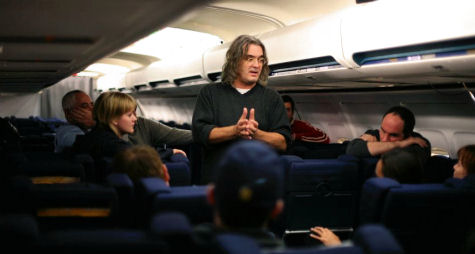
Director Paul Greengrass during filming of United 93

United 93 may have been made with the “idea” of it being about the heroism, selflessness and standing-up-to-terrorism valor shown by the passengers on flight #93, but honestly, actually…? The passengers in the film are mainly reacting to a realization that the hijackers are on a suicide mission and that they’re basically all dead, and so the bravest among them say “screw it, let’s do something instead of just waiting for it.”
This kicks in toward the very end, but the movie is really not about that (and thank God it isn’t) because, as Poland says, the drama is never delivered on any kind of individual character level. A kind of frantic heroism happened, an undeniable valor, but the film isn’t about that. Well, it is…but not finally.
< ?php include ('/home/hollyw9/public_html/wired'); ?>
Director Paul Greengrass may have begun with the idea of developing a heroism-of- the-passengers story, but I think he said along the way, “Sod it…let’s just make a minute-by-minute, you-are-there, this-is-how-it-probably-felt movie from the POV of the United #93 passengers and the perspective of the professionals charged with keeping tabs on commercial plane activity…and then we’ll sort it out in the editing room.”
And yet the movie has, ironically, a big current running through it.
This current, for me, is Greengrass’s big inspiration, his brainwave. Because it’s the first two thirds of this film — the experience and the perspective of the people trying to keep tabs on what’s happening from the air control centers — that gives United 93 its intrigue and electricity.

What, then, is United 93 “about”? It’s about revisiting, recapturing, reanimating… living through the particulars. Which means that Poland will be chasing his own tail around a tree trying to find the Big Meaning…unless, of course, he breaks through all that.
The theme of United 93 is the deceptive nature of “reality” as it unfolds. The reality of what life in these particular spaces felt like, and Greengrass’s striking ability to reconstitute recent history with a feeling of gripping verisimilitude, which I regard as a kind of cinematic theme or belief system in and of itself.
In short, I believe in Paul Greengrass when he’s working at the top of his form. As far as this movie is concerned, that’s my religion and my faith. Nobody needs a high falutin’ analysis about “what it’s really about” to make it feel whole or justified, because what it’s about is its own constitution. A big resounding echo isn’t the point in a film composed of a thousand echoes of minutae.
Poland also asks who is it really about?
That’s the really interesting question, and the answer is that United 93 is about us. Then and right now. Us.

Greene Grab

Blown Away

Is Paul Greengrass’s United 93 (Universal, 4.28) a knockout, a time-stopper, a mind-blower? It sure as hell is.
You’re probably going to need to stand outside the theatre for a few minutes after it’s over and just chill…trust me. And then you’re going to want a drink, even if you don’t drink. And then talk it out with friends for an hour or so. See it with some. Don’t go alone.
Is feeling power-drilled all over again by one of the worst real-life nightmares of all time a good thing? To me, it is.


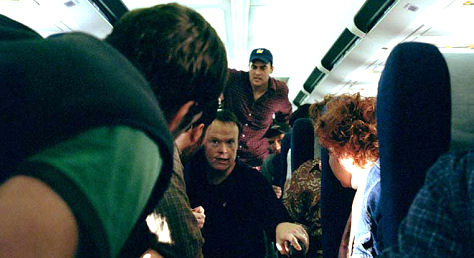
Christian Clemenson (kneeling) as Thomas Burnett in the middle of passenger huddle during last act of United 93; Cheyenne Jackson, as Mark Bingham, is standing behind with the maroon shirt and hat.

It happened, it’s real, and this film knocks your socks off because it takes you right back to that surreal morning and that feeling, that almost-afraid-to-breathe feeling, and to me, that’s partly what good films do — they lift you out of your realm and make you forget about everything but what’s on-screen.
All I know is that I was watching and taking it all in, and that the old feelings started to build and churn around and then pour back in, like a damburst. The chills and forebodings of doom were back, and this time with a closer, more comprehensive perspective.
United 93 didn’t make me “happy” but I relished it. I’m not a baby or a coward. I’m not a “too-sooner.” Show me anything that smacks of honesty and hard truth or at least skillful manipulations of same, and I’m there for firsts, seconds and thirds.
Time‘s Richard Corliss called it “unbearable and unmissable.” Mainly the latter, I’d say. As long as it’s not a cheap-ass horror film, I eat “unbearable” for breakfast.
Not one frame of this film struck me as distasteful or exploitative. It shows what needs to be shown with as much restraint as could be managed without changing the known facts.
We were told at the screening that the print shown wasn’t quite finished. It looked pretty finished to me. No obviously raw effects, nothing that screamed out, “Oops …sorry!”


United 93 director Paul Greengrass during filming on set of Pinewood Studios.

What surprised me is that two-thirds of United 93 don’t have a whole lot to do with United #93. They’re about what happened as air traffic controllers, the FAA and the military tried to monitor what was happening with American Airlines #11, United #193 and American #77 (i.e., the flights that slammed into the North Tower, the South Tower and the Pentagon, respectively). It’s about how a lot of focused dec- ent professionals tried to keep up with the horror and couldn’t.
United 93 runs about an hour and 45 minutes. It’s about 30 minutes before Flight 93 takes off, but you’re not really paying that much attention, frankly, to those doomed souls on the plane…not at first. It’s the confused folks in the control rooms who pull you in. The second plane hits about 45 minutes in, give or take, and it’s another 15 minutes — a full hour — before the hijackers, who’ve waited and eyeball- ed each other from their first-class seats and stalled, it seems to me, like nervous nellies, before finally making their move.
For me, that opening hour is classic. Greengrass has never done anything quite as good. The tension and verisimilitude surpasses his work in Bloody Sunday, and that’s saying something. Each and every bit actor, every line…every last piece of it screws you to your seat.
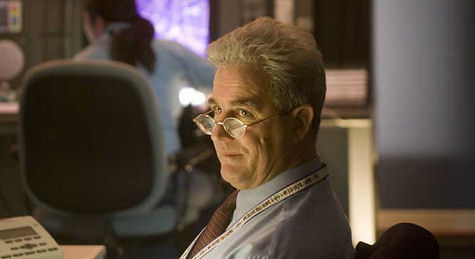
Those guys playing air-traffic controllers are perfect. Remember the tension in that air-traffic controller scene in the opening moments of Close Encounters of the Third Kind? It’s that tripled or quadrupled. Ben Sliney, a gray-haired office mana- ger type who was having his first day on 9/11 as national operations manager for the FAA, plays himself. Nobody, really, seems to be “acting” in this. Every bit player rules in every control-room scene in this film.


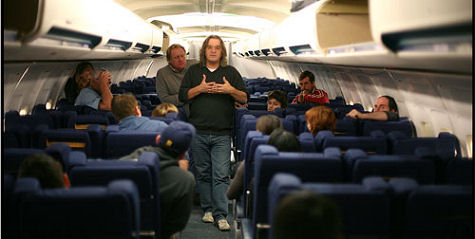
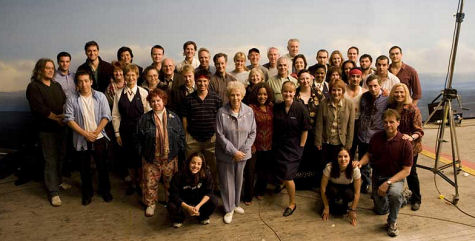
Cast of United 93 on Pinewood sound stage.

What’s so affecting is that you know what’s coming, and Greengrass just lets it come…tick, tock, tick. There’s a spellbinding moment when it all starts…when a 40ish Boston air traffic controller first realizes that American #11 is off-course and not communicating. The moment isn’t especially heightened or emphasized. It’s just this guy going, “Okay…something’s off here”
Once the hijacking on United #93 begins and the killings and screamings and all the rest of that sad melodrama kicks in, then it’s a bit more familiar, especially if you’re up on what’s known to have happened and if you saw A&E’s Flight 93 movie last January. That was an okay film. I didn’t like the family members crying and saying “I love you” to their loved ones who were calling from the plane (which felt almost icky to me), but it was all right. And yet United 93, no offense, is about two and a half to three times better.
I saw it at the first non-Time magazine press screening on Tuesday night in Santa Monica, and a woman sitting two seats away got up twice, and it’s measure of how caught up I was that I was vaguely irritated when she left the second time. How many times does this woman need to take a leak? I wondered. Or is she leaving the room to give herself a break from the tension? Either way, I was vaguely irked. (Why should I care, right? It was her business. But I didn’t want any nearby move- ment.)
The remarkable accomplishent, for me, is that I felt no sense of time while watch- ing United 93. It lasts about 105 minutes, and it could have been 40 or 50 minutes. I didn’t care, didn’t think about it. The damn thing held me, vise-gripped me. Did I have a good time? Definitely, by my standards. I haven’t sat through a pulse-poun- der like this in months, and I can’t wait to see it again.


Ben Sliney, who was having his first day as national operations manager for the FAA on 9.11.01, plays himself.

Cheyenne Jackson, who plays Mark Bingham, the gay guy who died on United #93, was one of those at last night’s screening. I spoke to him briefly, told him it’s a hell of a film. He seemed kind of choked up and needed some alone time. Chris- tian Clemenson, who plays Thomas Burnett, was also there, but he was gone in a flash as soon as the credits started rolling.
One tiny beef: The last piece of copy on the black screen says that after 9/11, “America’s war on terror had begun.” The implied statement, of course, is, “And it continues today!” That it does, but if anyone thinks that what’s happening in Iraq right now (and what may even happen with Iran…who knows?) is a blow against terror they’re very much mistaken, and that final line struck me as a bit of a rah-rah statement. I think Greengrass should have just let what happened in the film (as he chose to dramatize it) stand on its own and leave well enough alone.

Puck Everlasting

The movies that seem to grab me the most are the ones that ask us to consider the mystical, the undefined, the intangibles…the ones that say “look up, look out, look beyond…there’s more to this world than what you can own, eat, taste or feel.”
The latest film to do this kind of thing well, and frankly one of the more interesting, amusing and affecting films I’ve seen over the last few weeks (if you don’t include An Inconvenient Truth, that is), is a new documentary about a bunch of guys who love to play air hockey.
It’s called Way of the Puck — and no one anywhere has seen it, except for a handful of film festival programmers. It’ll be having its world premiere at Houston’s Worldfest Film Festival in mid to late April.


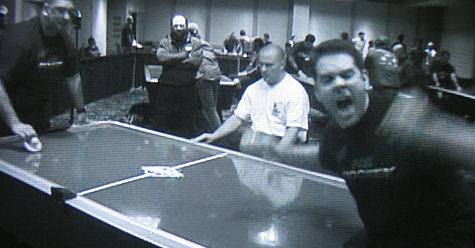
Atypical action moment in Eric D. Anderson’s Way of the Puck, meaning that 98% of it was shot in regular color video.

I’m not saying it’s wet-your-pants fantastic, but if you can imagine something as arcane as a thinking man’s air-hockey film…one that doesn’t so much focus on a stupid plastic puck getting knocked back and forth by a couple of guys leaning over a gleaming blue plastic surface as much as…well, the zen approach to this simple-ass game, keeping a light touch, concentrating hard and yet not concen- trating as much as feeling the force…this is it.
The “maker” is Eric D. Anderson, a Los Angeles-based guy who works on music videos and commercials and has spent the last two-plus years putting this doc together, partly (as you might expect) because he’s a big air hockey nut himself, but also because he sees a Great Beyond inside it…a world within a world.
“On the surface air hockey seems like a story with very low stakes,” he writes on the film’s website. “Or no stakes at all. I get a lot of this. ‘Air hockey?’ people say, nodding slowly. ‘That game from the ’70s? Hunh.’
“Air hockey isn’t the unpopular kid who gets kicked around at recess. Air hockey is the kid no one notices, including the teacher. It’s a forgotten arcade game, a kid’s game, a relic, a jobby, a diversion, a trifle…and what could be less important than that?”

But in the making of this film, says Anderson, “I discovered a passionate and intelligent community of players. These are underdogs, participating in a fringe sport. They know they are dismissed and sometimes mocked and that air hockey will proably never be accepted by the mainstream. And yet they continue to travel thousands of miles to compete against the best players in the world.”
Way of the Puck is a guy film, mostly, obviously, but a smart one. Alert, spiritual, philosophically loaded. “Small” and a little familiar in certain ways, maybe a tiny bit repetitive (and maybe a little long…just a wee bit) but within its own territory it feels solid and connected and complete.
It’s a real middle-class film about a gaggle (somehow that word feels right rather than ‘group’) of five or six American middle class guys, most of them married and either pudgy or bearded or balding (or all three) who are serious air hockey freaks, and who all happen to be quite thoughtful and intelligent.
That’s the first big revelation — air hockey doesn’t seem to be played by meatball blue-collar types but by unusually bright and creative guys. Or so this film implies.


Eric D. Anderson

These aren’t exactly rugged individualists, but guys with a certain consistency and tenacity. Not the kind of men whom anyone would call intense or magnetic or start- ling, but men with an undeniable passion and dignity. And maybe a certain sadness or resignation thrown in, marital responsibilities and the day-to-day slog being what they are.
And yet they share an obvious, unshakable, undeniable belief in air hockey as some kind of transcendent pursuit…something that sustains their spirit, gets them through the rough patches, puts a special kind of English on their existence, makes life feel whole (or at least gives it a certain weight and dimension) and worth living.
More so from the audience perspective because air hockey isn’t that recognized or celebrated…far from it…but it’s their own thing, played as it is in those little rooms, and they’re happy with that. Or happy enough.
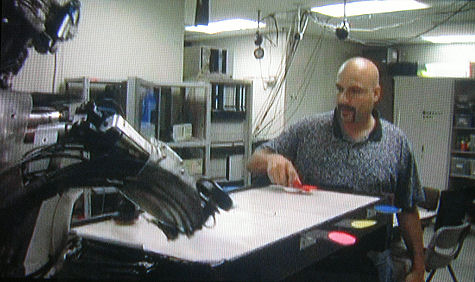
And there’s that cool robot. A one-armed guy resembling one of those Empire droids in Attack of the Clones playing a pretty good game of defensive air hockey with very some very fast reflexes. I’ve only seen human-sized robots with arms and legs do things like walk dogs and vacuum rugs. This guy’s different. Impressive.


Robot air hockey

The point of Way of the Puck is that an air-hockey player needs to be alive and alert and in touch with something inward and flowing to get anything out of the game. More than just a fast hand and a light touch, but man…that robot.
Anderson believes that air hockey is “the culmination of 2500 years of human thought — connected to astronomy and artificial intelligence, music and missiles, comics and country + western dancing, painting and punk rock.” I don’t know if I can go that far, but Way of the Puck convinced me that air hockey amounts to something, or at least the players do.

Memory Lane

April has barely begun and the media drumbeat over the year’s two big 9/11 films, both produced with the upcoming five-year anniversary in mind, is already pretty loud.
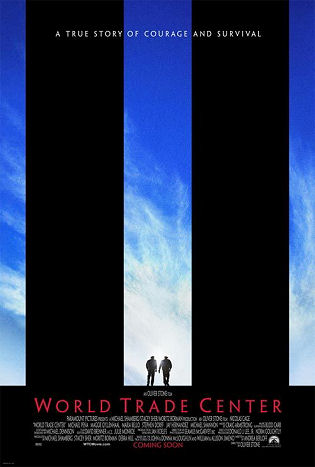
Press screenings for United 93 are beginning this week, stories attempting to gauge the public’s interest in seeing this and other 9/11 presentations are running (the Wall Street Journal and Newsweek ran theirs on 4.7 and 4.10, respectively), and we’ll be hearing more and more about Oliver Stone’s World Trade Center next month when a 20-minute reel from the 8.11 Paramount release is shown at the Cannes Film Festival.


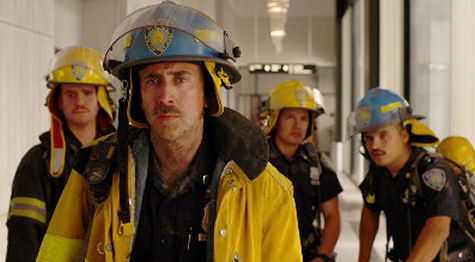
Nicolas Cage as Sgt. John McLouglin in Oliver Stone’s World Trade Center (Paramount, 8.11)

The 9/11 anniversary isn’t for another five months, of course, but I’ve been thinking about another startling event that happened in Manhattan nearly five years ago — a panel discussion on Saturday, October 6, 2001, at Alice Tully Hall called “Making Movies That Matter: The Role of Film in the National Debate.”
I reported on this right after it happened and I’ve mentioned it since (most recently in a WIRED item around noon on Sunday, 4.9), so why dredge it up for the third or fourth time? Because what panelist Oliver Stone said that day is, to me, still bang -on-the-head thrilling, and I’ve been wondering what’s changed in the four and a half years since…if anything?
It’s Sunday, it’s sunny outside, birds are chirping and I’m just going to run this piece again. (Most of it.) It’s a portrait of what’s been happening in this town for a long time, but the precision and candor in Stone’s rant still resonates.
Stone tried to describe the mindset and inclinations of corporate-run Hollywood as he saw it back then. Has the situation abated, remained the same, gotten worse or what? Read this through and think about it. I’m asking.
I’m repeating what I said in the WIRED item, but this sure was a long time ago, especially considering the apparent repositioning that has happened inside Stone himself, who was obviously more than a bit of a firebrand on 10.6.01 and now look at him, the director of a 9/11 pic about a couple of Port Authority guys who got buried under the fallen towers…a film that’s starting to sound, frankly, like it may be a head-in-the-sand emotional comfort blanket disguised as a rescue thriller.


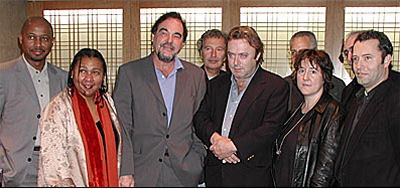
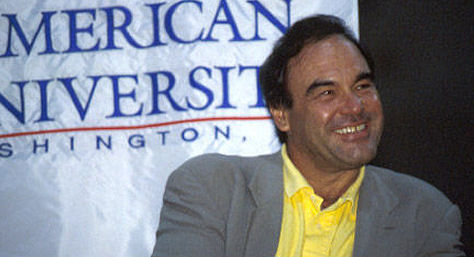
Before the ’01 debate: Lumumba director Raoul Peck, essayist Bell Hicks, director Oliver Stone, New Line Cinema honcho Robert Shaye, political writer Christopher Hitchens, former Universal Pictures chairman Tom Pollock, indie producer Christine Vachon (Boys Don’t Cry, Storytelling), former Universal Pictuers chairman Tom Pollock (almost completely hidden), and HBO executive Colin Callender.

I’m not saying World Trade Center won’t be a well-crafted or emotionally affecting drama. (Alexander aside, Stone is still a top-notch filmmaker). And who knows? Maybe it will contain echos and undercurrents that will add dimension to what screenwriter Andrea Berloff believes it is (“a boy-down-a-well saga’). But read the following and tell me Stone hasn’t trimmed his sails just a tad.
“Say what you will about Oliver Stone’s political views, but he’s a master at whipping up a crowd,” I began. “This was plainly evident during a panel discussion he participated in last Saturday at New York’s Alice Tully Hall called ‘Making Movies That Matter: The Role of Film in the National Debate.’
“The same brio that has enlivened many of Stone’s politically driven films, including JFK, Born on the Fourth of July, Platoon, and Nixon, was in full force during the sometimes brawl-like, HBO-sponsored discussion.
“Stone’s chief nemesis during the discussion — which also included some volleys from from political writer Christopher Hitchens, former Universal Pictures chairman Tom Pollock, indie producer Christine Vachon (Boys Don’t Cry, Storytelling), Lumumba director Raoul Peck, and political essayist Bell Hooks — was New Line Cinema chairman and CEO Robert Shaye.
“It fell to Shaye to articulate the status-quo views of corporate Hollywood, which elicited not only the wrath of Oliver but occasional groans from the audience. Much of what Shaye said was fair and sensible, but it was no match for the sweep of Stone’s oratory, which occasionally vaulted past the concerns of the entertainment industry to include speculation on the whys and wherefores of the 9/11 disaster.

“The central issue was whether Hollywood’s increasing reluctance to finance films with a strong political undercurrent (particularly in the wake of the World Trade Center attack) was being caused by a corporate-driven aversion to anything that isn’t essentially banal or superficial, as Stone asserted, or whether the main impediment to the funding of risky and/or controversial films is ‘the tyranny of talent,’ as Shaye put it, referring to astronomical fees demanded by actors and certain high-profile directors.
“Stone launched into one of his hardest-hitting points by recalling the relatively modest financing that gave birth to Born on the Fourth of July, his Oscar-winning 1989 drama about Vietnam veteran Ron Kovic that starred Tom Cruise.
“‘We struggled to make it,’ said Stone. ‘We had fights. The picture cost $16 million, and then it went to $17 or $18 million, and we fought for that extra two million like crazy.
“‘But this was 1989 — and there’s been no significant inflation in the United States since then,’ he continued. ‘Why, in 2001, does a picture that was done very tightly in 1989…[would] that picture today cost $60 to $80 million? With the marketing costs added in, which are inflated, putting it into the $90s…advertising and television…we’re talking a $100 to $135 million event.
“‘This would no longer be a movie, but an event. And someone like Tom Pollock would say…’Born on the Fourth of July? I’m not going to make that for $130 million!’ Because [this kind of film] can’t work any more in a system that has gone bananas .’


Lincoln Center’s Alice Tully Hall

“Stone was greeted by a passionate, sustained round of applause. Who doesn’t feel that films like Born on the Fourth of July, for which Stone won a Best Director Oscar and Cruise was nominated as Best Actor, are in woefully short supply these days?
“‘And this ties in to the Arab situation,’ Stone went on. ‘Why have we gone, in a non-inflationary era, to a [place] where our corporations have become huge over the last 10, 12 years? We’ve let them go. There’s been no trust-buster around. Teddy Roosevelt is long dead. And these media corporations have conglomerated themselves into six principal fiefdoms run by barons…they’re bigger than barons. They’re kings.’
“Stone was referring to Sumner Redstone who runs Viacom, which owns Paramount; Barry Meyer of Time-Warner, which owns Warner Bros. and New Line Cinema; Rupert Murdoch of Fox Newscorp., which runs 20th Century Fox; Mel Harris of Sony Pictures; Michael Eisner, the chairman/CEO of the Walt Disney Company; and Jean-Marie Messier of Vivendi, which owns Universal Pictures.”
[Note: Today’s media barons are Viacom’s Redstone, Newscorp’s Murdoch, Richard D. Parsons of Time-Warner, Sony Corp.’s chairman and CEO Howard Stringer, Disney CEO Bob Iger and Jeffrey R. Immelt, CEO of General Electric, which owns NBC Universal.]
“And these six companies decide,” said Stone. “Rupert Murdoch says ‘I would not make JFK,’ or Mike Eisner says ‘I would not do a film on Martin Luther King, Oliver, [because] there’s gonna be rioting at the gates of Disneyland’…you know, this is bullshit!”

“Gales of applause greeted this one, with some scattered yelps and cries of ‘right on!’
“‘These six people have control of the world and that’s what the new world order is,’ he explained. ‘Six men are deciding what you’re seeing in film, and they own all the small companies…it’s hard to find one that’s not owned by one of these huge companies buying new companies, so it’s a dilemma. There’s a control of culture, ideas, everything.
“Now, within reason, they let [filmmakers] do certain things, and that is far better obviously than, say, the Arabs where they don’t let you do anything, and I agree it’s relative. But we are in a dilemma. We have too much order.”
“‘And I think the revolt on September 11 was about order,’ Stone went on. “It was about fuck you, fuck your order…it was an eruption of rage about this. And is it time perhaps to reconsider the world order? Is it time to wonder why the banks have joined the movie companies and all the corporations, and where this is all going?”
“Hitchens, who writes for The Nation and Vanity Fair , bridled at the use of the term ‘revolt’ and said the September 11 massacre ‘was not a revolt. It was a state-supported mass murder using civilians as missiles. It was an attack on civil society and civilization.’ This drew vigorous applause, albeit slightly more subdued.
“Shaye said, ‘I disagree with Oliver about this. I think he’s talking about an era and the studio system of 30 years ago. I will tell you, and Tom Pollock will back me up on this, that this is a tyranny of talent right now, and I don’t know what Oliver gets for directing a film, but I know what a lot of other people get, and it’s way too much. I do know that the last guys to get paid, believe it or not, are the studios that put up the money, and…’


Robert Shaye (r.), co-chairman and co-CEO of New Line Cinema (pictured with Michael Lynne (l.)

“At this last remark, Stone shuddered and flopped back in his chair and looked up at the ceiling as if to say, ‘Did he just say that? I give up!’ Torrents of laughter. The hall was jumping.
“‘And if there’s a tyranny, it’s a tyranny of talent,’ Shaye concluded, drawing muted sneers and guffaws.
“Pollock, who was running Universal’s movie division when Born on the Fourth of July got made, said the go-ahead happened ‘because Oliver Stone was willing to make it for no money, and Tom Cruise was willing to make it for no money. The film was successful, they made a lot of money, and so did Universal, but it would not have been made had they not done that.
“‘Controversial films can still get made,’ said Pollock, ‘but films cost what they cost because most of the people who make them want to get paid as much as they can. They want control, but there is still that trade-off of money for control. We are in an oligarchy now where the large companies control what we see…yes, Rupert Murdoch has a political agenda, but by and large Rupert Murdoch is only interested in money.
“‘The problem with the six guys running the six companies is, they want to take no risks at all,’ he concluded. ‘They want movies that entertain only, if they can be marketed. There was little room before September 11 to make political movies inside the system. There’s less room now. It isn’t that it’s not going to happen. But it is going to be harder. And to that extent, Oliver is right.’
“Shaye said that New Line Cinema ‘started out in my apartment on 14th Street. We made our way in the world. We started out with Sympathy for the Devil. Talk about political…give me a break. And you know why it made money? Because the Rolling Stones were in it, not because Jean-Luc Godard had anything particularly profound to tell the world.’ Random hoots and snorts greeted this one.

“‘It’s a little disenchanting,’ Shaye continued. ‘The truth of the matter now is, right now, that with high-definition and video and stuff like that you can make a good movie for not very much money. The great thing about the entertainment business and the movie business is that when a movie’s good, you attract people. People talk about it, the whole word-of-mouth thing…the quality of a movie is a self-fulfilling mechanism.”
“Stone jumped back in. ‘Thirty years ago, Bob said before. That’s when he got started. It was all…it was another world. [But] nobody here has answered that question why, between ’89 and 2001, everything has become so uniform…what’s basically happened in the last 10 years is that the studios have bought television stations. And why?’
“Referring to the so-called ‘syn-fin’ legislation passed under the Clinton administration a couple of years ago that allowed studios to own more TV stations, Stone asked, ‘Why did that telecommunications bill get passed at midnight? It was basically a division of the world by a few media moguls and it was a giveaway and it was done at midnight and it’s a disgusting thing. To own TV stations is the basis upon which movie companies today have to exist. And that’s changed everything. There are only so many television stations. Each one has their big build-up and that’s their base of operation.
“‘And Bob [Shaye] knows it because he sold his little movie company to Warner Bros. for more money than I could ever dream of making,” Stone continued. He acknowledged that certain high-profile directors, such as himself, are well paid for helming big-studio films. But the majors these days “don’t need a top director, they feel. Just make the movie. Because for them it’s all about marketing and about subject. That’s what they think.
“‘So there’s no ‘left’ point of view. It’s not financially interesting for them to make a movie with a director who costs more money…they’d rather go with a marginal director. It’s all about product…movie product…and it’s all about this new world order.

“‘And the Arabs have a point. Whether it’s right or wrong, there’s an objection to the way the world is going. There’s a lot of hate and revolt in that state. It may continue and although the shoe may drop on the other foot the next time, the point is they’re objecting to something. And I say that we’re not dealing with that objection on this stage today. There was a breakdown in the ’90s, in the system, the world system, the world banking system…it’s the new world order, and it’s about order and control, but this control comes with a cost.
“‘One of the most banal ways for censorship to operate in America,’ Stone continued, ‘is to drive out thought by explosions of People magazines and celebrity culture and…our culture is focused on Sarah Jessica Parker and kind-of inane, superficial stuff…it just becomes the noise, the white noise of our society.”
“Turning to Pollock, Stone said, ‘I don’t want to pick on you, Tom, but you’re ignoring the banks, you’re ignoring television, you’re ignoring the size of this thing, and you’re saying this thing is okay because that’s the way of the world because capitalism will go that way.
“‘The so-called ways of capitalism are not inevitable,’ Stone exclaimed. ‘It’s changed historically. Teddy Roosevelt changed the direction of it. Franklin Roosevelt changed the direction of it. Everybody in Hollywood says, ‘Well, what can I do about it?” These six companies have taken over just like the oil companies, and it’s wrong, wrong, wrong because they’re subverting political will.'”

Ales & Stouts

Filmmakers tend to be a

Filmmakers tend to be a bit more affectionate and supportive of other filmmakers than, say, critics or the public, but that aside, Kevin Smith has seen Mission: Impossible: 3 (Paramount, 5.5) and passes along the following: “I saw it last month in [director-writer J.J. Abrams’] editing room, and it’s really great: far, far superior to the second one, and as good (if not better) than the first. Philip Seymour Hoffman plays the most believable bad guy since Anthony Hopkins in Silence — he’s just plain frightening. [The film has] great tent-pole scenes and Tom Cruise is in top form. There’s no fat on it at all. All those years working on Alias made for fine training for JJ, as this thing is very well plotted and paced. It’ll do extremely well. I know I’ll see it again in theaters.” Why is Paramount publicity not showing it then? What is the strategy in keeping word-of-mouth spreaders away from it until three days before it opens? I think it’s part of the New Hollywood World Order…the truly big tent-polers are their own engine, about themselves & their own self-perpetuating inevitability, and writers and reporters are but lint on the lapels of the big-studio distribs in this context…at best incidental to the process. And the p.r. people are looking to make a statement to that effect.